

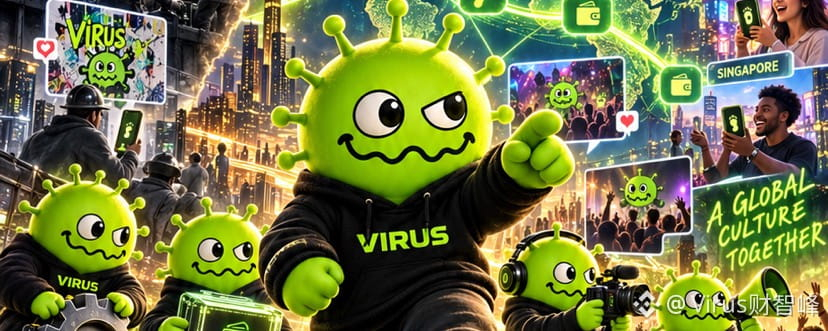



In Web3, most projects truly lack not a single moment of exposure, but a complete path that can gradually convert strangers into real users.
Users may see a project on social media, but leave halfway because it requires jumping across multiple platforms, downloading a wallet, finding the contract, joining a community, and learning how to trade.
With each additional step in the process, a batch of potential users is lost.
Many Meme projects therefore fall into a dilemma:
There is traffic, but no retention.
There are token holder addresses, but no real interaction.
There is a community, but no use case.
There is short-term hype but no long-term retention.
What Virus is exploring in the Envo envelope is precisely a different growth model:
Concentrate content exposure, live-stream education, meeting exchanges, community follow-through, reward-envelope experiences, wallet transfers, and product/service swapping within a single Web3 social finance ecosystem.
This gives Virus a chance to build a truly complete user-growth flywheel:
Seen → Interested → Understand deeply → First possession → Join the community → Actual usage → Share and spread.
After 63 million-level addresses, what problem does Virus truly need to solve?
Virus has already entered more than 63 million BNB Chain addresses through purchases, transfers, and mechanism-based distribution.
This is a massive on-chain coverage network, but it must be clarified:
A token-holding address is not equal to a unique user, and not equal to an active user.
One address may hold only a tiny amount of Virus and may even have no active behavior for a long time; one user may control multiple addresses. Therefore, address size solves the question of “how many on-chain coordinates Virus reached,” but does not automatically solve “how many people truly recognized, understood, and used Virus.”
Virus’s most important task in the next phase is not just to keep increasing addresses, but to activate the people behind those addresses.
That is,
Silent addresses become discoverers;
Discoverers become understanders;
Understanders become participants;
Participants become users;
Users become promoters and builders.
And Envo’s strategic value lies in the fact that it may become an important scenario where Virus completes this conversion step.
II. Envo isn’t a single distribution channel—it’s a user handoff system
Envo officially positions itself as a “Web3 deeply interactive social finance wallet.” Its product structure covers social circles, communities, wallets, transfers, reward envelopes, live streams, meetings, and other Web3 functions. It is not merely a chat app, nor just a wallet with asset-management features. Instead, it tries to connect social relationships, content distribution, and digital assets within a single application.
This is very important for Virus.
Because traditional promotion usually requires users to complete a chain of redirects:
See content on an external platform
→ Click the link
→ Download the wallet
→ Find a community
→ Verify the contract
→ Learn how to operate
→ Then decide whether to participate
And within Envo, after users see the Virus social post in the social circle, they can continue into live streams, join meetings, join communities, claim Virus reward envelopes, check wallet balances, make transfers, and even enter swaps-for-stuff groups to use Virus to swap for products and services.
Actions that were previously scattered across multiple apps are shortened into being completed within the same ecosystem.
The key to growth efficiency isn’t just how big the traffic is, but how many obstacles a user needs to overcome to move from “seeing” to “acting.”
The shorter the path, the higher the likelihood of conversion.
III. Social Circle: Help Virus break beyond the boundaries of the original community
According to the actual operations of the Virus community, currently, each day the Virus social post content published on Envo can be seen by a broader set of users within the platform.
This means Virus’s content is no longer just circulating within the original holder community, but can continuously reach investors, merchants, creators, community organizers, and ordinary Web3 users on the Envo platform.
Envo’s official social circle supports functions such as text, images, videos, links, topic hashtags, comments, reposts, quotes, follows, and private messages. In essence, it already has a complete capability for content discovery and relationship connection. (help.envo.world)
Therefore, Virus can build layered content structures within the social circle:
Use posters and short videos to attract people who see Virus for the first time;
Use mechanism articles to explain fair launches, buyback distribution, and the address network;
Use community members’ stories to build emotional connections;
Use live-stream previews and meeting links to push users to learn more;
Use reward envelope campaigns and swaps-for-stuff case studies to demonstrate real usage;
Use real experiences from merchants, users, and builders to build social proof.
The value of a single朋友圈 (social post) isn’t just getting a few likes.
Its real role is to become the first entry point of the entire user flywheel.
IV. Live Streams and Meetings: Turn attention into understanding and trust
A Meme image can attract attention, but complex mechanisms, contracts, and community logic can’t be explained clearly with just one poster.
Live streams are best for creating atmosphere, telling stories, showcasing people, and enabling real-time interaction; meetings are better for systematic explanations, screen projection, Q&A exchange, and builder training.
Envo live streams support video, voice, chat, and like-style interaction, and allow certain hosts to introduce products or services. The platform also recommends high-quality live streams based on content quality and interaction levels. (help.envo.world)
Envo meetings support public or private meetings, a meeting plaza, link sharing, screen sharing, speaker management, and large-scale online interactions. Public meetings can be discovered by more users in the meeting plaza, and meeting links can spread through social circles, group chats, and external platforms. (help.envo.world)
This creates two different educational scenarios for Virus:
Live streams are responsible for attracting and activating; meetings are responsible for explaining and consolidating.
The Virus community holds live streams every night at 8:30 and distributes Virus reward envelopes to users who answer correctly through Q&A. This makes live streams no longer just one-way output, but creates an interactive process of “learning → answering → gaining experience → continuing to understand.”
Users may come into a live stream because of a social post, get Virus for the first time because of a Q&A, and then learn about wallets, contracts, and on-chain transactions because of that Virus.
The endpoint of a live stream isn’t counting the number of people.
Its real value is: how many unknown users have completed their first recognition, first interaction, and first possession.
V. Virus reward envelopes: Turn “heard of it” into “actually owned it”
Reward envelopes are a very critical part of the entire growth flywheel.
For people who have never held Virus, buying directly often means high decision pressure; but by participating in live-stream Q&A, community activities, or receiving small amounts of Virus through friends’ sharing, the experience threshold will be clearly lowered.
Envo’s official materials show that its ecosystem supports project tokens for interaction scenarios such as reward envelopes among users and in group chats, platform transfers, and more. After ordinary reward envelopes and lucky-hand reward envelopes are successfully claimed, the amounts can be transferred into the user’s account immediately.
What’s truly important about reward envelopes isn’t the size or quantity, but that they complete three conversions:
The first conversion is from a bystander to a participant;
The second conversion is from knowing about Virus to actually having Virus;
The third conversion is from an abstract concept to a real wallet experience.
In the past, project teams often increased addresses through large-scale airdrops, but they couldn’t confirm who truly saw and who truly understood.
And live-stream Q&A红包 (reward envelopes) come with a clear behavioral path:
Users watch the content first, then participate in the Q&A, and finally receive Virus.
This distribution isn’t just sending tokens to an address—it also gives the token to a real user who has already experienced interaction.
VI. Transfers and Communities: Turn a single claim into a lasting relationship
When a user claims a reward envelope only once, it can only be counted as completing activation.
If users take no further action after claiming, they may quickly churn out.
Therefore, the community must take over after the reward envelopes.
Envo’s communities can be divided into different functional areas around Virus:
Newcomer learning group;
Mechanism research group;
Live-stream group every night;
Content creators group;
Merchant partnership group;
Swaps-for-stuff group;
Global multilingual community.
In the community, users can ask questions, join activities, forward content, use Virus for transfers, and gradually get to know other holders and builders.
At this point, Virus is no longer just a string of numbers in a wallet—it starts to become a medium for interaction between people.
From the growth perspective, reward envelopes solve first activation, transfers create interaction, and communities handle long-term retention.
After combining these three, Virus’s growth path upgrades from a “one-time airdrop” to a “continuous relationship network.”
VII. Swaps-for-stuff: Moving from holding Virus to using Virus
A token with only buying and selling but no consumption or service scenarios makes user behavior very easy to be completely dominated by price fluctuations.
Therefore, the Virus community in Envo has built swaps-for-stuff groups, which carries very important experimental significance.
Merchants in the group can offer entirely new, standardized, publicly sold normal product categories and genuine services, and the parties involved voluntarily negotiate the use of Virus for swaps.
This is what gives Virus reasons to use beyond price:
Some people can swap Virus for everyday goods;
Some people can use Virus to buy services;
Merchants can reach new consumer groups;
Users can experience the circulation of digital assets in real-world scenarios;
Each real swap can form a new community story.
The value of swaps-for-stuff isn’t that it claims Virus has already become a widespread payment tool, but that it proves Virus is trying to move from “holdable and tradable” to “usable.”
To develop this ecosystem long-term, transparent rules still need to be gradually established:
Products must be entirely new, standardized, legitimately sold regular categories in public;
Service details, quantities, prices, and delivery methods should be explained in advance;
The quantity of Virus swapped should be voluntarily confirmed by both parties;
Orders, logistics, inspection/acceptance, and after-sales support should be documented;
Merchant identity, product sources, and quality need to be reviewed;
When disputes arise, there must be a clear coordination and handling process;
All participants should comply with local regulations regarding digital assets, transactions, taxes, and consumer protection.
Only when the goods are real, delivery is real, and services are real can swaps-for-stuff grow from a promotional story into a credible ecosystem.
VIII. The complete growth flywheel formed by Virus in Envo
By connecting every scenario, Virus’s user-growth flywheel in Envo can be summarized as:
Content impressions across the whole platform
→ Users become interested
→ Enter a live stream or meeting
→ Learn the Virus mechanism
→ Participate in Q&A and interactions
→ Claim Virus reward envelopes
→ Have Virus for the first time in the wallet
→ Join the Virus community
→ Use Virus for transfers
→ Participate in product or service swaps
→ Share real experiences
→ Attract more users to see Virus.
The most important feature of this path is that every step serves the next one.
A social post isn’t just an isolated update—it’s an entry point to live streams;
A live stream isn’t just talking—it’s educating newcomers;
A reward envelope isn’t a simple benefit—it’s first activation;
A wallet isn’t static storage—it’s a transfer tool;
A community isn’t just a chat place—it’s a user retention system;
Swaps-for-stuff isn’t a gimmick—it’s a practical usage experiment;
Real usage creates stories, and stories loop back into social posts to form a new round of distribution.
This is what we call a growth flywheel.
IX. What can Virus and Envo bring to each other?
What Envo provides for Virus is a complete set of social and financial infrastructure:
Content can be seen;
Users can be educated;
Communities can be organized;
Reward envelopes can be claimed;
Assets can be stored and transferred;
Products and services can be presented;
Real experiences can continue to spread.
What Virus can bring to Envo is a set of large-scale on-chain address networks already formed, continually updated content, daily live streams, community activities, merchant scenarios, and long-term builders.
The connection between the two sides isn’t binding token value—it’s application-scenario synergy.
Envo enables Virus to have a vehicle from exposure to usage; Virus, through content, communities, and real interactions, brings Envo more active scenarios.
If Envo’s user base continues to grow, the content published by Virus each day has the opportunity to reach more external users; and if Virus’s reward envelopes, live streams, communities, and swaps-for-stuff continue to generate real interactions, Envo will gain more active content and usage behavior as well.
This is a bidirectional growth built on real utility, not a cooperative fantasy that stays at the level of slogans.
X. How do we prove that this flywheel is truly effective?
A truly mature growth system can’t only tell stories; it must also validate with data.
In the future, Virus can continuously track the following metrics:
Number of people exposed to social circle content daily;
Number of people entering live streams and meetings from the social circle;
New followers gained and number of people joining the group through live streams;
The number of unique users who claim the Virus reward envelope for the first time;
Seven-day and thirty-day retention rates after claiming the reward envelope;
Number of transfers and transfer counts within the Virus platform;
Swaps-for-stuff order volume, transaction scale, and repurchase rate;
Number of newly added merchants, creators, and community builders;
The conversion ratio from growing from regular users into promoters;
The number of real Virus holders brought by the Envo ecosystem.
When these data can continue to grow, Virus is no longer just a nice ecosystem story—it becomes a user-growth system that can be verified.
Conclusion: Addresses are the starting point; real usage is the real flywheel
Virus has completed a large-scale on-chain seeding.
The 63-million-level token-holding addresses have placed Virus in a large number of on-chain coordinates; while Envo provides social circles, live streams, meetings, reward envelopes, transfers, communities, and swaps-for-stuff scenarios—offering the chance to gradually connect those on-chain data points to real people.
What Virus truly needs to pursue in its next phase isn’t just more addresses, but more real behavior:
Someone sees Virus;
Someone enters a live stream;
Someone understands the mechanism;
Someone claims a reward envelope;
Someone starts transferring;
Someone joins a community;
Someone uses Virus to swap for products and services;
Someone shares their real-life experience.
When this kind of behavior can be repeated continuously, Virus’s address network will gradually transform into a user network, consumption network, content network, and cultural network.
The social circle is responsible for helping users see it.
Live streams and meetings are responsible for helping users understand.
The reward envelope is what gives users their first experience of having it.
The wallet and transfers are responsible for keeping assets flowing.
The community is responsible for letting relationships take root.
Swapping things for things is what brings Virus into real life.
Real stories are what kick off the next round of distribution.
That is the real meaning of how Virus builds a user-growth flywheel in Envo.
It’s not simply placing Virus into an app.
It’s also about letting Virus, within the same ecosystem, be seen, understood, owned, used, and shared.
From addresses to users, from users to scenarios, from scenarios to the ecosystem.
What Virus is moving toward is a step more important than increasing token-holding addresses.
