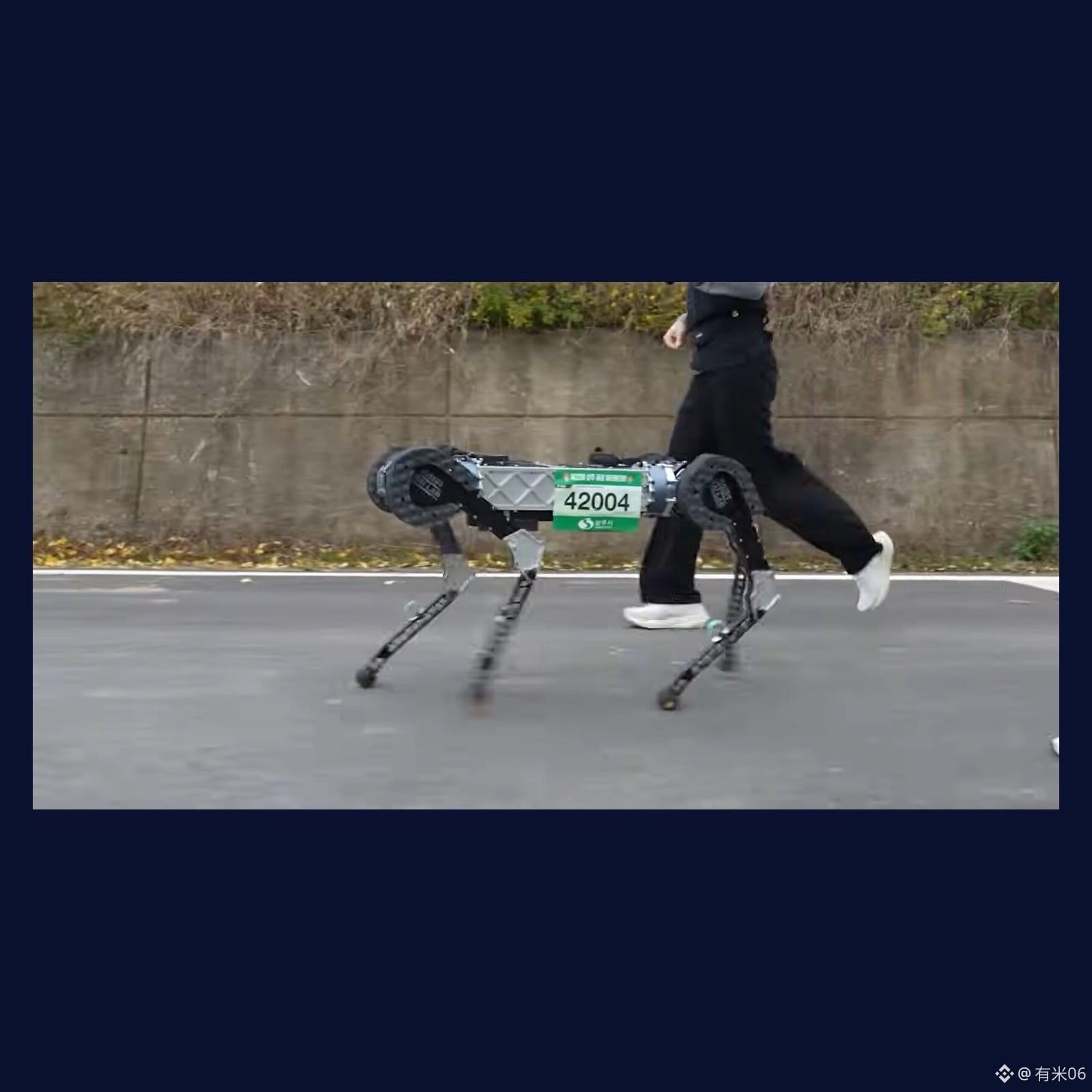
Can a quadruped robot really run a full marathon? KAIST’s “dog” finished it on a single battery.
At the 2024 November Sihusu Marathon in Sacheon, South Korea, the quadruped robot RAIBO2 from the Huang Fu-zaimin team at the Korea Advanced Institute of Science and Technology (KAIST) completed the full 42.195 kilometers in 4 hours 19 minutes 52 seconds, without swapping batteries or changing power mid-run. A paper published on 2026-09-23 in Nature’s main journal (DOI 10.1038/s41586-026-11102-5)—according to the press release, this is also the first time a robotics study from South Korea’s domestic research community has appeared in Nature’s main journal.
The route wasn’t easy: it included an ascent of about 286 meters and slippery sections. Over the entire course, the average speed was about 2.64 meters per second, and power consumption was about 1280 Wh. The team’s reported average total transport cost (TCOT) was around 0.25, lower than the human benchmark of 0.37 cited in the paper. Estimated using a battery capacity of about 2016 Wh, it could theoretically run an additional ~25 kilometers, with endurance roughly triple that of existing comparable quadruped robots. On the hardware side, they optimized lightweight legs and motor drive; on the software side, they used reinforcement learning to improve the running policy—putting “staying stable” and “using less energy” into the same design framework.
Independent verification: TechXplore (Nature Publishing Group) on 2026-09-23, reiterated the finish time and energy-consumption data using the same figures as DongA Science and Seoul Economic SEDaily.
Image: RAIBO2 during the marathon (KAIST, via TechXplore/Nature)
#机器人 #KAIST
At the 2024 November Sihusu Marathon in Sacheon, South Korea, the quadruped robot RAIBO2 from the Huang Fu-zaimin team at the Korea Advanced Institute of Science and Technology (KAIST) completed the full 42.195 kilometers in 4 hours 19 minutes 52 seconds, without swapping batteries or changing power mid-run. A paper published on 2026-09-23 in Nature’s main journal (DOI 10.1038/s41586-026-11102-5)—according to the press release, this is also the first time a robotics study from South Korea’s domestic research community has appeared in Nature’s main journal.
The route wasn’t easy: it included an ascent of about 286 meters and slippery sections. Over the entire course, the average speed was about 2.64 meters per second, and power consumption was about 1280 Wh. The team’s reported average total transport cost (TCOT) was around 0.25, lower than the human benchmark of 0.37 cited in the paper. Estimated using a battery capacity of about 2016 Wh, it could theoretically run an additional ~25 kilometers, with endurance roughly triple that of existing comparable quadruped robots. On the hardware side, they optimized lightweight legs and motor drive; on the software side, they used reinforcement learning to improve the running policy—putting “staying stable” and “using less energy” into the same design framework.
Independent verification: TechXplore (Nature Publishing Group) on 2026-09-23, reiterated the finish time and energy-consumption data using the same figures as DongA Science and Seoul Economic SEDaily.
Image: RAIBO2 during the marathon (KAIST, via TechXplore/Nature)
#机器人 #KAIST