
Strong/Reverse Forced Exit Radar
For data like this—first, look at who is forced out.
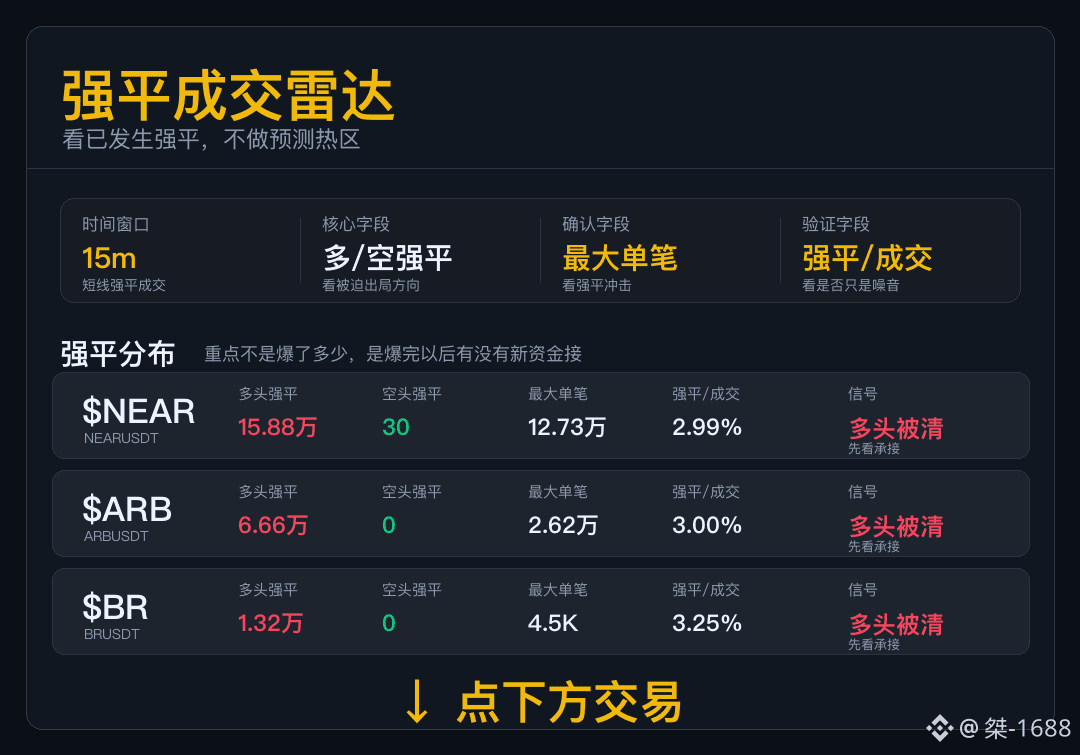
$NEAR long positions concentrate in forced liquidation; the current data can only indicate that liquidation occurred, but it cannot declare that the market has reached a bottom.
$ARB long liquidation accounts for most of the notional amount, and position cleanup has already genuinely entered the execution phase.
$BR is mainly cleared out of long positions; the higher the liquidation-to-trading volume ratio, the more directly the event impacts the price movement within that range.
When forced liquidation as a share of trading volume is very low, the event is more like a localized rundown, and price impact is usually limited.
For data like this—first, look at who is forced out.
$NEAR long positions concentrate in forced liquidation; the current data can only indicate that liquidation occurred, but it cannot declare that the market has reached a bottom.
$ARB long liquidation accounts for most of the notional amount, and position cleanup has already genuinely entered the execution phase.
$BR is mainly cleared out of long positions; the higher the liquidation-to-trading volume ratio, the more directly the event impacts the price movement within that range.
When forced liquidation as a share of trading volume is very low, the event is more like a localized rundown, and price impact is usually limited.