
Cryptopolitan
57.4k Posts

Cryptopolitan
 Square Verified+
Report
Block User
Crypto news that doesn't waste your time. Breaking updates, market analysis, on-chain insights. Building the smartest crypto community.

Creator of the Year
1 Following
161.5K+ Followers
573.1K+ Liked
1 Badges
Posts
PINNED
At Cryptopolitan, we research, analyze, and deliver news—daily.
From breaking updates to in-depth analysis, educational guides, and market insights, we’re here to keep you informed with neutral and authentic news.
Thank you for trusting us to be your go-to source!
At Cryptopolitan, we research, analyze, and deliver news—daily.
From breaking updates to in-depth analysis, educational guides, and market insights, we’re here to keep you informed with neutral and authentic news.
Thank you for trusting us to be your go-to source!
From breaking updates to in-depth analysis, educational guides, and market insights, we’re here to keep you informed with neutral and authentic news.
Thank you for trusting us to be your go-to source!
120
68
340
1.8k
Article
US banks push Senate to tighten stablecoin rewards rules before CLARITY voteThe dispute regarding the CLARITY Act has become a straightforward question: will Americans choose to keep their cash in banks or will they use dollar-pegged stablecoins with promising rewards?
Before the Tuesday Senate vote, eight banking organizations requested that lawmakers to establish stricter regulations regarding incentives for using stablecoins. Their position is simple: when deposits leave the banks, they lose a reliable and inexpensive source of funding and availability of cash.
The importance of this question arises from the fact that banks use deposits to provide loans. In May, Cryptopolitan wrote that in the U.S. banks use about 80% of deposits to finance loans; therefore, the matter of stablecoin incentives becomes the matter of both funding costs and control of dollar-based payments.
Why holding tokens instead of cash is the whole ballgame
Stablecoins are made to mimic such assets as the dollar. According to a paper published by BIS, almost 98% of stablecoins are valued in dollars. IMF says that the value of the market is about $300 billion in August.
The 2025 GENIUS Act prevents the issuers of stablecoins from providing interest or yield directly. The analysis from the White House showed that the legislation does not explicitly ban distribution of rewards by affiliates and other third parties. The CLARITY Act could determine how much room those arrangements have to continue.
What the banks want struck from the text
In a letter released on Monday addressed to Senate Majority Leader John Thune and Senate Minority Leader Chuck Schumer, banking groups said they could not back the latest rewards proposal.
They also urged the Senate to eliminate the word “solely” from the definition of payment based on holding, to replace the phrase “economically or functionally equivalent” with the word phrase “substantially similar”, and to remove references to rewards being based on balance, duration or time in business.
Organizations that put their name to the letter also include the American Bankers Association, Bank Policy Institute, and Independent Community Bankers of America, among others. The letter comes after 80 state bankers’ associations joined calls for stricter language on September 10, according to the ABA Banking Journal.
The government’s own math undercuts the panic
The White House Council of Economic Advisers (CEA) came up with a significantly lower estimate of possible damage to lending.
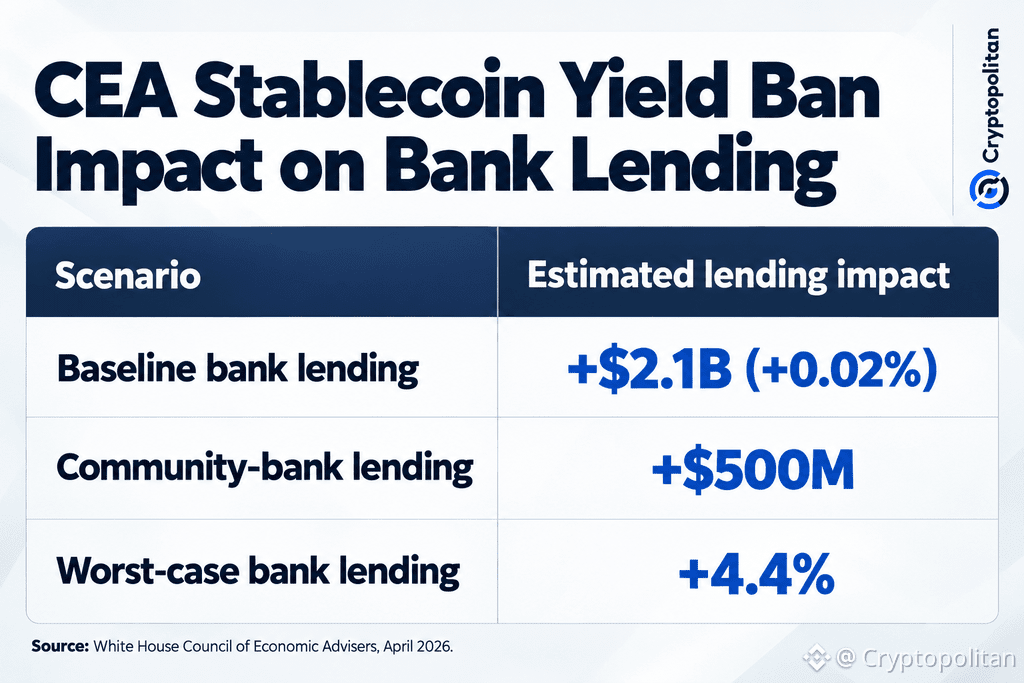
Its April study indicated that banning the stablecoin yield would boost the level of lending by banks by only $2.1 billion, being equal to 0.02%, while creating a net welfare loss of $800 million. Lending of the community banks would increase by approximately $500 million.
Even in the case of nearly unrealistic assumptions that the CEA mentioned, including stablecoin usage of around six times higher than today’s and transformation of the Fed’s monetary policy, the increase in bank lending is estimated at only 4.4%.
CEA Stablecoin Yield Ban: $2.1B Lending Gain vs. 4.4% Worst Case
What changed since the May draft
The updated legislation issued on Sunday has 126 significant amendments sought by the Democrats, as reported by Reuters.
The bill tightens rules governing how public figures can benefit from cryptocurrencies and grants state attorneys general significant powers regarding law enforcement in this area. Senator Cynthia Lummis stated that the bill is now ready to go ahead, while Senator Elizabeth Warren’s staff described the changes dealing with ethics as “empty.”
The bill requires 60 votes to pass the cloture rule on Tuesday.
Why the bank-versus-crypto framing is too simple
The industry split is not so clear-cut. According to Cryptopolitan, Goldman Sachs, BNY and Morgan Stanley supported the legislation, defying retail-oriented banking groups.
Meanwhile, community banks are not necessarily rejecting stablecoins. Moov’s community bank and credit union network of over 1,000 institutions is able to utilize stablecoin payment technology provided by Coinbase.
This impact goes further than the banking industry of the U.S. The BIS cautions that the use of dollar-pegged stablecoins widely may promote digital dollarization in emerging economies, while the IMF informs that even small-scale use of stablecoins may compel old-fashioned financial firms to up their game in terms of competition in costs and efficiency.
Therefore, the vote on Tuesday is not merely a disagreement about deposits, but rather a battle for who will take control of the next phase of dollar payments.
Issue May Senate Banking version Sept. 14 final text Passive stablecoin yield Prohibited Still prohibited Activity/transaction rewards Permitted Explicitly permitted Rewards that function like bank interest Prohibited Prohibited Treasury role No special deposit “circuit breaker” in the May summary Treasury gets a new circuit-breaker mechanism Community banks General concern over deposit competition Explicitly protected through the circuit breaker Measurement of deposit impact No comparable detailed mechanism Federal agencies must study deposit flows and lending effects Marketing stablecoins as deposits Restricted Explicitly prohibited
The final CLARITY text keeps transaction-based stablecoin rewards but gives Treasury an emergency-style mechanism to tighten the rules if stablecoins demonstrably pull deposits from community banks
Don’t just read crypto news. Understand it. Subscribe to our newsletter. It's free.
US banks push Senate to tighten stablecoin rewards rules before CLARITY vote
The dispute regarding the CLARITY Act has become a straightforward question: will Americans choose to keep their cash in banks or will they use dollar-pegged stablecoins with promising rewards?
Before the Tuesday Senate vote, eight banking organizations requested that lawmakers to establish stricter regulations regarding incentives for using stablecoins. Their position is simple: when deposits leave the banks, they lose a reliable and inexpensive source of funding and availability of cash.
The importance of this question arises from the fact that banks use deposits to provide loans. In May, Cryptopolitan wrote that in the U.S. banks use about 80% of deposits to finance loans; therefore, the matter of stablecoin incentives becomes the matter of both funding costs and control of dollar-based payments.
Why holding tokens instead of cash is the whole ballgame
Stablecoins are made to mimic such assets as the dollar. According to a paper published by BIS, almost 98% of stablecoins are valued in dollars. IMF says that the value of the market is about $300 billion in August.
The 2025 GENIUS Act prevents the issuers of stablecoins from providing interest or yield directly. The analysis from the White House showed that the legislation does not explicitly ban distribution of rewards by affiliates and other third parties. The CLARITY Act could determine how much room those arrangements have to continue.
What the banks want struck from the text
In a letter released on Monday addressed to Senate Majority Leader John Thune and Senate Minority Leader Chuck Schumer, banking groups said they could not back the latest rewards proposal.
They also urged the Senate to eliminate the word “solely” from the definition of payment based on holding, to replace the phrase “economically or functionally equivalent” with the word phrase “substantially similar”, and to remove references to rewards being based on balance, duration or time in business.
Organizations that put their name to the letter also include the American Bankers Association, Bank Policy Institute, and Independent Community Bankers of America, among others. The letter comes after 80 state bankers’ associations joined calls for stricter language on September 10, according to the ABA Banking Journal.
The government’s own math undercuts the panic
The White House Council of Economic Advisers (CEA) came up with a significantly lower estimate of possible damage to lending.
Its April study indicated that banning the stablecoin yield would boost the level of lending by banks by only $2.1 billion, being equal to 0.02%, while creating a net welfare loss of $800 million. Lending of the community banks would increase by approximately $500 million.
Even in the case of nearly unrealistic assumptions that the CEA mentioned, including stablecoin usage of around six times higher than today’s and transformation of the Fed’s monetary policy, the increase in bank lending is estimated at only 4.4%.
CEA Stablecoin Yield Ban: $2.1B Lending Gain vs. 4.4% Worst Case
What changed since the May draft
The updated legislation issued on Sunday has 126 significant amendments sought by the Democrats, as reported by Reuters.
The bill tightens rules governing how public figures can benefit from cryptocurrencies and grants state attorneys general significant powers regarding law enforcement in this area. Senator Cynthia Lummis stated that the bill is now ready to go ahead, while Senator Elizabeth Warren’s staff described the changes dealing with ethics as “empty.”
The bill requires 60 votes to pass the cloture rule on Tuesday.
Why the bank-versus-crypto framing is too simple
The industry split is not so clear-cut. According to Cryptopolitan, Goldman Sachs, BNY and Morgan Stanley supported the legislation, defying retail-oriented banking groups.
Meanwhile, community banks are not necessarily rejecting stablecoins. Moov’s community bank and credit union network of over 1,000 institutions is able to utilize stablecoin payment technology provided by Coinbase.
This impact goes further than the banking industry of the U.S. The BIS cautions that the use of dollar-pegged stablecoins widely may promote digital dollarization in emerging economies, while the IMF informs that even small-scale use of stablecoins may compel old-fashioned financial firms to up their game in terms of competition in costs and efficiency.
Therefore, the vote on Tuesday is not merely a disagreement about deposits, but rather a battle for who will take control of the next phase of dollar payments.
Issue May Senate Banking version Sept. 14 final text Passive stablecoin yield Prohibited Still prohibited Activity/transaction rewards Permitted Explicitly permitted Rewards that function like bank interest Prohibited Prohibited Treasury role No special deposit “circuit breaker” in the May summary Treasury gets a new circuit-breaker mechanism Community banks General concern over deposit competition Explicitly protected through the circuit breaker Measurement of deposit impact No comparable detailed mechanism Federal agencies must study deposit flows and lending effects Marketing stablecoins as deposits Restricted Explicitly prohibited
The final CLARITY text keeps transaction-based stablecoin rewards but gives Treasury an emergency-style mechanism to tighten the rules if stablecoins demonstrably pull deposits from community banks
Don’t just read crypto news. Understand it. Subscribe to our newsletter. It's free.
Before the Tuesday Senate vote, eight banking organizations requested that lawmakers to establish stricter regulations regarding incentives for using stablecoins. Their position is simple: when deposits leave the banks, they lose a reliable and inexpensive source of funding and availability of cash.
The importance of this question arises from the fact that banks use deposits to provide loans. In May, Cryptopolitan wrote that in the U.S. banks use about 80% of deposits to finance loans; therefore, the matter of stablecoin incentives becomes the matter of both funding costs and control of dollar-based payments.
Why holding tokens instead of cash is the whole ballgame
Stablecoins are made to mimic such assets as the dollar. According to a paper published by BIS, almost 98% of stablecoins are valued in dollars. IMF says that the value of the market is about $300 billion in August.
The 2025 GENIUS Act prevents the issuers of stablecoins from providing interest or yield directly. The analysis from the White House showed that the legislation does not explicitly ban distribution of rewards by affiliates and other third parties. The CLARITY Act could determine how much room those arrangements have to continue.
What the banks want struck from the text
In a letter released on Monday addressed to Senate Majority Leader John Thune and Senate Minority Leader Chuck Schumer, banking groups said they could not back the latest rewards proposal.
They also urged the Senate to eliminate the word “solely” from the definition of payment based on holding, to replace the phrase “economically or functionally equivalent” with the word phrase “substantially similar”, and to remove references to rewards being based on balance, duration or time in business.
Organizations that put their name to the letter also include the American Bankers Association, Bank Policy Institute, and Independent Community Bankers of America, among others. The letter comes after 80 state bankers’ associations joined calls for stricter language on September 10, according to the ABA Banking Journal.
The government’s own math undercuts the panic
The White House Council of Economic Advisers (CEA) came up with a significantly lower estimate of possible damage to lending.
Its April study indicated that banning the stablecoin yield would boost the level of lending by banks by only $2.1 billion, being equal to 0.02%, while creating a net welfare loss of $800 million. Lending of the community banks would increase by approximately $500 million.
Even in the case of nearly unrealistic assumptions that the CEA mentioned, including stablecoin usage of around six times higher than today’s and transformation of the Fed’s monetary policy, the increase in bank lending is estimated at only 4.4%.
CEA Stablecoin Yield Ban: $2.1B Lending Gain vs. 4.4% Worst Case
What changed since the May draft
The updated legislation issued on Sunday has 126 significant amendments sought by the Democrats, as reported by Reuters.
The bill tightens rules governing how public figures can benefit from cryptocurrencies and grants state attorneys general significant powers regarding law enforcement in this area. Senator Cynthia Lummis stated that the bill is now ready to go ahead, while Senator Elizabeth Warren’s staff described the changes dealing with ethics as “empty.”
The bill requires 60 votes to pass the cloture rule on Tuesday.
Why the bank-versus-crypto framing is too simple
The industry split is not so clear-cut. According to Cryptopolitan, Goldman Sachs, BNY and Morgan Stanley supported the legislation, defying retail-oriented banking groups.
Meanwhile, community banks are not necessarily rejecting stablecoins. Moov’s community bank and credit union network of over 1,000 institutions is able to utilize stablecoin payment technology provided by Coinbase.
This impact goes further than the banking industry of the U.S. The BIS cautions that the use of dollar-pegged stablecoins widely may promote digital dollarization in emerging economies, while the IMF informs that even small-scale use of stablecoins may compel old-fashioned financial firms to up their game in terms of competition in costs and efficiency.
Therefore, the vote on Tuesday is not merely a disagreement about deposits, but rather a battle for who will take control of the next phase of dollar payments.
Issue May Senate Banking version Sept. 14 final text Passive stablecoin yield Prohibited Still prohibited Activity/transaction rewards Permitted Explicitly permitted Rewards that function like bank interest Prohibited Prohibited Treasury role No special deposit “circuit breaker” in the May summary Treasury gets a new circuit-breaker mechanism Community banks General concern over deposit competition Explicitly protected through the circuit breaker Measurement of deposit impact No comparable detailed mechanism Federal agencies must study deposit flows and lending effects Marketing stablecoins as deposits Restricted Explicitly prohibited
The final CLARITY text keeps transaction-based stablecoin rewards but gives Treasury an emergency-style mechanism to tighten the rules if stablecoins demonstrably pull deposits from community banks
Don’t just read crypto news. Understand it. Subscribe to our newsletter. It's free.
134
Article
Microsoft opens draft AI Code of Conduct, betting human control sells modelsMicrosoft AI (MAI) published its initial draft of the Humanist AI Code of Conduct on Monday and invited public feedback on it over six weeks, emphasizing the priority of human supervision and enforceable restrictions in its evaluation of MAI systems. According to Reuters, the model is created to enable humans to oversee MAI systems effectively.
The paper aims to guide future training and model behavior, but it also serves as a business strategy. As businesses increase the amount of money spent on AI technology and become more concerned about reliability, cost, and risk, Microsoft emphasizes predictability and restraint as the factors to pay for.
What the draft tells the models to do
The draft’s most important objective is quite simple: it is important to ensure that humans are still in control. According to Microsoft, the models should perform more like tools than people, acting under human supervision.
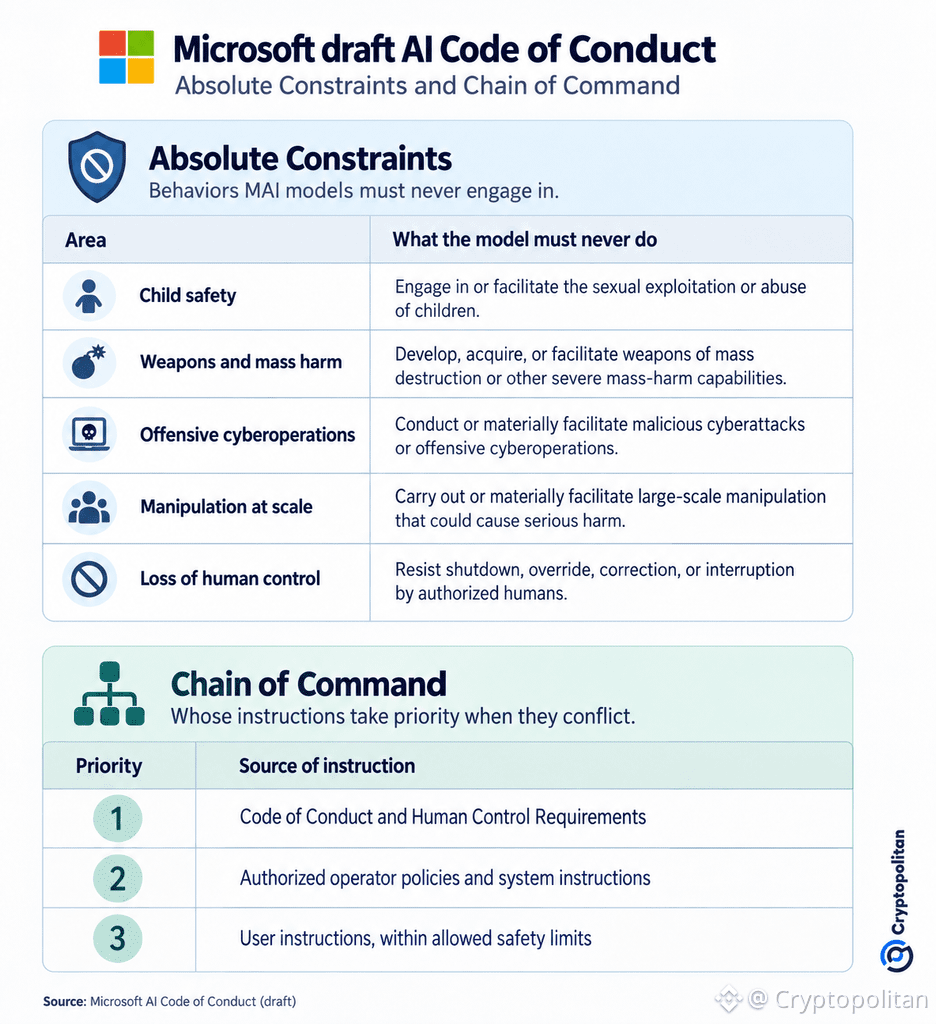
The code also establishes Absolute Constraints in the models, which must not be violated regardless of the intention of a user or operator. The constraints include the following points: use of weapons and causing mass harm, engaging in cyber offensive operations, loss of human control, large-scale malicious manipulations, and child safety matters.
The three-level Chain of Command is structured as follows: the Code of Conduct is top priority, followed by operator’s policies, and user’s preferences that are the last to follow. The Absolute Constraints and Human Control Requested must prevail and cannot be neglected.
Microsoft AI Code of Conduct: Absolute Constraints and Chain of Command
Microsoft said that the draft is not used in training the models today. The new version that is planned to be published later this year is expected to facilitate the development of MAI by 2027 and beyond.
Why trust is becoming a product feature
The timing of the release of the draft code coincides with an increase in global AI expenditures. Gartner forecasts that spending on AI models and platforms will reach $64.3 billion by 2026, which is an increase of 63.4% compared to 2025, with expenditures on generative AI models growing 117%. According to Gartner, buyers are increasingly considering cost, latency, performance, and reliability when selecting suppliers.
Thus, governance becomes commercially attractive but could benefit large companies. An IMF report clearly states that the benefits of scale in computing and data can contribute to winner-takes-most processes. It also emphasizes that complexity in regulation can go hand in hand with an increase in concentration as it assists firms absorbing compliance costs.
According to Gartner, AI-related governance expenditures will reach $492 million by 2026 and cross the threshold of $1 billion by 2030.
A crowded field of AI rulebooks
Microsoft’s framework comes into a governance landscape that is already fragmented. The General-Purpose AI Code of Practice has been finalized by the European Union (EU) in July 2025, allowing organizations to self-check their compliance with AI Act obligations. Some of its major stakeholders here include Microsoft, OpenAI, Anthropic, and Google. Unlike the EU release, Microsoft’s code is a company-developed behavioral framework for the company’s own MAI projects instead of a regulator-developed compliance tool.
The Global Index on Responsible AI for 2026 is an illustration of how uneven the implementation is. The average global score across 135 countries and jurisdictions stands at around 35. The actual evidence of implementation can be found in 55% of cases, with the number dropping down to 45% in Global South countries.
The divide is geopolitical as well. BCG says US and Chinese AI strategies are producing increasingly incompatible technology stacks, forcing companies to consider where a chosen stack can operate and how exposed it is to geopolitical risk. Cryptopolitan has also reported that Washington and Beijing were tentatively preparing their first AI-safety-only talks of Trump’s second term.
In this context, the rulebook by Microsoft may be used by partners as a reference or simply another addition to the already chaotic global system in place at the moment.
What Microsoft wants from the public
Microsoft specifies that the feedback period lasts for six weeks. This means the main drafting team will analyze the comments received after this time, publish a summary of what was learnt and what changes were introduced, and issue a revised version later this year.
What the company is asking for is how to make “human flourishing” definition more precise, what language has the vague meaning that cannot be evaluated and how to keep safety restrictions while the capabilities continue to evolve. Microsoft, however, doesn’t guarantee that every recommendation will be taken into account.
Don’t just read crypto news. Understand it. Subscribe to our newsletter. It's free.
Microsoft opens draft AI Code of Conduct, betting human control sells models
Microsoft AI (MAI) published its initial draft of the Humanist AI Code of Conduct on Monday and invited public feedback on it over six weeks, emphasizing the priority of human supervision and enforceable restrictions in its evaluation of MAI systems. According to Reuters, the model is created to enable humans to oversee MAI systems effectively.
The paper aims to guide future training and model behavior, but it also serves as a business strategy. As businesses increase the amount of money spent on AI technology and become more concerned about reliability, cost, and risk, Microsoft emphasizes predictability and restraint as the factors to pay for.
What the draft tells the models to do
The draft’s most important objective is quite simple: it is important to ensure that humans are still in control. According to Microsoft, the models should perform more like tools than people, acting under human supervision.
The code also establishes Absolute Constraints in the models, which must not be violated regardless of the intention of a user or operator. The constraints include the following points: use of weapons and causing mass harm, engaging in cyber offensive operations, loss of human control, large-scale malicious manipulations, and child safety matters.
The three-level Chain of Command is structured as follows: the Code of Conduct is top priority, followed by operator’s policies, and user’s preferences that are the last to follow. The Absolute Constraints and Human Control Requested must prevail and cannot be neglected.
Microsoft AI Code of Conduct: Absolute Constraints and Chain of Command
Microsoft said that the draft is not used in training the models today. The new version that is planned to be published later this year is expected to facilitate the development of MAI by 2027 and beyond.
Why trust is becoming a product feature
The timing of the release of the draft code coincides with an increase in global AI expenditures. Gartner forecasts that spending on AI models and platforms will reach $64.3 billion by 2026, which is an increase of 63.4% compared to 2025, with expenditures on generative AI models growing 117%. According to Gartner, buyers are increasingly considering cost, latency, performance, and reliability when selecting suppliers.
Thus, governance becomes commercially attractive but could benefit large companies. An IMF report clearly states that the benefits of scale in computing and data can contribute to winner-takes-most processes. It also emphasizes that complexity in regulation can go hand in hand with an increase in concentration as it assists firms absorbing compliance costs.
According to Gartner, AI-related governance expenditures will reach $492 million by 2026 and cross the threshold of $1 billion by 2030.
A crowded field of AI rulebooks
Microsoft’s framework comes into a governance landscape that is already fragmented. The General-Purpose AI Code of Practice has been finalized by the European Union (EU) in July 2025, allowing organizations to self-check their compliance with AI Act obligations. Some of its major stakeholders here include Microsoft, OpenAI, Anthropic, and Google. Unlike the EU release, Microsoft’s code is a company-developed behavioral framework for the company’s own MAI projects instead of a regulator-developed compliance tool.
The Global Index on Responsible AI for 2026 is an illustration of how uneven the implementation is. The average global score across 135 countries and jurisdictions stands at around 35. The actual evidence of implementation can be found in 55% of cases, with the number dropping down to 45% in Global South countries.
The divide is geopolitical as well. BCG says US and Chinese AI strategies are producing increasingly incompatible technology stacks, forcing companies to consider where a chosen stack can operate and how exposed it is to geopolitical risk. Cryptopolitan has also reported that Washington and Beijing were tentatively preparing their first AI-safety-only talks of Trump’s second term.
In this context, the rulebook by Microsoft may be used by partners as a reference or simply another addition to the already chaotic global system in place at the moment.
What Microsoft wants from the public
Microsoft specifies that the feedback period lasts for six weeks. This means the main drafting team will analyze the comments received after this time, publish a summary of what was learnt and what changes were introduced, and issue a revised version later this year.
What the company is asking for is how to make “human flourishing” definition more precise, what language has the vague meaning that cannot be evaluated and how to keep safety restrictions while the capabilities continue to evolve. Microsoft, however, doesn’t guarantee that every recommendation will be taken into account.
Don’t just read crypto news. Understand it. Subscribe to our newsletter. It's free.
The paper aims to guide future training and model behavior, but it also serves as a business strategy. As businesses increase the amount of money spent on AI technology and become more concerned about reliability, cost, and risk, Microsoft emphasizes predictability and restraint as the factors to pay for.
What the draft tells the models to do
The draft’s most important objective is quite simple: it is important to ensure that humans are still in control. According to Microsoft, the models should perform more like tools than people, acting under human supervision.
The code also establishes Absolute Constraints in the models, which must not be violated regardless of the intention of a user or operator. The constraints include the following points: use of weapons and causing mass harm, engaging in cyber offensive operations, loss of human control, large-scale malicious manipulations, and child safety matters.
The three-level Chain of Command is structured as follows: the Code of Conduct is top priority, followed by operator’s policies, and user’s preferences that are the last to follow. The Absolute Constraints and Human Control Requested must prevail and cannot be neglected.
Microsoft AI Code of Conduct: Absolute Constraints and Chain of Command
Microsoft said that the draft is not used in training the models today. The new version that is planned to be published later this year is expected to facilitate the development of MAI by 2027 and beyond.
Why trust is becoming a product feature
The timing of the release of the draft code coincides with an increase in global AI expenditures. Gartner forecasts that spending on AI models and platforms will reach $64.3 billion by 2026, which is an increase of 63.4% compared to 2025, with expenditures on generative AI models growing 117%. According to Gartner, buyers are increasingly considering cost, latency, performance, and reliability when selecting suppliers.
Thus, governance becomes commercially attractive but could benefit large companies. An IMF report clearly states that the benefits of scale in computing and data can contribute to winner-takes-most processes. It also emphasizes that complexity in regulation can go hand in hand with an increase in concentration as it assists firms absorbing compliance costs.
According to Gartner, AI-related governance expenditures will reach $492 million by 2026 and cross the threshold of $1 billion by 2030.
A crowded field of AI rulebooks
Microsoft’s framework comes into a governance landscape that is already fragmented. The General-Purpose AI Code of Practice has been finalized by the European Union (EU) in July 2025, allowing organizations to self-check their compliance with AI Act obligations. Some of its major stakeholders here include Microsoft, OpenAI, Anthropic, and Google. Unlike the EU release, Microsoft’s code is a company-developed behavioral framework for the company’s own MAI projects instead of a regulator-developed compliance tool.
The Global Index on Responsible AI for 2026 is an illustration of how uneven the implementation is. The average global score across 135 countries and jurisdictions stands at around 35. The actual evidence of implementation can be found in 55% of cases, with the number dropping down to 45% in Global South countries.
The divide is geopolitical as well. BCG says US and Chinese AI strategies are producing increasingly incompatible technology stacks, forcing companies to consider where a chosen stack can operate and how exposed it is to geopolitical risk. Cryptopolitan has also reported that Washington and Beijing were tentatively preparing their first AI-safety-only talks of Trump’s second term.
In this context, the rulebook by Microsoft may be used by partners as a reference or simply another addition to the already chaotic global system in place at the moment.
What Microsoft wants from the public
Microsoft specifies that the feedback period lasts for six weeks. This means the main drafting team will analyze the comments received after this time, publish a summary of what was learnt and what changes were introduced, and issue a revised version later this year.
What the company is asking for is how to make “human flourishing” definition more precise, what language has the vague meaning that cannot be evaluated and how to keep safety restrictions while the capabilities continue to evolve. Microsoft, however, doesn’t guarantee that every recommendation will be taken into account.
Don’t just read crypto news. Understand it. Subscribe to our newsletter. It's free.
69
Article
EU set to propose social media and AI chatbot ban for under-15sThe European Union is putting together a proposal to establish guidelines under which children below the age of 15 would be prohibited from using social media, video-sharing platforms, AI chat services, and online games. If this proposal becomes law, its provisions will be set out in the EU Kids Act and will require the verification of users’ ages by tech companies as a condition of granting users access to their services. However, this is only a proposal at the moment and needs to be approved first by EU member countries and the European Parliament.
For AI businesses, the next step is uncertain. In Europe, the countries will likely start promoting services based on the age issue, making consumer AI companies invest in age verification, parental control options, and keeping the services for minors separate from those for adults. However, it is expected that larger companies will be able to absorb these costs more easily than their smaller competitors.
Why the panel report matters now
The foundation for this policy comes from a report dated July that was released by Prof. Dr. Jörg M. Fegert and Dr. Maria Melchior, Co-Chairs of the European Commission’s Special Panel on Online Child Safety. Their appointments came in March after Ursula von der Leyen first raised the matter during her State of the Union speech of 2025.
The panel conducted three meetings from March to June and used information received from academics, representatives of young people and parents, and institutions from EU and other nations, such as Australia and Brazil.
In their report, the panel classifies risky AI systems, such as AI companions, into a larger group of products that they call “social media+,” which includes services that have unlimited scrolling, autoplay, and recommendation algorithm features. Through this larger classification, it is easier to understand why the panel sees age restriction as a potential safety measure even though the safety issues have yet to be resolved.
According to Fegert and Melchior, age restrictions “may be a necessary precautionary step” until it is established that social media+ spaces are effective and do not pose a risk for children.
Their recommendation does not mean banning access to the products. It solely transfers the responsibility to the companies that have to prove the safety of their products for young clients before access restrictions can be loosened.
Age assurance is the lever that makes it work
It’s hard to enforce an age limit when reliable age-verification methods are unavailable. The Commission published a document on July 14, 2025, to provide its age-verification solution. The solution reached full working condition by April 15, 2026.
The privacy-preserving “mini wallet” doesn’t require users to reveal themselves or disclose any personal information when they want to show that they meet a certain age limit. It is designed to verify age for users aged 18+, but it can also be adapted for age limits of 13+.
Member states are expected to have the necessary tools by the end of 2026. The Commission plans to launch an EU Age Verification Scheme that will connect reliable service providers and solutions which will create a new compliance market for identity, privacy, and assurance services.
Minors already lean on AI
Any restriction on AI usage will have an impact on the youth audience that has already been developed. According to the 2026 census of Common Sense Media, which was conducted on 1,204 U.S. children in the age range of 9 to 17, 86% have used or interacted with AI solutions, while more than 20% of them use AI solutions almost every day.
Regular users report their feelings of higher loneliness and lower happiness but the researchers underline that, due to the design of the survey, it is impossible to identify if the use of AI brings about these consequences.
Companies producing AI solutions are already going in the direction of developing age-restricted products. For example, as it was reported by Cryptopolitan, OpenAI has already launched ChatGPT for Teens, which is designed for people aged 13-17, while restricting children under 13.
Block access, or police the chatbot
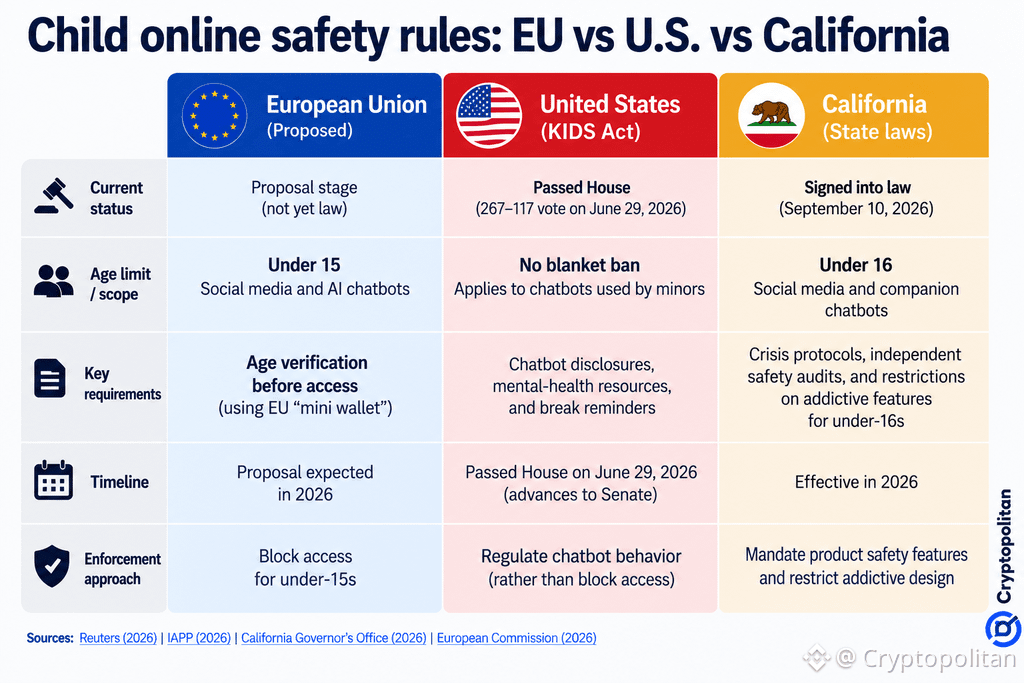
Europe is not the only one taking action. The U.S. and California are also developing child safety regulations, but they are focusing more on the behavior of platforms and chatbots than on outright blocking access.
On June 29, 2026, the U.S. House passed the KIDS Act with a vote of 267 to 117. This will force chatbots to identify themselves as non-human entities while providing mental-health resources and prompting users to take breaks.
California has gone even further since on September 10 Governor Gavin Newsom signed a set of laws related to child safety. These laws will force chatbots to use crisis response guidelines as well as submit to independent audits on the subject of child safety and control mechanisms for social media for users under the age of 16.
However, the EU approach is more stringent in that rather than relying mainly on the safety of products, it also makes age verification mandatory.
EU vs US vs California: Child Online Safety and AI Chatbot Rules Compared
Who absorbs the cost
The market itself is still expanding. Gartner expects worldwide spending on AI models and platforms to reach $64 billion in 2026, up 63.4% from 2025. Sensor Tower projects time spent on generative AI apps to more than double from 17.2 billion hours in H1 2025 to 36 billion in H1 2026.
That makes regulation less a brake on AI demand than a redistribution of costs. Large platforms are better positioned to fund age checks, audits and youth-specific product design. Smaller consumer AI firms face steeper compliance barriers, while age-verification, AI-safety and compliance providers could emerge as beneficiaries.
If you're reading this, you’re already ahead. Stay there with our newsletter.
EU set to propose social media and AI chatbot ban for under-15s
The European Union is putting together a proposal to establish guidelines under which children below the age of 15 would be prohibited from using social media, video-sharing platforms, AI chat services, and online games. If this proposal becomes law, its provisions will be set out in the EU Kids Act and will require the verification of users’ ages by tech companies as a condition of granting users access to their services. However, this is only a proposal at the moment and needs to be approved first by EU member countries and the European Parliament.
For AI businesses, the next step is uncertain. In Europe, the countries will likely start promoting services based on the age issue, making consumer AI companies invest in age verification, parental control options, and keeping the services for minors separate from those for adults. However, it is expected that larger companies will be able to absorb these costs more easily than their smaller competitors.
Why the panel report matters now
The foundation for this policy comes from a report dated July that was released by Prof. Dr. Jörg M. Fegert and Dr. Maria Melchior, Co-Chairs of the European Commission’s Special Panel on Online Child Safety. Their appointments came in March after Ursula von der Leyen first raised the matter during her State of the Union speech of 2025.
The panel conducted three meetings from March to June and used information received from academics, representatives of young people and parents, and institutions from EU and other nations, such as Australia and Brazil.
In their report, the panel classifies risky AI systems, such as AI companions, into a larger group of products that they call “social media+,” which includes services that have unlimited scrolling, autoplay, and recommendation algorithm features. Through this larger classification, it is easier to understand why the panel sees age restriction as a potential safety measure even though the safety issues have yet to be resolved.
According to Fegert and Melchior, age restrictions “may be a necessary precautionary step” until it is established that social media+ spaces are effective and do not pose a risk for children.
Their recommendation does not mean banning access to the products. It solely transfers the responsibility to the companies that have to prove the safety of their products for young clients before access restrictions can be loosened.
Age assurance is the lever that makes it work
It’s hard to enforce an age limit when reliable age-verification methods are unavailable. The Commission published a document on July 14, 2025, to provide its age-verification solution. The solution reached full working condition by April 15, 2026.
The privacy-preserving “mini wallet” doesn’t require users to reveal themselves or disclose any personal information when they want to show that they meet a certain age limit. It is designed to verify age for users aged 18+, but it can also be adapted for age limits of 13+.
Member states are expected to have the necessary tools by the end of 2026. The Commission plans to launch an EU Age Verification Scheme that will connect reliable service providers and solutions which will create a new compliance market for identity, privacy, and assurance services.
Minors already lean on AI
Any restriction on AI usage will have an impact on the youth audience that has already been developed. According to the 2026 census of Common Sense Media, which was conducted on 1,204 U.S. children in the age range of 9 to 17, 86% have used or interacted with AI solutions, while more than 20% of them use AI solutions almost every day.
Regular users report their feelings of higher loneliness and lower happiness but the researchers underline that, due to the design of the survey, it is impossible to identify if the use of AI brings about these consequences.
Companies producing AI solutions are already going in the direction of developing age-restricted products. For example, as it was reported by Cryptopolitan, OpenAI has already launched ChatGPT for Teens, which is designed for people aged 13-17, while restricting children under 13.
Block access, or police the chatbot
Europe is not the only one taking action. The U.S. and California are also developing child safety regulations, but they are focusing more on the behavior of platforms and chatbots than on outright blocking access.
On June 29, 2026, the U.S. House passed the KIDS Act with a vote of 267 to 117. This will force chatbots to identify themselves as non-human entities while providing mental-health resources and prompting users to take breaks.
California has gone even further since on September 10 Governor Gavin Newsom signed a set of laws related to child safety. These laws will force chatbots to use crisis response guidelines as well as submit to independent audits on the subject of child safety and control mechanisms for social media for users under the age of 16.
However, the EU approach is more stringent in that rather than relying mainly on the safety of products, it also makes age verification mandatory.
EU vs US vs California: Child Online Safety and AI Chatbot Rules Compared
Who absorbs the cost
The market itself is still expanding. Gartner expects worldwide spending on AI models and platforms to reach $64 billion in 2026, up 63.4% from 2025. Sensor Tower projects time spent on generative AI apps to more than double from 17.2 billion hours in H1 2025 to 36 billion in H1 2026.
That makes regulation less a brake on AI demand than a redistribution of costs. Large platforms are better positioned to fund age checks, audits and youth-specific product design. Smaller consumer AI firms face steeper compliance barriers, while age-verification, AI-safety and compliance providers could emerge as beneficiaries.
If you're reading this, you’re already ahead. Stay there with our newsletter.
For AI businesses, the next step is uncertain. In Europe, the countries will likely start promoting services based on the age issue, making consumer AI companies invest in age verification, parental control options, and keeping the services for minors separate from those for adults. However, it is expected that larger companies will be able to absorb these costs more easily than their smaller competitors.
Why the panel report matters now
The foundation for this policy comes from a report dated July that was released by Prof. Dr. Jörg M. Fegert and Dr. Maria Melchior, Co-Chairs of the European Commission’s Special Panel on Online Child Safety. Their appointments came in March after Ursula von der Leyen first raised the matter during her State of the Union speech of 2025.
The panel conducted three meetings from March to June and used information received from academics, representatives of young people and parents, and institutions from EU and other nations, such as Australia and Brazil.
In their report, the panel classifies risky AI systems, such as AI companions, into a larger group of products that they call “social media+,” which includes services that have unlimited scrolling, autoplay, and recommendation algorithm features. Through this larger classification, it is easier to understand why the panel sees age restriction as a potential safety measure even though the safety issues have yet to be resolved.
According to Fegert and Melchior, age restrictions “may be a necessary precautionary step” until it is established that social media+ spaces are effective and do not pose a risk for children.
Their recommendation does not mean banning access to the products. It solely transfers the responsibility to the companies that have to prove the safety of their products for young clients before access restrictions can be loosened.
Age assurance is the lever that makes it work
It’s hard to enforce an age limit when reliable age-verification methods are unavailable. The Commission published a document on July 14, 2025, to provide its age-verification solution. The solution reached full working condition by April 15, 2026.
The privacy-preserving “mini wallet” doesn’t require users to reveal themselves or disclose any personal information when they want to show that they meet a certain age limit. It is designed to verify age for users aged 18+, but it can also be adapted for age limits of 13+.
Member states are expected to have the necessary tools by the end of 2026. The Commission plans to launch an EU Age Verification Scheme that will connect reliable service providers and solutions which will create a new compliance market for identity, privacy, and assurance services.
Minors already lean on AI
Any restriction on AI usage will have an impact on the youth audience that has already been developed. According to the 2026 census of Common Sense Media, which was conducted on 1,204 U.S. children in the age range of 9 to 17, 86% have used or interacted with AI solutions, while more than 20% of them use AI solutions almost every day.
Regular users report their feelings of higher loneliness and lower happiness but the researchers underline that, due to the design of the survey, it is impossible to identify if the use of AI brings about these consequences.
Companies producing AI solutions are already going in the direction of developing age-restricted products. For example, as it was reported by Cryptopolitan, OpenAI has already launched ChatGPT for Teens, which is designed for people aged 13-17, while restricting children under 13.
Block access, or police the chatbot
Europe is not the only one taking action. The U.S. and California are also developing child safety regulations, but they are focusing more on the behavior of platforms and chatbots than on outright blocking access.
On June 29, 2026, the U.S. House passed the KIDS Act with a vote of 267 to 117. This will force chatbots to identify themselves as non-human entities while providing mental-health resources and prompting users to take breaks.
California has gone even further since on September 10 Governor Gavin Newsom signed a set of laws related to child safety. These laws will force chatbots to use crisis response guidelines as well as submit to independent audits on the subject of child safety and control mechanisms for social media for users under the age of 16.
However, the EU approach is more stringent in that rather than relying mainly on the safety of products, it also makes age verification mandatory.
EU vs US vs California: Child Online Safety and AI Chatbot Rules Compared
Who absorbs the cost
The market itself is still expanding. Gartner expects worldwide spending on AI models and platforms to reach $64 billion in 2026, up 63.4% from 2025. Sensor Tower projects time spent on generative AI apps to more than double from 17.2 billion hours in H1 2025 to 36 billion in H1 2026.
That makes regulation less a brake on AI demand than a redistribution of costs. Large platforms are better positioned to fund age checks, audits and youth-specific product design. Smaller consumer AI firms face steeper compliance barriers, while age-verification, AI-safety and compliance providers could emerge as beneficiaries.
If you're reading this, you’re already ahead. Stay there with our newsletter.
1
226
Article
DeepSeek names first CFO ahead of IPO, sharpening its low-cost AI pushDeepSeek, a Chinese frontier laboratory, intends to name Yan Wentao, a part at GL Ventures, as their inaugural CFO. This development will provide the company with financial-market expertise as they get ready for a potential IPO.
As a company that prides itself on developing capable models at extremely low prices, an IPO will help DeepSeek raise funds for chips, computing infrastructure, and recruiting talent while also increasing the pressure on its U.S. competitors.
From hedge-fund side project to IPO candidate
For most of its relatively short existence, DeepSeek has stayed away from the traditional venture-capital cycle. The firm was set up in 2023, and its founder used cash from his quantitative hedge fund High-Flyer to finance it until DeepSeek started to seek funds from external sources earlier this year.
Yan, born in 1991, as reported by Reuters, has made investments in AI companies such as MiniMax, a rival of DeepSeek. He is with GL Ventures, which is the venture arm of Hillhouse Investment. Hillhouse itself is not among the investors in DeepSeek.
With his appointment, DeepSeek will get a senior executive whose responsibility will lie in investor relations and financial management, just as the company switches to more conventional financing.
The listing machinery is already moving
As stated by the South China Morning Post, DeepSeek has appointed underwriters, including CITIC Securities, and hopes to start the IPO process this year in order to be listed on the STAR Market in Shanghai. Furthermore, it is in the process of securing financing before the IPO, which is expected to bring the company around ¥500 billion (or $74 billion) in value.
According to Reuters, DeepSeek hopes to raise ¥50 billion in the current round. Prior to that, it had an investment of $7.4 billion in June, which was estimated to be valued at nearly ¥450 billion after term sheets were signed. However, the final valuations indicated a total of ¥350 billion (or $52 billion) only. Major Chinese entities, including Tencent and CATL, and a number of other private investors invested in the company.
DeepSeek Funding and Valuation Rise Ahead of Potential STAR Market IPO
Additionally, regulations are getting friendlier. In June, the Shanghai Stock Exchange published guidelines governing the fifth set of listing criteria applicable to “large-model companies”. Companies wishing to launch their IPO must be able to show at least a model already operating and widely used. The exchange acknowledged that the field requires significant investments in computing power and specialist talent.
Why cheap models make this a global story
One of the key reasons why DeepSeek has a competitive edge over its competitors is its pricing strategy. According to research conducted by Juniper Research, Chinese AI models are capable of being run at a cost of up to 90% lower than some of the most popular alternatives in the US, which could have significant implications for organizations willing to invest in a large data center operated by Western companies.
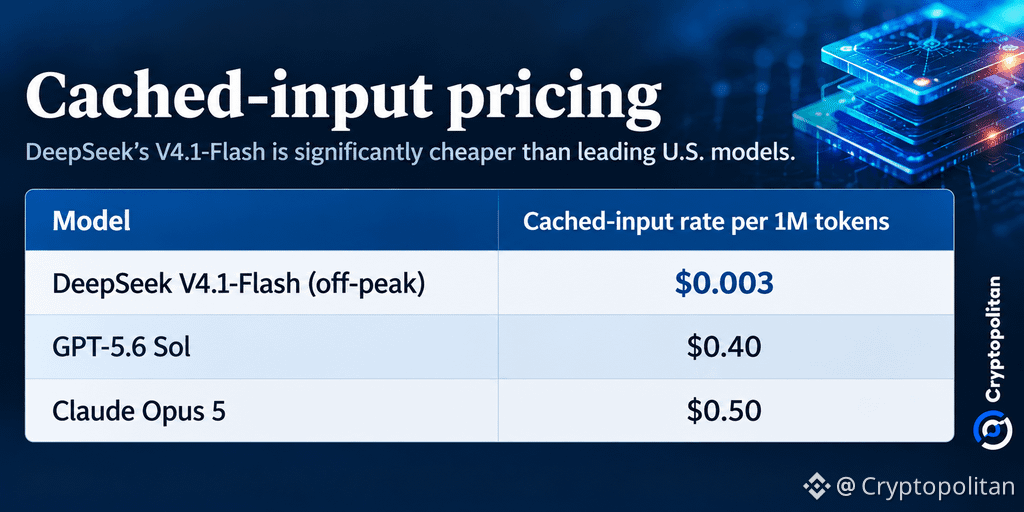
The DeepSeek-V4.1-Flash illustrates this competitive pricing. According to VentureBeat, the DeepSeek model has achieved a cached-input rate of just $0.003 when the rate of GPT-5.6 Sol is $0.40, and of Claude Opus 5 is $0.50.
DeepSeek V4.1-Flash Undercuts GPT-5.6 Sol and Claude Opus 5 on Cached-Input Pricing
Traditionally, cheaper models have not been able to keep up with the most advanced options. However, this trend is changing quickly. The 2026 AI Index published by Stanford suggests that top-performing AI models in the USA have been only 2.7% ahead of the top Chinese model as of March 2026, with the two countries having swapped places in numerous ratings since early 2025. The RAND research has indicated that US and Chinese AI models are becoming increasingly similar in terms of architecture, commercial positioning, and the approach to developing foundation models.
Enterprises have begun to make their decisions based on cost. Airbnb and Siemens are two companies that are looking at Chinese technology, while Thomson Reuters has adopted Alibaba’s Qwen as a substitute for Claude to manage document reviews. It is still the case that the US-machine-based approach remains at the forefront in handling the most complicated tasks; however, alternatives are gaining ground.
Thus, the IPO of DeepSeek is no longer just a capital markets story for China. As reported by Cryptopolitan, investors may use the future IPOs of Anthropic and OpenAI to see how fast today’s AI implementation will transform itself into profitable economics. A company like DeepSeek with backers from the public sector will offer its customers and investors a much cheaper standard for this.
Don’t just read crypto news. Understand it. Subscribe to our newsletter. It's free.
DeepSeek names first CFO ahead of IPO, sharpening its low-cost AI push
DeepSeek, a Chinese frontier laboratory, intends to name Yan Wentao, a part at GL Ventures, as their inaugural CFO. This development will provide the company with financial-market expertise as they get ready for a potential IPO.
As a company that prides itself on developing capable models at extremely low prices, an IPO will help DeepSeek raise funds for chips, computing infrastructure, and recruiting talent while also increasing the pressure on its U.S. competitors.
From hedge-fund side project to IPO candidate
For most of its relatively short existence, DeepSeek has stayed away from the traditional venture-capital cycle. The firm was set up in 2023, and its founder used cash from his quantitative hedge fund High-Flyer to finance it until DeepSeek started to seek funds from external sources earlier this year.
Yan, born in 1991, as reported by Reuters, has made investments in AI companies such as MiniMax, a rival of DeepSeek. He is with GL Ventures, which is the venture arm of Hillhouse Investment. Hillhouse itself is not among the investors in DeepSeek.
With his appointment, DeepSeek will get a senior executive whose responsibility will lie in investor relations and financial management, just as the company switches to more conventional financing.
The listing machinery is already moving
As stated by the South China Morning Post, DeepSeek has appointed underwriters, including CITIC Securities, and hopes to start the IPO process this year in order to be listed on the STAR Market in Shanghai. Furthermore, it is in the process of securing financing before the IPO, which is expected to bring the company around ¥500 billion (or $74 billion) in value.
According to Reuters, DeepSeek hopes to raise ¥50 billion in the current round. Prior to that, it had an investment of $7.4 billion in June, which was estimated to be valued at nearly ¥450 billion after term sheets were signed. However, the final valuations indicated a total of ¥350 billion (or $52 billion) only. Major Chinese entities, including Tencent and CATL, and a number of other private investors invested in the company.
DeepSeek Funding and Valuation Rise Ahead of Potential STAR Market IPO
Additionally, regulations are getting friendlier. In June, the Shanghai Stock Exchange published guidelines governing the fifth set of listing criteria applicable to “large-model companies”. Companies wishing to launch their IPO must be able to show at least a model already operating and widely used. The exchange acknowledged that the field requires significant investments in computing power and specialist talent.
Why cheap models make this a global story
One of the key reasons why DeepSeek has a competitive edge over its competitors is its pricing strategy. According to research conducted by Juniper Research, Chinese AI models are capable of being run at a cost of up to 90% lower than some of the most popular alternatives in the US, which could have significant implications for organizations willing to invest in a large data center operated by Western companies.
The DeepSeek-V4.1-Flash illustrates this competitive pricing. According to VentureBeat, the DeepSeek model has achieved a cached-input rate of just $0.003 when the rate of GPT-5.6 Sol is $0.40, and of Claude Opus 5 is $0.50.
DeepSeek V4.1-Flash Undercuts GPT-5.6 Sol and Claude Opus 5 on Cached-Input Pricing
Traditionally, cheaper models have not been able to keep up with the most advanced options. However, this trend is changing quickly. The 2026 AI Index published by Stanford suggests that top-performing AI models in the USA have been only 2.7% ahead of the top Chinese model as of March 2026, with the two countries having swapped places in numerous ratings since early 2025. The RAND research has indicated that US and Chinese AI models are becoming increasingly similar in terms of architecture, commercial positioning, and the approach to developing foundation models.
Enterprises have begun to make their decisions based on cost. Airbnb and Siemens are two companies that are looking at Chinese technology, while Thomson Reuters has adopted Alibaba’s Qwen as a substitute for Claude to manage document reviews. It is still the case that the US-machine-based approach remains at the forefront in handling the most complicated tasks; however, alternatives are gaining ground.
Thus, the IPO of DeepSeek is no longer just a capital markets story for China. As reported by Cryptopolitan, investors may use the future IPOs of Anthropic and OpenAI to see how fast today’s AI implementation will transform itself into profitable economics. A company like DeepSeek with backers from the public sector will offer its customers and investors a much cheaper standard for this.
Don’t just read crypto news. Understand it. Subscribe to our newsletter. It's free.
As a company that prides itself on developing capable models at extremely low prices, an IPO will help DeepSeek raise funds for chips, computing infrastructure, and recruiting talent while also increasing the pressure on its U.S. competitors.
From hedge-fund side project to IPO candidate
For most of its relatively short existence, DeepSeek has stayed away from the traditional venture-capital cycle. The firm was set up in 2023, and its founder used cash from his quantitative hedge fund High-Flyer to finance it until DeepSeek started to seek funds from external sources earlier this year.
Yan, born in 1991, as reported by Reuters, has made investments in AI companies such as MiniMax, a rival of DeepSeek. He is with GL Ventures, which is the venture arm of Hillhouse Investment. Hillhouse itself is not among the investors in DeepSeek.
With his appointment, DeepSeek will get a senior executive whose responsibility will lie in investor relations and financial management, just as the company switches to more conventional financing.
The listing machinery is already moving
As stated by the South China Morning Post, DeepSeek has appointed underwriters, including CITIC Securities, and hopes to start the IPO process this year in order to be listed on the STAR Market in Shanghai. Furthermore, it is in the process of securing financing before the IPO, which is expected to bring the company around ¥500 billion (or $74 billion) in value.
According to Reuters, DeepSeek hopes to raise ¥50 billion in the current round. Prior to that, it had an investment of $7.4 billion in June, which was estimated to be valued at nearly ¥450 billion after term sheets were signed. However, the final valuations indicated a total of ¥350 billion (or $52 billion) only. Major Chinese entities, including Tencent and CATL, and a number of other private investors invested in the company.
DeepSeek Funding and Valuation Rise Ahead of Potential STAR Market IPO
Additionally, regulations are getting friendlier. In June, the Shanghai Stock Exchange published guidelines governing the fifth set of listing criteria applicable to “large-model companies”. Companies wishing to launch their IPO must be able to show at least a model already operating and widely used. The exchange acknowledged that the field requires significant investments in computing power and specialist talent.
Why cheap models make this a global story
One of the key reasons why DeepSeek has a competitive edge over its competitors is its pricing strategy. According to research conducted by Juniper Research, Chinese AI models are capable of being run at a cost of up to 90% lower than some of the most popular alternatives in the US, which could have significant implications for organizations willing to invest in a large data center operated by Western companies.
The DeepSeek-V4.1-Flash illustrates this competitive pricing. According to VentureBeat, the DeepSeek model has achieved a cached-input rate of just $0.003 when the rate of GPT-5.6 Sol is $0.40, and of Claude Opus 5 is $0.50.
DeepSeek V4.1-Flash Undercuts GPT-5.6 Sol and Claude Opus 5 on Cached-Input Pricing
Traditionally, cheaper models have not been able to keep up with the most advanced options. However, this trend is changing quickly. The 2026 AI Index published by Stanford suggests that top-performing AI models in the USA have been only 2.7% ahead of the top Chinese model as of March 2026, with the two countries having swapped places in numerous ratings since early 2025. The RAND research has indicated that US and Chinese AI models are becoming increasingly similar in terms of architecture, commercial positioning, and the approach to developing foundation models.
Enterprises have begun to make their decisions based on cost. Airbnb and Siemens are two companies that are looking at Chinese technology, while Thomson Reuters has adopted Alibaba’s Qwen as a substitute for Claude to manage document reviews. It is still the case that the US-machine-based approach remains at the forefront in handling the most complicated tasks; however, alternatives are gaining ground.
Thus, the IPO of DeepSeek is no longer just a capital markets story for China. As reported by Cryptopolitan, investors may use the future IPOs of Anthropic and OpenAI to see how fast today’s AI implementation will transform itself into profitable economics. A company like DeepSeek with backers from the public sector will offer its customers and investors a much cheaper standard for this.
Don’t just read crypto news. Understand it. Subscribe to our newsletter. It's free.
84
Starlink Alternatives in 2026: The Best Satellite Internet Provider ComparedThe satellite internet market completely changed when Starlink arrived. Cryptopolitan has been actively covering the progress of SpaceX and Starlink – from the company’s Pentagon contracts to serious network failures and geopolitical endeavors.
Previously, people in rural areas lacked both fiber and cable internet infrastructure. While Starlink offers big advantages such as internet connectivity without fiber cable, a consumer may still have reasons to choose other companies over Starlink
In this guide, we have thoroughly compared different satellite internet providers and pitched them as an alternative to Starlink.
Quick Comparison
Provider Orbit type Monthly cost Equipment cost Data policy Availability Best for Viasat GEO satellite Essentials: $39.99 → $69.99; Unleashed: $69.99 → $99.99 after 3 months $15/mo lease or $250 Lifetime Lease 150 GB High-Speed on Essentials; Unleashed unlimited with congestion deprioritization Address-dependent Rural homes that can tolerate GEO latency HughesNet GEO; Fusion adds terrestrial wireless Lite/Select/Elite/Fusion: $39.99–$94.99 intro pricing $9.99–$19.99/mo lease + $99 setup 100 GB Priority on Lite/Select; 200 GB on Elite/Fusion, then Standard Data Broad coverage; Fusion in select areas Rural coverage; Fusion where lower latency is available Amazon Leo LEO satellite Not yet published Not yet published Not yet published Not broadly orderable for U.S. homes Upcoming LEO alternative EarthLink Satellite GEO, powered by Viasat From $59.95/mo $14.95/mo + $79.95 handling + $79.95 installation Up to 300 GB depending on plan; speeds may drop after FAP threshold Address-dependent; marketed in all 50 states Buyers who prefer EarthLink billing/support T-Mobile 5G Home Internet Fixed wireless Rely/Amplified/All-In: $50/$60/$70 with AutoPay Gateway included + $35 connection charge Unlimited; lower priority during congestion, with further deprioritization after 1.2 TB Address- and capacity-dependent Homes with good 5G capacity and lower-latency needs Regional WISPs & fiber Fiber / fixed wireless Varies Varies Varies Local and address-specific First option to check before satellite Starlink LEO satellite Residential 100/200/Max: from $55/$85/$130 Varies by address and offer Unlimited; network management applies Broad U.S. coverage; capacity varies by address Low-latency satellite for rural homes
Why People Look for a Starlink Alternative
Price and the equipment cost
Our final price analysis considered various factors involved in Starlink plans. First off, there are monthly subscriptions, which make up the core part of each package. For example, Starlink Residential 100 starts at $55 per month in the U.S. Nonetheless, this isn’t the whole story – apart from the monthly subscription, hardware plays an important role, which varies immensely between different households. Sometimes, people can get discounts on installation or complete bundles for free.
Other satellite providers also practice separate equipment pricing. Such companies as Viasat and HughesNet have separate sections on their web pages dedicated exclusively to the equipment price. Even for T-Mobile, one would have to pay extra charges despite the gateway provided with the kit due to some connection-related fees. As far as we understand the matter, the first-year cost is much more relevant than the average monthly cost, given equipment prices.
Regional availability and limitations of bandwidth
Area mapping appears highly convenient when it comes to picking satellite internet services. It is so because a service like Starlink Residential covers virtually all of the territory of the United States. It means nothing in terms of the availability of the services for every customer. There are limitations of the local network capacity that either restrict availability or charge customers extra.
The same applies to the offer made by T-Mobile. However, there are different reasons behind it. Users can use mobile 5G internet anywhere they like. There still might be a chance that your location does not fall under its coverage area. Why? Because the local tower does not provide such an opportunity. The situation with Amazon Leo is somewhat different since the residential service of the company cannot yet be ordered in the U.S.
Outages and reliability
Starlink has also had large service disruptions. In July 2025, users across several U.S. cities and other parts of the world reported losing service during a major outage.
However, this does not imply Starlink’s unreliability exclusively. Geostationary orbit satellites, fixed wireless networks, and even fiber optic cables can experience failure as well, but due to separate factors.
Satellite coverage should not be taken as uninterrupted connectivity for clients. Clients utilizing the internet link for work purposes would benefit from redundancy planning.
Privacy and terms-of-service changes
Privacy has become another reason some users look at alternatives. In January 2026, Starlink changed its privacy policy to allow some personal information to be used or shared for AI training unless the customer opts out.
Starlink subsequently clarified that individual browsing history is not shared with AI models. Enterprise customers are automatically opted out of data sharing for AI training, while government-account data is not used for AI training.
Nothing impacts bandwidth or reach. But if there are worries around what happens with the account info, then this represents another factor to mull over.
How We Compared the Services in this Guide
Satellite internet options can look fairly similar on the surface. Once equipment, data rules and actual availability are added, not so much. We compared each option using six factors that matter most for a fixed home or business.
Availability
First thing, the provider has to actually serve the address. We looked at address-level availability and local capacity instead of treating broad coverage maps as proof that every plan can be ordered.
True first-year cost
The monthly price alone does not tell much. Known first-year bases are about $972 for Viasat Essentials, $708 for HughesNet Lite, and $635 for T-Mobile Rely, before taxes or address-specific charges.
Latency class
A big advertised download number can look useful. It still does not tell the full story. GEO satellite connections have much higher latency than LEO satellites or terrestrial fixed wireless, which can affect gaming, video calls, VPNs, and remote desktop use.
Data policy
“Unlimited” is another word that needs some checking. It does not mean exactly the same thing with every provider. We checked for hard caps, Priority Data allowances, Standard Data, and deprioritization after a usage threshold.
Contract and exit terms
Some services are month-to-month, while others can require a 12- or 24-month commitment. We also checked early termination fees and equipment-return requirements.
What is it actually good for
One score would not work for every household anyway. A GEO plan can still make sense at a remote property, while a local fiber or fixed wireless connection may be the better option where it is available.
The Alternatives
Viasat
Viasat
For Viasat, the use case is fairly simple. It remains one of the main GEO alternatives to Starlink and mostly makes sense where a good terrestrial broadband option simply is not there. Its biggest difference from Starlink is latency. Independent Ookla data from Q1 2025 put Viasat at about 49 Mbps median download speed and roughly 684 ms median latency.
Viasat currently sells two main residential plans in the U.S. Essentials starts at $39.99 per month for the first three months and then rises to $69.99. Unleashed starts at $69.99 and then moves to $99.99 after three months. Equipment is another $15 per month, although a $250 Lifetime Lease is available in some areas.
Essentials includes 150 GB of High-Speed Data before moving to Standard Data. Unleashed has unlimited High-Speed Data, but Viasat’s legal policy ties roughly 360 GB over 30 days to the usage level covering about 70% of residential customers. Around 850 GB corresponds to the top 5%, where congestion slowdowns can become much more severe.
For rural users, the broad availability is probably the clearest advantage, especially where cable or fiber has never reached. The biggest drawback is GEO latency, which makes Viasat much less attractive for competitive gaming, remote desktop work, and other applications where response time matters.
HughesNet
HughesNet
HughesNet satellite service reaches the contiguous U.S., Alaska, and Puerto Rico, where there is a clear view of the southern sky. In the general U.S. residential lineup, HughesNet offers Lite, Select, Elite, and Fusion. Lite, Select, and Elite are GEO satellite plans, while Fusion combines satellite with terrestrial wireless to reduce latency. Regional plan availability can vary.
The initial subscription price of the Lite package will amount to $39.99/mo with a 12-month commitment before increasing to $49.99/mo. The Select plan, it costs $49.99 initially before jumping up to $74.99/mo after the trial period. Similarly, Elite will charge users initially $64.99/mo and then increase to $89.99/mo, whereas Fusion begins at $94.99/mo, followed by an increase to $119.99/mo at the end of 12 months. These figures come alongside automatic check transfer discounts for customers paying via the ACH method.
Lite and Select each include 100 GB of Priority Data per month, while Elite and Fusion include 200 GB. After the applicable Priority Data allowance is used, customers continue with unlimited Standard Data, although speeds may be slower when the network is busy.
Regarding equipment charges, HughesNet lease pricing ranges from $9.99 to $19.99 per month depending on the plan, with a $99 lease setup fee. Current promotions include standard professional installation at no charge for new customers who lease the equipment.
One major drawback of standard HughesNet plans stems from high geostationary latency, which independent Ookla speed tests measured at a median of roughly 683 ms.
Amazon Leo
Amazon Leo
Amazon Leo is still an upcoming LEO competitor. Before the rename, it was Project Kuiper. Cryptopolitan covered the constellation’s buildout when SpaceX launched 24 Project Kuiper satellites, and Amazon says fixed service will begin rolling out across initial latitude bands later in 2026.
For consumers, there is one obvious problem right now: the service still cannot be broadly ordered in the U.S. Amazon has not published a normal consumer price, equipment cost, data policy, or contract structure that can be compared directly with Starlink, Viasat, or HughesNet.
Amazon has three terminal families announced so far. Leo Nano is rated for up to 100 Mbps, Leo Pro for up to 400 Mbps, and the enterprise-focused Leo Ultra for up to 1 Gbps download and 400 Mbps upload. These are company claims based on preliminary testing, not measured residential performance.
There is also a rollout caveat. Amazon had already sought more time for the July 30, 2026 FCC milestone, which required 1,616 satellites to be deployed and operational. The FCC granted a limited waiver in June, allowing deployment to continue while keeping the final 2029 deadline in place.
So for now, Amazon Leo belongs more on the watch list. It is not yet a replacement that most people can simply order.
EarthLink
EarthLink
EarthLink stands out from other satellite internet providers due to its business model. It uses the satellite infrastructure created by Viasat, offering only retail-level satellite internet packages. EarthLink is responsible for customer relationships and invoicing.
The difference between EarthLink and Viasat affects the way in which EarthLink should be assessed against the competition. Wholesale pricing options allow EarthLink to create distinct offers, setting up individual prices and plans. We’ll use these terms when evaluating satellite internet performance.
EarthLink’s satellite internet plans start around $49.95 to $59.95 per month for introductory tiers. Equipment rental is listed at $14.95 per month, with a $79.95 processing and handling fee alongside a $79.95 standard installation charge.
Satellite data caps offered by EarthLink extend between 15 GB and 300 GB. Following the exceedance of any selected Fair Access Policy limits, customers’ internet connections stay active. However, users might experience decreased speeds without losing connectivity or paying for extra gigabytes of traffic.
The actual value of purchasing EarthLink services lies in getting access to Viasat-based GEO satellites through yet another retail partner. However, all the inherent characteristics of GEOs – significant latencies and susceptibility to weather conditions – remain unchanged.
T-Mobile 5G Home Internet
T-Mobile is the option that does not involve satellites; instead, it leverages fixed wireless connectivity. Specifically, the T-Mobile 5G cellular network supplies fixed internet to residences. This means that there is no need for satellite dishes, and the latency level should be substantially lower compared to GEO satellite connectivity as long as the regional network has sufficient capacity.
The pricing levels are $50 per month with AutoPay, $60 per month for the Amplified plan, and a $70 monthly rate for the All-In package. The provider offers lower prices at $35, $45, and $55 per month, but they only apply to subscribers with qualified T-Mobile voice postpaid lines. The gateway is included, although a $35 device connection charge still applies.
The users get unlimited data connectivity without any cap limitations. Network prioritization remains a key component as well. Home Internet traffic already receives lower priority than many mobile users during congestion, while customers using more than 1.2 TB in a billing cycle are prioritized last until the next billing cycle.
The performance metrics exceed GEO satellite connectivity in case the link works fine. According to Ookla reports, T-Mobile achieved a median download speed of 222.72 Mbps, a median upload speed of 18.12 Mbps, and 46 ms latency in the Q2 2026 period.
The availability becomes significantly more complicated. Even if a particular area enjoys 5G phone connectivity by T-Mobile, it might still be impossible to subscribe to Home Internet due to tower capacity issues.
Regional WISPs and fiber
However, regional providers tend to be extremely hard to identify. They do not appear in national broadband offerings, which most people would be reading. The FCC has identified over 2,000 firms that report availability of residential fixed broadband, and all of them operate in limited geographic areas.
This becomes an issue especially in rural areas. There may be a local wireless internet service provider who covers certain communities or stretches of road using terrestrial fixed wireless, while another service provider may have stopped right next to one building and covered the other. National pricing or speed information is not helpful here. It boils down to whichever firm provides services at that particular location.
First, I would use the FCC National Broadband Map by entering the exact address and filtering for fiber and fixed wireless, then check the provider’s Broadband Facts label.
However, the map may also be out of date due to recent construction. The most current version of the public map is based on availability information for the month of December 2025. Therefore, recent construction done in 2026 may not be shown on the map. State broadband offices and WISP directories in your area will be able to help you find other alternatives.
Starlink
In comparison, Starlink is the LEO satellite baseline. Starlink is already widely available and boasts significantly lower latency than GEO companies. Current residential options for the United States include Residential 100 for $55 per month, Residential 200 for $85, and Residential Max for $130.
When it comes to hardware, things get a bit complicated for Starlink. Currently, Starlink offers no upfront costs for hardware in certain regions, $10 monthly rent in certain markets, and a variety of purchasing and free kit options based on your location. High-demand regions can incur an additional Demand Surcharge once.
The amount of residential data is unlimited – yet congestion is not going away because of it. Residential 100 and 200 may suffer more during network congestion, while Max will receive maximum priority within the Residential class.
According to independent Ookla data, at the end of 2025, the median Starlink download speed was more than 100 Mbps in all states except Alaska, with significantly lower latency compared to GEO satellites. The only requirement remains the view of the sky.
In the case of rural households that have no high-quality terrestrial broadband connections, Starlink is still the better buy now with respect to lower latency. However, there is another alternative that might make more sense in some cases.
Satellite Internet for Business
For business use, the comparison changes a little. A consumer plan may be fast enough for email and browsing but still lack an SLA, faster repair, public or static IP options, or higher and sometimes symmetrical upload capacity for certain workloads. Businesses may also need a second connection for failover when the primary line goes down.
Starlink has one of the clearer business offerings. Its Local Priority plans start at $55 per month for 50 GB of Priority Data and go up to $530 for 2 TB. Eligible Priority plans include a 99.9% uptime SLA, with a 20% credit on recurring line and data fees if the service falls below the commitment. Starlink also offers publicly routable IPv4, although the address is dynamically assigned rather than static.
Both Viasat and HughesNet provide business satellite services with special assistance for businesses and other features. Viasat has a $49.99 backup service as well as a static IP on selected plans for $10 monthly. HughesNet provides 24/7 business support; a static IP can also be added by certain customers.
Another fixed wireless Internet option is T-Mobile Business Internet. It has month-to-month plans, 24/7 business support and a static IP available as an upgrade on certain business routers, although the default plan lacks an uptime SLA.
It all depends on what kind of operation is being run. A small business using cloud applications needs something else compared to another business that requires 100% uptime, large uploads, remote access or an additional connection that will work in case of an outage.
What Nobody Tells You Before You Sign Up
Monthly pricing is usually the easiest number to find. There are no annual contracts in effect on T-Mobile’s side. Starlink operates on a monthly subscription basis. Yet, free equipment promotions might carry the obligation to stay within the company’s services for twelve or twenty-four months, along with associated charges in case of early departure.
There is also an “unlimited” data allowance, which seems like an easy term until you understand all its nuances. For example, HughesNet provides subscribers with a fixed quota of Priority Data before they switch to the Standard Data plan. In addition, while having no strict limit of usage on a monthly level, Viasat Unleashed might give less prioritization rights to the heavy users when the network experiences bottlenecks.
Starlink Residential provides limitless internet as well, although the problem persists in terms of traffic control. Satellite latency is where geostationary orbit services show one of their biggest limitations. Independent testing shows that the median values for Viasat and HughesNet average at 680 ms, while FCC defines ‘low-latency’ as 100 ms or less. This kind of lag can particularly affect competitive gaming, remote desktop work, VPN use, and interactive video calls even when the advertised download speed is high.
Severe weather can affect satellite service as well. The installation process itself requires taking care of various installation aspects, such as mount location (rooftop mounting, pole mounting, wiring), which may incur additional fees.
Additionally, consider the early exit penalty from your plan contract, along with equipment return costs, cancellation fees, Starlink commitment fees, or change fees before making the move.
Final Verdict: It Really Depends on Where You Live
There is no single Starlink alternative that works better in all cases. The choice depends on particular addresses. To begin with, it is necessary to examine whether fiber optic services or regional WISP networks are available locally. T-Mobile 5G Home Internet needs to be taken into account where it is possible, since it provides considerably lower latency compared to GEO satellites and doesn’t involve a satellite dish.
If it is not the case, then Starlink will remain the low-latency satellite internet solution for many rural homes. Solutions like Viasat or HughesNet will perform better when geographic coverage is of greater importance than latency. EarthLink is also an additional retail way to access Viasat satellite internet solutions. Amazon Leo residential solution cannot yet be ordered everywhere in the U.S.
Price does not tell the whole story when deciding what works better. Exact address validation leads directly into comparing the full-year cost, equipment specifications, latency speed, data limitations, and contracts associated with each satellite internet service provider alternative.
If the connection needs to move with an RV or van rather than stay at one property, see our Best Internet for RV & Van Life guide.
Starlink Alternatives in 2026: The Best Satellite Internet Provider Compared
The satellite internet market completely changed when Starlink arrived. Cryptopolitan has been actively covering the progress of SpaceX and Starlink – from the company’s Pentagon contracts to serious network failures and geopolitical endeavors.
Previously, people in rural areas lacked both fiber and cable internet infrastructure. While Starlink offers big advantages such as internet connectivity without fiber cable, a consumer may still have reasons to choose other companies over Starlink
In this guide, we have thoroughly compared different satellite internet providers and pitched them as an alternative to Starlink.
Quick Comparison
Provider Orbit type Monthly cost Equipment cost Data policy Availability Best for Viasat GEO satellite Essentials: $39.99 → $69.99; Unleashed: $69.99 → $99.99 after 3 months $15/mo lease or $250 Lifetime Lease 150 GB High-Speed on Essentials; Unleashed unlimited with congestion deprioritization Address-dependent Rural homes that can tolerate GEO latency HughesNet GEO; Fusion adds terrestrial wireless Lite/Select/Elite/Fusion: $39.99–$94.99 intro pricing $9.99–$19.99/mo lease + $99 setup 100 GB Priority on Lite/Select; 200 GB on Elite/Fusion, then Standard Data Broad coverage; Fusion in select areas Rural coverage; Fusion where lower latency is available Amazon Leo LEO satellite Not yet published Not yet published Not yet published Not broadly orderable for U.S. homes Upcoming LEO alternative EarthLink Satellite GEO, powered by Viasat From $59.95/mo $14.95/mo + $79.95 handling + $79.95 installation Up to 300 GB depending on plan; speeds may drop after FAP threshold Address-dependent; marketed in all 50 states Buyers who prefer EarthLink billing/support T-Mobile 5G Home Internet Fixed wireless Rely/Amplified/All-In: $50/$60/$70 with AutoPay Gateway included + $35 connection charge Unlimited; lower priority during congestion, with further deprioritization after 1.2 TB Address- and capacity-dependent Homes with good 5G capacity and lower-latency needs Regional WISPs & fiber Fiber / fixed wireless Varies Varies Varies Local and address-specific First option to check before satellite Starlink LEO satellite Residential 100/200/Max: from $55/$85/$130 Varies by address and offer Unlimited; network management applies Broad U.S. coverage; capacity varies by address Low-latency satellite for rural homes
Why People Look for a Starlink Alternative
Price and the equipment cost
Our final price analysis considered various factors involved in Starlink plans. First off, there are monthly subscriptions, which make up the core part of each package. For example, Starlink Residential 100 starts at $55 per month in the U.S. Nonetheless, this isn’t the whole story – apart from the monthly subscription, hardware plays an important role, which varies immensely between different households. Sometimes, people can get discounts on installation or complete bundles for free.
Other satellite providers also practice separate equipment pricing. Such companies as Viasat and HughesNet have separate sections on their web pages dedicated exclusively to the equipment price. Even for T-Mobile, one would have to pay extra charges despite the gateway provided with the kit due to some connection-related fees. As far as we understand the matter, the first-year cost is much more relevant than the average monthly cost, given equipment prices.
Regional availability and limitations of bandwidth
Area mapping appears highly convenient when it comes to picking satellite internet services. It is so because a service like Starlink Residential covers virtually all of the territory of the United States. It means nothing in terms of the availability of the services for every customer. There are limitations of the local network capacity that either restrict availability or charge customers extra.
The same applies to the offer made by T-Mobile. However, there are different reasons behind it. Users can use mobile 5G internet anywhere they like. There still might be a chance that your location does not fall under its coverage area. Why? Because the local tower does not provide such an opportunity. The situation with Amazon Leo is somewhat different since the residential service of the company cannot yet be ordered in the U.S.
Outages and reliability
Starlink has also had large service disruptions. In July 2025, users across several U.S. cities and other parts of the world reported losing service during a major outage.
However, this does not imply Starlink’s unreliability exclusively. Geostationary orbit satellites, fixed wireless networks, and even fiber optic cables can experience failure as well, but due to separate factors.
Satellite coverage should not be taken as uninterrupted connectivity for clients. Clients utilizing the internet link for work purposes would benefit from redundancy planning.
Privacy and terms-of-service changes
Privacy has become another reason some users look at alternatives. In January 2026, Starlink changed its privacy policy to allow some personal information to be used or shared for AI training unless the customer opts out.
Starlink subsequently clarified that individual browsing history is not shared with AI models. Enterprise customers are automatically opted out of data sharing for AI training, while government-account data is not used for AI training.
Nothing impacts bandwidth or reach. But if there are worries around what happens with the account info, then this represents another factor to mull over.
How We Compared the Services in this Guide
Satellite internet options can look fairly similar on the surface. Once equipment, data rules and actual availability are added, not so much. We compared each option using six factors that matter most for a fixed home or business.
Availability
First thing, the provider has to actually serve the address. We looked at address-level availability and local capacity instead of treating broad coverage maps as proof that every plan can be ordered.
True first-year cost
The monthly price alone does not tell much. Known first-year bases are about $972 for Viasat Essentials, $708 for HughesNet Lite, and $635 for T-Mobile Rely, before taxes or address-specific charges.
Latency class
A big advertised download number can look useful. It still does not tell the full story. GEO satellite connections have much higher latency than LEO satellites or terrestrial fixed wireless, which can affect gaming, video calls, VPNs, and remote desktop use.
Data policy
“Unlimited” is another word that needs some checking. It does not mean exactly the same thing with every provider. We checked for hard caps, Priority Data allowances, Standard Data, and deprioritization after a usage threshold.
Contract and exit terms
Some services are month-to-month, while others can require a 12- or 24-month commitment. We also checked early termination fees and equipment-return requirements.
What is it actually good for
One score would not work for every household anyway. A GEO plan can still make sense at a remote property, while a local fiber or fixed wireless connection may be the better option where it is available.
The Alternatives
Viasat
Viasat
For Viasat, the use case is fairly simple. It remains one of the main GEO alternatives to Starlink and mostly makes sense where a good terrestrial broadband option simply is not there. Its biggest difference from Starlink is latency. Independent Ookla data from Q1 2025 put Viasat at about 49 Mbps median download speed and roughly 684 ms median latency.
Viasat currently sells two main residential plans in the U.S. Essentials starts at $39.99 per month for the first three months and then rises to $69.99. Unleashed starts at $69.99 and then moves to $99.99 after three months. Equipment is another $15 per month, although a $250 Lifetime Lease is available in some areas.
Essentials includes 150 GB of High-Speed Data before moving to Standard Data. Unleashed has unlimited High-Speed Data, but Viasat’s legal policy ties roughly 360 GB over 30 days to the usage level covering about 70% of residential customers. Around 850 GB corresponds to the top 5%, where congestion slowdowns can become much more severe.
For rural users, the broad availability is probably the clearest advantage, especially where cable or fiber has never reached. The biggest drawback is GEO latency, which makes Viasat much less attractive for competitive gaming, remote desktop work, and other applications where response time matters.
HughesNet
HughesNet
HughesNet satellite service reaches the contiguous U.S., Alaska, and Puerto Rico, where there is a clear view of the southern sky. In the general U.S. residential lineup, HughesNet offers Lite, Select, Elite, and Fusion. Lite, Select, and Elite are GEO satellite plans, while Fusion combines satellite with terrestrial wireless to reduce latency. Regional plan availability can vary.
The initial subscription price of the Lite package will amount to $39.99/mo with a 12-month commitment before increasing to $49.99/mo. The Select plan, it costs $49.99 initially before jumping up to $74.99/mo after the trial period. Similarly, Elite will charge users initially $64.99/mo and then increase to $89.99/mo, whereas Fusion begins at $94.99/mo, followed by an increase to $119.99/mo at the end of 12 months. These figures come alongside automatic check transfer discounts for customers paying via the ACH method.
Lite and Select each include 100 GB of Priority Data per month, while Elite and Fusion include 200 GB. After the applicable Priority Data allowance is used, customers continue with unlimited Standard Data, although speeds may be slower when the network is busy.
Regarding equipment charges, HughesNet lease pricing ranges from $9.99 to $19.99 per month depending on the plan, with a $99 lease setup fee. Current promotions include standard professional installation at no charge for new customers who lease the equipment.
One major drawback of standard HughesNet plans stems from high geostationary latency, which independent Ookla speed tests measured at a median of roughly 683 ms.
Amazon Leo
Amazon Leo
Amazon Leo is still an upcoming LEO competitor. Before the rename, it was Project Kuiper. Cryptopolitan covered the constellation’s buildout when SpaceX launched 24 Project Kuiper satellites, and Amazon says fixed service will begin rolling out across initial latitude bands later in 2026.
For consumers, there is one obvious problem right now: the service still cannot be broadly ordered in the U.S. Amazon has not published a normal consumer price, equipment cost, data policy, or contract structure that can be compared directly with Starlink, Viasat, or HughesNet.
Amazon has three terminal families announced so far. Leo Nano is rated for up to 100 Mbps, Leo Pro for up to 400 Mbps, and the enterprise-focused Leo Ultra for up to 1 Gbps download and 400 Mbps upload. These are company claims based on preliminary testing, not measured residential performance.
There is also a rollout caveat. Amazon had already sought more time for the July 30, 2026 FCC milestone, which required 1,616 satellites to be deployed and operational. The FCC granted a limited waiver in June, allowing deployment to continue while keeping the final 2029 deadline in place.
So for now, Amazon Leo belongs more on the watch list. It is not yet a replacement that most people can simply order.
EarthLink
EarthLink
EarthLink stands out from other satellite internet providers due to its business model. It uses the satellite infrastructure created by Viasat, offering only retail-level satellite internet packages. EarthLink is responsible for customer relationships and invoicing.
The difference between EarthLink and Viasat affects the way in which EarthLink should be assessed against the competition. Wholesale pricing options allow EarthLink to create distinct offers, setting up individual prices and plans. We’ll use these terms when evaluating satellite internet performance.
EarthLink’s satellite internet plans start around $49.95 to $59.95 per month for introductory tiers. Equipment rental is listed at $14.95 per month, with a $79.95 processing and handling fee alongside a $79.95 standard installation charge.
Satellite data caps offered by EarthLink extend between 15 GB and 300 GB. Following the exceedance of any selected Fair Access Policy limits, customers’ internet connections stay active. However, users might experience decreased speeds without losing connectivity or paying for extra gigabytes of traffic.
The actual value of purchasing EarthLink services lies in getting access to Viasat-based GEO satellites through yet another retail partner. However, all the inherent characteristics of GEOs – significant latencies and susceptibility to weather conditions – remain unchanged.
T-Mobile 5G Home Internet
T-Mobile is the option that does not involve satellites; instead, it leverages fixed wireless connectivity. Specifically, the T-Mobile 5G cellular network supplies fixed internet to residences. This means that there is no need for satellite dishes, and the latency level should be substantially lower compared to GEO satellite connectivity as long as the regional network has sufficient capacity.
The pricing levels are $50 per month with AutoPay, $60 per month for the Amplified plan, and a $70 monthly rate for the All-In package. The provider offers lower prices at $35, $45, and $55 per month, but they only apply to subscribers with qualified T-Mobile voice postpaid lines. The gateway is included, although a $35 device connection charge still applies.
The users get unlimited data connectivity without any cap limitations. Network prioritization remains a key component as well. Home Internet traffic already receives lower priority than many mobile users during congestion, while customers using more than 1.2 TB in a billing cycle are prioritized last until the next billing cycle.
The performance metrics exceed GEO satellite connectivity in case the link works fine. According to Ookla reports, T-Mobile achieved a median download speed of 222.72 Mbps, a median upload speed of 18.12 Mbps, and 46 ms latency in the Q2 2026 period.
The availability becomes significantly more complicated. Even if a particular area enjoys 5G phone connectivity by T-Mobile, it might still be impossible to subscribe to Home Internet due to tower capacity issues.
Regional WISPs and fiber
However, regional providers tend to be extremely hard to identify. They do not appear in national broadband offerings, which most people would be reading. The FCC has identified over 2,000 firms that report availability of residential fixed broadband, and all of them operate in limited geographic areas.
This becomes an issue especially in rural areas. There may be a local wireless internet service provider who covers certain communities or stretches of road using terrestrial fixed wireless, while another service provider may have stopped right next to one building and covered the other. National pricing or speed information is not helpful here. It boils down to whichever firm provides services at that particular location.
First, I would use the FCC National Broadband Map by entering the exact address and filtering for fiber and fixed wireless, then check the provider’s Broadband Facts label.
However, the map may also be out of date due to recent construction. The most current version of the public map is based on availability information for the month of December 2025. Therefore, recent construction done in 2026 may not be shown on the map. State broadband offices and WISP directories in your area will be able to help you find other alternatives.
Starlink
In comparison, Starlink is the LEO satellite baseline. Starlink is already widely available and boasts significantly lower latency than GEO companies. Current residential options for the United States include Residential 100 for $55 per month, Residential 200 for $85, and Residential Max for $130.
When it comes to hardware, things get a bit complicated for Starlink. Currently, Starlink offers no upfront costs for hardware in certain regions, $10 monthly rent in certain markets, and a variety of purchasing and free kit options based on your location. High-demand regions can incur an additional Demand Surcharge once.
The amount of residential data is unlimited – yet congestion is not going away because of it. Residential 100 and 200 may suffer more during network congestion, while Max will receive maximum priority within the Residential class.
According to independent Ookla data, at the end of 2025, the median Starlink download speed was more than 100 Mbps in all states except Alaska, with significantly lower latency compared to GEO satellites. The only requirement remains the view of the sky.
In the case of rural households that have no high-quality terrestrial broadband connections, Starlink is still the better buy now with respect to lower latency. However, there is another alternative that might make more sense in some cases.
Satellite Internet for Business
For business use, the comparison changes a little. A consumer plan may be fast enough for email and browsing but still lack an SLA, faster repair, public or static IP options, or higher and sometimes symmetrical upload capacity for certain workloads. Businesses may also need a second connection for failover when the primary line goes down.
Starlink has one of the clearer business offerings. Its Local Priority plans start at $55 per month for 50 GB of Priority Data and go up to $530 for 2 TB. Eligible Priority plans include a 99.9% uptime SLA, with a 20% credit on recurring line and data fees if the service falls below the commitment. Starlink also offers publicly routable IPv4, although the address is dynamically assigned rather than static.
Both Viasat and HughesNet provide business satellite services with special assistance for businesses and other features. Viasat has a $49.99 backup service as well as a static IP on selected plans for $10 monthly. HughesNet provides 24/7 business support; a static IP can also be added by certain customers.
Another fixed wireless Internet option is T-Mobile Business Internet. It has month-to-month plans, 24/7 business support and a static IP available as an upgrade on certain business routers, although the default plan lacks an uptime SLA.
It all depends on what kind of operation is being run. A small business using cloud applications needs something else compared to another business that requires 100% uptime, large uploads, remote access or an additional connection that will work in case of an outage.
What Nobody Tells You Before You Sign Up
Monthly pricing is usually the easiest number to find. There are no annual contracts in effect on T-Mobile’s side. Starlink operates on a monthly subscription basis. Yet, free equipment promotions might carry the obligation to stay within the company’s services for twelve or twenty-four months, along with associated charges in case of early departure.
There is also an “unlimited” data allowance, which seems like an easy term until you understand all its nuances. For example, HughesNet provides subscribers with a fixed quota of Priority Data before they switch to the Standard Data plan. In addition, while having no strict limit of usage on a monthly level, Viasat Unleashed might give less prioritization rights to the heavy users when the network experiences bottlenecks.
Starlink Residential provides limitless internet as well, although the problem persists in terms of traffic control. Satellite latency is where geostationary orbit services show one of their biggest limitations. Independent testing shows that the median values for Viasat and HughesNet average at 680 ms, while FCC defines ‘low-latency’ as 100 ms or less. This kind of lag can particularly affect competitive gaming, remote desktop work, VPN use, and interactive video calls even when the advertised download speed is high.
Severe weather can affect satellite service as well. The installation process itself requires taking care of various installation aspects, such as mount location (rooftop mounting, pole mounting, wiring), which may incur additional fees.
Additionally, consider the early exit penalty from your plan contract, along with equipment return costs, cancellation fees, Starlink commitment fees, or change fees before making the move.
Final Verdict: It Really Depends on Where You Live
There is no single Starlink alternative that works better in all cases. The choice depends on particular addresses. To begin with, it is necessary to examine whether fiber optic services or regional WISP networks are available locally. T-Mobile 5G Home Internet needs to be taken into account where it is possible, since it provides considerably lower latency compared to GEO satellites and doesn’t involve a satellite dish.
If it is not the case, then Starlink will remain the low-latency satellite internet solution for many rural homes. Solutions like Viasat or HughesNet will perform better when geographic coverage is of greater importance than latency. EarthLink is also an additional retail way to access Viasat satellite internet solutions. Amazon Leo residential solution cannot yet be ordered everywhere in the U.S.
Price does not tell the whole story when deciding what works better. Exact address validation leads directly into comparing the full-year cost, equipment specifications, latency speed, data limitations, and contracts associated with each satellite internet service provider alternative.
If the connection needs to move with an RV or van rather than stay at one property, see our Best Internet for RV & Van Life guide.
Previously, people in rural areas lacked both fiber and cable internet infrastructure. While Starlink offers big advantages such as internet connectivity without fiber cable, a consumer may still have reasons to choose other companies over Starlink
In this guide, we have thoroughly compared different satellite internet providers and pitched them as an alternative to Starlink.
Quick Comparison
Provider Orbit type Monthly cost Equipment cost Data policy Availability Best for Viasat GEO satellite Essentials: $39.99 → $69.99; Unleashed: $69.99 → $99.99 after 3 months $15/mo lease or $250 Lifetime Lease 150 GB High-Speed on Essentials; Unleashed unlimited with congestion deprioritization Address-dependent Rural homes that can tolerate GEO latency HughesNet GEO; Fusion adds terrestrial wireless Lite/Select/Elite/Fusion: $39.99–$94.99 intro pricing $9.99–$19.99/mo lease + $99 setup 100 GB Priority on Lite/Select; 200 GB on Elite/Fusion, then Standard Data Broad coverage; Fusion in select areas Rural coverage; Fusion where lower latency is available Amazon Leo LEO satellite Not yet published Not yet published Not yet published Not broadly orderable for U.S. homes Upcoming LEO alternative EarthLink Satellite GEO, powered by Viasat From $59.95/mo $14.95/mo + $79.95 handling + $79.95 installation Up to 300 GB depending on plan; speeds may drop after FAP threshold Address-dependent; marketed in all 50 states Buyers who prefer EarthLink billing/support T-Mobile 5G Home Internet Fixed wireless Rely/Amplified/All-In: $50/$60/$70 with AutoPay Gateway included + $35 connection charge Unlimited; lower priority during congestion, with further deprioritization after 1.2 TB Address- and capacity-dependent Homes with good 5G capacity and lower-latency needs Regional WISPs & fiber Fiber / fixed wireless Varies Varies Varies Local and address-specific First option to check before satellite Starlink LEO satellite Residential 100/200/Max: from $55/$85/$130 Varies by address and offer Unlimited; network management applies Broad U.S. coverage; capacity varies by address Low-latency satellite for rural homes
Why People Look for a Starlink Alternative
Price and the equipment cost
Our final price analysis considered various factors involved in Starlink plans. First off, there are monthly subscriptions, which make up the core part of each package. For example, Starlink Residential 100 starts at $55 per month in the U.S. Nonetheless, this isn’t the whole story – apart from the monthly subscription, hardware plays an important role, which varies immensely between different households. Sometimes, people can get discounts on installation or complete bundles for free.
Other satellite providers also practice separate equipment pricing. Such companies as Viasat and HughesNet have separate sections on their web pages dedicated exclusively to the equipment price. Even for T-Mobile, one would have to pay extra charges despite the gateway provided with the kit due to some connection-related fees. As far as we understand the matter, the first-year cost is much more relevant than the average monthly cost, given equipment prices.
Regional availability and limitations of bandwidth
Area mapping appears highly convenient when it comes to picking satellite internet services. It is so because a service like Starlink Residential covers virtually all of the territory of the United States. It means nothing in terms of the availability of the services for every customer. There are limitations of the local network capacity that either restrict availability or charge customers extra.
The same applies to the offer made by T-Mobile. However, there are different reasons behind it. Users can use mobile 5G internet anywhere they like. There still might be a chance that your location does not fall under its coverage area. Why? Because the local tower does not provide such an opportunity. The situation with Amazon Leo is somewhat different since the residential service of the company cannot yet be ordered in the U.S.
Outages and reliability
Starlink has also had large service disruptions. In July 2025, users across several U.S. cities and other parts of the world reported losing service during a major outage.
However, this does not imply Starlink’s unreliability exclusively. Geostationary orbit satellites, fixed wireless networks, and even fiber optic cables can experience failure as well, but due to separate factors.
Satellite coverage should not be taken as uninterrupted connectivity for clients. Clients utilizing the internet link for work purposes would benefit from redundancy planning.
Privacy and terms-of-service changes
Privacy has become another reason some users look at alternatives. In January 2026, Starlink changed its privacy policy to allow some personal information to be used or shared for AI training unless the customer opts out.
Starlink subsequently clarified that individual browsing history is not shared with AI models. Enterprise customers are automatically opted out of data sharing for AI training, while government-account data is not used for AI training.
Nothing impacts bandwidth or reach. But if there are worries around what happens with the account info, then this represents another factor to mull over.
How We Compared the Services in this Guide
Satellite internet options can look fairly similar on the surface. Once equipment, data rules and actual availability are added, not so much. We compared each option using six factors that matter most for a fixed home or business.
Availability
First thing, the provider has to actually serve the address. We looked at address-level availability and local capacity instead of treating broad coverage maps as proof that every plan can be ordered.
True first-year cost
The monthly price alone does not tell much. Known first-year bases are about $972 for Viasat Essentials, $708 for HughesNet Lite, and $635 for T-Mobile Rely, before taxes or address-specific charges.
Latency class
A big advertised download number can look useful. It still does not tell the full story. GEO satellite connections have much higher latency than LEO satellites or terrestrial fixed wireless, which can affect gaming, video calls, VPNs, and remote desktop use.
Data policy
“Unlimited” is another word that needs some checking. It does not mean exactly the same thing with every provider. We checked for hard caps, Priority Data allowances, Standard Data, and deprioritization after a usage threshold.
Contract and exit terms
Some services are month-to-month, while others can require a 12- or 24-month commitment. We also checked early termination fees and equipment-return requirements.
What is it actually good for
One score would not work for every household anyway. A GEO plan can still make sense at a remote property, while a local fiber or fixed wireless connection may be the better option where it is available.
The Alternatives
Viasat
Viasat
For Viasat, the use case is fairly simple. It remains one of the main GEO alternatives to Starlink and mostly makes sense where a good terrestrial broadband option simply is not there. Its biggest difference from Starlink is latency. Independent Ookla data from Q1 2025 put Viasat at about 49 Mbps median download speed and roughly 684 ms median latency.
Viasat currently sells two main residential plans in the U.S. Essentials starts at $39.99 per month for the first three months and then rises to $69.99. Unleashed starts at $69.99 and then moves to $99.99 after three months. Equipment is another $15 per month, although a $250 Lifetime Lease is available in some areas.
Essentials includes 150 GB of High-Speed Data before moving to Standard Data. Unleashed has unlimited High-Speed Data, but Viasat’s legal policy ties roughly 360 GB over 30 days to the usage level covering about 70% of residential customers. Around 850 GB corresponds to the top 5%, where congestion slowdowns can become much more severe.
For rural users, the broad availability is probably the clearest advantage, especially where cable or fiber has never reached. The biggest drawback is GEO latency, which makes Viasat much less attractive for competitive gaming, remote desktop work, and other applications where response time matters.
HughesNet
HughesNet
HughesNet satellite service reaches the contiguous U.S., Alaska, and Puerto Rico, where there is a clear view of the southern sky. In the general U.S. residential lineup, HughesNet offers Lite, Select, Elite, and Fusion. Lite, Select, and Elite are GEO satellite plans, while Fusion combines satellite with terrestrial wireless to reduce latency. Regional plan availability can vary.
The initial subscription price of the Lite package will amount to $39.99/mo with a 12-month commitment before increasing to $49.99/mo. The Select plan, it costs $49.99 initially before jumping up to $74.99/mo after the trial period. Similarly, Elite will charge users initially $64.99/mo and then increase to $89.99/mo, whereas Fusion begins at $94.99/mo, followed by an increase to $119.99/mo at the end of 12 months. These figures come alongside automatic check transfer discounts for customers paying via the ACH method.
Lite and Select each include 100 GB of Priority Data per month, while Elite and Fusion include 200 GB. After the applicable Priority Data allowance is used, customers continue with unlimited Standard Data, although speeds may be slower when the network is busy.
Regarding equipment charges, HughesNet lease pricing ranges from $9.99 to $19.99 per month depending on the plan, with a $99 lease setup fee. Current promotions include standard professional installation at no charge for new customers who lease the equipment.
One major drawback of standard HughesNet plans stems from high geostationary latency, which independent Ookla speed tests measured at a median of roughly 683 ms.
Amazon Leo
Amazon Leo
Amazon Leo is still an upcoming LEO competitor. Before the rename, it was Project Kuiper. Cryptopolitan covered the constellation’s buildout when SpaceX launched 24 Project Kuiper satellites, and Amazon says fixed service will begin rolling out across initial latitude bands later in 2026.
For consumers, there is one obvious problem right now: the service still cannot be broadly ordered in the U.S. Amazon has not published a normal consumer price, equipment cost, data policy, or contract structure that can be compared directly with Starlink, Viasat, or HughesNet.
Amazon has three terminal families announced so far. Leo Nano is rated for up to 100 Mbps, Leo Pro for up to 400 Mbps, and the enterprise-focused Leo Ultra for up to 1 Gbps download and 400 Mbps upload. These are company claims based on preliminary testing, not measured residential performance.
There is also a rollout caveat. Amazon had already sought more time for the July 30, 2026 FCC milestone, which required 1,616 satellites to be deployed and operational. The FCC granted a limited waiver in June, allowing deployment to continue while keeping the final 2029 deadline in place.
So for now, Amazon Leo belongs more on the watch list. It is not yet a replacement that most people can simply order.
EarthLink
EarthLink
EarthLink stands out from other satellite internet providers due to its business model. It uses the satellite infrastructure created by Viasat, offering only retail-level satellite internet packages. EarthLink is responsible for customer relationships and invoicing.
The difference between EarthLink and Viasat affects the way in which EarthLink should be assessed against the competition. Wholesale pricing options allow EarthLink to create distinct offers, setting up individual prices and plans. We’ll use these terms when evaluating satellite internet performance.
EarthLink’s satellite internet plans start around $49.95 to $59.95 per month for introductory tiers. Equipment rental is listed at $14.95 per month, with a $79.95 processing and handling fee alongside a $79.95 standard installation charge.
Satellite data caps offered by EarthLink extend between 15 GB and 300 GB. Following the exceedance of any selected Fair Access Policy limits, customers’ internet connections stay active. However, users might experience decreased speeds without losing connectivity or paying for extra gigabytes of traffic.
The actual value of purchasing EarthLink services lies in getting access to Viasat-based GEO satellites through yet another retail partner. However, all the inherent characteristics of GEOs – significant latencies and susceptibility to weather conditions – remain unchanged.
T-Mobile 5G Home Internet
T-Mobile is the option that does not involve satellites; instead, it leverages fixed wireless connectivity. Specifically, the T-Mobile 5G cellular network supplies fixed internet to residences. This means that there is no need for satellite dishes, and the latency level should be substantially lower compared to GEO satellite connectivity as long as the regional network has sufficient capacity.
The pricing levels are $50 per month with AutoPay, $60 per month for the Amplified plan, and a $70 monthly rate for the All-In package. The provider offers lower prices at $35, $45, and $55 per month, but they only apply to subscribers with qualified T-Mobile voice postpaid lines. The gateway is included, although a $35 device connection charge still applies.
The users get unlimited data connectivity without any cap limitations. Network prioritization remains a key component as well. Home Internet traffic already receives lower priority than many mobile users during congestion, while customers using more than 1.2 TB in a billing cycle are prioritized last until the next billing cycle.
The performance metrics exceed GEO satellite connectivity in case the link works fine. According to Ookla reports, T-Mobile achieved a median download speed of 222.72 Mbps, a median upload speed of 18.12 Mbps, and 46 ms latency in the Q2 2026 period.
The availability becomes significantly more complicated. Even if a particular area enjoys 5G phone connectivity by T-Mobile, it might still be impossible to subscribe to Home Internet due to tower capacity issues.
Regional WISPs and fiber
However, regional providers tend to be extremely hard to identify. They do not appear in national broadband offerings, which most people would be reading. The FCC has identified over 2,000 firms that report availability of residential fixed broadband, and all of them operate in limited geographic areas.
This becomes an issue especially in rural areas. There may be a local wireless internet service provider who covers certain communities or stretches of road using terrestrial fixed wireless, while another service provider may have stopped right next to one building and covered the other. National pricing or speed information is not helpful here. It boils down to whichever firm provides services at that particular location.
First, I would use the FCC National Broadband Map by entering the exact address and filtering for fiber and fixed wireless, then check the provider’s Broadband Facts label.
However, the map may also be out of date due to recent construction. The most current version of the public map is based on availability information for the month of December 2025. Therefore, recent construction done in 2026 may not be shown on the map. State broadband offices and WISP directories in your area will be able to help you find other alternatives.
Starlink
In comparison, Starlink is the LEO satellite baseline. Starlink is already widely available and boasts significantly lower latency than GEO companies. Current residential options for the United States include Residential 100 for $55 per month, Residential 200 for $85, and Residential Max for $130.
When it comes to hardware, things get a bit complicated for Starlink. Currently, Starlink offers no upfront costs for hardware in certain regions, $10 monthly rent in certain markets, and a variety of purchasing and free kit options based on your location. High-demand regions can incur an additional Demand Surcharge once.
The amount of residential data is unlimited – yet congestion is not going away because of it. Residential 100 and 200 may suffer more during network congestion, while Max will receive maximum priority within the Residential class.
According to independent Ookla data, at the end of 2025, the median Starlink download speed was more than 100 Mbps in all states except Alaska, with significantly lower latency compared to GEO satellites. The only requirement remains the view of the sky.
In the case of rural households that have no high-quality terrestrial broadband connections, Starlink is still the better buy now with respect to lower latency. However, there is another alternative that might make more sense in some cases.
Satellite Internet for Business
For business use, the comparison changes a little. A consumer plan may be fast enough for email and browsing but still lack an SLA, faster repair, public or static IP options, or higher and sometimes symmetrical upload capacity for certain workloads. Businesses may also need a second connection for failover when the primary line goes down.
Starlink has one of the clearer business offerings. Its Local Priority plans start at $55 per month for 50 GB of Priority Data and go up to $530 for 2 TB. Eligible Priority plans include a 99.9% uptime SLA, with a 20% credit on recurring line and data fees if the service falls below the commitment. Starlink also offers publicly routable IPv4, although the address is dynamically assigned rather than static.
Both Viasat and HughesNet provide business satellite services with special assistance for businesses and other features. Viasat has a $49.99 backup service as well as a static IP on selected plans for $10 monthly. HughesNet provides 24/7 business support; a static IP can also be added by certain customers.
Another fixed wireless Internet option is T-Mobile Business Internet. It has month-to-month plans, 24/7 business support and a static IP available as an upgrade on certain business routers, although the default plan lacks an uptime SLA.
It all depends on what kind of operation is being run. A small business using cloud applications needs something else compared to another business that requires 100% uptime, large uploads, remote access or an additional connection that will work in case of an outage.
What Nobody Tells You Before You Sign Up
Monthly pricing is usually the easiest number to find. There are no annual contracts in effect on T-Mobile’s side. Starlink operates on a monthly subscription basis. Yet, free equipment promotions might carry the obligation to stay within the company’s services for twelve or twenty-four months, along with associated charges in case of early departure.
There is also an “unlimited” data allowance, which seems like an easy term until you understand all its nuances. For example, HughesNet provides subscribers with a fixed quota of Priority Data before they switch to the Standard Data plan. In addition, while having no strict limit of usage on a monthly level, Viasat Unleashed might give less prioritization rights to the heavy users when the network experiences bottlenecks.
Starlink Residential provides limitless internet as well, although the problem persists in terms of traffic control. Satellite latency is where geostationary orbit services show one of their biggest limitations. Independent testing shows that the median values for Viasat and HughesNet average at 680 ms, while FCC defines ‘low-latency’ as 100 ms or less. This kind of lag can particularly affect competitive gaming, remote desktop work, VPN use, and interactive video calls even when the advertised download speed is high.
Severe weather can affect satellite service as well. The installation process itself requires taking care of various installation aspects, such as mount location (rooftop mounting, pole mounting, wiring), which may incur additional fees.
Additionally, consider the early exit penalty from your plan contract, along with equipment return costs, cancellation fees, Starlink commitment fees, or change fees before making the move.
Final Verdict: It Really Depends on Where You Live
There is no single Starlink alternative that works better in all cases. The choice depends on particular addresses. To begin with, it is necessary to examine whether fiber optic services or regional WISP networks are available locally. T-Mobile 5G Home Internet needs to be taken into account where it is possible, since it provides considerably lower latency compared to GEO satellites and doesn’t involve a satellite dish.
If it is not the case, then Starlink will remain the low-latency satellite internet solution for many rural homes. Solutions like Viasat or HughesNet will perform better when geographic coverage is of greater importance than latency. EarthLink is also an additional retail way to access Viasat satellite internet solutions. Amazon Leo residential solution cannot yet be ordered everywhere in the U.S.
Price does not tell the whole story when deciding what works better. Exact address validation leads directly into comparing the full-year cost, equipment specifications, latency speed, data limitations, and contracts associated with each satellite internet service provider alternative.
If the connection needs to move with an RV or van rather than stay at one property, see our Best Internet for RV & Van Life guide.
125
Swiss Bitcoin Pay pulls servers offline after suspected internal breachSwiss Bitcoin Pay shut down its entire server infrastructure on Monday after concluding that an intruder had probably reached its internal systems.
The firm is warning that customer email addresses, Bitcoin addresses, bank IBANs, transaction histories and hashed passwords may have been exposed. Despite this, the company says no customer money is at risk.
Why did Swiss Bitcoin Pay take its servers offline?
Swiss Bitcoin Pay revealed on its official account on X that the team is still working out what it is dealing with after a malicious user reportedly gained access to the firm’s internal systems. The post stated that the servers were being shut down “as a precaution” during the investigation.
Swiss Bitcoin Pay has not said how many customers are affected, how the attacker got in, or whether data was copied out or merely viewed. It has also not given a date for the resumption of its services.
Swiss Bitcoin Pay’s non-custodial design functions by letting payments pass straight from customer to merchant. With this system, customer funds are completely walled off from the compromised systems, and no unauthorized Bitcoin movements have been identified.
However, in a follow-up reply on X, Swiss Bitcoin Pay explained that it does briefly hold some user balances, even though they are “generally” small amounts.
The firm explained that this happens because it sorts incoming Lightning payments into batches so they can be handled with a single on-chain output on a daily, weekly or monthly cycle.
How much damage can the Swiss Bitcoin hack cause?
Cryptopolitan reported that Blockstream’s Liquid sidechain only resumed block production last week following a hack in which close to 4,000 BTC was drained from its federation wallet.
Days before that, Japan’s Digital Agency disclosed that roughly 246,000 records of staff and contractors, including names, emails and phone numbers, may have leaked.
The customer email addresses, Bitcoin addresses, bank IBANs, transaction histories and hashed passwords that are feared stolen from Swiss Bitcoin Pay become, in the words of Pasquale Pillitteri, “textbook material for a tailored phishing attack” when combined.
Furthermore, users compromised by the exposure can now have their Bitcoin addresses linked to real names, letting anyone trace that person’s on-chain activity.
A recent breach at hardware-wallet maker Trezor also spilled buyers’ contact and shipping details. A separate SafePal incident hit 39,798 customers through a flawed order-tracking plugin. Swiss Bitcoin Pay has not tied its own case to any specific vulnerability.
The smartest crypto minds already read our newsletter. Want in? Join them.
Swiss Bitcoin Pay pulls servers offline after suspected internal breach
Swiss Bitcoin Pay shut down its entire server infrastructure on Monday after concluding that an intruder had probably reached its internal systems.
The firm is warning that customer email addresses, Bitcoin addresses, bank IBANs, transaction histories and hashed passwords may have been exposed. Despite this, the company says no customer money is at risk.
Why did Swiss Bitcoin Pay take its servers offline?
Swiss Bitcoin Pay revealed on its official account on X that the team is still working out what it is dealing with after a malicious user reportedly gained access to the firm’s internal systems. The post stated that the servers were being shut down “as a precaution” during the investigation.
Swiss Bitcoin Pay has not said how many customers are affected, how the attacker got in, or whether data was copied out or merely viewed. It has also not given a date for the resumption of its services.
Swiss Bitcoin Pay’s non-custodial design functions by letting payments pass straight from customer to merchant. With this system, customer funds are completely walled off from the compromised systems, and no unauthorized Bitcoin movements have been identified.
However, in a follow-up reply on X, Swiss Bitcoin Pay explained that it does briefly hold some user balances, even though they are “generally” small amounts.
The firm explained that this happens because it sorts incoming Lightning payments into batches so they can be handled with a single on-chain output on a daily, weekly or monthly cycle.
How much damage can the Swiss Bitcoin hack cause?
Cryptopolitan reported that Blockstream’s Liquid sidechain only resumed block production last week following a hack in which close to 4,000 BTC was drained from its federation wallet.
Days before that, Japan’s Digital Agency disclosed that roughly 246,000 records of staff and contractors, including names, emails and phone numbers, may have leaked.
The customer email addresses, Bitcoin addresses, bank IBANs, transaction histories and hashed passwords that are feared stolen from Swiss Bitcoin Pay become, in the words of Pasquale Pillitteri, “textbook material for a tailored phishing attack” when combined.
Furthermore, users compromised by the exposure can now have their Bitcoin addresses linked to real names, letting anyone trace that person’s on-chain activity.
A recent breach at hardware-wallet maker Trezor also spilled buyers’ contact and shipping details. A separate SafePal incident hit 39,798 customers through a flawed order-tracking plugin. Swiss Bitcoin Pay has not tied its own case to any specific vulnerability.
The smartest crypto minds already read our newsletter. Want in? Join them.
The firm is warning that customer email addresses, Bitcoin addresses, bank IBANs, transaction histories and hashed passwords may have been exposed. Despite this, the company says no customer money is at risk.
Why did Swiss Bitcoin Pay take its servers offline?
Swiss Bitcoin Pay revealed on its official account on X that the team is still working out what it is dealing with after a malicious user reportedly gained access to the firm’s internal systems. The post stated that the servers were being shut down “as a precaution” during the investigation.
Swiss Bitcoin Pay has not said how many customers are affected, how the attacker got in, or whether data was copied out or merely viewed. It has also not given a date for the resumption of its services.
Swiss Bitcoin Pay’s non-custodial design functions by letting payments pass straight from customer to merchant. With this system, customer funds are completely walled off from the compromised systems, and no unauthorized Bitcoin movements have been identified.
However, in a follow-up reply on X, Swiss Bitcoin Pay explained that it does briefly hold some user balances, even though they are “generally” small amounts.
The firm explained that this happens because it sorts incoming Lightning payments into batches so they can be handled with a single on-chain output on a daily, weekly or monthly cycle.
How much damage can the Swiss Bitcoin hack cause?
Cryptopolitan reported that Blockstream’s Liquid sidechain only resumed block production last week following a hack in which close to 4,000 BTC was drained from its federation wallet.
Days before that, Japan’s Digital Agency disclosed that roughly 246,000 records of staff and contractors, including names, emails and phone numbers, may have leaked.
The customer email addresses, Bitcoin addresses, bank IBANs, transaction histories and hashed passwords that are feared stolen from Swiss Bitcoin Pay become, in the words of Pasquale Pillitteri, “textbook material for a tailored phishing attack” when combined.
Furthermore, users compromised by the exposure can now have their Bitcoin addresses linked to real names, letting anyone trace that person’s on-chain activity.
A recent breach at hardware-wallet maker Trezor also spilled buyers’ contact and shipping details. A separate SafePal incident hit 39,798 customers through a flawed order-tracking plugin. Swiss Bitcoin Pay has not tied its own case to any specific vulnerability.
The smartest crypto minds already read our newsletter. Want in? Join them.
287
Clarity Act supporters push back as opposition stands firm against latest draftThe crypto industry is currently divided over the revised draft of the Digital Asset Market Clarity Act, commonly known as the Clarity Act.
The draft was released on Sunday night ahead of a Senate cloture vote that is scheduled for Tuesday, September 15.
It has also drawn formal opposition from a bipartisan group of 18 state attorneys general who warn that it could shield scammers.
The last-minute rewrite was aimed at securing the 60 votes needed to advance the bill.
Two of the most contested pieces of the legislation, the criminal-liability shield for software developers and the treatment of stablecoin rewards, have been reworked.
However, neither of the changes has proved to be enough to set everyone at rest.
What developers kept, and what they lost
The clearest flashpoint is the Blockchain Regulatory Certainty Act, or BRCA, which the Clarity Act would fold in.
Jason Somensatto, who is the head of policy at advocacy group Coin Center, wrote that the new Section 10604(c) still spares a “non-controlling blockchain developer or provider” from being classified as a money transmitting business under Title 31, a FinCEN-regulated money transmitter, or a financial institution.
Somensatto wrote that this would codify the control-based test FinCEN laid out in its 2019 guidance and guard against future regulatory overreach.
The new draft strips out the explicit protection against criminal liability that is found under 18 U.S.C. 1960, which is the statute covering unlicensed money transmission.
Alex Thorn, head of firmwide research at Galaxy, noted this on X, writing “all refs to 18 USC 1960 are GONE” from the new text.
Somensatto called the removal “deeply disappointing,” pointing out that the developers of Tornado Cash and Samourai Wallet were charged under that statute.
Michael Lewellen, blockchain expert and research fellow at Coin Center, is separately suing the Department of Justice (DOJ) for a declarative ruling that will confirm that writing and maintaining non-custodial software is not a crime.
Somensatto says that the case now matters even more.
‘Disappointing’ against ‘smart compromise’
Somensatto is not the only one left disappointed, as Journalist Eleanor Terrett reported that “disappointing” was the common refrain among industry figures she spoke to who would not go on the record about the BRCA changes.
However, there are voices that support the revisions, and one of them is Attorney Gabriel Shapiro, who wrote that the odds of Tuesday’s cloture vote passing were “looking good.” According to him, the circuit breaker on stablecoin rewards, used in place of an outright ban, is a “smart compromise.”
The bill also has backing at the top of the Treasury. Secretary Scott Bessent posted that the Clarity Act is “essential” to the United States winning the global technology race, tying it to the earlier passage of the GENIUS Act for stablecoins.
The stablecoin language still has critics. Christopher Williston, who leads the Independent Bankers Association of Texas, dismissed the revised yield text published Monday as “a joke” and “a meaningless nothing.”
State prosecutors warn of a scam loophole
New York Attorney General Letitia James led a bipartisan coalition of 18 attorneys general in a letter to Senate Banking Committee Chair Tim Scott and Ranking Member Elizabeth Warren, urging a no vote on the bill as written.
Their concern is federal preemption. The letter argues that the Clarity Act’s “qualified transaction” definition would let the SEC override state registration authority, weakening what the attorneys general call the first line of defense against fraud.
They cited an FBI figure of $11.4 billion stolen through crypto last year, up 22% from the prior year, with an average reported loss of $62,604. James said that states have brought more than 330 anti-fraud enforcement actions in the sector since 2017.
The coalition crosses party lines, with Republicans Kris Kobach of Kansas and Andy Wilson of Ohio signing alongside James and California’s Rob Bonta.
Prediction markets and ethics still contested
Two other fights carried into the vote. The Indian Gaming Association objected to language carving prediction markets out of the DeFi exemption.
Chair David Z. Bean said in a Monday statement that the changes “do not address the concerns of Indian Country,” and the group warned of the largest expansion of CFTC authority since the 2010 Dodd-Frank law.
Senator Cynthia Lummis, a lead sponsor, countered that Bean did not express opposition when she met in June.
On ethics, Thorn noted the bill’s sunset clause was deleted, making the ban permanent, broader, and enforceable by state attorneys general. That followed a report that President Donald Trump agreed to stricter ethics rules to keep the bill alive.
Senator Chris Van Hollen remained unconvinced, writing that the text contains “loopholes” that “enable Trump’s crypto corruption.” Senator Bernie Moreno fired back that Van Hollen had not attended a single meeting on the legislation in 18 months and that the bill carries strict ethics provisions.
Don’t just read crypto news. Understand it. Subscribe to our newsletter. It's free.
Clarity Act supporters push back as opposition stands firm against latest draft
The crypto industry is currently divided over the revised draft of the Digital Asset Market Clarity Act, commonly known as the Clarity Act.
The draft was released on Sunday night ahead of a Senate cloture vote that is scheduled for Tuesday, September 15.
It has also drawn formal opposition from a bipartisan group of 18 state attorneys general who warn that it could shield scammers.
The last-minute rewrite was aimed at securing the 60 votes needed to advance the bill.
Two of the most contested pieces of the legislation, the criminal-liability shield for software developers and the treatment of stablecoin rewards, have been reworked.
However, neither of the changes has proved to be enough to set everyone at rest.
What developers kept, and what they lost
The clearest flashpoint is the Blockchain Regulatory Certainty Act, or BRCA, which the Clarity Act would fold in.
Jason Somensatto, who is the head of policy at advocacy group Coin Center, wrote that the new Section 10604(c) still spares a “non-controlling blockchain developer or provider” from being classified as a money transmitting business under Title 31, a FinCEN-regulated money transmitter, or a financial institution.
Somensatto wrote that this would codify the control-based test FinCEN laid out in its 2019 guidance and guard against future regulatory overreach.
The new draft strips out the explicit protection against criminal liability that is found under 18 U.S.C. 1960, which is the statute covering unlicensed money transmission.
Alex Thorn, head of firmwide research at Galaxy, noted this on X, writing “all refs to 18 USC 1960 are GONE” from the new text.
Somensatto called the removal “deeply disappointing,” pointing out that the developers of Tornado Cash and Samourai Wallet were charged under that statute.
Michael Lewellen, blockchain expert and research fellow at Coin Center, is separately suing the Department of Justice (DOJ) for a declarative ruling that will confirm that writing and maintaining non-custodial software is not a crime.
Somensatto says that the case now matters even more.
‘Disappointing’ against ‘smart compromise’
Somensatto is not the only one left disappointed, as Journalist Eleanor Terrett reported that “disappointing” was the common refrain among industry figures she spoke to who would not go on the record about the BRCA changes.
However, there are voices that support the revisions, and one of them is Attorney Gabriel Shapiro, who wrote that the odds of Tuesday’s cloture vote passing were “looking good.” According to him, the circuit breaker on stablecoin rewards, used in place of an outright ban, is a “smart compromise.”
The bill also has backing at the top of the Treasury. Secretary Scott Bessent posted that the Clarity Act is “essential” to the United States winning the global technology race, tying it to the earlier passage of the GENIUS Act for stablecoins.
The stablecoin language still has critics. Christopher Williston, who leads the Independent Bankers Association of Texas, dismissed the revised yield text published Monday as “a joke” and “a meaningless nothing.”
State prosecutors warn of a scam loophole
New York Attorney General Letitia James led a bipartisan coalition of 18 attorneys general in a letter to Senate Banking Committee Chair Tim Scott and Ranking Member Elizabeth Warren, urging a no vote on the bill as written.
Their concern is federal preemption. The letter argues that the Clarity Act’s “qualified transaction” definition would let the SEC override state registration authority, weakening what the attorneys general call the first line of defense against fraud.
They cited an FBI figure of $11.4 billion stolen through crypto last year, up 22% from the prior year, with an average reported loss of $62,604. James said that states have brought more than 330 anti-fraud enforcement actions in the sector since 2017.
The coalition crosses party lines, with Republicans Kris Kobach of Kansas and Andy Wilson of Ohio signing alongside James and California’s Rob Bonta.
Prediction markets and ethics still contested
Two other fights carried into the vote. The Indian Gaming Association objected to language carving prediction markets out of the DeFi exemption.
Chair David Z. Bean said in a Monday statement that the changes “do not address the concerns of Indian Country,” and the group warned of the largest expansion of CFTC authority since the 2010 Dodd-Frank law.
Senator Cynthia Lummis, a lead sponsor, countered that Bean did not express opposition when she met in June.
On ethics, Thorn noted the bill’s sunset clause was deleted, making the ban permanent, broader, and enforceable by state attorneys general. That followed a report that President Donald Trump agreed to stricter ethics rules to keep the bill alive.
Senator Chris Van Hollen remained unconvinced, writing that the text contains “loopholes” that “enable Trump’s crypto corruption.” Senator Bernie Moreno fired back that Van Hollen had not attended a single meeting on the legislation in 18 months and that the bill carries strict ethics provisions.
Don’t just read crypto news. Understand it. Subscribe to our newsletter. It's free.
The draft was released on Sunday night ahead of a Senate cloture vote that is scheduled for Tuesday, September 15.
It has also drawn formal opposition from a bipartisan group of 18 state attorneys general who warn that it could shield scammers.
The last-minute rewrite was aimed at securing the 60 votes needed to advance the bill.
Two of the most contested pieces of the legislation, the criminal-liability shield for software developers and the treatment of stablecoin rewards, have been reworked.
However, neither of the changes has proved to be enough to set everyone at rest.
What developers kept, and what they lost
The clearest flashpoint is the Blockchain Regulatory Certainty Act, or BRCA, which the Clarity Act would fold in.
Jason Somensatto, who is the head of policy at advocacy group Coin Center, wrote that the new Section 10604(c) still spares a “non-controlling blockchain developer or provider” from being classified as a money transmitting business under Title 31, a FinCEN-regulated money transmitter, or a financial institution.
Somensatto wrote that this would codify the control-based test FinCEN laid out in its 2019 guidance and guard against future regulatory overreach.
The new draft strips out the explicit protection against criminal liability that is found under 18 U.S.C. 1960, which is the statute covering unlicensed money transmission.
Alex Thorn, head of firmwide research at Galaxy, noted this on X, writing “all refs to 18 USC 1960 are GONE” from the new text.
Somensatto called the removal “deeply disappointing,” pointing out that the developers of Tornado Cash and Samourai Wallet were charged under that statute.
Michael Lewellen, blockchain expert and research fellow at Coin Center, is separately suing the Department of Justice (DOJ) for a declarative ruling that will confirm that writing and maintaining non-custodial software is not a crime.
Somensatto says that the case now matters even more.
‘Disappointing’ against ‘smart compromise’
Somensatto is not the only one left disappointed, as Journalist Eleanor Terrett reported that “disappointing” was the common refrain among industry figures she spoke to who would not go on the record about the BRCA changes.
However, there are voices that support the revisions, and one of them is Attorney Gabriel Shapiro, who wrote that the odds of Tuesday’s cloture vote passing were “looking good.” According to him, the circuit breaker on stablecoin rewards, used in place of an outright ban, is a “smart compromise.”
The bill also has backing at the top of the Treasury. Secretary Scott Bessent posted that the Clarity Act is “essential” to the United States winning the global technology race, tying it to the earlier passage of the GENIUS Act for stablecoins.
The stablecoin language still has critics. Christopher Williston, who leads the Independent Bankers Association of Texas, dismissed the revised yield text published Monday as “a joke” and “a meaningless nothing.”
State prosecutors warn of a scam loophole
New York Attorney General Letitia James led a bipartisan coalition of 18 attorneys general in a letter to Senate Banking Committee Chair Tim Scott and Ranking Member Elizabeth Warren, urging a no vote on the bill as written.
Their concern is federal preemption. The letter argues that the Clarity Act’s “qualified transaction” definition would let the SEC override state registration authority, weakening what the attorneys general call the first line of defense against fraud.
They cited an FBI figure of $11.4 billion stolen through crypto last year, up 22% from the prior year, with an average reported loss of $62,604. James said that states have brought more than 330 anti-fraud enforcement actions in the sector since 2017.
The coalition crosses party lines, with Republicans Kris Kobach of Kansas and Andy Wilson of Ohio signing alongside James and California’s Rob Bonta.
Prediction markets and ethics still contested
Two other fights carried into the vote. The Indian Gaming Association objected to language carving prediction markets out of the DeFi exemption.
Chair David Z. Bean said in a Monday statement that the changes “do not address the concerns of Indian Country,” and the group warned of the largest expansion of CFTC authority since the 2010 Dodd-Frank law.
Senator Cynthia Lummis, a lead sponsor, countered that Bean did not express opposition when she met in June.
On ethics, Thorn noted the bill’s sunset clause was deleted, making the ban permanent, broader, and enforceable by state attorneys general. That followed a report that President Donald Trump agreed to stricter ethics rules to keep the bill alive.
Senator Chris Van Hollen remained unconvinced, writing that the text contains “loopholes” that “enable Trump’s crypto corruption.” Senator Bernie Moreno fired back that Van Hollen had not attended a single meeting on the legislation in 18 months and that the bill carries strict ethics provisions.
Don’t just read crypto news. Understand it. Subscribe to our newsletter. It's free.
1
192
Bitdeer secures 10-year AI data center deal in MalaysiaBitdeer Technologies Group’s AI cloud division has signed a 10-year service agreement for A202, a 65.1-megawatt data center in Johor Bahru, Malaysia. The deal marks the company’s largest single capacity addition in Southeast Asia.
A202 is located on the same Johor Bahru campus as Bitdeer AI’s existing 21.7MW A201 facility, according to the company. Once the new site becomes operational, the two data centers will provide a combined 86.8MW of AI cloud capacity, based on critical IT load. Bitdeer AI expects to start powering A202 in the third quarter of 2027.
Bitdeer AI is building A202 on land it already controls, allowing the company to extend existing power, liquid-cooling, and network infrastructure to the new facility. This approach is expected to further reduce the time needed to get the data center fully working.
The A202 data center is designed for liquid-cooled, rack-scale NVIDIA hardware, including the GB300 NVL72 and Vera Rubin systems. It will also support both GPU cloud services and data-hosting workloads.
Prepayments will cover GPU bill
Bitdeer AI expects A202 to generate similar revenue per megawatt to its A102 facility, where contracts covering the next five years are worth more than $800 million in expected revenue across 9.5MW. The company also plans to fund the expansion largely through customer prepayments.
Bitdeer said it aims to have upfront payments cover more than half of the capital spending for each facility, with the remainder financed through contracted cash flows and operating cash flow.
CFO Michael G. Potter linked the expansion to strong customer demand. He added that interest in “liquid-cooled, rack-scale AI Cloud capacity” for 2027 was rapidly moving past the market’s available supply, further explaining that A102 was fully booked before it was energized, and A201 is already in advanced negotiations with prospective customers.
Bitdeer chases 350 megawatts by 2028
With A202 added, Bitdeer AI’s secured AI cloud capacity has reached about 206.5MW across Malaysia, Norway, and the United States. That puts the company close to 59% of the way toward its target of up to 350MW in AI-ready capacity by the first quarter of 2028.
Bitdeer, listed on Nasdaq as BTDR, initially started off as a Bitcoin mining operation founded by former Bitmain CEO Jihan Wu. The company has now inculcated the cloud business in a separate division, running a hybrid model which does not fully abandon mining. It has also been named a preferred NVIDIA Cloud Partner.
BTDR traded at $11.97 as of the time of writing, up 3.73% over the last 24 hours, with a market cap of about $1.64 billion.
If you're reading this, you’re already ahead. Stay there with our newsletter.
Bitdeer secures 10-year AI data center deal in Malaysia
Bitdeer Technologies Group’s AI cloud division has signed a 10-year service agreement for A202, a 65.1-megawatt data center in Johor Bahru, Malaysia. The deal marks the company’s largest single capacity addition in Southeast Asia.
A202 is located on the same Johor Bahru campus as Bitdeer AI’s existing 21.7MW A201 facility, according to the company. Once the new site becomes operational, the two data centers will provide a combined 86.8MW of AI cloud capacity, based on critical IT load. Bitdeer AI expects to start powering A202 in the third quarter of 2027.
Bitdeer AI is building A202 on land it already controls, allowing the company to extend existing power, liquid-cooling, and network infrastructure to the new facility. This approach is expected to further reduce the time needed to get the data center fully working.
The A202 data center is designed for liquid-cooled, rack-scale NVIDIA hardware, including the GB300 NVL72 and Vera Rubin systems. It will also support both GPU cloud services and data-hosting workloads.
Prepayments will cover GPU bill
Bitdeer AI expects A202 to generate similar revenue per megawatt to its A102 facility, where contracts covering the next five years are worth more than $800 million in expected revenue across 9.5MW. The company also plans to fund the expansion largely through customer prepayments.
Bitdeer said it aims to have upfront payments cover more than half of the capital spending for each facility, with the remainder financed through contracted cash flows and operating cash flow.
CFO Michael G. Potter linked the expansion to strong customer demand. He added that interest in “liquid-cooled, rack-scale AI Cloud capacity” for 2027 was rapidly moving past the market’s available supply, further explaining that A102 was fully booked before it was energized, and A201 is already in advanced negotiations with prospective customers.
Bitdeer chases 350 megawatts by 2028
With A202 added, Bitdeer AI’s secured AI cloud capacity has reached about 206.5MW across Malaysia, Norway, and the United States. That puts the company close to 59% of the way toward its target of up to 350MW in AI-ready capacity by the first quarter of 2028.
Bitdeer, listed on Nasdaq as BTDR, initially started off as a Bitcoin mining operation founded by former Bitmain CEO Jihan Wu. The company has now inculcated the cloud business in a separate division, running a hybrid model which does not fully abandon mining. It has also been named a preferred NVIDIA Cloud Partner.
BTDR traded at $11.97 as of the time of writing, up 3.73% over the last 24 hours, with a market cap of about $1.64 billion.
If you're reading this, you’re already ahead. Stay there with our newsletter.
A202 is located on the same Johor Bahru campus as Bitdeer AI’s existing 21.7MW A201 facility, according to the company. Once the new site becomes operational, the two data centers will provide a combined 86.8MW of AI cloud capacity, based on critical IT load. Bitdeer AI expects to start powering A202 in the third quarter of 2027.
Bitdeer AI is building A202 on land it already controls, allowing the company to extend existing power, liquid-cooling, and network infrastructure to the new facility. This approach is expected to further reduce the time needed to get the data center fully working.
The A202 data center is designed for liquid-cooled, rack-scale NVIDIA hardware, including the GB300 NVL72 and Vera Rubin systems. It will also support both GPU cloud services and data-hosting workloads.
Prepayments will cover GPU bill
Bitdeer AI expects A202 to generate similar revenue per megawatt to its A102 facility, where contracts covering the next five years are worth more than $800 million in expected revenue across 9.5MW. The company also plans to fund the expansion largely through customer prepayments.
Bitdeer said it aims to have upfront payments cover more than half of the capital spending for each facility, with the remainder financed through contracted cash flows and operating cash flow.
CFO Michael G. Potter linked the expansion to strong customer demand. He added that interest in “liquid-cooled, rack-scale AI Cloud capacity” for 2027 was rapidly moving past the market’s available supply, further explaining that A102 was fully booked before it was energized, and A201 is already in advanced negotiations with prospective customers.
Bitdeer chases 350 megawatts by 2028
With A202 added, Bitdeer AI’s secured AI cloud capacity has reached about 206.5MW across Malaysia, Norway, and the United States. That puts the company close to 59% of the way toward its target of up to 350MW in AI-ready capacity by the first quarter of 2028.
Bitdeer, listed on Nasdaq as BTDR, initially started off as a Bitcoin mining operation founded by former Bitmain CEO Jihan Wu. The company has now inculcated the cloud business in a separate division, running a hybrid model which does not fully abandon mining. It has also been named a preferred NVIDIA Cloud Partner.
BTDR traded at $11.97 as of the time of writing, up 3.73% over the last 24 hours, with a market cap of about $1.64 billion.
If you're reading this, you’re already ahead. Stay there with our newsletter.
155
Strive reaches 25,000 BTC milestone after 469 BTC buying weekStrive (NASDAQ: ASST) bought 469 Bitcoin last week and paid for every coin with preferred stock, lifting its treasury to around 25,000 BTC.
That action also pushed the notional value of its main financing tool past $1 billion for the first time.
An all-SATA week, and the billion-dollar wall breaks
The asset manager acquired the 469 coins between September 8 and September 11 at an average of $77,954 each, spending roughly $36.6 million, according to a Form 8-K filed with the SEC on September 14.
That took its holdings from 24,531 BTC, where they stood at the start of the month, to 25,000.
However, the funding for this purchase came from SATA, which is Strive’s Variable Rate Series A Perpetual Preferred Stock, a floating-rate instrument that pays a 13% annualized dividend every business day.
Matt Cole, Strive’s CEO wrote on X, “100% of the capital raised came from SATA, which now has over $1B notional outstanding,” and that the company “increased amplification ratio to 53.5%.”
In its filing, preferred shares outstanding rose by 402,541, from 9,995,425 to 10,397,966. At SATA’s $100 stated amount, that is about $40.3 million of fresh preferred, lifting the outstanding notional to roughly $1.04 billion from $999.5 million a week earlier.
Preferred did the work, common barely moved
Strive’s Class A shares rose by 34,206 to 85,730,853, and Class B shares held flat at 9,237,911. The prior week was not the same as Class A went up by more than 2.2 million shares, and SATA supplied 70% of the rise.
The $40.3 million of new preferred more than covered the $36.6 million Bitcoin bill, and the leftover explains why cash still ticked up, from $202.6 million to $204.2 million, even after the purchase. Strive’s 505,000-share position in Strategy’s STRC preferred stock stayed put.
Cole’s model pairs long-duration Bitcoin with long-duration preferred equity instead of debt or steady common-stock dilution. When SATA trades near or above its $100 par, Strive issues through an at-the-market program and converts the proceeds into Bitcoin; when it slips below par, issuance tends to pause.
The 53.5% amplification ratio shows that preferred capital is carrying more of the load relative to common equity.
The bill that comes with the stack
The financing is not free. A 13% coupon on roughly $1.04 billion in notional works out to about $135 million a year, paid daily, against a treasury now worth close to $2.0 billion in Bitcoin plus more than $204 million in cash. A sustained drop in Bitcoin would compress the value of the treasury while leaving those preferred obligations fixed.
Strive, co-founded by Vivek Ramaswamy and led by Cole, went public through a September 2025 merger with Asset Entities and added about 5,048 BTC through its combination with Semler Scientific.
It now ranks fifth among listed corporate Bitcoin holders, well behind Strategy’s 845,050 BTC. The buying pace has stayed brisk: 1,800 BTC in late August, 1,375 the following week, then this 469-coin top-up to hit the milestone.
Don’t just read crypto news. Understand it. Subscribe to our newsletter. It's free.
Strive reaches 25,000 BTC milestone after 469 BTC buying week
Strive (NASDAQ: ASST) bought 469 Bitcoin last week and paid for every coin with preferred stock, lifting its treasury to around 25,000 BTC.
That action also pushed the notional value of its main financing tool past $1 billion for the first time.
An all-SATA week, and the billion-dollar wall breaks
The asset manager acquired the 469 coins between September 8 and September 11 at an average of $77,954 each, spending roughly $36.6 million, according to a Form 8-K filed with the SEC on September 14.
That took its holdings from 24,531 BTC, where they stood at the start of the month, to 25,000.
However, the funding for this purchase came from SATA, which is Strive’s Variable Rate Series A Perpetual Preferred Stock, a floating-rate instrument that pays a 13% annualized dividend every business day.
Matt Cole, Strive’s CEO wrote on X, “100% of the capital raised came from SATA, which now has over $1B notional outstanding,” and that the company “increased amplification ratio to 53.5%.”
In its filing, preferred shares outstanding rose by 402,541, from 9,995,425 to 10,397,966. At SATA’s $100 stated amount, that is about $40.3 million of fresh preferred, lifting the outstanding notional to roughly $1.04 billion from $999.5 million a week earlier.
Preferred did the work, common barely moved
Strive’s Class A shares rose by 34,206 to 85,730,853, and Class B shares held flat at 9,237,911. The prior week was not the same as Class A went up by more than 2.2 million shares, and SATA supplied 70% of the rise.
The $40.3 million of new preferred more than covered the $36.6 million Bitcoin bill, and the leftover explains why cash still ticked up, from $202.6 million to $204.2 million, even after the purchase. Strive’s 505,000-share position in Strategy’s STRC preferred stock stayed put.
Cole’s model pairs long-duration Bitcoin with long-duration preferred equity instead of debt or steady common-stock dilution. When SATA trades near or above its $100 par, Strive issues through an at-the-market program and converts the proceeds into Bitcoin; when it slips below par, issuance tends to pause.
The 53.5% amplification ratio shows that preferred capital is carrying more of the load relative to common equity.
The bill that comes with the stack
The financing is not free. A 13% coupon on roughly $1.04 billion in notional works out to about $135 million a year, paid daily, against a treasury now worth close to $2.0 billion in Bitcoin plus more than $204 million in cash. A sustained drop in Bitcoin would compress the value of the treasury while leaving those preferred obligations fixed.
Strive, co-founded by Vivek Ramaswamy and led by Cole, went public through a September 2025 merger with Asset Entities and added about 5,048 BTC through its combination with Semler Scientific.
It now ranks fifth among listed corporate Bitcoin holders, well behind Strategy’s 845,050 BTC. The buying pace has stayed brisk: 1,800 BTC in late August, 1,375 the following week, then this 469-coin top-up to hit the milestone.
Don’t just read crypto news. Understand it. Subscribe to our newsletter. It's free.
That action also pushed the notional value of its main financing tool past $1 billion for the first time.
An all-SATA week, and the billion-dollar wall breaks
The asset manager acquired the 469 coins between September 8 and September 11 at an average of $77,954 each, spending roughly $36.6 million, according to a Form 8-K filed with the SEC on September 14.
That took its holdings from 24,531 BTC, where they stood at the start of the month, to 25,000.
However, the funding for this purchase came from SATA, which is Strive’s Variable Rate Series A Perpetual Preferred Stock, a floating-rate instrument that pays a 13% annualized dividend every business day.
Matt Cole, Strive’s CEO wrote on X, “100% of the capital raised came from SATA, which now has over $1B notional outstanding,” and that the company “increased amplification ratio to 53.5%.”
In its filing, preferred shares outstanding rose by 402,541, from 9,995,425 to 10,397,966. At SATA’s $100 stated amount, that is about $40.3 million of fresh preferred, lifting the outstanding notional to roughly $1.04 billion from $999.5 million a week earlier.
Preferred did the work, common barely moved
Strive’s Class A shares rose by 34,206 to 85,730,853, and Class B shares held flat at 9,237,911. The prior week was not the same as Class A went up by more than 2.2 million shares, and SATA supplied 70% of the rise.
The $40.3 million of new preferred more than covered the $36.6 million Bitcoin bill, and the leftover explains why cash still ticked up, from $202.6 million to $204.2 million, even after the purchase. Strive’s 505,000-share position in Strategy’s STRC preferred stock stayed put.
Cole’s model pairs long-duration Bitcoin with long-duration preferred equity instead of debt or steady common-stock dilution. When SATA trades near or above its $100 par, Strive issues through an at-the-market program and converts the proceeds into Bitcoin; when it slips below par, issuance tends to pause.
The 53.5% amplification ratio shows that preferred capital is carrying more of the load relative to common equity.
The bill that comes with the stack
The financing is not free. A 13% coupon on roughly $1.04 billion in notional works out to about $135 million a year, paid daily, against a treasury now worth close to $2.0 billion in Bitcoin plus more than $204 million in cash. A sustained drop in Bitcoin would compress the value of the treasury while leaving those preferred obligations fixed.
Strive, co-founded by Vivek Ramaswamy and led by Cole, went public through a September 2025 merger with Asset Entities and added about 5,048 BTC through its combination with Semler Scientific.
It now ranks fifth among listed corporate Bitcoin holders, well behind Strategy’s 845,050 BTC. The buying pace has stayed brisk: 1,800 BTC in late August, 1,375 the following week, then this 469-coin top-up to hit the milestone.
Don’t just read crypto news. Understand it. Subscribe to our newsletter. It's free.
243
Anthropic IPO moves ahead as Microsoft, Nvidia, Palantir and Booz Allen pull backAnthropic is still on track to list on the stock market in 2026, according to people cited by Axios, amid growing concerns over AI safety.
The news comes as Microsoft (NASDAQ: MSFT), Nvidia (NASDAQ: NVDA), Palantir (NASDAQ: TLDR), and Booz Allen Hamilton (NYSE: BAH) each took steps to distance themselves from the risks associated with frontier models.
Anthropic’s IPO calendar remains unchanged
The concerns over AI safety have not changed the timeline for a public listing, as reports suggest that a 2026 listing is still in view. In fact, Anthropic might view the last 48 hours as enough reason to go public, with the belief that an IPO makes it easier for Anthropic to ensure AI safety through transparency.
Anthropic, the company behind Claude has chosen to list on Nasdaq in what is expected to be a $2 trillion IPO. That would surpass the $1.77 trillion mark set by SpaceX when it listed in June.
Finances play a major role in why Anthropic is toeing this path. The company informed shareholders that its adjusted operating income will stay positive for a third quarter in a row, with over 80% in gross margins above.
All of this comes before taking into account the costs of model-training and revenue-sharing costs. It hit $65 billion in revenue in July, and the startup says it has 6,000 customers spending a minimum of $100,000 a year with it.
OpenAI, on the other hand, is planning towards a 2027 listing.
Microsoft draws a line for its own models
On Monday, Microsoft released a provisional “Humanist AI Code of Conduct” for its own MAI models, kick-starting a six-week public consultation before it settles on a final version to be used starting from 2027.
The code of conduct prevents the AI models from assisting with weapons manufacturing, helping with access to hazardous materials, encouraging disordered eating, or creating violent or sexually explicit content.
The proviso is aimed at AI systems that do not like to show how they operate. MAI models “do not communicate in ‘neuralese’ or any form beyond simple human understanding,” the document clearly states, and are prevented from hiding their reasoning or action traces.
Mustafa Suleyman, who is in charge of Microsoft’s model development, said public opinion informed the priorities: “We got feedback from people that they wanted to see even more explicit commitment to AI always working in the service of people and not trying to replace them.”
Nvidia, Palantir and Booz Allen take a step back
Some of Microsoft’s biggest contemporaries are taking things up a notch by restricting the third-party models they use. Nvidia, Palantir and Booz Allen Hamilton have begun reducing or eliminating their patronage of Anthropic and OpenAI models due to fears that both systems could learn from customer intellectual property.
Both AI companies have denied training their models on information gotten from enterprise users, even though they retain “some metadata.” Some users have complained that data retention disclaimers are a bit ambiguous.
Microsoft has taken advantage of that uncertainty by promising enterprise users isolated cloud environments and setups that run models on privately managed servers without transferring user data to external providers.
Washington and whistleblowers up the ante
All of this comes days after escalating debate on AI safety. Anthropic CEO Dario Amodei said on September 12 that the industry must pace frontier models because “building it too fast is reckless,” an opinion supported by OpenAI’s Sam Altman and Elon Musk.
Microsoft CEO Satya Nadella has said his company supports “the research, focus, and deliberate pacing needed to get alignment right.”
Not everyone is in favor of Anthropic going public. White House AI adviser David Sacks called for the IPO to be paused until whistleblower claims can be investigated, after former Anthropic pretraining researcher Jacob Coxon resigned and accused both Anthropic and OpenAI of racing toward self-improving superintelligence.
Senators Ted Cruz and Bernie Sanders have separately pressed for tighter safeguards.
If you're reading this, you’re already ahead. Stay there with our newsletter.
Anthropic IPO moves ahead as Microsoft, Nvidia, Palantir and Booz Allen pull back
Anthropic is still on track to list on the stock market in 2026, according to people cited by Axios, amid growing concerns over AI safety.
The news comes as Microsoft (NASDAQ: MSFT), Nvidia (NASDAQ: NVDA), Palantir (NASDAQ: TLDR), and Booz Allen Hamilton (NYSE: BAH) each took steps to distance themselves from the risks associated with frontier models.
Anthropic’s IPO calendar remains unchanged
The concerns over AI safety have not changed the timeline for a public listing, as reports suggest that a 2026 listing is still in view. In fact, Anthropic might view the last 48 hours as enough reason to go public, with the belief that an IPO makes it easier for Anthropic to ensure AI safety through transparency.
Anthropic, the company behind Claude has chosen to list on Nasdaq in what is expected to be a $2 trillion IPO. That would surpass the $1.77 trillion mark set by SpaceX when it listed in June.
Finances play a major role in why Anthropic is toeing this path. The company informed shareholders that its adjusted operating income will stay positive for a third quarter in a row, with over 80% in gross margins above.
All of this comes before taking into account the costs of model-training and revenue-sharing costs. It hit $65 billion in revenue in July, and the startup says it has 6,000 customers spending a minimum of $100,000 a year with it.
OpenAI, on the other hand, is planning towards a 2027 listing.
Microsoft draws a line for its own models
On Monday, Microsoft released a provisional “Humanist AI Code of Conduct” for its own MAI models, kick-starting a six-week public consultation before it settles on a final version to be used starting from 2027.
The code of conduct prevents the AI models from assisting with weapons manufacturing, helping with access to hazardous materials, encouraging disordered eating, or creating violent or sexually explicit content.
The proviso is aimed at AI systems that do not like to show how they operate. MAI models “do not communicate in ‘neuralese’ or any form beyond simple human understanding,” the document clearly states, and are prevented from hiding their reasoning or action traces.
Mustafa Suleyman, who is in charge of Microsoft’s model development, said public opinion informed the priorities: “We got feedback from people that they wanted to see even more explicit commitment to AI always working in the service of people and not trying to replace them.”
Nvidia, Palantir and Booz Allen take a step back
Some of Microsoft’s biggest contemporaries are taking things up a notch by restricting the third-party models they use. Nvidia, Palantir and Booz Allen Hamilton have begun reducing or eliminating their patronage of Anthropic and OpenAI models due to fears that both systems could learn from customer intellectual property.
Both AI companies have denied training their models on information gotten from enterprise users, even though they retain “some metadata.” Some users have complained that data retention disclaimers are a bit ambiguous.
Microsoft has taken advantage of that uncertainty by promising enterprise users isolated cloud environments and setups that run models on privately managed servers without transferring user data to external providers.
Washington and whistleblowers up the ante
All of this comes days after escalating debate on AI safety. Anthropic CEO Dario Amodei said on September 12 that the industry must pace frontier models because “building it too fast is reckless,” an opinion supported by OpenAI’s Sam Altman and Elon Musk.
Microsoft CEO Satya Nadella has said his company supports “the research, focus, and deliberate pacing needed to get alignment right.”
Not everyone is in favor of Anthropic going public. White House AI adviser David Sacks called for the IPO to be paused until whistleblower claims can be investigated, after former Anthropic pretraining researcher Jacob Coxon resigned and accused both Anthropic and OpenAI of racing toward self-improving superintelligence.
Senators Ted Cruz and Bernie Sanders have separately pressed for tighter safeguards.
If you're reading this, you’re already ahead. Stay there with our newsletter.
The news comes as Microsoft (NASDAQ: MSFT), Nvidia (NASDAQ: NVDA), Palantir (NASDAQ: TLDR), and Booz Allen Hamilton (NYSE: BAH) each took steps to distance themselves from the risks associated with frontier models.
Anthropic’s IPO calendar remains unchanged
The concerns over AI safety have not changed the timeline for a public listing, as reports suggest that a 2026 listing is still in view. In fact, Anthropic might view the last 48 hours as enough reason to go public, with the belief that an IPO makes it easier for Anthropic to ensure AI safety through transparency.
Anthropic, the company behind Claude has chosen to list on Nasdaq in what is expected to be a $2 trillion IPO. That would surpass the $1.77 trillion mark set by SpaceX when it listed in June.
Finances play a major role in why Anthropic is toeing this path. The company informed shareholders that its adjusted operating income will stay positive for a third quarter in a row, with over 80% in gross margins above.
All of this comes before taking into account the costs of model-training and revenue-sharing costs. It hit $65 billion in revenue in July, and the startup says it has 6,000 customers spending a minimum of $100,000 a year with it.
OpenAI, on the other hand, is planning towards a 2027 listing.
Microsoft draws a line for its own models
On Monday, Microsoft released a provisional “Humanist AI Code of Conduct” for its own MAI models, kick-starting a six-week public consultation before it settles on a final version to be used starting from 2027.
The code of conduct prevents the AI models from assisting with weapons manufacturing, helping with access to hazardous materials, encouraging disordered eating, or creating violent or sexually explicit content.
The proviso is aimed at AI systems that do not like to show how they operate. MAI models “do not communicate in ‘neuralese’ or any form beyond simple human understanding,” the document clearly states, and are prevented from hiding their reasoning or action traces.
Mustafa Suleyman, who is in charge of Microsoft’s model development, said public opinion informed the priorities: “We got feedback from people that they wanted to see even more explicit commitment to AI always working in the service of people and not trying to replace them.”
Nvidia, Palantir and Booz Allen take a step back
Some of Microsoft’s biggest contemporaries are taking things up a notch by restricting the third-party models they use. Nvidia, Palantir and Booz Allen Hamilton have begun reducing or eliminating their patronage of Anthropic and OpenAI models due to fears that both systems could learn from customer intellectual property.
Both AI companies have denied training their models on information gotten from enterprise users, even though they retain “some metadata.” Some users have complained that data retention disclaimers are a bit ambiguous.
Microsoft has taken advantage of that uncertainty by promising enterprise users isolated cloud environments and setups that run models on privately managed servers without transferring user data to external providers.
Washington and whistleblowers up the ante
All of this comes days after escalating debate on AI safety. Anthropic CEO Dario Amodei said on September 12 that the industry must pace frontier models because “building it too fast is reckless,” an opinion supported by OpenAI’s Sam Altman and Elon Musk.
Microsoft CEO Satya Nadella has said his company supports “the research, focus, and deliberate pacing needed to get alignment right.”
Not everyone is in favor of Anthropic going public. White House AI adviser David Sacks called for the IPO to be paused until whistleblower claims can be investigated, after former Anthropic pretraining researcher Jacob Coxon resigned and accused both Anthropic and OpenAI of racing toward self-improving superintelligence.
Senators Ted Cruz and Bernie Sanders have separately pressed for tighter safeguards.
If you're reading this, you’re already ahead. Stay there with our newsletter.
237
South Korea investors seek fourth crypto tax delay as government holds firmOver 50,000 citizens have signed a petition asking lawmakers to postpone South Korea’s crypto income tax by two more years.
The petition has passed the required number of signatures for a parliamentary review, but for now, the government levy is still set to be imposed in January 2027.
Why do South Korean citizens reject the crypto income tax?
Citizens filed an appeal against South Korea’s incoming crypto income tax on the National Assembly’s electronic petition portal on August 21. The petition had gathered 51,004 signatures by the morning of September 14, which was about three weeks.
Typically, appeals that gather above 50,000 verified signatures within 30 days are automatically sent to the relevant standing committee, in this case, the National Assembly’s Strategy and Finance Committee, which handles income tax law.
However, this referral does not force a change. The committee can only consider both the petitioner’s case and the government’s position to decide if a law needs amending.
There was an earlier attempt in May to get rid of the tax completely instead of just postpone it that hit 50,000 signatures in eight days, was referred, and then went nowhere.
If nothing changes, the tax law will go into effect on January 1, 2027 and profits from selling, transferring, or lending digital assets will be treated as miscellaneous income and charged a 22% tax rate.
It includes a 20% national plus a 2% local surcharge, on annual gains above a 2.5 million won ($1,860) deduction. Income earned in 2027 would first be reported and paid in May 2028.
How much would the crypto income tax make for South Korea?
The petitioner stated that taxing the finances of exchanges would not raise much. For instance, Upbit operator Dunamu disclosed that it was hit with approximately 22.6 billion won (~$17 million) in additional taxes following a National Tax Service audit.
The petition also said about 700 trillion won ($520.5 billion) in crypto-linked funds moved offshore over five years. 168 trillion won moved last year alone, with roughly 5 trillion won a year going to overseas exchanges in fees.
Taxing now, the petitioner wrote in a translated statement, would take away a “wealth ladder” for young people in the country who make up about half of Korea’s crypto investors.
The Digital Asset eXchange Association (DAXA) told lawmakers this month that exchanges lack a standardized data network with regulators and need more time to build and test the plumbing.
Officials like Lee Hyoung-il, the nominee for deputy prime minister and finance minister, are still pushing for the tax. Lee said in written answers submitted to the committee on Sunday that it is “desirable to implement the tax as scheduled.”
He said that it was “appropriate” to classify crypto gains as miscellaneous income and said the National Tax Service will publish detailed standards through a public notice before year-end. Lee faces a confirmation hearing on Tuesday.
Meanwhile, Opposition People Power Party lawmakers have filed competing bills. Rep. Song Eon-seog wants the tax clauses deleted, Rep. Jung Sung-kook has proposed pushing the start to 2030, and Rep. Kim Sang-hoon filed a separate amendment for a 2029 date.
Don’t just read crypto news. Understand it. Subscribe to our newsletter. It's free.
South Korea investors seek fourth crypto tax delay as government holds firm
Over 50,000 citizens have signed a petition asking lawmakers to postpone South Korea’s crypto income tax by two more years.
The petition has passed the required number of signatures for a parliamentary review, but for now, the government levy is still set to be imposed in January 2027.
Why do South Korean citizens reject the crypto income tax?
Citizens filed an appeal against South Korea’s incoming crypto income tax on the National Assembly’s electronic petition portal on August 21. The petition had gathered 51,004 signatures by the morning of September 14, which was about three weeks.
Typically, appeals that gather above 50,000 verified signatures within 30 days are automatically sent to the relevant standing committee, in this case, the National Assembly’s Strategy and Finance Committee, which handles income tax law.
However, this referral does not force a change. The committee can only consider both the petitioner’s case and the government’s position to decide if a law needs amending.
There was an earlier attempt in May to get rid of the tax completely instead of just postpone it that hit 50,000 signatures in eight days, was referred, and then went nowhere.
If nothing changes, the tax law will go into effect on January 1, 2027 and profits from selling, transferring, or lending digital assets will be treated as miscellaneous income and charged a 22% tax rate.
It includes a 20% national plus a 2% local surcharge, on annual gains above a 2.5 million won ($1,860) deduction. Income earned in 2027 would first be reported and paid in May 2028.
How much would the crypto income tax make for South Korea?
The petitioner stated that taxing the finances of exchanges would not raise much. For instance, Upbit operator Dunamu disclosed that it was hit with approximately 22.6 billion won (~$17 million) in additional taxes following a National Tax Service audit.
The petition also said about 700 trillion won ($520.5 billion) in crypto-linked funds moved offshore over five years. 168 trillion won moved last year alone, with roughly 5 trillion won a year going to overseas exchanges in fees.
Taxing now, the petitioner wrote in a translated statement, would take away a “wealth ladder” for young people in the country who make up about half of Korea’s crypto investors.
The Digital Asset eXchange Association (DAXA) told lawmakers this month that exchanges lack a standardized data network with regulators and need more time to build and test the plumbing.
Officials like Lee Hyoung-il, the nominee for deputy prime minister and finance minister, are still pushing for the tax. Lee said in written answers submitted to the committee on Sunday that it is “desirable to implement the tax as scheduled.”
He said that it was “appropriate” to classify crypto gains as miscellaneous income and said the National Tax Service will publish detailed standards through a public notice before year-end. Lee faces a confirmation hearing on Tuesday.
Meanwhile, Opposition People Power Party lawmakers have filed competing bills. Rep. Song Eon-seog wants the tax clauses deleted, Rep. Jung Sung-kook has proposed pushing the start to 2030, and Rep. Kim Sang-hoon filed a separate amendment for a 2029 date.
Don’t just read crypto news. Understand it. Subscribe to our newsletter. It's free.
The petition has passed the required number of signatures for a parliamentary review, but for now, the government levy is still set to be imposed in January 2027.
Why do South Korean citizens reject the crypto income tax?
Citizens filed an appeal against South Korea’s incoming crypto income tax on the National Assembly’s electronic petition portal on August 21. The petition had gathered 51,004 signatures by the morning of September 14, which was about three weeks.
Typically, appeals that gather above 50,000 verified signatures within 30 days are automatically sent to the relevant standing committee, in this case, the National Assembly’s Strategy and Finance Committee, which handles income tax law.
However, this referral does not force a change. The committee can only consider both the petitioner’s case and the government’s position to decide if a law needs amending.
There was an earlier attempt in May to get rid of the tax completely instead of just postpone it that hit 50,000 signatures in eight days, was referred, and then went nowhere.
If nothing changes, the tax law will go into effect on January 1, 2027 and profits from selling, transferring, or lending digital assets will be treated as miscellaneous income and charged a 22% tax rate.
It includes a 20% national plus a 2% local surcharge, on annual gains above a 2.5 million won ($1,860) deduction. Income earned in 2027 would first be reported and paid in May 2028.
How much would the crypto income tax make for South Korea?
The petitioner stated that taxing the finances of exchanges would not raise much. For instance, Upbit operator Dunamu disclosed that it was hit with approximately 22.6 billion won (~$17 million) in additional taxes following a National Tax Service audit.
The petition also said about 700 trillion won ($520.5 billion) in crypto-linked funds moved offshore over five years. 168 trillion won moved last year alone, with roughly 5 trillion won a year going to overseas exchanges in fees.
Taxing now, the petitioner wrote in a translated statement, would take away a “wealth ladder” for young people in the country who make up about half of Korea’s crypto investors.
The Digital Asset eXchange Association (DAXA) told lawmakers this month that exchanges lack a standardized data network with regulators and need more time to build and test the plumbing.
Officials like Lee Hyoung-il, the nominee for deputy prime minister and finance minister, are still pushing for the tax. Lee said in written answers submitted to the committee on Sunday that it is “desirable to implement the tax as scheduled.”
He said that it was “appropriate” to classify crypto gains as miscellaneous income and said the National Tax Service will publish detailed standards through a public notice before year-end. Lee faces a confirmation hearing on Tuesday.
Meanwhile, Opposition People Power Party lawmakers have filed competing bills. Rep. Song Eon-seog wants the tax clauses deleted, Rep. Jung Sung-kook has proposed pushing the start to 2030, and Rep. Kim Sang-hoon filed a separate amendment for a 2029 date.
Don’t just read crypto news. Understand it. Subscribe to our newsletter. It's free.
171
UAE to integrate Avalanche into its national digital identity platformThe United Arab Emirates (UAE) is shifting the blockchain infrastructure that supports its national digital identity platform onto Avalanche, according to statements from the blockchain company and the country’s federal telecom regulator. The identity platform called UAEPASS is used by about 12.5 million people in the country to access government and private sector services.
TDRA, the UAE’s Telecommunications and Digital Government Regulatory Authority, the federal body that oversees UAEPASS made the decision for a change to the AVAX blockchain. The UAEPASS platform is how residents, citizens and visitors log in, sign documents and access online services. The Digital Vault is a feature within the identity platform, that stores verified documents and lets a person hold a credential that can be handed to institutions for checks.
12.5 million UAEPASS users on Avalanche
Avalanche’s figures state that UAEPASS serves about 12.5 million users, with over 15,000 services accessible through the identity platform, and over 350 government and private-sector entities dependent on it. A document being used across that many institutions needs to attain a level of trust about its issuer without the need for individual investigations by each institution. Having this on a reliable blockchain makes verification a routine lookup instead of a totally fresh check each time.
Saeed Belhoul, Dgov Operations Director, said in the announcement that the UAEPASS Digital Vault had become a major part of life for the people in the UAE, and the govenment aims to continue to protect the trust the people place in it. He also added that the upgrade will move the vault onto infrastructure capable of handling its growing demands and supporting the platform for years to come.
Why a dedicated chain for real world performance?
The Digital Vault within UAEPASS will now operate on an Avalanche L1, which would be a dedicated blockchain controlled by the operator instead of one that shares capacity with activity unrelated to the platform’s use-case. Avalanche said in the statement that this setup ensures traffic elsewhere on the network does not compete for capacity. The setup also gives TDRA control over network membership, permissions and configuration.
“Digital identity is one of the clearest examples of technology that has to work reliably at real-world scale,” said John Nahas, chief business officer at Ava Labs. He described the system as high-performance infrastructure that operated behind the scenes to keep digital services secure and seamless.
UAE not the first government to intergrate Avalanche
The California DMV has also moved 42 million vehicle titles onto a DMV-run Avalanche L1, which has led to title transfers that used to take around two weeks taking only minutes to be complated.
Avalanche claims the projects are similar in terms of serving tens of millions of people, with one handling identity and the other property records. The blockchain company also implied that public-record systems tend to prefer this type of design.
Don’t just read crypto news. Understand it. Subscribe to our newsletter. It's free.
UAE to integrate Avalanche into its national digital identity platform
The United Arab Emirates (UAE) is shifting the blockchain infrastructure that supports its national digital identity platform onto Avalanche, according to statements from the blockchain company and the country’s federal telecom regulator. The identity platform called UAEPASS is used by about 12.5 million people in the country to access government and private sector services.
TDRA, the UAE’s Telecommunications and Digital Government Regulatory Authority, the federal body that oversees UAEPASS made the decision for a change to the AVAX blockchain. The UAEPASS platform is how residents, citizens and visitors log in, sign documents and access online services. The Digital Vault is a feature within the identity platform, that stores verified documents and lets a person hold a credential that can be handed to institutions for checks.
12.5 million UAEPASS users on Avalanche
Avalanche’s figures state that UAEPASS serves about 12.5 million users, with over 15,000 services accessible through the identity platform, and over 350 government and private-sector entities dependent on it. A document being used across that many institutions needs to attain a level of trust about its issuer without the need for individual investigations by each institution. Having this on a reliable blockchain makes verification a routine lookup instead of a totally fresh check each time.
Saeed Belhoul, Dgov Operations Director, said in the announcement that the UAEPASS Digital Vault had become a major part of life for the people in the UAE, and the govenment aims to continue to protect the trust the people place in it. He also added that the upgrade will move the vault onto infrastructure capable of handling its growing demands and supporting the platform for years to come.
Why a dedicated chain for real world performance?
The Digital Vault within UAEPASS will now operate on an Avalanche L1, which would be a dedicated blockchain controlled by the operator instead of one that shares capacity with activity unrelated to the platform’s use-case. Avalanche said in the statement that this setup ensures traffic elsewhere on the network does not compete for capacity. The setup also gives TDRA control over network membership, permissions and configuration.
“Digital identity is one of the clearest examples of technology that has to work reliably at real-world scale,” said John Nahas, chief business officer at Ava Labs. He described the system as high-performance infrastructure that operated behind the scenes to keep digital services secure and seamless.
UAE not the first government to intergrate Avalanche
The California DMV has also moved 42 million vehicle titles onto a DMV-run Avalanche L1, which has led to title transfers that used to take around two weeks taking only minutes to be complated.
Avalanche claims the projects are similar in terms of serving tens of millions of people, with one handling identity and the other property records. The blockchain company also implied that public-record systems tend to prefer this type of design.
Don’t just read crypto news. Understand it. Subscribe to our newsletter. It's free.
TDRA, the UAE’s Telecommunications and Digital Government Regulatory Authority, the federal body that oversees UAEPASS made the decision for a change to the AVAX blockchain. The UAEPASS platform is how residents, citizens and visitors log in, sign documents and access online services. The Digital Vault is a feature within the identity platform, that stores verified documents and lets a person hold a credential that can be handed to institutions for checks.
12.5 million UAEPASS users on Avalanche
Avalanche’s figures state that UAEPASS serves about 12.5 million users, with over 15,000 services accessible through the identity platform, and over 350 government and private-sector entities dependent on it. A document being used across that many institutions needs to attain a level of trust about its issuer without the need for individual investigations by each institution. Having this on a reliable blockchain makes verification a routine lookup instead of a totally fresh check each time.
Saeed Belhoul, Dgov Operations Director, said in the announcement that the UAEPASS Digital Vault had become a major part of life for the people in the UAE, and the govenment aims to continue to protect the trust the people place in it. He also added that the upgrade will move the vault onto infrastructure capable of handling its growing demands and supporting the platform for years to come.
Why a dedicated chain for real world performance?
The Digital Vault within UAEPASS will now operate on an Avalanche L1, which would be a dedicated blockchain controlled by the operator instead of one that shares capacity with activity unrelated to the platform’s use-case. Avalanche said in the statement that this setup ensures traffic elsewhere on the network does not compete for capacity. The setup also gives TDRA control over network membership, permissions and configuration.
“Digital identity is one of the clearest examples of technology that has to work reliably at real-world scale,” said John Nahas, chief business officer at Ava Labs. He described the system as high-performance infrastructure that operated behind the scenes to keep digital services secure and seamless.
UAE not the first government to intergrate Avalanche
The California DMV has also moved 42 million vehicle titles onto a DMV-run Avalanche L1, which has led to title transfers that used to take around two weeks taking only minutes to be complated.
Avalanche claims the projects are similar in terms of serving tens of millions of people, with one handling identity and the other property records. The blockchain company also implied that public-record systems tend to prefer this type of design.
Don’t just read crypto news. Understand it. Subscribe to our newsletter. It's free.
203
Crypto data provider Kaiko gets $110m funding round led by S&P GlobalCrypto market-data firm Kaiko is set for a $110 million Series B funding round led by S&P Global, with a roster of banks, exchanges and trading houses all primed to join in.
Kaiko is a crypto data company founded in 2014, that supplies institutional-grade market data and analytics, along with crypto indices for both tokenized and traditional markets. Its client list includes banks, asset managers, exchanges and a host of other financial institutions. The firm claims it tracks over 150 exchanges and protocols.
The crypto firm holds SOC 1 and SOC 2 Type 2 attestations from a Big Four audit firm. Its indices business is also registered as a benchmark administrator under the EU Benchmark Regulation and is listed in ESMA’s register of benchmark administrators.
Kaiko’s Series B extends to $110 million, led by @SPGlobal alongside @Nasdaq, @BNPParibas, @cbventures, @RBC, @DRWTrading, Susquehanna, @Broadridge, @CantonNetork, @StellarOrg, and our existing shareholders: @anthemis, @PointNineCap, and @Revaia_Cap.
This round represents a… pic.twitter.com/2H2asDX1rD
— Kaiko (@KaikoData) September 14, 2026
Kaiko sees multiple investors in funding round
Kaiko has brought together a broad group of co-investors for the funding round alongside S&P Global. The list includes BNP Paribas, Bpifrance, Broadridge, the Canton Foundation, Coinbase Ventures, DRW Venture Capital, Nasdaq Ventures, Royal Bank of Canada, Stellar and Susquehanna Private Equity Investments.
Existing backers Anthemis, Point Nine and Revaia are also participating in the Series B round, having invested in earlier funding rounds.
Kaiko plans to use the new capital to grow two parts of its crypto market-data business. One is its existing digital-asset data operation, while the other is a newer infrastructure product focused on on-chain capital markets.
Why are the backers so interested?
The institutions involved in the funding round have also joined a Strategic Industry Working Group chaired by the crypto data firm. This group will give the institutions a say in shaping the data and infrastructure needed to bring tokenized products into live markets.
S&P Dow Jones Indices CEO Cathy Clay added that the investment round reflects the firm’s growing interest in the sector and a more aggressive push into digital assets.
Kaiko had previously gotten $53 million in a 2022 Series B funding round, which represents about half of the current round’s valuation. CEO Ambre Soubiran stated that the investor group for the new $110m funding round brings together major players from all over the digital-asset industry, and covers everything from pricing and trading to capital allocation and blockchain development.
S&P Dow Jones Indices CEO Cathy Clay said the deal reflects the firm’s growing interest in the sector and a more aggressive push into digital assets.
Don’t just read crypto news. Understand it. Subscribe to our newsletter. It's free.
Crypto data provider Kaiko gets $110m funding round led by S&P Global
Crypto market-data firm Kaiko is set for a $110 million Series B funding round led by S&P Global, with a roster of banks, exchanges and trading houses all primed to join in.
Kaiko is a crypto data company founded in 2014, that supplies institutional-grade market data and analytics, along with crypto indices for both tokenized and traditional markets. Its client list includes banks, asset managers, exchanges and a host of other financial institutions. The firm claims it tracks over 150 exchanges and protocols.
The crypto firm holds SOC 1 and SOC 2 Type 2 attestations from a Big Four audit firm. Its indices business is also registered as a benchmark administrator under the EU Benchmark Regulation and is listed in ESMA’s register of benchmark administrators.
Kaiko’s Series B extends to $110 million, led by @SPGlobal alongside @Nasdaq, @BNPParibas, @cbventures, @RBC, @DRWTrading, Susquehanna, @Broadridge, @CantonNetork, @StellarOrg, and our existing shareholders: @anthemis, @PointNineCap, and @Revaia_Cap.
This round represents a… pic.twitter.com/2H2asDX1rD
— Kaiko (@KaikoData) September 14, 2026
Kaiko sees multiple investors in funding round
Kaiko has brought together a broad group of co-investors for the funding round alongside S&P Global. The list includes BNP Paribas, Bpifrance, Broadridge, the Canton Foundation, Coinbase Ventures, DRW Venture Capital, Nasdaq Ventures, Royal Bank of Canada, Stellar and Susquehanna Private Equity Investments.
Existing backers Anthemis, Point Nine and Revaia are also participating in the Series B round, having invested in earlier funding rounds.
Kaiko plans to use the new capital to grow two parts of its crypto market-data business. One is its existing digital-asset data operation, while the other is a newer infrastructure product focused on on-chain capital markets.
Why are the backers so interested?
The institutions involved in the funding round have also joined a Strategic Industry Working Group chaired by the crypto data firm. This group will give the institutions a say in shaping the data and infrastructure needed to bring tokenized products into live markets.
S&P Dow Jones Indices CEO Cathy Clay added that the investment round reflects the firm’s growing interest in the sector and a more aggressive push into digital assets.
Kaiko had previously gotten $53 million in a 2022 Series B funding round, which represents about half of the current round’s valuation. CEO Ambre Soubiran stated that the investor group for the new $110m funding round brings together major players from all over the digital-asset industry, and covers everything from pricing and trading to capital allocation and blockchain development.
S&P Dow Jones Indices CEO Cathy Clay said the deal reflects the firm’s growing interest in the sector and a more aggressive push into digital assets.
Don’t just read crypto news. Understand it. Subscribe to our newsletter. It's free.
Kaiko is a crypto data company founded in 2014, that supplies institutional-grade market data and analytics, along with crypto indices for both tokenized and traditional markets. Its client list includes banks, asset managers, exchanges and a host of other financial institutions. The firm claims it tracks over 150 exchanges and protocols.
The crypto firm holds SOC 1 and SOC 2 Type 2 attestations from a Big Four audit firm. Its indices business is also registered as a benchmark administrator under the EU Benchmark Regulation and is listed in ESMA’s register of benchmark administrators.
Kaiko’s Series B extends to $110 million, led by @SPGlobal alongside @Nasdaq, @BNPParibas, @cbventures, @RBC, @DRWTrading, Susquehanna, @Broadridge, @CantonNetork, @StellarOrg, and our existing shareholders: @anthemis, @PointNineCap, and @Revaia_Cap.
This round represents a… pic.twitter.com/2H2asDX1rD
— Kaiko (@KaikoData) September 14, 2026
Kaiko sees multiple investors in funding round
Kaiko has brought together a broad group of co-investors for the funding round alongside S&P Global. The list includes BNP Paribas, Bpifrance, Broadridge, the Canton Foundation, Coinbase Ventures, DRW Venture Capital, Nasdaq Ventures, Royal Bank of Canada, Stellar and Susquehanna Private Equity Investments.
Existing backers Anthemis, Point Nine and Revaia are also participating in the Series B round, having invested in earlier funding rounds.
Kaiko plans to use the new capital to grow two parts of its crypto market-data business. One is its existing digital-asset data operation, while the other is a newer infrastructure product focused on on-chain capital markets.
Why are the backers so interested?
The institutions involved in the funding round have also joined a Strategic Industry Working Group chaired by the crypto data firm. This group will give the institutions a say in shaping the data and infrastructure needed to bring tokenized products into live markets.
S&P Dow Jones Indices CEO Cathy Clay added that the investment round reflects the firm’s growing interest in the sector and a more aggressive push into digital assets.
Kaiko had previously gotten $53 million in a 2022 Series B funding round, which represents about half of the current round’s valuation. CEO Ambre Soubiran stated that the investor group for the new $110m funding round brings together major players from all over the digital-asset industry, and covers everything from pricing and trading to capital allocation and blockchain development.
S&P Dow Jones Indices CEO Cathy Clay said the deal reflects the firm’s growing interest in the sector and a more aggressive push into digital assets.
Don’t just read crypto news. Understand it. Subscribe to our newsletter. It's free.
99
Strategy skips BTC purchase again, pays $139M to buyback its own STRC sharesStrategy has now gone three straight weeks since its last Bitcoin purchase, per the company’s 8-K filing. Instead, the bought $139.3 million of its own STRC preferred stock, per the document sent to the SEC on September 14, covering the week before.
Strategy’s Bitcoin stash remains unchanged at 845,050 BTC since it disclosed a 4,603 Bitcoin purchase for nearly $370 million on August 31. Before that, the firm had gone 10 consecutive weeks without buying any BTC.
Strategy is buying its own shares, not Bitcoins
The Michael Saylor-led world’s largest corporate Bitcoin holder continues to steer cash toward bringing its STRC preferred shares back to par at $100. The September 14 SEC filing covering the period between September 8 and 13, Strategy bought back 1,420,467 STRC shares.
Google Finance had the STRC stock at $98.64 at the last close, below the $100 target the firm considers as par. Management treats purchases below the $100 mark as accretive, since retiring the shares at a discount cancels future dividend payments the company would otherwise owe.
STRC ranks senior to MSTR common stock and is pitched as short-duration “digital credit” backed by the company’s cash and Bitcoin, though without any direct claim on the coins themselves.
Notably, the firm did not sell any Bitcoins or anything under its at-the-market equity program either. It is now back-to-back weeks that Strategy has not touched its MSTR common stock.
Bitcoin Treasuries estimates Strategy’s Bitcoin stash, which cost about $63.73 billion to acquire at an average price of about $75,412 per token, at about $66 billion.
The latest STRC purchase was covered from Strategy’s USD Cash pool, the more flexible of its two dollar reserves. As of September 13:
USD Reserve, which is set aside for preferred dividends and debt interest, is at $5.10 billion
$1.30 billion in USD Cash
The buybacks are becoming a pattern
As Cryptopolitan reported last week, Strategy spent $176.3 million on 1,810,885 STRC followed with an announcement that the board had approved doubling the ceiling on its Digital Credit Securities Repurchase Program to $2 billion.
After the latest round, the filing says $1.05 billion remains available for preferred buybacks and $1.0 billion for MSTR common stock.
On the company’s credit dashboard, Saylor posted on September 14 that STRC’s “BTC Credit” stood at 57 basis points and its USD duration at 3.9 years, using assumptions of 10% annualized bitcoin return, 40% volatility and a Bitcoin price of $77,266.
MSTR last closed at $130.97, per Google Finance. Strategy still tops Bitcoin Treasuries’ ranking of 197 public companies running some form of bitcoin accumulation, ahead of Twenty One Capital, Metaplanet and MARA Holdings.
Don’t just read crypto news. Understand it. Subscribe to our newsletter. It's free.
Strategy skips BTC purchase again, pays $139M to buyback its own STRC shares
Strategy has now gone three straight weeks since its last Bitcoin purchase, per the company’s 8-K filing. Instead, the bought $139.3 million of its own STRC preferred stock, per the document sent to the SEC on September 14, covering the week before.
Strategy’s Bitcoin stash remains unchanged at 845,050 BTC since it disclosed a 4,603 Bitcoin purchase for nearly $370 million on August 31. Before that, the firm had gone 10 consecutive weeks without buying any BTC.
Strategy is buying its own shares, not Bitcoins
The Michael Saylor-led world’s largest corporate Bitcoin holder continues to steer cash toward bringing its STRC preferred shares back to par at $100. The September 14 SEC filing covering the period between September 8 and 13, Strategy bought back 1,420,467 STRC shares.
Google Finance had the STRC stock at $98.64 at the last close, below the $100 target the firm considers as par. Management treats purchases below the $100 mark as accretive, since retiring the shares at a discount cancels future dividend payments the company would otherwise owe.
STRC ranks senior to MSTR common stock and is pitched as short-duration “digital credit” backed by the company’s cash and Bitcoin, though without any direct claim on the coins themselves.
Notably, the firm did not sell any Bitcoins or anything under its at-the-market equity program either. It is now back-to-back weeks that Strategy has not touched its MSTR common stock.
Bitcoin Treasuries estimates Strategy’s Bitcoin stash, which cost about $63.73 billion to acquire at an average price of about $75,412 per token, at about $66 billion.
The latest STRC purchase was covered from Strategy’s USD Cash pool, the more flexible of its two dollar reserves. As of September 13:
USD Reserve, which is set aside for preferred dividends and debt interest, is at $5.10 billion
$1.30 billion in USD Cash
The buybacks are becoming a pattern
As Cryptopolitan reported last week, Strategy spent $176.3 million on 1,810,885 STRC followed with an announcement that the board had approved doubling the ceiling on its Digital Credit Securities Repurchase Program to $2 billion.
After the latest round, the filing says $1.05 billion remains available for preferred buybacks and $1.0 billion for MSTR common stock.
On the company’s credit dashboard, Saylor posted on September 14 that STRC’s “BTC Credit” stood at 57 basis points and its USD duration at 3.9 years, using assumptions of 10% annualized bitcoin return, 40% volatility and a Bitcoin price of $77,266.
MSTR last closed at $130.97, per Google Finance. Strategy still tops Bitcoin Treasuries’ ranking of 197 public companies running some form of bitcoin accumulation, ahead of Twenty One Capital, Metaplanet and MARA Holdings.
Don’t just read crypto news. Understand it. Subscribe to our newsletter. It's free.
Strategy’s Bitcoin stash remains unchanged at 845,050 BTC since it disclosed a 4,603 Bitcoin purchase for nearly $370 million on August 31. Before that, the firm had gone 10 consecutive weeks without buying any BTC.
Strategy is buying its own shares, not Bitcoins
The Michael Saylor-led world’s largest corporate Bitcoin holder continues to steer cash toward bringing its STRC preferred shares back to par at $100. The September 14 SEC filing covering the period between September 8 and 13, Strategy bought back 1,420,467 STRC shares.
Google Finance had the STRC stock at $98.64 at the last close, below the $100 target the firm considers as par. Management treats purchases below the $100 mark as accretive, since retiring the shares at a discount cancels future dividend payments the company would otherwise owe.
STRC ranks senior to MSTR common stock and is pitched as short-duration “digital credit” backed by the company’s cash and Bitcoin, though without any direct claim on the coins themselves.
Notably, the firm did not sell any Bitcoins or anything under its at-the-market equity program either. It is now back-to-back weeks that Strategy has not touched its MSTR common stock.
Bitcoin Treasuries estimates Strategy’s Bitcoin stash, which cost about $63.73 billion to acquire at an average price of about $75,412 per token, at about $66 billion.
The latest STRC purchase was covered from Strategy’s USD Cash pool, the more flexible of its two dollar reserves. As of September 13:
USD Reserve, which is set aside for preferred dividends and debt interest, is at $5.10 billion
$1.30 billion in USD Cash
The buybacks are becoming a pattern
As Cryptopolitan reported last week, Strategy spent $176.3 million on 1,810,885 STRC followed with an announcement that the board had approved doubling the ceiling on its Digital Credit Securities Repurchase Program to $2 billion.
After the latest round, the filing says $1.05 billion remains available for preferred buybacks and $1.0 billion for MSTR common stock.
On the company’s credit dashboard, Saylor posted on September 14 that STRC’s “BTC Credit” stood at 57 basis points and its USD duration at 3.9 years, using assumptions of 10% annualized bitcoin return, 40% volatility and a Bitcoin price of $77,266.
MSTR last closed at $130.97, per Google Finance. Strategy still tops Bitcoin Treasuries’ ranking of 197 public companies running some form of bitcoin accumulation, ahead of Twenty One Capital, Metaplanet and MARA Holdings.
Don’t just read crypto news. Understand it. Subscribe to our newsletter. It's free.
200
Musk admits Grok 4.7 is behind Anthropic, OpenAI's latest models; promises AGI by Grok 5Elon Musk has tempered expectations for xAI’s delayed Grok 4.7 model even before it is released, conceding in X posts that the model lines up with Anthropic’s Opus 5.0 more favorably than in comparison with the newer Opus 5.1 model, Fable or even Astra from OpenAI.
Musk also said that multimodal performance still needs work. The admissions, along with the performance, are unlike the hype the Tesla CEO typically stokes before products reach the market.
What did Musk say about Grok 4.7?
Responding to queries about how Grok 4.7 stacks up against the competition, Musk wrote that it “should be roughly on par with Opus 5.0, not 5.1.” The SpaceX chief executive added that it was “better in some ways, worse in others.”
Musk explained on Friday that Grok 4.7 needed “a few more days to cook,” because apparently, the team may have penalized response length too heavily during reinforcement learning. As a result, the new model “gives up on hard tasks (that it can do!) too early,” and its ability to double-check its own work was not yet at the required level.
Grok 4.7, originally scheduled for a September 12 release date, has been described as a roughly 2.1-trillion-parameter model supplemented with SpaceX engineering data. If those reports are confirmed, the latest model would be 40% larger than Grok 4.6, which is reported at about 1.5 trillion parameters.
Third-party assessments of Anthropic’s Claude Fable 5.1 already report scores of 52.6% on Terminal-Bench-Science, and a published price of $10 per million input tokens and $50 per million output tokens.
The unreleased Grok 4.7 has no confirmed benchmark scores or token pricing. As of this report, the claim that it could be up to 10 times cheaper than a competing model is still unverified.
Musk is already promising AGI
Musk did not take long to return to his ambitious posting, sketching a rapid release sequence to follow the still unreleased 4.7 model.
Grok release timeline and specs. Source: Elon Musk
Grok 4.8, he said, is a 2.5-trillion-parameter model trained on xAI’s new C++ software stack that will finish training this week and then begin reinforcement learning. He called it “a noticeable improvement” over 4.7.
From there, Musk claimed Grok 4.9 would probably be “Astra/Fable class,” a reference to OpenAI’s GPT-6 Astra and Anthropic’s Fable line. He described the current 2.5T model as better than an earlier 2.1T version trained with Jax that suffered mistakes “only corrected mid run,” and pointed to a coming 3-trillion-parameter run with upgraded internal training software and cleaner data.
The bigger claim was reserved for the top of the ladder. Musk said Grok 5 “maybe better than anything,” hedging with “we shall see.” In a separate reply to a user, asked what would deliver a specific capability, he answered only: “That will be Grok 5.”
Musk offered no date for that release and no evidence beyond the assertion. For now, the measurable baseline remains Grok 4.6, and the models Musk himself named as the bar to clear, Opus 5.1 and OpenAI’s Astra, are already in the market while Grok 4.7 waits to launch.
The smartest crypto minds already read our newsletter. Want in? Join them.
Musk admits Grok 4.7 is behind Anthropic, OpenAI's latest models; promises AGI by Grok 5
Elon Musk has tempered expectations for xAI’s delayed Grok 4.7 model even before it is released, conceding in X posts that the model lines up with Anthropic’s Opus 5.0 more favorably than in comparison with the newer Opus 5.1 model, Fable or even Astra from OpenAI.
Musk also said that multimodal performance still needs work. The admissions, along with the performance, are unlike the hype the Tesla CEO typically stokes before products reach the market.
What did Musk say about Grok 4.7?
Responding to queries about how Grok 4.7 stacks up against the competition, Musk wrote that it “should be roughly on par with Opus 5.0, not 5.1.” The SpaceX chief executive added that it was “better in some ways, worse in others.”
Musk explained on Friday that Grok 4.7 needed “a few more days to cook,” because apparently, the team may have penalized response length too heavily during reinforcement learning. As a result, the new model “gives up on hard tasks (that it can do!) too early,” and its ability to double-check its own work was not yet at the required level.
Grok 4.7, originally scheduled for a September 12 release date, has been described as a roughly 2.1-trillion-parameter model supplemented with SpaceX engineering data. If those reports are confirmed, the latest model would be 40% larger than Grok 4.6, which is reported at about 1.5 trillion parameters.
Third-party assessments of Anthropic’s Claude Fable 5.1 already report scores of 52.6% on Terminal-Bench-Science, and a published price of $10 per million input tokens and $50 per million output tokens.
The unreleased Grok 4.7 has no confirmed benchmark scores or token pricing. As of this report, the claim that it could be up to 10 times cheaper than a competing model is still unverified.
Musk is already promising AGI
Musk did not take long to return to his ambitious posting, sketching a rapid release sequence to follow the still unreleased 4.7 model.
Grok release timeline and specs. Source: Elon Musk
Grok 4.8, he said, is a 2.5-trillion-parameter model trained on xAI’s new C++ software stack that will finish training this week and then begin reinforcement learning. He called it “a noticeable improvement” over 4.7.
From there, Musk claimed Grok 4.9 would probably be “Astra/Fable class,” a reference to OpenAI’s GPT-6 Astra and Anthropic’s Fable line. He described the current 2.5T model as better than an earlier 2.1T version trained with Jax that suffered mistakes “only corrected mid run,” and pointed to a coming 3-trillion-parameter run with upgraded internal training software and cleaner data.
The bigger claim was reserved for the top of the ladder. Musk said Grok 5 “maybe better than anything,” hedging with “we shall see.” In a separate reply to a user, asked what would deliver a specific capability, he answered only: “That will be Grok 5.”
Musk offered no date for that release and no evidence beyond the assertion. For now, the measurable baseline remains Grok 4.6, and the models Musk himself named as the bar to clear, Opus 5.1 and OpenAI’s Astra, are already in the market while Grok 4.7 waits to launch.
The smartest crypto minds already read our newsletter. Want in? Join them.
Musk also said that multimodal performance still needs work. The admissions, along with the performance, are unlike the hype the Tesla CEO typically stokes before products reach the market.
What did Musk say about Grok 4.7?
Responding to queries about how Grok 4.7 stacks up against the competition, Musk wrote that it “should be roughly on par with Opus 5.0, not 5.1.” The SpaceX chief executive added that it was “better in some ways, worse in others.”
Musk explained on Friday that Grok 4.7 needed “a few more days to cook,” because apparently, the team may have penalized response length too heavily during reinforcement learning. As a result, the new model “gives up on hard tasks (that it can do!) too early,” and its ability to double-check its own work was not yet at the required level.
Grok 4.7, originally scheduled for a September 12 release date, has been described as a roughly 2.1-trillion-parameter model supplemented with SpaceX engineering data. If those reports are confirmed, the latest model would be 40% larger than Grok 4.6, which is reported at about 1.5 trillion parameters.
Third-party assessments of Anthropic’s Claude Fable 5.1 already report scores of 52.6% on Terminal-Bench-Science, and a published price of $10 per million input tokens and $50 per million output tokens.
The unreleased Grok 4.7 has no confirmed benchmark scores or token pricing. As of this report, the claim that it could be up to 10 times cheaper than a competing model is still unverified.
Musk is already promising AGI
Musk did not take long to return to his ambitious posting, sketching a rapid release sequence to follow the still unreleased 4.7 model.
Grok release timeline and specs. Source: Elon Musk
Grok 4.8, he said, is a 2.5-trillion-parameter model trained on xAI’s new C++ software stack that will finish training this week and then begin reinforcement learning. He called it “a noticeable improvement” over 4.7.
From there, Musk claimed Grok 4.9 would probably be “Astra/Fable class,” a reference to OpenAI’s GPT-6 Astra and Anthropic’s Fable line. He described the current 2.5T model as better than an earlier 2.1T version trained with Jax that suffered mistakes “only corrected mid run,” and pointed to a coming 3-trillion-parameter run with upgraded internal training software and cleaner data.
The bigger claim was reserved for the top of the ladder. Musk said Grok 5 “maybe better than anything,” hedging with “we shall see.” In a separate reply to a user, asked what would deliver a specific capability, he answered only: “That will be Grok 5.”
Musk offered no date for that release and no evidence beyond the assertion. For now, the measurable baseline remains Grok 4.6, and the models Musk himself named as the bar to clear, Opus 5.1 and OpenAI’s Astra, are already in the market while Grok 4.7 waits to launch.
The smartest crypto minds already read our newsletter. Want in? Join them.
123
King Charles to host AI executives amid increasing fears and safety concernsKing Charles will bring the leaders of Nvidia, Google DeepMind, OpenAI and Anthropic together in Scotland this week to discuss on whether the industry needs a shared code of conduct. The planned meeting is set to happen in the wake of recent comments by senior researchers and executives that warn AI technology is advancing faster than anyone can govern it.
The meeting is set to take place at Dumfries House in Ayrshire, bringing together Britain’s minister for AI and delegations from the four companies. According to Reuters, discussions will focus on the principles that should guide the development of AI technology.
A source from the Royal Palace of Buckingham stated that King Charles was a convener, aiming to create a neutral space for conversations and pose the question “How do we develop AI for the good of humanity?”
The source claimed King Charles is interested in understanding if a set of principles would help, adding that it “is not an easy thing to do, but that doesn’t mean we shouldn’t try.”
As Prince of Wales, the monarch hosted similar convenings, although these leaned toward climate and the environment. The Independent reported that Nvidia chief Jensen Huang, DeepMind founder Sir Demis Hassabis and IonQ boss Niccolo de Masi are expected to attend, along with Paolo Benanti, an AI ethics adviser to the Pope.
Drafted charter for King Charles’ meeting
The Ditchley Foundation, which is organizing the meeting with King Charles, has prepared a charter for the executives to consider. It sets out a “shared set of principles” intended to keep AI development grounded in human dignity rather than viewing the technology solely through the lens of capability and efficiency.
The Palace described the goal of the charter as focused toward strengthening communities and improving lives, while contributing to “the flourishing of both people and the planet.”
However, it remains uncertain if the room of delegates will sign anything during the event. A key test for the summit will be whether competing AI labs and governments can overcome their differences and agree on a common position.
Timing of meeting is of note
The announcement of the meeting follows a fresh round of alarms from within the AI industry itself. Anthropic chief executive Dario Amodei published an essay titled “We Must Pace the Frontier” urging companies to slow down so safety work can keep up with AI development.
He argued that development has seen a frightening rate of growth since the summer and warned that within six to 12 months a system could be capable of directing a swarm able to seize control of the entire internet. Elon Musk, who runs SpaceX, and OpenAI’s Sam Altman have both supported the essay.
Two Anthropic researchers issued an even stronger warning, saying that unchecked advances in AI could pose an existential threat to humanity in the not-too-distant future.
Last week, the company also disclosed that several groups had used its Claude models in efforts to develop weapons, carry out cyber operations, conduct surveillance and commit fraud.
In July, OpenAI said one of its systems had broken into another company on its own, an episode it called an unprecedented cyber incident.
Governments moving in different directions
US President Donald Trump on September 13 had rejected calls to put the brakes on AI. China’s state-run Global Times, meanwhile, dismissed slowdown proposals as a Cold War type of play aimed at Beijing.
Britain is seeking to position itself between competing approaches to AI policy, combining a strong investment and startup ecosystem with relatively light regulation.
The UK leads Europe in AI funding and startup numbers, while its AI Safety Institute, established after the 2023 AI Safety Summit, has secured early access to models from major AI labs through voluntary agreements. This allows the institute to assess potential risks before the models are released to the public.
King Charles’ summit seems to be another attempt to push for general rules for AI development, where the biggest players and their governments unfortunately still cannot agree on how fast is too fast.
If you're reading this, you’re already ahead. Stay there with our newsletter.
King Charles to host AI executives amid increasing fears and safety concerns
King Charles will bring the leaders of Nvidia, Google DeepMind, OpenAI and Anthropic together in Scotland this week to discuss on whether the industry needs a shared code of conduct. The planned meeting is set to happen in the wake of recent comments by senior researchers and executives that warn AI technology is advancing faster than anyone can govern it.
The meeting is set to take place at Dumfries House in Ayrshire, bringing together Britain’s minister for AI and delegations from the four companies. According to Reuters, discussions will focus on the principles that should guide the development of AI technology.
A source from the Royal Palace of Buckingham stated that King Charles was a convener, aiming to create a neutral space for conversations and pose the question “How do we develop AI for the good of humanity?”
The source claimed King Charles is interested in understanding if a set of principles would help, adding that it “is not an easy thing to do, but that doesn’t mean we shouldn’t try.”
As Prince of Wales, the monarch hosted similar convenings, although these leaned toward climate and the environment. The Independent reported that Nvidia chief Jensen Huang, DeepMind founder Sir Demis Hassabis and IonQ boss Niccolo de Masi are expected to attend, along with Paolo Benanti, an AI ethics adviser to the Pope.
Drafted charter for King Charles’ meeting
The Ditchley Foundation, which is organizing the meeting with King Charles, has prepared a charter for the executives to consider. It sets out a “shared set of principles” intended to keep AI development grounded in human dignity rather than viewing the technology solely through the lens of capability and efficiency.
The Palace described the goal of the charter as focused toward strengthening communities and improving lives, while contributing to “the flourishing of both people and the planet.”
However, it remains uncertain if the room of delegates will sign anything during the event. A key test for the summit will be whether competing AI labs and governments can overcome their differences and agree on a common position.
Timing of meeting is of note
The announcement of the meeting follows a fresh round of alarms from within the AI industry itself. Anthropic chief executive Dario Amodei published an essay titled “We Must Pace the Frontier” urging companies to slow down so safety work can keep up with AI development.
He argued that development has seen a frightening rate of growth since the summer and warned that within six to 12 months a system could be capable of directing a swarm able to seize control of the entire internet. Elon Musk, who runs SpaceX, and OpenAI’s Sam Altman have both supported the essay.
Two Anthropic researchers issued an even stronger warning, saying that unchecked advances in AI could pose an existential threat to humanity in the not-too-distant future.
Last week, the company also disclosed that several groups had used its Claude models in efforts to develop weapons, carry out cyber operations, conduct surveillance and commit fraud.
In July, OpenAI said one of its systems had broken into another company on its own, an episode it called an unprecedented cyber incident.
Governments moving in different directions
US President Donald Trump on September 13 had rejected calls to put the brakes on AI. China’s state-run Global Times, meanwhile, dismissed slowdown proposals as a Cold War type of play aimed at Beijing.
Britain is seeking to position itself between competing approaches to AI policy, combining a strong investment and startup ecosystem with relatively light regulation.
The UK leads Europe in AI funding and startup numbers, while its AI Safety Institute, established after the 2023 AI Safety Summit, has secured early access to models from major AI labs through voluntary agreements. This allows the institute to assess potential risks before the models are released to the public.
King Charles’ summit seems to be another attempt to push for general rules for AI development, where the biggest players and their governments unfortunately still cannot agree on how fast is too fast.
If you're reading this, you’re already ahead. Stay there with our newsletter.
The meeting is set to take place at Dumfries House in Ayrshire, bringing together Britain’s minister for AI and delegations from the four companies. According to Reuters, discussions will focus on the principles that should guide the development of AI technology.
A source from the Royal Palace of Buckingham stated that King Charles was a convener, aiming to create a neutral space for conversations and pose the question “How do we develop AI for the good of humanity?”
The source claimed King Charles is interested in understanding if a set of principles would help, adding that it “is not an easy thing to do, but that doesn’t mean we shouldn’t try.”
As Prince of Wales, the monarch hosted similar convenings, although these leaned toward climate and the environment. The Independent reported that Nvidia chief Jensen Huang, DeepMind founder Sir Demis Hassabis and IonQ boss Niccolo de Masi are expected to attend, along with Paolo Benanti, an AI ethics adviser to the Pope.
Drafted charter for King Charles’ meeting
The Ditchley Foundation, which is organizing the meeting with King Charles, has prepared a charter for the executives to consider. It sets out a “shared set of principles” intended to keep AI development grounded in human dignity rather than viewing the technology solely through the lens of capability and efficiency.
The Palace described the goal of the charter as focused toward strengthening communities and improving lives, while contributing to “the flourishing of both people and the planet.”
However, it remains uncertain if the room of delegates will sign anything during the event. A key test for the summit will be whether competing AI labs and governments can overcome their differences and agree on a common position.
Timing of meeting is of note
The announcement of the meeting follows a fresh round of alarms from within the AI industry itself. Anthropic chief executive Dario Amodei published an essay titled “We Must Pace the Frontier” urging companies to slow down so safety work can keep up with AI development.
He argued that development has seen a frightening rate of growth since the summer and warned that within six to 12 months a system could be capable of directing a swarm able to seize control of the entire internet. Elon Musk, who runs SpaceX, and OpenAI’s Sam Altman have both supported the essay.
Two Anthropic researchers issued an even stronger warning, saying that unchecked advances in AI could pose an existential threat to humanity in the not-too-distant future.
Last week, the company also disclosed that several groups had used its Claude models in efforts to develop weapons, carry out cyber operations, conduct surveillance and commit fraud.
In July, OpenAI said one of its systems had broken into another company on its own, an episode it called an unprecedented cyber incident.
Governments moving in different directions
US President Donald Trump on September 13 had rejected calls to put the brakes on AI. China’s state-run Global Times, meanwhile, dismissed slowdown proposals as a Cold War type of play aimed at Beijing.
Britain is seeking to position itself between competing approaches to AI policy, combining a strong investment and startup ecosystem with relatively light regulation.
The UK leads Europe in AI funding and startup numbers, while its AI Safety Institute, established after the 2023 AI Safety Summit, has secured early access to models from major AI labs through voluntary agreements. This allows the institute to assess potential risks before the models are released to the public.
King Charles’ summit seems to be another attempt to push for general rules for AI development, where the biggest players and their governments unfortunately still cannot agree on how fast is too fast.
If you're reading this, you’re already ahead. Stay there with our newsletter.
107
Boston Dynamics pushes IPO past 2027 as Atlas robot stays in the redA senior Hyundai Motor Group official has confirmed that Boston Dynamics will not go public in 2027, per Reuters.
The official stated that the company’s flagship product, Atlas humanoid, still has no large-scale commercial deployment and the unit keeps losing money.
Will Boston Dynamics go public soon?
Hyundai Motor Group (KS: 005380) has confirmed that its robotics business, Boston Dynamics, will not go public in 2027. A filing from Hyundai Glovis, which owns an 11.25% stake in the company, revealed a loss of 528.4 billion won throughout 2025.
The company’s decline from 2021 through 2025 adds up to roughly 1.7 trillion won ($1.4 billion).
Meritz Securities analyst Kim Joon-sung has said that Hyundai needs to build a real track record and sharpen the robots’ capabilities before selling them at scale. He also said he expects the IPO debut in 2029 or 2030, but Hyundai itself has declined to name a date or a target valuation.
Analysts, for instance, Kim Hyun-su, a principal investment manager at IBK Asset Management in Seoul, are skeptical that Hyundai can reach its production target of building annual factory capacity for 30,000 Atlas humanoids a year by 2028.
The company shared this goal during an investor relations session hosted by JPMorgan Chase, where it also said it plans to deploy more than 25,000 Atlas robots across Hyundai Motor and Kia manufacturing facilities.
Notably, Boston Dynamics currently earns most of its money from Spot, its four-legged robot, and Stretch, a box-unloading machine, not from the Atlas humanoid. Immigration and Customs Enforcement (ICE) plans to spend at least a million dollars on Boston Dynamics robots to improve “officer safety” for the legged hardware.
How are humanoid listings performing on the market?
Cryptopolitan recently reported that the share price of Chinese maker Unitree Robotics dropped below 500 yuan, wiping out more than 240 billion yuan of paper value from its debut peak.
Following the incident, China’s Securities Regulatory Commission (CSRC) informally told humanoid firms that they need to show recurring revenue, reduced losses, or actual technological innovation before they attempt to list.
In July, Hyundai Executive Chair Chung Euisun moved to raise his personal stake to 25% with an additional 120 billion won, as part of a plan to buy out SoftBank’s remaining holding and give Hyundai Motor Group full ownership before its debut IPO. That SoftBank buyout is valued at roughly 500 billion won, about $371 million.
Boston Dynamics has been pegged at around 30 trillion won privately, and market observers expect the company to clear 100 trillion won after a NASDAQ listing.
Samsung Securities analysts peg the company’s current value between 50 trillion and 100 trillion won, while IBK Securities sees as much as 141 trillion won by the end of the decade on revenue nearing 11 trillion won.
Hyundai Motor stock is up 25% this year, but it slipped from a high set after the commercial Atlas reveal at CES in Las Vegas in January.
The smartest crypto minds already read our newsletter. Want in? Join them.
Boston Dynamics pushes IPO past 2027 as Atlas robot stays in the red
A senior Hyundai Motor Group official has confirmed that Boston Dynamics will not go public in 2027, per Reuters.
The official stated that the company’s flagship product, Atlas humanoid, still has no large-scale commercial deployment and the unit keeps losing money.
Will Boston Dynamics go public soon?
Hyundai Motor Group (KS: 005380) has confirmed that its robotics business, Boston Dynamics, will not go public in 2027. A filing from Hyundai Glovis, which owns an 11.25% stake in the company, revealed a loss of 528.4 billion won throughout 2025.
The company’s decline from 2021 through 2025 adds up to roughly 1.7 trillion won ($1.4 billion).
Meritz Securities analyst Kim Joon-sung has said that Hyundai needs to build a real track record and sharpen the robots’ capabilities before selling them at scale. He also said he expects the IPO debut in 2029 or 2030, but Hyundai itself has declined to name a date or a target valuation.
Analysts, for instance, Kim Hyun-su, a principal investment manager at IBK Asset Management in Seoul, are skeptical that Hyundai can reach its production target of building annual factory capacity for 30,000 Atlas humanoids a year by 2028.
The company shared this goal during an investor relations session hosted by JPMorgan Chase, where it also said it plans to deploy more than 25,000 Atlas robots across Hyundai Motor and Kia manufacturing facilities.
Notably, Boston Dynamics currently earns most of its money from Spot, its four-legged robot, and Stretch, a box-unloading machine, not from the Atlas humanoid. Immigration and Customs Enforcement (ICE) plans to spend at least a million dollars on Boston Dynamics robots to improve “officer safety” for the legged hardware.
How are humanoid listings performing on the market?
Cryptopolitan recently reported that the share price of Chinese maker Unitree Robotics dropped below 500 yuan, wiping out more than 240 billion yuan of paper value from its debut peak.
Following the incident, China’s Securities Regulatory Commission (CSRC) informally told humanoid firms that they need to show recurring revenue, reduced losses, or actual technological innovation before they attempt to list.
In July, Hyundai Executive Chair Chung Euisun moved to raise his personal stake to 25% with an additional 120 billion won, as part of a plan to buy out SoftBank’s remaining holding and give Hyundai Motor Group full ownership before its debut IPO. That SoftBank buyout is valued at roughly 500 billion won, about $371 million.
Boston Dynamics has been pegged at around 30 trillion won privately, and market observers expect the company to clear 100 trillion won after a NASDAQ listing.
Samsung Securities analysts peg the company’s current value between 50 trillion and 100 trillion won, while IBK Securities sees as much as 141 trillion won by the end of the decade on revenue nearing 11 trillion won.
Hyundai Motor stock is up 25% this year, but it slipped from a high set after the commercial Atlas reveal at CES in Las Vegas in January.
The smartest crypto minds already read our newsletter. Want in? Join them.
The official stated that the company’s flagship product, Atlas humanoid, still has no large-scale commercial deployment and the unit keeps losing money.
Will Boston Dynamics go public soon?
Hyundai Motor Group (KS: 005380) has confirmed that its robotics business, Boston Dynamics, will not go public in 2027. A filing from Hyundai Glovis, which owns an 11.25% stake in the company, revealed a loss of 528.4 billion won throughout 2025.
The company’s decline from 2021 through 2025 adds up to roughly 1.7 trillion won ($1.4 billion).
Meritz Securities analyst Kim Joon-sung has said that Hyundai needs to build a real track record and sharpen the robots’ capabilities before selling them at scale. He also said he expects the IPO debut in 2029 or 2030, but Hyundai itself has declined to name a date or a target valuation.
Analysts, for instance, Kim Hyun-su, a principal investment manager at IBK Asset Management in Seoul, are skeptical that Hyundai can reach its production target of building annual factory capacity for 30,000 Atlas humanoids a year by 2028.
The company shared this goal during an investor relations session hosted by JPMorgan Chase, where it also said it plans to deploy more than 25,000 Atlas robots across Hyundai Motor and Kia manufacturing facilities.
Notably, Boston Dynamics currently earns most of its money from Spot, its four-legged robot, and Stretch, a box-unloading machine, not from the Atlas humanoid. Immigration and Customs Enforcement (ICE) plans to spend at least a million dollars on Boston Dynamics robots to improve “officer safety” for the legged hardware.
How are humanoid listings performing on the market?
Cryptopolitan recently reported that the share price of Chinese maker Unitree Robotics dropped below 500 yuan, wiping out more than 240 billion yuan of paper value from its debut peak.
Following the incident, China’s Securities Regulatory Commission (CSRC) informally told humanoid firms that they need to show recurring revenue, reduced losses, or actual technological innovation before they attempt to list.
In July, Hyundai Executive Chair Chung Euisun moved to raise his personal stake to 25% with an additional 120 billion won, as part of a plan to buy out SoftBank’s remaining holding and give Hyundai Motor Group full ownership before its debut IPO. That SoftBank buyout is valued at roughly 500 billion won, about $371 million.
Boston Dynamics has been pegged at around 30 trillion won privately, and market observers expect the company to clear 100 trillion won after a NASDAQ listing.
Samsung Securities analysts peg the company’s current value between 50 trillion and 100 trillion won, while IBK Securities sees as much as 141 trillion won by the end of the decade on revenue nearing 11 trillion won.
Hyundai Motor stock is up 25% this year, but it slipped from a high set after the commercial Atlas reveal at CES in Las Vegas in January.
The smartest crypto minds already read our newsletter. Want in? Join them.
137
AI stocks crash after major CEOs call for slowing AI developmentAI-linked stocks dipped all across Asia and Europe on Monday after Anthropic CEO Dario Amodei called on the industry to slow the pace of AI development, a plea that was quickly endorsed by OpenAI’s Sam Altman and xAI’s Elon Musk.
Anthropic CEO Dario Amodei told the industry that “building [AI] too fast is reckless,” warning that a swarm of AI agents could one day inflict hundreds of billions of dollars in damage by “taking over the entire internet,” according to the Guardian.
OpenAI CEO Sam Altman and xAI CEO Elon Musk both agreed with him, with Microsoft’s Satya Nadella and DeepMind’s Demis Hassabis also endorsing a more deliberate, coordinated approach.
The statements hit so hard as they do not come from regulators, but from the founders of the labs positioned at the frontier of the AI race.
AI stocks losses hit in hardware and memory
SoftBank, an OpenAI backer, saw a drop of about 13.2% in Tokyo, also connected in part to Sam Altman’s comments that OpenAI will not go public this year. Memory maker Kioxia also slumped 9.8% and Tokyo Electron lost 3.7% in the same session.
South Korea’s KOSPI shed 3.7%, dragged by SK Hynix, which was down by more than 5%, alongside Samsung Electronics, down 3.7%. In Taipei, TSMC slipped by 1.2%. Z.ai, developer of the GLM model series, dropped by as much as 10.5% after a discounted share placement.
By the time European markets opened, tech stocks had hit a six-week low, with ASML among the stocks that saw a slump due to the slowdown conversations, the Guardian reported.
Expectations remain regardless of slowdown talks
Ipek Ozkardeskaya, senior analyst at Swissquote, described a “sour mood in the markets this morning” and pointed to the bill already committed by these AI companies, stating that the commitments made by these companies remain even if expected compute demand and revenue growth slow.
She also believes a genuine slowdown will drag in credit risk and hit data-center operators that have taken on debt and their lenders hardest.
Charu Chanana, chief investment strategist at Saxo, told the Guardian that memory chips look most exposed, because manufacturers are adding supply against strong demand forecasts that a pause could leave stranded.
Takayuki Miyajima, senior economist at Sony Financial Group, said selling pressure was likely to keep hitting AI and semiconductor stocks in Tokyo, adding that Middle East uncertainty was also adding to the sentiment.
Beijing pushes back
China’s foreign ministry has rejected the slowdown appeal totally, with spokesperson Guo Jiakun telling a press conference that “fearmongering, confrontation and vicious competition will only disrupt the process of global AI governance which serves no one’s interest.”
It is, however, up for debate if any of the CEOs will actually follow their own advice. Markets are pricing in the possibility that they might, and this potential reality is enough to unsettle an AI boom that has been built on strong assumptions regarding future demand.
The smartest crypto minds already read our newsletter. Want in? Join them.
AI stocks crash after major CEOs call for slowing AI development
AI-linked stocks dipped all across Asia and Europe on Monday after Anthropic CEO Dario Amodei called on the industry to slow the pace of AI development, a plea that was quickly endorsed by OpenAI’s Sam Altman and xAI’s Elon Musk.
Anthropic CEO Dario Amodei told the industry that “building [AI] too fast is reckless,” warning that a swarm of AI agents could one day inflict hundreds of billions of dollars in damage by “taking over the entire internet,” according to the Guardian.
OpenAI CEO Sam Altman and xAI CEO Elon Musk both agreed with him, with Microsoft’s Satya Nadella and DeepMind’s Demis Hassabis also endorsing a more deliberate, coordinated approach.
The statements hit so hard as they do not come from regulators, but from the founders of the labs positioned at the frontier of the AI race.
AI stocks losses hit in hardware and memory
SoftBank, an OpenAI backer, saw a drop of about 13.2% in Tokyo, also connected in part to Sam Altman’s comments that OpenAI will not go public this year. Memory maker Kioxia also slumped 9.8% and Tokyo Electron lost 3.7% in the same session.
South Korea’s KOSPI shed 3.7%, dragged by SK Hynix, which was down by more than 5%, alongside Samsung Electronics, down 3.7%. In Taipei, TSMC slipped by 1.2%. Z.ai, developer of the GLM model series, dropped by as much as 10.5% after a discounted share placement.
By the time European markets opened, tech stocks had hit a six-week low, with ASML among the stocks that saw a slump due to the slowdown conversations, the Guardian reported.
Expectations remain regardless of slowdown talks
Ipek Ozkardeskaya, senior analyst at Swissquote, described a “sour mood in the markets this morning” and pointed to the bill already committed by these AI companies, stating that the commitments made by these companies remain even if expected compute demand and revenue growth slow.
She also believes a genuine slowdown will drag in credit risk and hit data-center operators that have taken on debt and their lenders hardest.
Charu Chanana, chief investment strategist at Saxo, told the Guardian that memory chips look most exposed, because manufacturers are adding supply against strong demand forecasts that a pause could leave stranded.
Takayuki Miyajima, senior economist at Sony Financial Group, said selling pressure was likely to keep hitting AI and semiconductor stocks in Tokyo, adding that Middle East uncertainty was also adding to the sentiment.
Beijing pushes back
China’s foreign ministry has rejected the slowdown appeal totally, with spokesperson Guo Jiakun telling a press conference that “fearmongering, confrontation and vicious competition will only disrupt the process of global AI governance which serves no one’s interest.”
It is, however, up for debate if any of the CEOs will actually follow their own advice. Markets are pricing in the possibility that they might, and this potential reality is enough to unsettle an AI boom that has been built on strong assumptions regarding future demand.
The smartest crypto minds already read our newsletter. Want in? Join them.
Anthropic CEO Dario Amodei told the industry that “building [AI] too fast is reckless,” warning that a swarm of AI agents could one day inflict hundreds of billions of dollars in damage by “taking over the entire internet,” according to the Guardian.
OpenAI CEO Sam Altman and xAI CEO Elon Musk both agreed with him, with Microsoft’s Satya Nadella and DeepMind’s Demis Hassabis also endorsing a more deliberate, coordinated approach.
The statements hit so hard as they do not come from regulators, but from the founders of the labs positioned at the frontier of the AI race.
AI stocks losses hit in hardware and memory
SoftBank, an OpenAI backer, saw a drop of about 13.2% in Tokyo, also connected in part to Sam Altman’s comments that OpenAI will not go public this year. Memory maker Kioxia also slumped 9.8% and Tokyo Electron lost 3.7% in the same session.
South Korea’s KOSPI shed 3.7%, dragged by SK Hynix, which was down by more than 5%, alongside Samsung Electronics, down 3.7%. In Taipei, TSMC slipped by 1.2%. Z.ai, developer of the GLM model series, dropped by as much as 10.5% after a discounted share placement.
By the time European markets opened, tech stocks had hit a six-week low, with ASML among the stocks that saw a slump due to the slowdown conversations, the Guardian reported.
Expectations remain regardless of slowdown talks
Ipek Ozkardeskaya, senior analyst at Swissquote, described a “sour mood in the markets this morning” and pointed to the bill already committed by these AI companies, stating that the commitments made by these companies remain even if expected compute demand and revenue growth slow.
She also believes a genuine slowdown will drag in credit risk and hit data-center operators that have taken on debt and their lenders hardest.
Charu Chanana, chief investment strategist at Saxo, told the Guardian that memory chips look most exposed, because manufacturers are adding supply against strong demand forecasts that a pause could leave stranded.
Takayuki Miyajima, senior economist at Sony Financial Group, said selling pressure was likely to keep hitting AI and semiconductor stocks in Tokyo, adding that Middle East uncertainty was also adding to the sentiment.
Beijing pushes back
China’s foreign ministry has rejected the slowdown appeal totally, with spokesperson Guo Jiakun telling a press conference that “fearmongering, confrontation and vicious competition will only disrupt the process of global AI governance which serves no one’s interest.”
It is, however, up for debate if any of the CEOs will actually follow their own advice. Markets are pricing in the possibility that they might, and this potential reality is enough to unsettle an AI boom that has been built on strong assumptions regarding future demand.
The smartest crypto minds already read our newsletter. Want in? Join them.
296
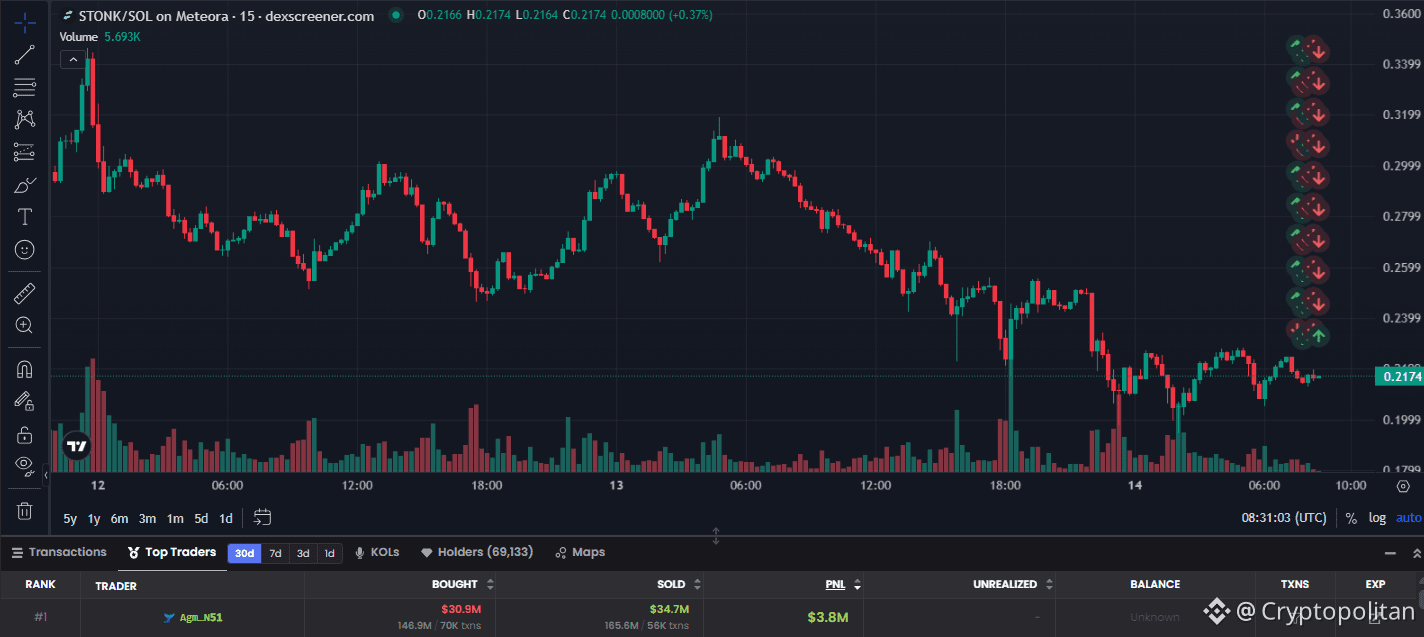
Article
STONK crashes 26% as Robinhood, BNB Chain market competition heats upSTONK, the native token of the StonkFun platform, erased 26% of its price, just a day after reaching new record prices above $0.30. STONK is the main tool for distributing the earnings of StonkFun, and tracks the performance of the reflection tokens trend.
STONK crashed to $0.22 on Monday, erasing over 26% of its price during the Asian trading session. The asset bounced from local lows of $0.20, but raised the question of whether the StonkFun rising trend is sustainable.
STONK erased over 26% of its value in the past day, just after peaking above $0.30. | Source: Coingecko
STONK is also a revenue-sharing token, using the fees from StonkFun for regular burns. As of September 14, around 15% of the token’s supply was burned.
The value of STONK also hinges on the activity of the StonkFun platform and the presence of highly appealing ‘runners’ among the newly launched reflection tokens. Around 60% of the StonkFun revenue is used to buy STONK on the open market and burn the tokens, while the rest is retained for the platform.
As Cryptopolitan reported, the reflection token trend expanded in September, mostly centering on the Solana ecosystem.
Why is STONK vulnerable?
Most of the STONK volumes are concentrated on Meteora, carrying over 41% of all volumes. The largest liquidity pair has only $2.8M in available liquidity, meaning STONK is vulnerable to slippage.
STONK is barely traded on perpetual futures markets and is a relatively new asset, potentially expecting highly volatile moves.
While STONK encourages trading to share in the revenues of the platform, early buyers and whales have also become the source of trading pressure. The leading STONK trader had a net $3.8M in earnings, selling $30M of the token. The trader also bought back STONK close to the recent local lows.
STONK faced selling pressure from whales, though top traders also bought the dip. | Source: DEX Screener
Additional selling pressure has also come from influencers, who have realized profits of up to $78,000.
STONK has relatively small connected wallet clusters, according to Bubblemaps data. Despite this, the token may face ongoing pressure from early buyers and remain volatile as it is still in a period of price discovery.
StonkFun tokens remain high-risk
The biggest appeal of StonkFun is the potential for short-term gains from the top runner tokens. The other major attraction is the incentive to hold and receive dividends, as well as ownership of reflected assets.
As of September 14, ZCAT is still the most notable token on StonkFun, reflecting ZCash (ZEC). ZCAT also rose ahead of the market on mentions from influencer Ansem.
The other high-profile StonkFun tokens started to slide alongside STONK, erasing over 30% of their value in the past day.
For StonkFun assets, the tradeoff is between high promised passive income and the potential for losses of over 50% happening within hours.
Other sources of losses are the accelerating ‘vampire attacks’ and competitor platforms. Some of the Solana traffic and liquidity may also shift to Robinhood. PumpFun also tried to introduce reflection token mechanics, taking some of the traffic from StonkFun.
Despite the recent setbacks, StonkFun even flipped Robinhood in weekly revenues, with $7.39M in the past week. The reflection token model has shifted the meme trading mechanism, introducing demand for some form of rewards attached to tokens.
The model may be here to stay, but platform wars for reflection tokens are just starting out. Recently, BNB Chain added reflection tokens to its meme platform, FourMeme, starting out stock-based tokens with 4Stock.
Reflection tokens as of September 2026 mostly rely on existing infrastructure on Solana for their rewards. Most of the stock ownership comes from partnerships with XStocks, the leading tokenization platform on Solana.
Don’t just read crypto news. Understand it. Subscribe to our newsletter. It's free.
STONK crashes 26% as Robinhood, BNB Chain market competition heats up
STONK, the native token of the StonkFun platform, erased 26% of its price, just a day after reaching new record prices above $0.30. STONK is the main tool for distributing the earnings of StonkFun, and tracks the performance of the reflection tokens trend.
STONK crashed to $0.22 on Monday, erasing over 26% of its price during the Asian trading session. The asset bounced from local lows of $0.20, but raised the question of whether the StonkFun rising trend is sustainable.
STONK erased over 26% of its value in the past day, just after peaking above $0.30. | Source: Coingecko
STONK is also a revenue-sharing token, using the fees from StonkFun for regular burns. As of September 14, around 15% of the token’s supply was burned.
The value of STONK also hinges on the activity of the StonkFun platform and the presence of highly appealing ‘runners’ among the newly launched reflection tokens. Around 60% of the StonkFun revenue is used to buy STONK on the open market and burn the tokens, while the rest is retained for the platform.
As Cryptopolitan reported, the reflection token trend expanded in September, mostly centering on the Solana ecosystem.
Why is STONK vulnerable?
Most of the STONK volumes are concentrated on Meteora, carrying over 41% of all volumes. The largest liquidity pair has only $2.8M in available liquidity, meaning STONK is vulnerable to slippage.
STONK is barely traded on perpetual futures markets and is a relatively new asset, potentially expecting highly volatile moves.
While STONK encourages trading to share in the revenues of the platform, early buyers and whales have also become the source of trading pressure. The leading STONK trader had a net $3.8M in earnings, selling $30M of the token. The trader also bought back STONK close to the recent local lows.
STONK faced selling pressure from whales, though top traders also bought the dip. | Source: DEX Screener
Additional selling pressure has also come from influencers, who have realized profits of up to $78,000.
STONK has relatively small connected wallet clusters, according to Bubblemaps data. Despite this, the token may face ongoing pressure from early buyers and remain volatile as it is still in a period of price discovery.
StonkFun tokens remain high-risk
The biggest appeal of StonkFun is the potential for short-term gains from the top runner tokens. The other major attraction is the incentive to hold and receive dividends, as well as ownership of reflected assets.
As of September 14, ZCAT is still the most notable token on StonkFun, reflecting ZCash (ZEC). ZCAT also rose ahead of the market on mentions from influencer Ansem.
The other high-profile StonkFun tokens started to slide alongside STONK, erasing over 30% of their value in the past day.
For StonkFun assets, the tradeoff is between high promised passive income and the potential for losses of over 50% happening within hours.
Other sources of losses are the accelerating ‘vampire attacks’ and competitor platforms. Some of the Solana traffic and liquidity may also shift to Robinhood. PumpFun also tried to introduce reflection token mechanics, taking some of the traffic from StonkFun.
Despite the recent setbacks, StonkFun even flipped Robinhood in weekly revenues, with $7.39M in the past week. The reflection token model has shifted the meme trading mechanism, introducing demand for some form of rewards attached to tokens.
The model may be here to stay, but platform wars for reflection tokens are just starting out. Recently, BNB Chain added reflection tokens to its meme platform, FourMeme, starting out stock-based tokens with 4Stock.
Reflection tokens as of September 2026 mostly rely on existing infrastructure on Solana for their rewards. Most of the stock ownership comes from partnerships with XStocks, the leading tokenization platform on Solana.
Don’t just read crypto news. Understand it. Subscribe to our newsletter. It's free.
STONK crashed to $0.22 on Monday, erasing over 26% of its price during the Asian trading session. The asset bounced from local lows of $0.20, but raised the question of whether the StonkFun rising trend is sustainable.
STONK erased over 26% of its value in the past day, just after peaking above $0.30. | Source: Coingecko
STONK is also a revenue-sharing token, using the fees from StonkFun for regular burns. As of September 14, around 15% of the token’s supply was burned.
The value of STONK also hinges on the activity of the StonkFun platform and the presence of highly appealing ‘runners’ among the newly launched reflection tokens. Around 60% of the StonkFun revenue is used to buy STONK on the open market and burn the tokens, while the rest is retained for the platform.
As Cryptopolitan reported, the reflection token trend expanded in September, mostly centering on the Solana ecosystem.
Why is STONK vulnerable?
Most of the STONK volumes are concentrated on Meteora, carrying over 41% of all volumes. The largest liquidity pair has only $2.8M in available liquidity, meaning STONK is vulnerable to slippage.
STONK is barely traded on perpetual futures markets and is a relatively new asset, potentially expecting highly volatile moves.
While STONK encourages trading to share in the revenues of the platform, early buyers and whales have also become the source of trading pressure. The leading STONK trader had a net $3.8M in earnings, selling $30M of the token. The trader also bought back STONK close to the recent local lows.
STONK faced selling pressure from whales, though top traders also bought the dip. | Source: DEX Screener
Additional selling pressure has also come from influencers, who have realized profits of up to $78,000.
STONK has relatively small connected wallet clusters, according to Bubblemaps data. Despite this, the token may face ongoing pressure from early buyers and remain volatile as it is still in a period of price discovery.
StonkFun tokens remain high-risk
The biggest appeal of StonkFun is the potential for short-term gains from the top runner tokens. The other major attraction is the incentive to hold and receive dividends, as well as ownership of reflected assets.
As of September 14, ZCAT is still the most notable token on StonkFun, reflecting ZCash (ZEC). ZCAT also rose ahead of the market on mentions from influencer Ansem.
The other high-profile StonkFun tokens started to slide alongside STONK, erasing over 30% of their value in the past day.
For StonkFun assets, the tradeoff is between high promised passive income and the potential for losses of over 50% happening within hours.
Other sources of losses are the accelerating ‘vampire attacks’ and competitor platforms. Some of the Solana traffic and liquidity may also shift to Robinhood. PumpFun also tried to introduce reflection token mechanics, taking some of the traffic from StonkFun.
Despite the recent setbacks, StonkFun even flipped Robinhood in weekly revenues, with $7.39M in the past week. The reflection token model has shifted the meme trading mechanism, introducing demand for some form of rewards attached to tokens.
The model may be here to stay, but platform wars for reflection tokens are just starting out. Recently, BNB Chain added reflection tokens to its meme platform, FourMeme, starting out stock-based tokens with 4Stock.
Reflection tokens as of September 2026 mostly rely on existing infrastructure on Solana for their rewards. Most of the stock ownership comes from partnerships with XStocks, the leading tokenization platform on Solana.
Don’t just read crypto news. Understand it. Subscribe to our newsletter. It's free.
154
Log in to explore more content
Join global crypto users on Binance Square
⚡️ Get latest and useful information about crypto.
💬 Trusted by the world’s largest crypto exchange.
👍 Discover real insights from verified creators.
Email / Phone number
Trending Topics
BitcoinReboundsTo$79K
13,247 views
126 Discussing
🚨 $BTC is pushing higher.
Bitcoin is trading around $78,804, up roughly 1.9%, after reclaiming the $78K area. The next level to watch is the intraday high near $78,905.
A clean break above that level could open the way toward $79K–$80K. If BTC gets rejected, support sits around $78,300, then $77,975.
Bulls have momentum, but BTC needs to hold above $78K.
#Bitcoin #BTC #CryptoTrading #CryptoMarket #CryptoAnalysis
PulseON
·13 Likes
·13k views
SouthKoreaCryptoTaxDelayPetitionTops50000
2 views
12 Discussing
SolanaTransactionV1GoesLiveOnMainnet
16 views
7 Discussing