

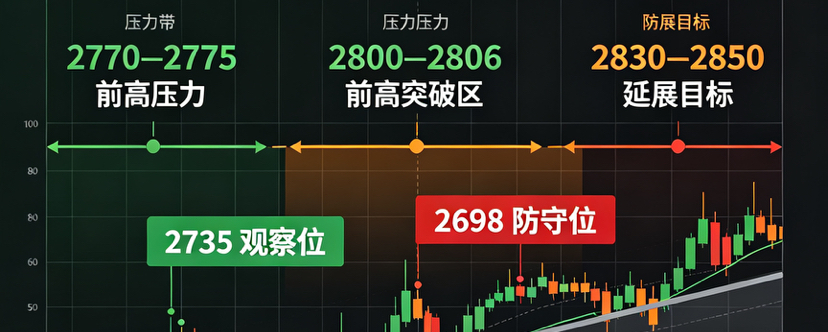

ETH is currently trading above the Bollinger middle band. The narrowing of the bands suggests that the short-term bulls and bears are moving into a balance phase, but the price has continued to hold above the middle band. The lower boundary of the range has provided support multiple times, and pullbacks have been limited, so the bullish structure remains intact. Therefore, around 2735 can be used as a bullish observation level, with a stop-loss at 2698. The first target is 2770—2775, the second target is 2800—2806, and the third target is 2830—2850. When price first touches the prior high resistance zone, it is more appropriate to reduce positions by 50% first to lock in part of the profits, then reassess whether the trend continues.
1. Bollinger Bands narrow—why isn't it a weakening signal?
ETH has been trading above the middle band of the Bollinger Band recently, with the bands clearly narrowing. Many people interpret this structure as “the direction is going to change.” But in fact, a narrowing Bollinger Band only indicates decreasing volatility—it doesn’t directly mean a trend reversal.
More important is where price stands after it narrows (consolidates).
If after the price narrows it continues running above the middle band, and the pullback lows gradually rise, it indicates that the bulls are still controlling the middle-axis cost line. In this case, the narrowing looks more like buildup after an advance—not a sign of weakening before a decline.
What you really need to be alert to is that after breaking the middle band, price keeps sliding lower, or that after breaking below the lower band, it can’t be reclaimed. As long as neither of these situations happens, you shouldn’t simply treat sideways movement as a bearish signal.
II. Resonance support at the middle band—why is 2735 worth watching?
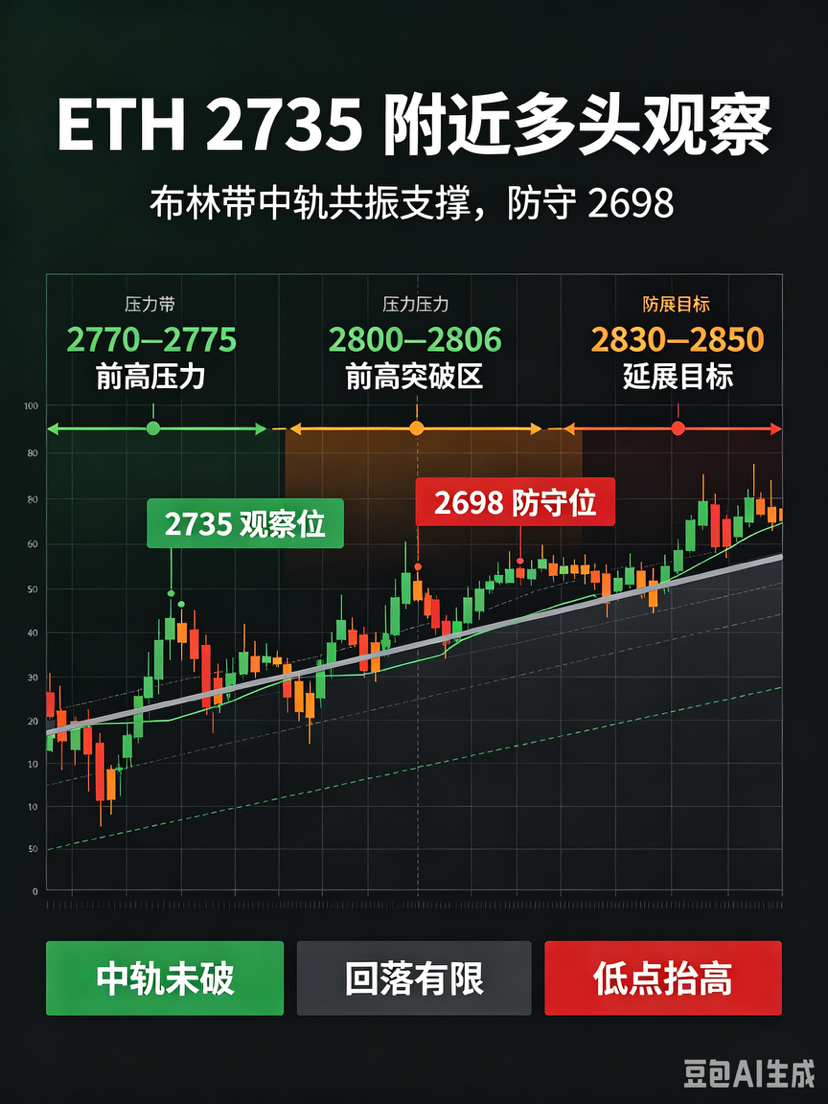
The significance near 2735 is not just a number, but the resonant support formed by the middle band of the Bollinger Band and the short-term cost zone.
After the price pulls back to this area, you usually see several favorable reactions for the bulls: first, the decline slows down; second, candles on a smaller timeframe turn bullish; third, trading volume no longer expands. This suggests that heavy selling pressure at high levels hasn’t continued to spread, and short-term buyers are willing to re-enter near the middle band.
Therefore, around 2735 can be used as a bullish observation level. But observation doesn’t mean entering immediately. More precisely: when price returns to this area, wait for the structure to stabilize before taking action.
If price quickly breaks below 2735 and fails to reclaim it, it means the middle band support has already failed; continuing to look for longs would lose its foundation.
III. Why is 2698 the key defensive level?
No matter what trend you’re tracking, you need a line of defense. ETH’s key defensive level is set at 2698.
The significance of this level is that it is the lifeline of the short-term bullish structure. If price breaks below 2698, it means the middle band support of the Bollinger Band has been lost, and the lower boundary of the prior consolidation range is also broken—then the logic behind the bulls directly fails.
So 2698 isn’t a normal reference point—it’s a “if broken, exit” condition level. As long as price runs above it, the long setup framework still holds; once there is an effective breakdown below it, you can’t explain it away as “just a pullback.”
IV. First target 2770—2775: why reduce position when it’s touched the first time?
2770—2775 is the prior high consolidation high on ETH, and it also sits close to the Bollinger Band upper-band resistance zone. When price reaches this area for the first time, it often encounters concentrated profit-taking pressure.
The reason is simple: many short-term funds enter near 2735, and their first target is the prior high resistance zone. When price touches this area for the first time, disagreement between bulls and bears expands noticeably.
So, when it first touches 2770—2775, it’s more appropriate to reduce your position by 50% first to lock in some profit. This has two benefits: first, you lock in part of the gains; second, you keep half of your position to continue observing whether the uptrend is sustained.
If you don’t reduce your position, and price quickly falls back from the resistance zone, it’s easy to give back all your unrealized profits.
V. Second target 2800—2806: why can you continue looking only after a breakout?
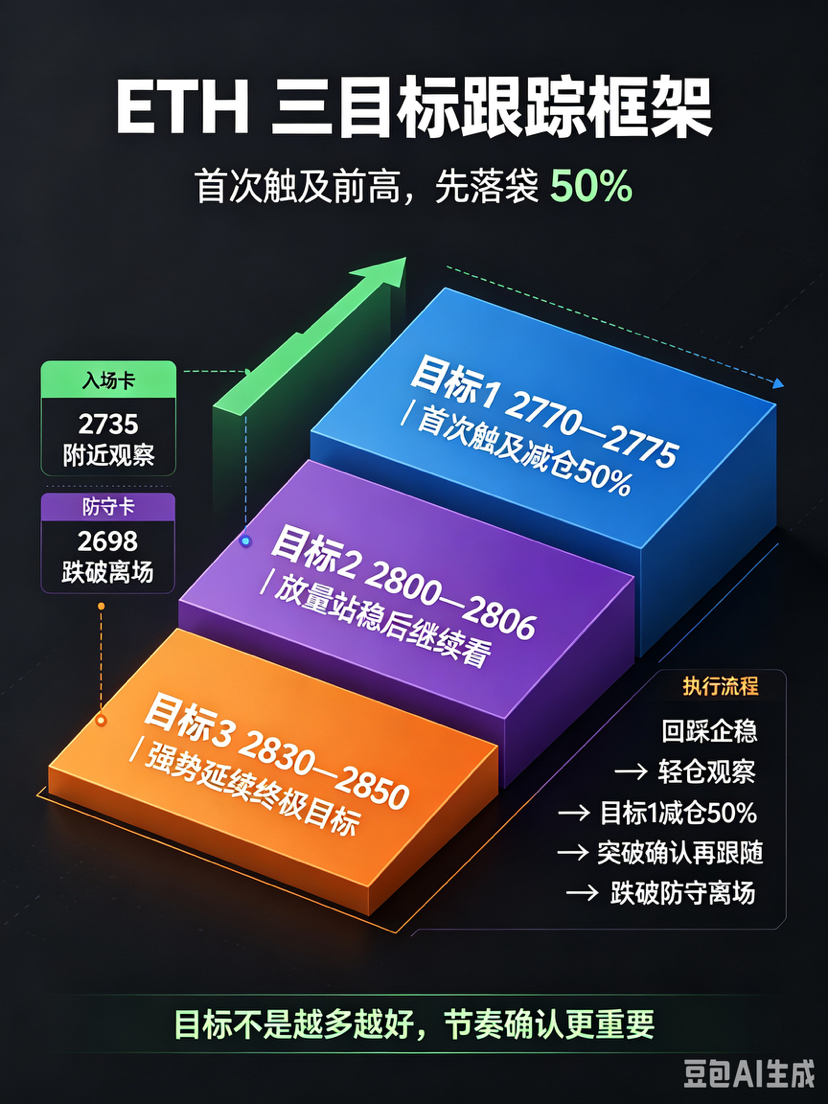
2800—2806 is a higher-level resistance zone, and around 2806.76 is a prior important high. Only if price breaks through with increased volume and holds there does it have the conditions to open up a larger space.
Here, you must clearly distinguish between “a spike through” and “holding steady.”
Often, price will quickly spike up to around 2806, but without volume confirmation and without continuous bullish candle validation, it then drops immediately. This kind of brief spike typically doesn’t count as a valid breakout.
A truly valid breakout needs three conditions: first, the closing price stands above 2806; second, trading volume clearly increases; third, after a retest, price no longer falls back below 2806.
Only when all three conditions are met at the same time does the second target 2800—2806 make sense; afterward, you can continue to look for 2830—2850.
VI. Third target 2830—2850: why can’t it be treated as an inevitable result in advance?
2830—2850 is the ultimate target for strong intraday bullish continuation, but it is not the first target, nor is it the main basis for entry.
A more reasonable order is to first look at 2770—2775, then 2800—2806, and only finally 2830—2850. If the earlier resistance zones can’t be broken effectively, then the later targets don’t matter.
Therefore, 2830—2850 can only be used as an extension target after trend confirmation; it can’t be used to justify the reasonableness of your current entry.
ETH is trading above the middle band of the Bollinger Band. After the bands narrow, the bullish structure hasn’t been broken. The area near 2735 is still worth watching as a bullish position, with defense set at 2698. First target 2770—2775, second target 2800—2806, third target 2830—2850.
More importantly than how far the target is, it’s about the timing. When first touching the prior high resistance zone, reduce your position first. After a valid breakout, continue following; if price breaks the defensive level, exit decisively.
⚠️ Risk warning: This article is for technical analysis and market observation only and does not constitute any investment advice. Trading cryptocurrencies involves extremely high risk; leveraged trading may cause rapid loss of principal—please make decisions carefully.#AI股持续上涨还有哪些投资机会 #比特币突破8.7万美元创八个月新高 #ZEC突破1600美元创新高 #纳指创历史新高 #BitwiseNEAR质押ETP资产突破1亿美元 $BTC


