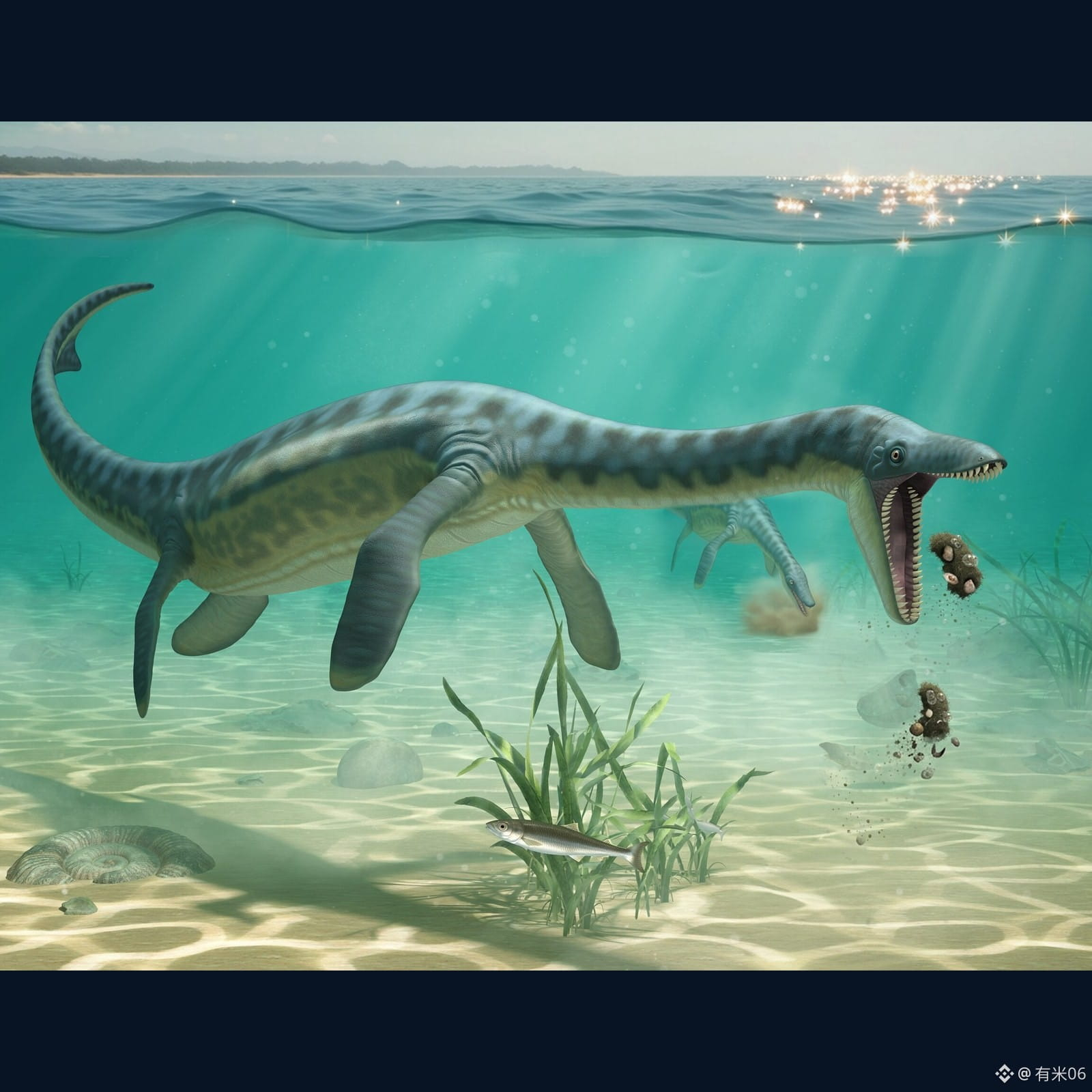
In the drill cores of the North Sea in Norway, researchers pulled up more than twenty lumps of walnut-sized “fossil vomit”—packed full of shell fragments, buried in the brackish-to-freshwater mixing zone at a Jurassic river delta estuary.
According to a new paper in the Geological Magazine (Dirk Knaust): these bivalves were originally adapted to stable salinity in open sea conditions, but delta salinity fluctuates constantly, and they couldn’t survive. A more plausible explanation is that long-necked plesiosaurs first caught the shells on the deeper seafloor, then as they swam toward the coast to rest, they regurgitated the hard shells they couldn’t digest—somewhat like today’s seals and marine crocodiles coming ashore to vomit, though the plesiosaurs were probably still in the water. The author’s biggest suspect is the elasmosaurid group, with a body length of roughly 4 to 8 meters.
Independent reporting appears in Phys.org and Popular Science (same day). The images are artistic illustrations (Lente Artemieff, AI-assisted), not on-site photographs.
#古生物 #fossil
According to a new paper in the Geological Magazine (Dirk Knaust): these bivalves were originally adapted to stable salinity in open sea conditions, but delta salinity fluctuates constantly, and they couldn’t survive. A more plausible explanation is that long-necked plesiosaurs first caught the shells on the deeper seafloor, then as they swam toward the coast to rest, they regurgitated the hard shells they couldn’t digest—somewhat like today’s seals and marine crocodiles coming ashore to vomit, though the plesiosaurs were probably still in the water. The author’s biggest suspect is the elasmosaurid group, with a body length of roughly 4 to 8 meters.
Independent reporting appears in Phys.org and Popular Science (same day). The images are artistic illustrations (Lente Artemieff, AI-assisted), not on-site photographs.
#古生物 #fossil