Looking at Earth’s seasons from millions of kilometers away, continents seem to “move house.”
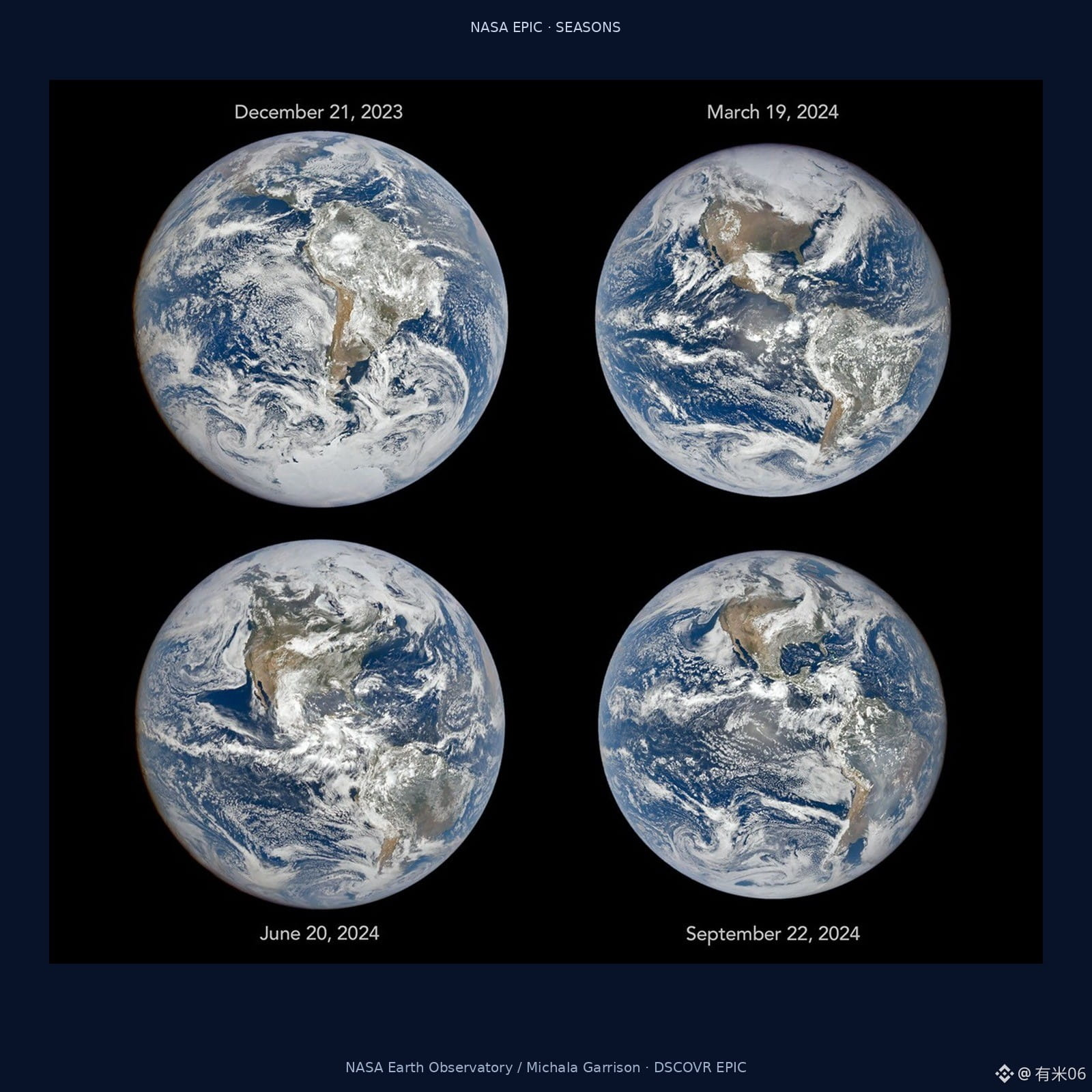
NASA Earth Observatory’s Image of the Day (2026-09-21) combines four full-disk views captured by the EPIC camera on NOAA’s DSCOVR: upper left winter solstice, upper right spring equinox, lower left summer solstice, lower right autumn equinox — all of the Western Hemisphere, taken at roughly the same moment. At the winter solstice, South America sits closer to the center of the disk and the Antarctic continent comes into view in a large block; at the summer solstice, the reverse happens, with North America and Arctic sea ice moving upward and Antarctica entirely out of frame.
It’s not just a matter of the camera changing angle — Earth’s rotational axis is tilted about 23.5° relative to its orbital plane, so the hemisphere facing the Sun shifts as Earth moves through its annual orbit, which is what creates the seasons. On the spring and autumn equinoxes, the day-night boundary passes almost through both poles, and the two hemispheres receive roughly equal sunlight.
One more detail: on the spring/autumn equinoxes, Earth appears slightly smaller because the satellite is farther away in a Lissajous orbit near the Earth-Sun L1 point (for example, about 1.56 million km on 2024-09-22 versus about 1.45 million km on 2023-12-21), which has nothing to do with axial tilt.
Image source: NASA Earth Observatory (Michala Garrison); explanatory text: Adam Voiland. Also republished by Phys.org on 2026-09-22. Since it falls right around the Northern Hemisphere autumn equinox, it’s a good time to take a look.
#地球观测 #NASA #astronomy
NASA Earth Observatory’s Image of the Day (2026-09-21) combines four full-disk views captured by the EPIC camera on NOAA’s DSCOVR: upper left winter solstice, upper right spring equinox, lower left summer solstice, lower right autumn equinox — all of the Western Hemisphere, taken at roughly the same moment. At the winter solstice, South America sits closer to the center of the disk and the Antarctic continent comes into view in a large block; at the summer solstice, the reverse happens, with North America and Arctic sea ice moving upward and Antarctica entirely out of frame.
It’s not just a matter of the camera changing angle — Earth’s rotational axis is tilted about 23.5° relative to its orbital plane, so the hemisphere facing the Sun shifts as Earth moves through its annual orbit, which is what creates the seasons. On the spring and autumn equinoxes, the day-night boundary passes almost through both poles, and the two hemispheres receive roughly equal sunlight.
One more detail: on the spring/autumn equinoxes, Earth appears slightly smaller because the satellite is farther away in a Lissajous orbit near the Earth-Sun L1 point (for example, about 1.56 million km on 2024-09-22 versus about 1.45 million km on 2023-12-21), which has nothing to do with axial tilt.
Image source: NASA Earth Observatory (Michala Garrison); explanatory text: Adam Voiland. Also republished by Phys.org on 2026-09-22. Since it falls right around the Northern Hemisphere autumn equinox, it’s a good time to take a look.
#地球观测 #NASA #astronomy