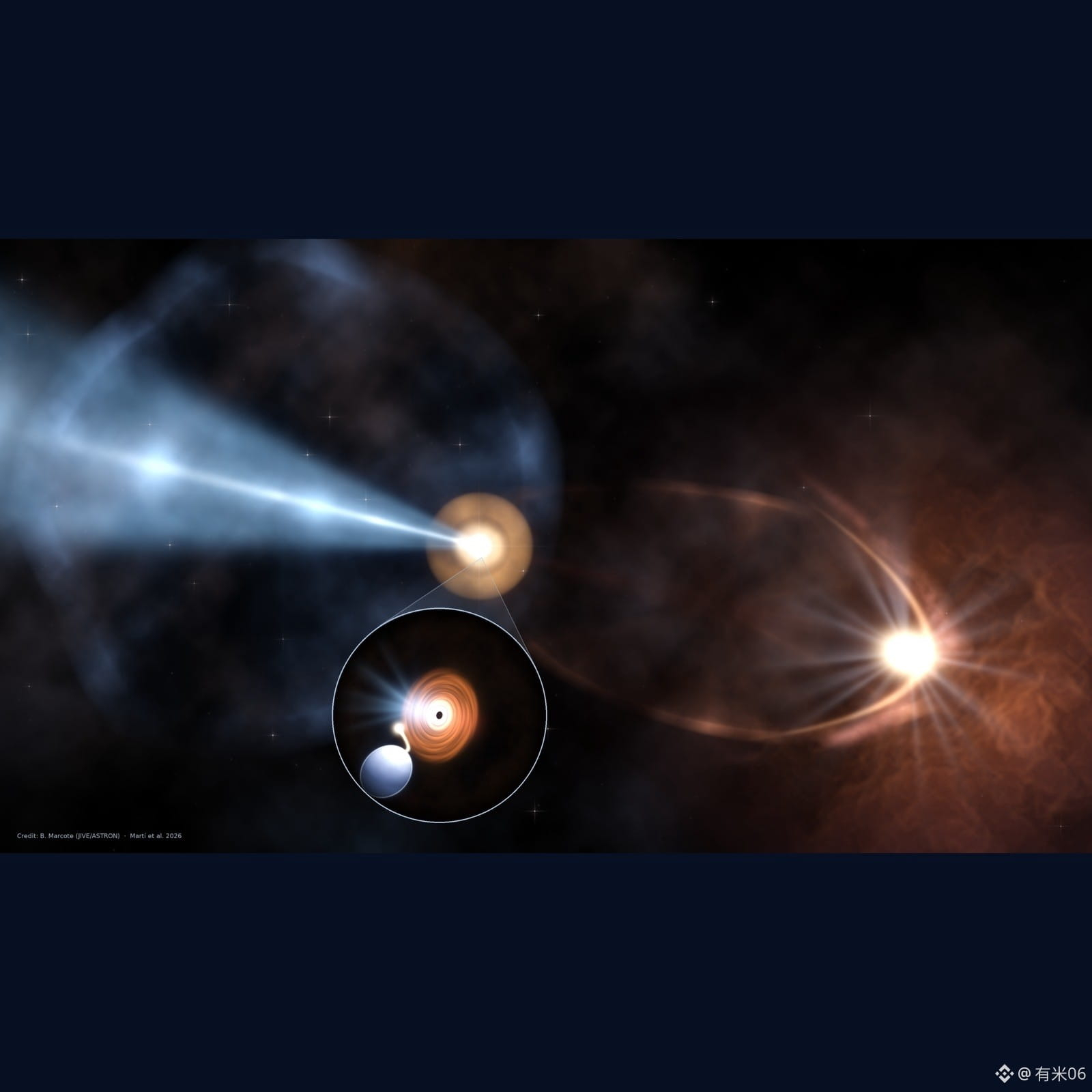
One-glance conclusion: At last, the Milky Way has a fairly solid candidate for a “micro blazar” — IRAS 18293−0941. Its black-hole jets are almost pointed at Earth; the opposite jet slams into a molecular cloud and may be accelerating particles to extremely high energies.
It’s hidden behind dust, about 12,000 light-years away. A hot, massive star and the black hole orbit each other roughly every 11.38 days. The accretion disk ejects two relativistic jets moving at about three-quarters the speed of light. The jet coming toward us is Doppler-boosted, making it look especially bright — essentially a “micro” version of a blazar (microblazar). The European VLBI Network (EVN) combined high-resolution radio images with Gaia’s star positions, confirming that the jet really belongs to this binary system, rather than merely coincidentally blocking the line of sight of some distant galaxy.
MeerKAT also sees a cavity carved out by the jet on a scale of about 100 light-years. Farther out, the jet impacts a molecular cloud and produces a hotspot, aligned with the direction of the nearby ultra-high-energy gamma-ray source LHAASO J1831−1007u*. The paper links this as a “possible particle accelerator,” not as the already-certified single explanation.
Two sources: Martí et al., Astronomy & Astrophysics (arXiv:2609.00990, 2026-09-01); South African Radio Astronomy Observatory SARAO press release (2026-09-22) with matching details. Phys.org summarized the same day.
Image: B. Marcote (JIVE/ASTRON) artistic impression (illustration, not real observation)
Data as of: SARAO 2026-09-22; arXiv 2609.00990
#天文 #black hole
It’s hidden behind dust, about 12,000 light-years away. A hot, massive star and the black hole orbit each other roughly every 11.38 days. The accretion disk ejects two relativistic jets moving at about three-quarters the speed of light. The jet coming toward us is Doppler-boosted, making it look especially bright — essentially a “micro” version of a blazar (microblazar). The European VLBI Network (EVN) combined high-resolution radio images with Gaia’s star positions, confirming that the jet really belongs to this binary system, rather than merely coincidentally blocking the line of sight of some distant galaxy.
MeerKAT also sees a cavity carved out by the jet on a scale of about 100 light-years. Farther out, the jet impacts a molecular cloud and produces a hotspot, aligned with the direction of the nearby ultra-high-energy gamma-ray source LHAASO J1831−1007u*. The paper links this as a “possible particle accelerator,” not as the already-certified single explanation.
Two sources: Martí et al., Astronomy & Astrophysics (arXiv:2609.00990, 2026-09-01); South African Radio Astronomy Observatory SARAO press release (2026-09-22) with matching details. Phys.org summarized the same day.
Image: B. Marcote (JIVE/ASTRON) artistic impression (illustration, not real observation)
Data as of: SARAO 2026-09-22; arXiv 2609.00990
#天文 #black hole