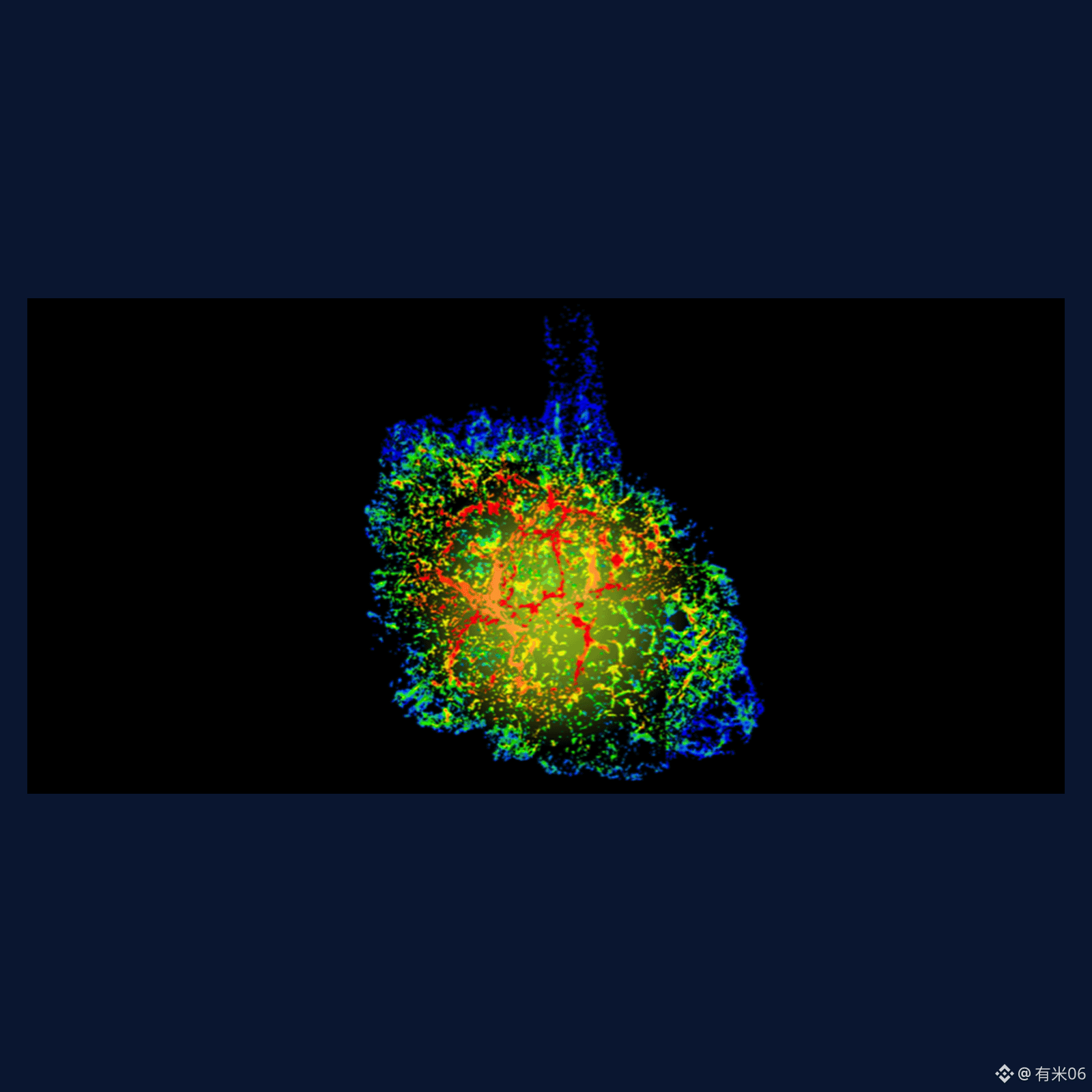
The “chimney” on the north side of the Crab Nebula—optical jets—has finally been disentangled in three dimensions.
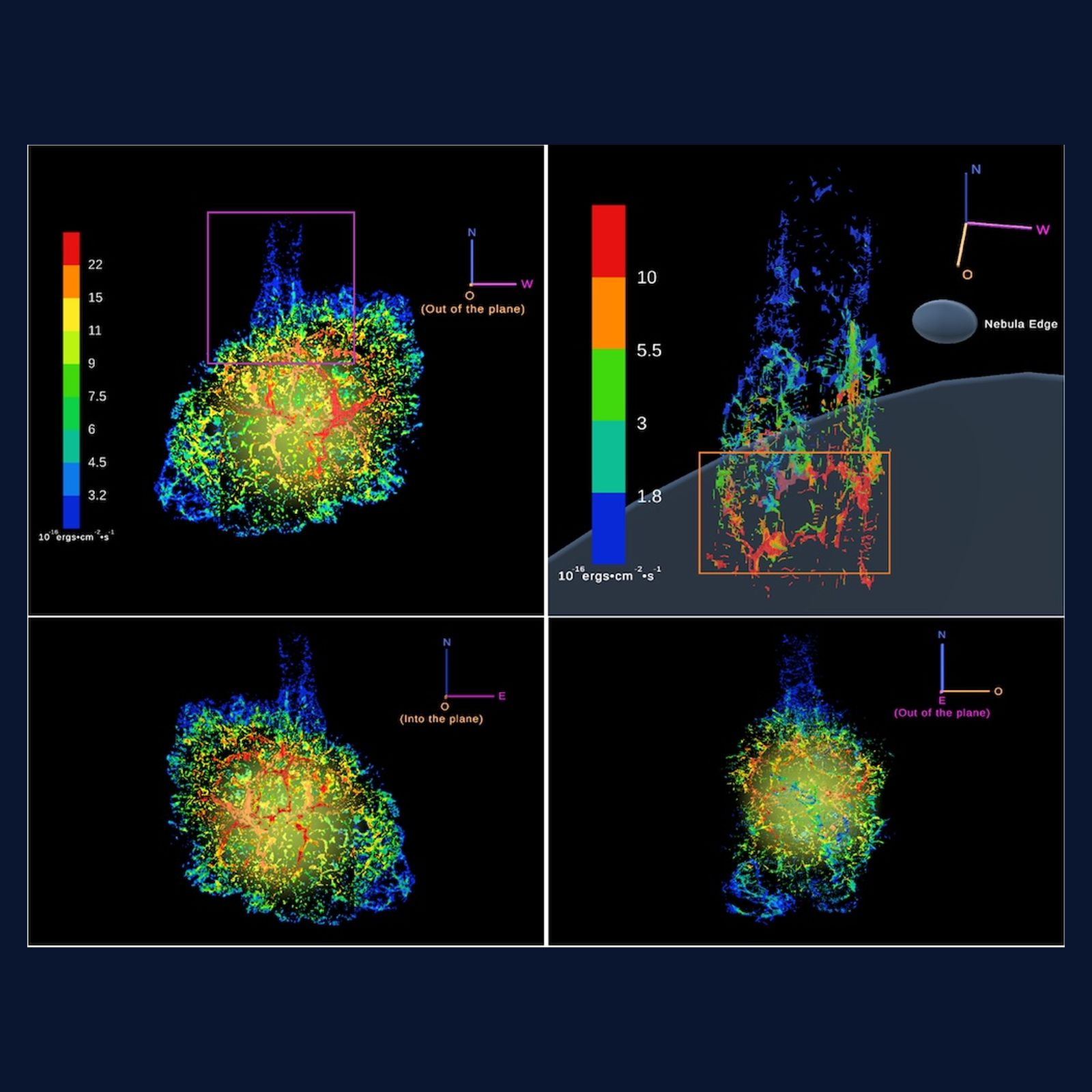
Using the SITELLE imaging Fourier transform spectrograph on the CFHT, Ding et al. of Purdue University have turned the Crab Nebula (the remnant of the 1054 supernova) into a new 3D kinematic model. The field of view covers a jet “funnel” about 45 arcseconds wide on the north side and extending about 100 arcseconds. Key point: at the base of the jet there is a ring-shaped cavity with a radius offset of roughly 0.3–0.4 arcseconds; for the first time, this cavity has been pinned down in 3D to be aligned with the jet’s same channel. The filamentary shell layer and the jet funnel are physically connected, not merely coincident in projection. The jet’s inclination relative to the sky plane is about 8°±2°, tilted westward by about 5°±2°. Both its morphology and kinematics point more strongly to early pulsar wind nebula (PWN) activity shaping the structure, rather than the explosion geometry alone calling the shots. Still, several possible causes may coexist: a north–south bipolar high-velocity ejection, a gap in the shell/low-density channel, or a low-density corridor left behind by mass loss from the progenitor; the paper notes that full 3D hydrodynamic simulations are needed to sort out which is responsible.
Source one: ApJ 1007 130 (Ding et al. 2026, doi 10.3847/1538-4357/ae84c0; CFHT/SITELLE 2020+2022 data). Source two: AAS Nova Featured Image (2026-09-21)—same-aperture retelling of the 3D reconstruction and the bottom cavity.
Figure: multi-view montage of the paper’s 3D reconstruction (AAS Nova / Ding et al.; letterbox, non-AI)
Data through: ApJ 2026; AAS Nova 2026-09-21
#天文 #supernova remnant
Using the SITELLE imaging Fourier transform spectrograph on the CFHT, Ding et al. of Purdue University have turned the Crab Nebula (the remnant of the 1054 supernova) into a new 3D kinematic model. The field of view covers a jet “funnel” about 45 arcseconds wide on the north side and extending about 100 arcseconds. Key point: at the base of the jet there is a ring-shaped cavity with a radius offset of roughly 0.3–0.4 arcseconds; for the first time, this cavity has been pinned down in 3D to be aligned with the jet’s same channel. The filamentary shell layer and the jet funnel are physically connected, not merely coincident in projection. The jet’s inclination relative to the sky plane is about 8°±2°, tilted westward by about 5°±2°. Both its morphology and kinematics point more strongly to early pulsar wind nebula (PWN) activity shaping the structure, rather than the explosion geometry alone calling the shots. Still, several possible causes may coexist: a north–south bipolar high-velocity ejection, a gap in the shell/low-density channel, or a low-density corridor left behind by mass loss from the progenitor; the paper notes that full 3D hydrodynamic simulations are needed to sort out which is responsible.
Source one: ApJ 1007 130 (Ding et al. 2026, doi 10.3847/1538-4357/ae84c0; CFHT/SITELLE 2020+2022 data). Source two: AAS Nova Featured Image (2026-09-21)—same-aperture retelling of the 3D reconstruction and the bottom cavity.
Figure: multi-view montage of the paper’s 3D reconstruction (AAS Nova / Ding et al.; letterbox, non-AI)
Data through: ApJ 2026; AAS Nova 2026-09-21
#天文 #supernova remnant