【CJ Market-Making Notes 05/14】
Impermanent loss cannot be judged by a single line like “volatility is high.” Before entering, you need to understand what happens to your position when the price reaches the edge of the range.
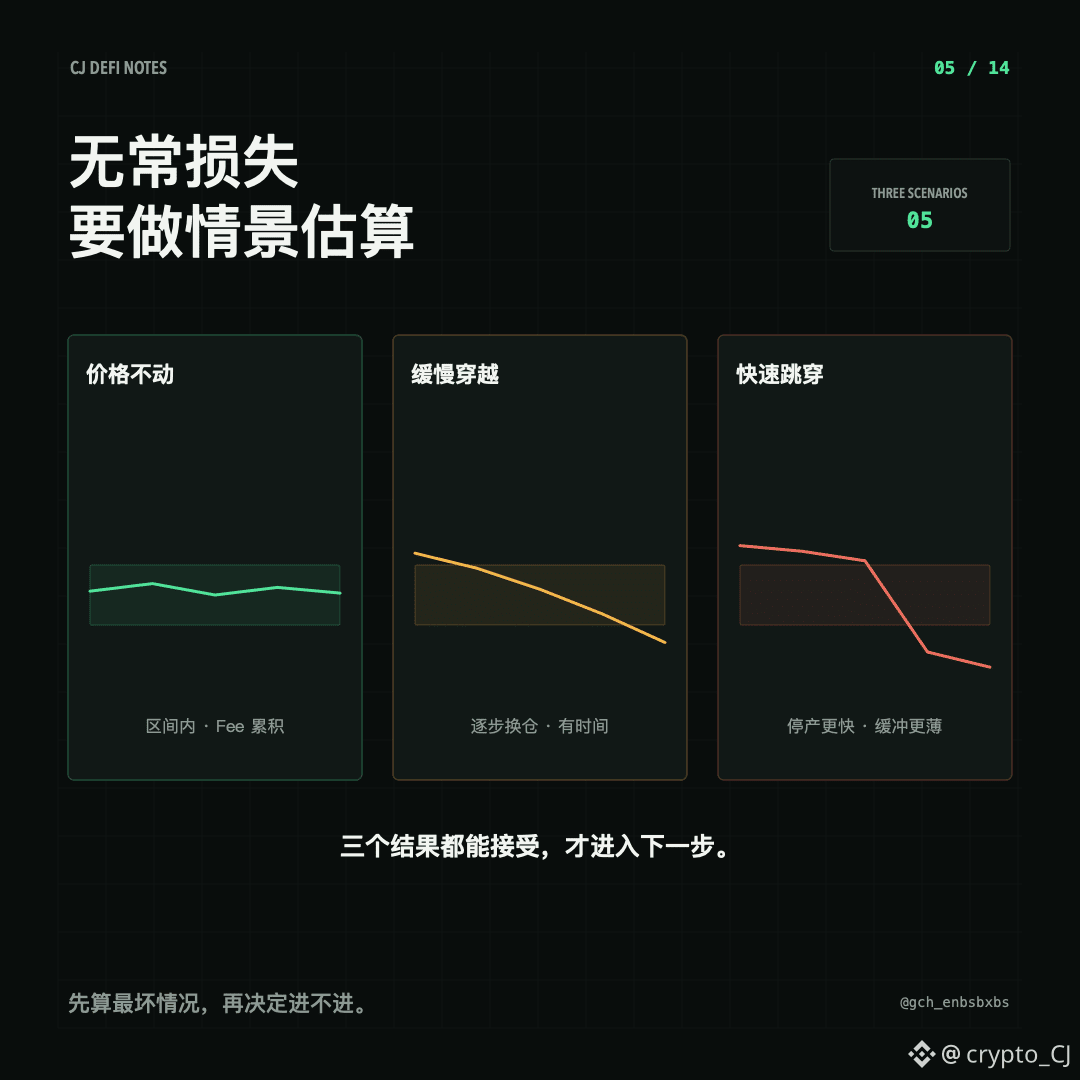
For one-sided LP, you can first do scenario estimation. If the price stays within the range, the position keeps trading continuously and generates fees. If the price gradually moves through the entire range, the capital will gradually be converted into the other asset. If the price suddenly jumps over the range, the time over which fees accumulate is shorter, and the result is usually worse. The real comparison is: how long the range is expected to hold, and how much fee you can collect during that time.
I used to do a quick rough estimate: under that one-sided setup at the time, after the range drops through by 10%, it roughly corresponds to a static loss of about 5%. This number is useful for understanding, but it’s not a universal formula that applies to every protocol, price curve, or position direction. Before placing a trade, you still need to calculate based on the specific protocol; you can’t just plug an experience-based number into any pool.
I’m mainly concerned with three scenarios: price stays flat, slowly breaks through, and quickly jumps through. All three outcomes can be acceptable—then consider entering. If you only look at the most favorable case, what you’ve calculated isn’t risk, it’s a wish.
Next post: Should the range be set narrower or wider?
#DeFi #Impermanent Loss
Impermanent loss cannot be judged by a single line like “volatility is high.” Before entering, you need to understand what happens to your position when the price reaches the edge of the range.
For one-sided LP, you can first do scenario estimation. If the price stays within the range, the position keeps trading continuously and generates fees. If the price gradually moves through the entire range, the capital will gradually be converted into the other asset. If the price suddenly jumps over the range, the time over which fees accumulate is shorter, and the result is usually worse. The real comparison is: how long the range is expected to hold, and how much fee you can collect during that time.
I used to do a quick rough estimate: under that one-sided setup at the time, after the range drops through by 10%, it roughly corresponds to a static loss of about 5%. This number is useful for understanding, but it’s not a universal formula that applies to every protocol, price curve, or position direction. Before placing a trade, you still need to calculate based on the specific protocol; you can’t just plug an experience-based number into any pool.
I’m mainly concerned with three scenarios: price stays flat, slowly breaks through, and quickly jumps through. All three outcomes can be acceptable—then consider entering. If you only look at the most favorable case, what you’ve calculated isn’t risk, it’s a wish.
Next post: Should the range be set narrower or wider?
#DeFi #Impermanent Loss