
I took a look at this year's AI stock data and would like to share my genuine thoughts.
Jensen Huang said that in 2027, chip sales will likely double, and then Anthropic's Amodei said that AI needs to slow down.
Both things happened at the same time, and the stock prices went up.
This suggests the market currently trusts Jensen more than Amodei.
I think this judgment is correct in the short term, but doubtful in the long run.
The reason is simple: Dell's Q2 earnings show a backlog of AI server orders totaling $95 billion. Old-guard money like New York Life, which manages $807 billion, moved bond funds onto Avalanche. And Nvidia turned GPUs into financial assets to get Wall Street to finance them—these are all actions with real money behind them, not just narratives.
Demand is real, and we haven't seen evidence of any slowdown yet.
But there is one thing that makes me stay cautious:
Spending on AI infrastructure is getting bigger, but there are still very few companies that are actually making money from using AI. Compute resources are burning, so where the monetization will come from is the most important question by the end of this year.
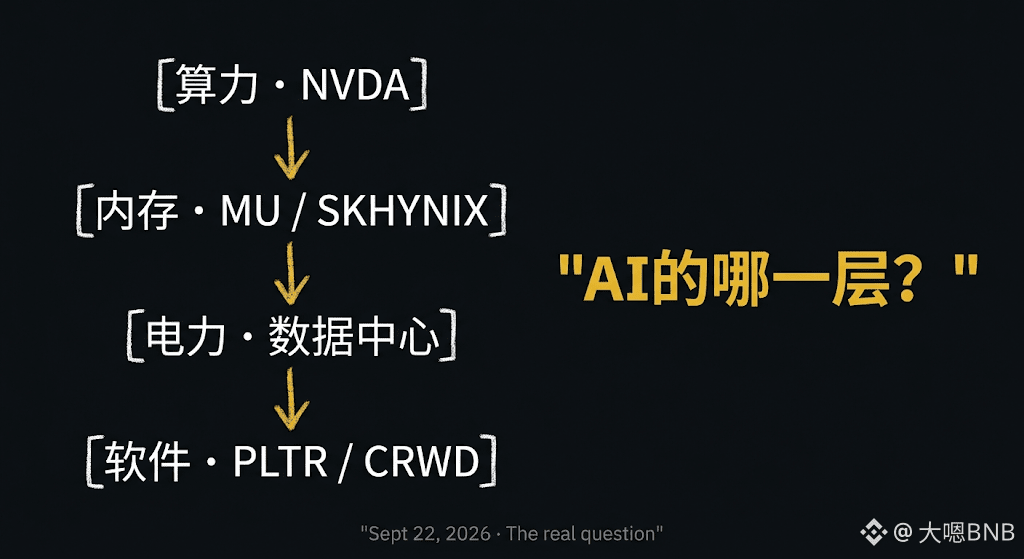
So my position is allocated like this—not just betting on Nvidia, but following the chain of "who is paying for AI infrastructure" downward: memory (SK hynix, Micron, and SanDisk), power and cooling (who supplies electricity to data centers), and software companies that are truly using AI to create revenue (Palantir, CrowdStrike).
The story for pure hardware is already very expensive, while the pricing in the software and application layers hasn't fully reflected AI penetration.
Is this AI-stock rally a strong counterattack or a short-term rebound? I think you're asking the wrong question.
The real question is: which layer of AI are you investing in?
$NVDAB
$MUB
#ai股持续上涨还有哪些投资机会
Jensen Huang said that in 2027, chip sales will likely double, and then Anthropic's Amodei said that AI needs to slow down.
Both things happened at the same time, and the stock prices went up.
This suggests the market currently trusts Jensen more than Amodei.
I think this judgment is correct in the short term, but doubtful in the long run.
The reason is simple: Dell's Q2 earnings show a backlog of AI server orders totaling $95 billion. Old-guard money like New York Life, which manages $807 billion, moved bond funds onto Avalanche. And Nvidia turned GPUs into financial assets to get Wall Street to finance them—these are all actions with real money behind them, not just narratives.
Demand is real, and we haven't seen evidence of any slowdown yet.
But there is one thing that makes me stay cautious:
Spending on AI infrastructure is getting bigger, but there are still very few companies that are actually making money from using AI. Compute resources are burning, so where the monetization will come from is the most important question by the end of this year.
So my position is allocated like this—not just betting on Nvidia, but following the chain of "who is paying for AI infrastructure" downward: memory (SK hynix, Micron, and SanDisk), power and cooling (who supplies electricity to data centers), and software companies that are truly using AI to create revenue (Palantir, CrowdStrike).
The story for pure hardware is already very expensive, while the pricing in the software and application layers hasn't fully reflected AI penetration.
Is this AI-stock rally a strong counterattack or a short-term rebound? I think you're asking the wrong question.
The real question is: which layer of AI are you investing in?
$NVDAB
$MUB
#ai股持续上涨还有哪些投资机会