

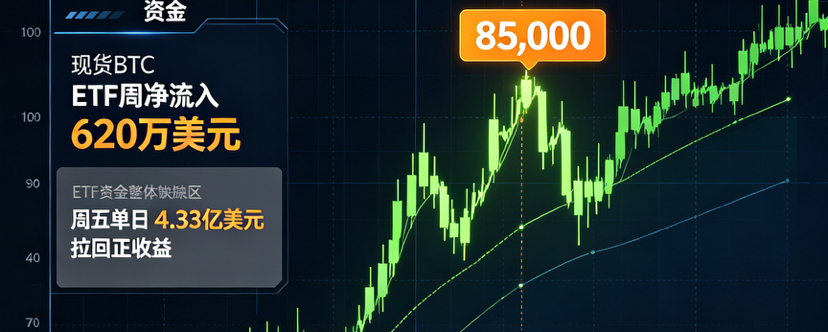

BTC touches 85,000 and sets an eight-month high, but this rally shows clear divergence: spot BTC ETF net inflows for the entire week total only $6.2 million. This is the quietest week since ETFs were launched. The week’s price action barely managed to turn positive because a single day on Friday accounted for inflows of $433 million. Judging by the fund structure, the main force pushing prices higher isn’t traditional ETF institutions buying; instead, it’s leverage capital like that from firms such as Strategy, which continuously accumulates coins and releases leverage via on-chain native collateralized lending, combined with policy expectations tied to U.S. legislation related to Bitcoin reserves. The key watershed for the next phase of the market is concentrated in the ETF fund flows over the next two trading days: if capital remains sluggish and prices hold steady above 85,000, it indicates that spot demand has sufficient “quality” and is solid. If funds dry up while prices quickly fall back below 83,000, then the large inflow on Friday was very likely just a month-end rebalancing spike, and the sustainability of the rally will be questionable.
I. New price highs, yet ETF capital is almost “silent”
Measured from the FOMC meeting low of 75,350, this round’s BTC rebound is up nearly 9% on the week. On September 21 it successfully broke through the 85,000 integer level to set a new high in eight months. Market sentiment warmed up quickly, and many views directly attributed this surge to Wall Street’s ETF inflows. But if you break down the weekly fund-flow data, the conclusion is completely different.
This week, the total net inflow into spot BTC ETFs was only about $6.2 million. Put against BTC’s massive daily transaction value, that amount is almost negligible. For most of the week, funds were even in net outflow. Yet the weekly data turned positive entirely because of Friday’s single-day concentrated inflow of $433 million acting as a backstop.
In previous rounds of big rallies, ETFs were often the core source of persistent buy-side demand—continual new capital would support the price and lift the floor. But this time, during the push to new highs, the ETF overall has been absent. This leads to a key question: if ETFs did not enter in bulk, who actually bought to push 85,000 to a new high?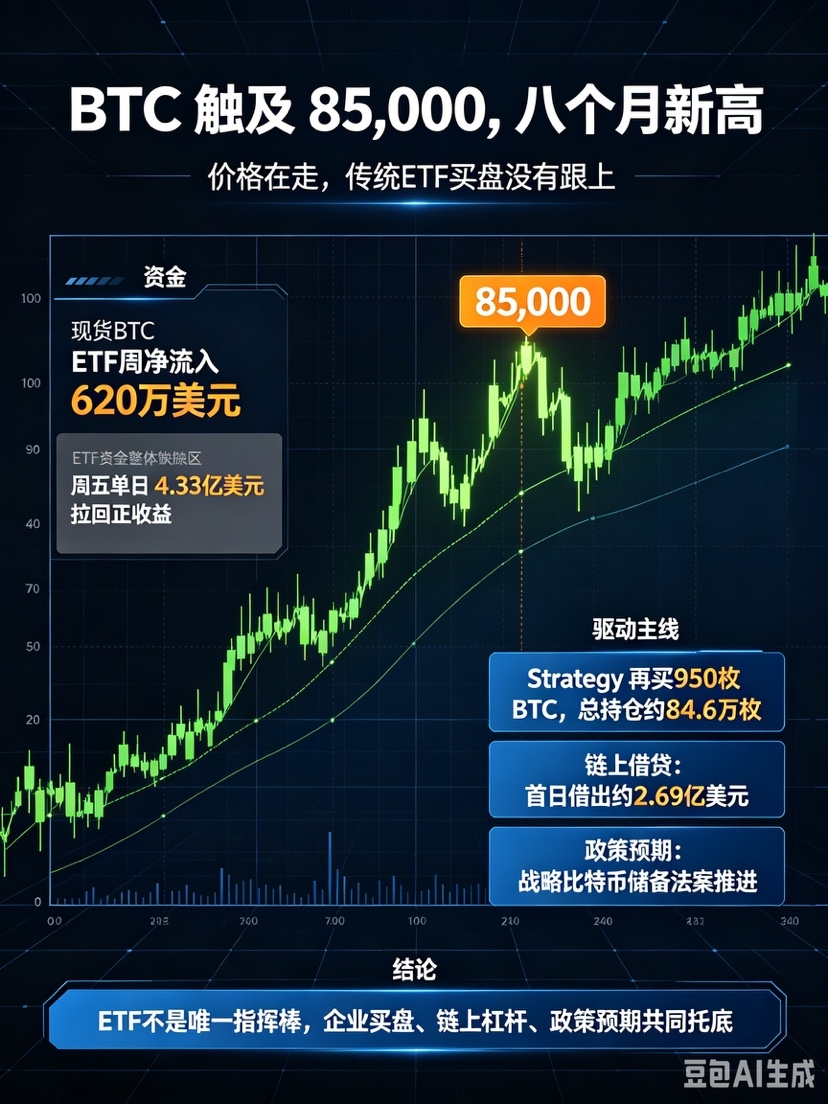
II and III are the two main funding lines supporting the rally without any ETF boost this round
By stringing together a few key recent events, you can see the capital map behind the tape.
First is Strategy’s ongoing accumulation. On September 21, disclosed filings showed the company bought another 950 BTC for $75.7 million, bringing its total holdings to about 846,000 BTC. As the largest corporate-level Bitcoin holder in terms of size, its purchases are not part of the ETF retail-fund ecosystem or traditional asset managers’ capital system. They are independent corporate reserve allocation funds—funds that do not move with day-to-day ETF fund-flow fluctuations. They are a medium-to-long-term buy-side base. This type of buying won’t frequently enter and exit due to short-term price up and down, and it provides stable downside support for high-level market structure.
Second is the incremental leverage created by on-chain native lending. Hyperliquid launched a native lending layer that uses BTC and HYPE as collateral. On the first day, the lending amount already reached $269 million. Collateralized borrowing means the existing stock of Bitcoin gets activated: holders can borrow stablecoins against the BTC they already have, then redeploy those stablecoins into the market, creating endogenous leverage. This capital is generated within the crypto ecosystem itself and does not go through ETF channels—so it is an incremental source that is easy to overlook in this cycle.
Third is an emotional boost from policy expectations. On September 16, the U.S. House committee voted 28 to 21 to formally write into legislation the strategic Bitcoin reserve executive order proposed by Trump. With the law’s passage expected, it raises the market’s long-term imagination about the U.S. government allocating Bitcoin at an official level, attracting some speculative capital to position early and amplifying the rebound’s elasticity.
Together, these three form the core driving force of this round of rally: companies hoard spot as the base, on-chain lending provides leverage, policy expectations ignite sentiment, while traditional ETF institutions surprisingly do not follow through with large-scale buying.
III. Friday: $433 million inflow—two completely different interpretations
That big $433 million inflow on Friday is the most crucial variable for the week’s market action. Its nature directly determines how far the rally can go. Right now, the market is split into two completely opposite interpretations.
First interpretation: this is end-of-month capital rebalancing. Many large asset-management institutions passively rebalance their holdings at month-end or quarter-end according to target asset allocation, temporarily buying Bitcoin to complete the portfolio rebalance. This kind of buying is passive and not driven by a desire to keep adding. It usually lasts only for a single day; by the following week the funds can quickly drop to zero or even flip back to outflows. If that is the case, this is a one-off pulse of capital and lacks continuity. With no buy-side follow-through, it becomes difficult to keep prices stable at high levels due to the lack of sustained demand.
Second interpretation: after institutions see a breakout signal, they concentrate on topping up their positions. When the price broke through the key resistance level of 85,000, it triggered many institutions’ conditions for trending entries. They entered in a concentrated manner on Friday to establish a base. If this is active adding, then over the next few trading days ETFs would keep maintaining positive inflows, with funds forming a coherent chain of buy-side demand. After setting new highs, there would still be further upside space.
These two scenarios may look like big gains in the short term, but in the medium to long term their outcomes are vastly different. To distinguish between them, you don’t need complex technical indicators—just focus on the ETF fund data for Monday and Tuesday next week.
IV. Two forward-looking observation scenarios—clearly separating the strong-versus-weak line
The next two trading days are the “quality-check period” for this round of price action, and the two scenario paths are already quite clear.
Scenario 1: ETF net inflows stay near the zero line, with no large outflows, and meanwhile BTC’s price can hold above 85,000.
This means that even without large ETF buys, the market’s own spot absorption capacity is strong enough. Long-term holding funds like Strategy, as well as on-chain existing stock funds, can already independently support the market. The spot foundation for this rally is solid. After setting new highs, the probability of consolidation with an upward bias is higher. In this kind of market, capital no longer relies on Wall Street ETFs; it’s a crypto endogenous capital-led market, and it should have stronger persistence.
Scenario 2: On Monday, ETF fund flow quickly turns negative, while price quickly falls—dropping back below 83,000.
Then it’s basically confirmed: the $433 million on Friday was the one-off end-of-month rebalancing capital—and also the final leg of this rebound. After the pulse capital exits, there is no new buy-side follow-through. High-level profit-taking will likely be realized in a concentrated way, and the market will enter a phase of pullback and digestion.
Technically, you also need to verify in parallel. 85,000 has now turned from prior resistance into the first support; 83,000 is a dense cost zone for both longs and shorts. Once it is effectively broken, the short-term long structure will be weakened. If price revisits support and then quickly reclaims it, that indicates sufficient turnover at high levels and the long structure remains intact.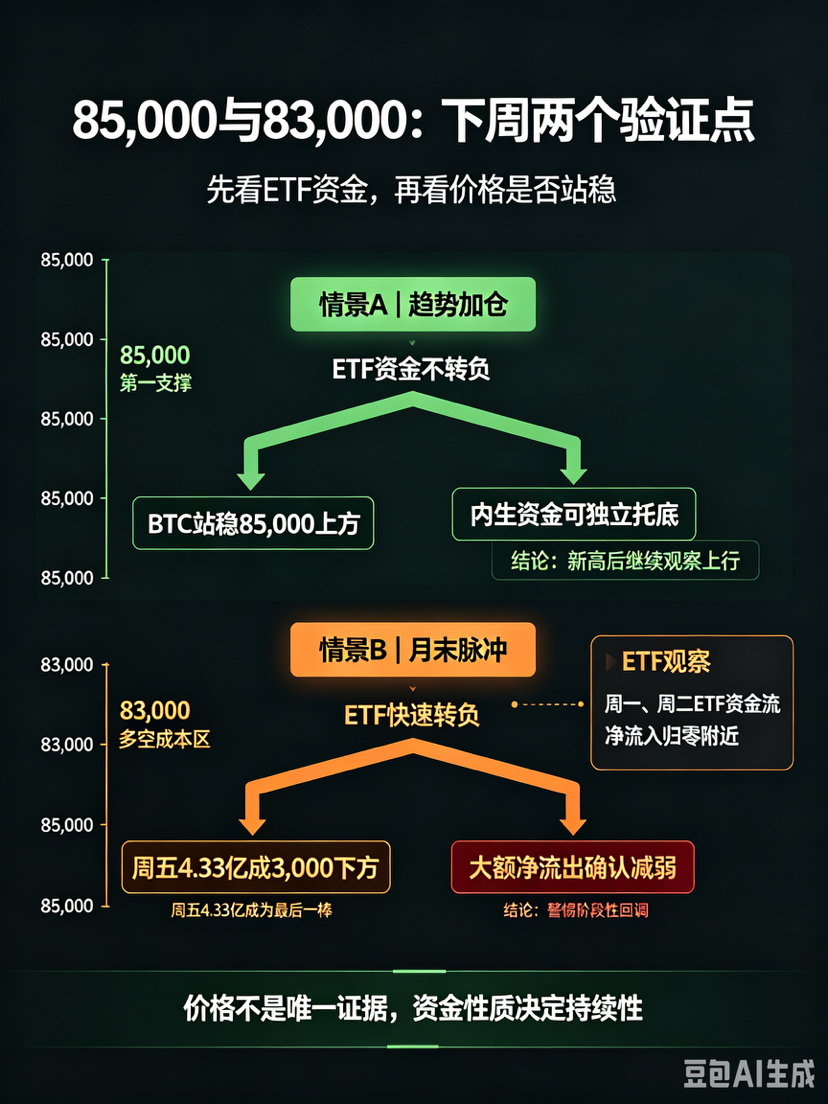
V. Market takeaways: stop treating ETFs as the only compass
The biggest lesson from this round is that the market structure is changing. In the past, when people predicted a big BTC move, their first reaction was to look at ETF inflows—treating the ETF as the compass for the trade. But now, corporate reserve allocations, on-chain collateralized borrowing, and local derivatives leverage are becoming a separate capital system independent of traditional Wall Street ETFs.
ETF capital can be absent, but the market can still make new highs. This does not mean the market will necessarily run bull. It only means the funding sources are more diversified and the reference value of any single indicator is declining. If you only watch ETF data, it’s easy to miss the rally and also easy to misjudge it.
For observers, the tracking framework going forward needs to expand: in addition to ETF flows, you should track corporate holding announcements, on-chain lending TVL, derivatives leverage size, and the progress of U.S. policy legislation—cross-validate across multiple dimensions rather than relying on a single data point for conclusions.
Behind BTC breaking above 85,000 and setting an eight-month new high is a set of very contradictory data: price is surging higher, yet ETF capital is unusually cold. Strategy’s continuous accumulation, on-chain lending releasing leverage, and policy expectations for the reserve legislation together fill the ETF buy-side gap left by their absence.
The market has already entered the validation window. In the next two trading days, ETF fund flows will be the litmus test to distinguish between a “one-off pulse” and “trend-driven accumulation.” If price holds above 85,000 and the funds do not collapse, it means the spot “foundation” is solid. If capital dries up and price breaks below 83,000, you need to be alert to the risk of a phase pullback.
The market is no longer an era where ETF capital is the sole definition of the trend. With multiple capital systems coexisting, volatility will be more complex and it will also test how patient observers are with cross-validation. #XRP上涨8% #苹果谷歌招募稳定币与代币化存款人才 #英伟达IPO前再购15亿美元SBEnergy股份 #Agora获OCC初步批准筹建国家信托银行 #NEAR一周涨近80% $BTC


