【CJ Market Making Notes 04/14】
APR is very high, and LPs may also lose money. Because APR only shows how fast fees are paid, it doesn’t tell you where the price will move with your position.
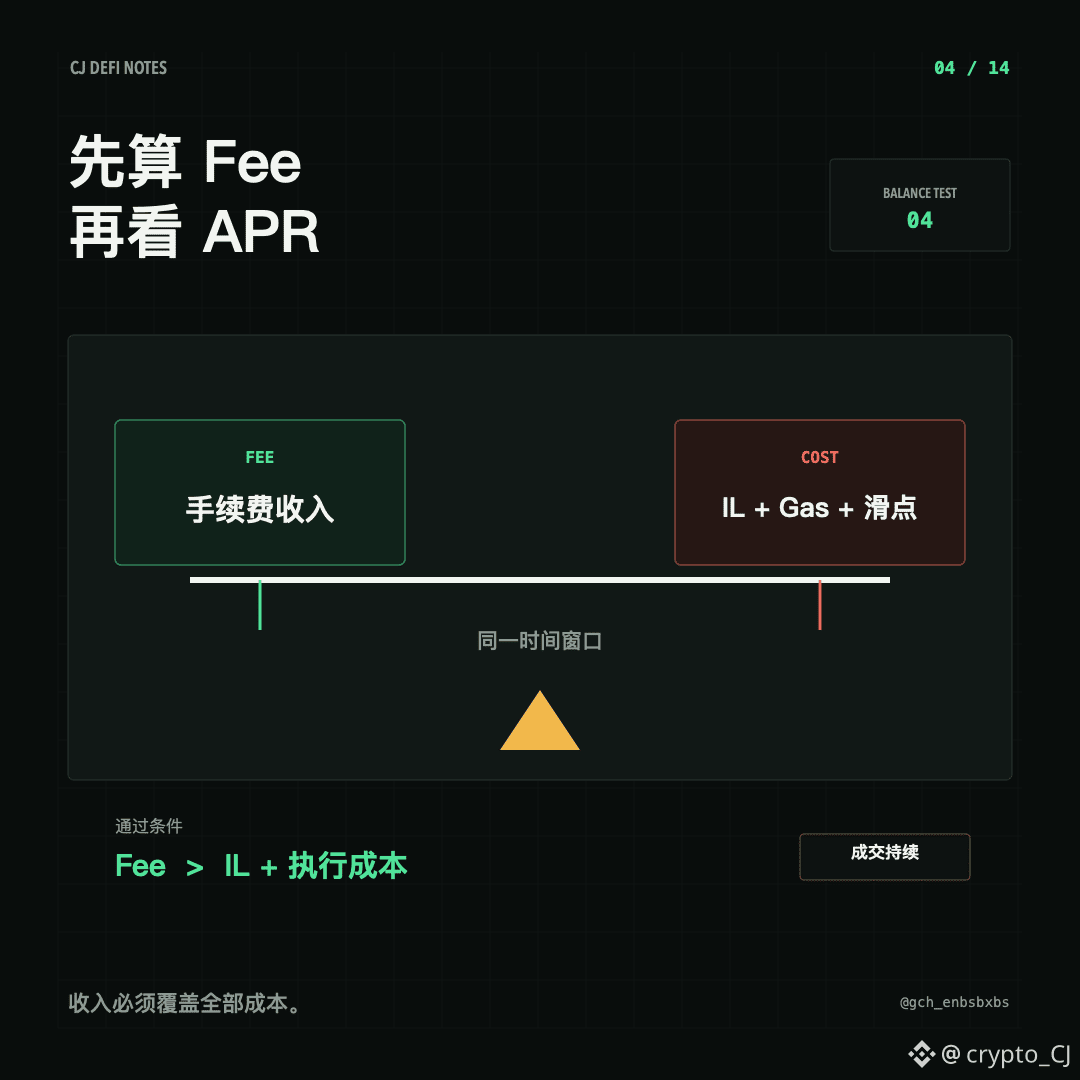
Before I become an LP, I calculate two things first: how much Fee I’m likely to receive, and how much IL (impermanent loss) the price deviation could cause. Fee is income, IL is the cost brought by changes in the position structure. Both must be compared over the same time period. A pool’s high annualization over the past day doesn’t mean the same level of trading volume will remain in the next few hours; if the price leaves the range faster, fees may not have accumulated enough, and your position may stop producing or turn into a single-sided asset.
Besides Fee and IL, you also need to factor in Gas, swap slippage, the cost of withdrawing from the pool, and the time your capital is tied up. With small positions on high-Gas chains, frequent adjustments may cause paper gains to be entirely consumed by execution costs. Larger positions, on the other hand, are constrained by order-book depth and the liquidity available when exiting.
In the end, I look at one simple question: within the holding time I expect, can conservatively estimated Fee cover IL and all execution costs? A position that only works under optimistic assumptions is something I usually don’t treat as a certain opportunity.
Next post: How to estimate impermanent loss before entering?
#DeFi #Impermanent loss
APR is very high, and LPs may also lose money. Because APR only shows how fast fees are paid, it doesn’t tell you where the price will move with your position.
Before I become an LP, I calculate two things first: how much Fee I’m likely to receive, and how much IL (impermanent loss) the price deviation could cause. Fee is income, IL is the cost brought by changes in the position structure. Both must be compared over the same time period. A pool’s high annualization over the past day doesn’t mean the same level of trading volume will remain in the next few hours; if the price leaves the range faster, fees may not have accumulated enough, and your position may stop producing or turn into a single-sided asset.
Besides Fee and IL, you also need to factor in Gas, swap slippage, the cost of withdrawing from the pool, and the time your capital is tied up. With small positions on high-Gas chains, frequent adjustments may cause paper gains to be entirely consumed by execution costs. Larger positions, on the other hand, are constrained by order-book depth and the liquidity available when exiting.
In the end, I look at one simple question: within the holding time I expect, can conservatively estimated Fee cover IL and all execution costs? A position that only works under optimistic assumptions is something I usually don’t treat as a certain opportunity.
Next post: How to estimate impermanent loss before entering?
#DeFi #Impermanent loss