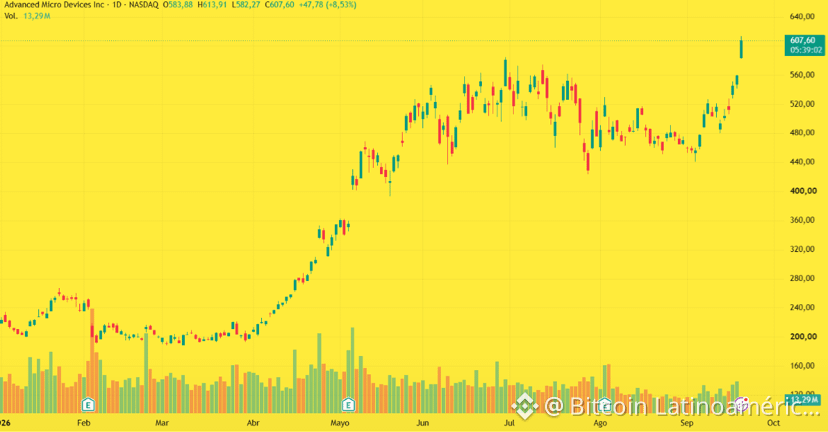
$AMD
Why do the shares of $AMD surge and print a new ATH?
The reason? It could lift the price of several of its chips by ~10% from Q4.
A supply-chain report indicates that AMD would be preparing increases close to 10% in AI accelerators, GPUs, and chipsets, after TSMC moved higher manufacturing costs.
If AMD can pass most of the cost increase to its customers without losing volume, it would be showing something Wall Street values a lot: pricing power.
Demand for compute capacity is still enormous, and when supply is constrained, higher prices don’t necessarily destroy demand. They can end up sustaining—or even expanding—revenue and margins.
The other side of the story is TSMC.
AMD relies on TSMC to manufacture a large portion of its chips. If advanced wafer costs continue to rise, semiconductor inflation could travel across the whole chain:
For now, the market seems to be interpreting the potential increase more as pricing power than as a cost problem.
Why do the shares of $AMD surge and print a new ATH?
The reason? It could lift the price of several of its chips by ~10% from Q4.
A supply-chain report indicates that AMD would be preparing increases close to 10% in AI accelerators, GPUs, and chipsets, after TSMC moved higher manufacturing costs.
If AMD can pass most of the cost increase to its customers without losing volume, it would be showing something Wall Street values a lot: pricing power.
Demand for compute capacity is still enormous, and when supply is constrained, higher prices don’t necessarily destroy demand. They can end up sustaining—or even expanding—revenue and margins.
The other side of the story is TSMC.
AMD relies on TSMC to manufacture a large portion of its chips. If advanced wafer costs continue to rise, semiconductor inflation could travel across the whole chain:
For now, the market seems to be interpreting the potential increase more as pricing power than as a cost problem.