
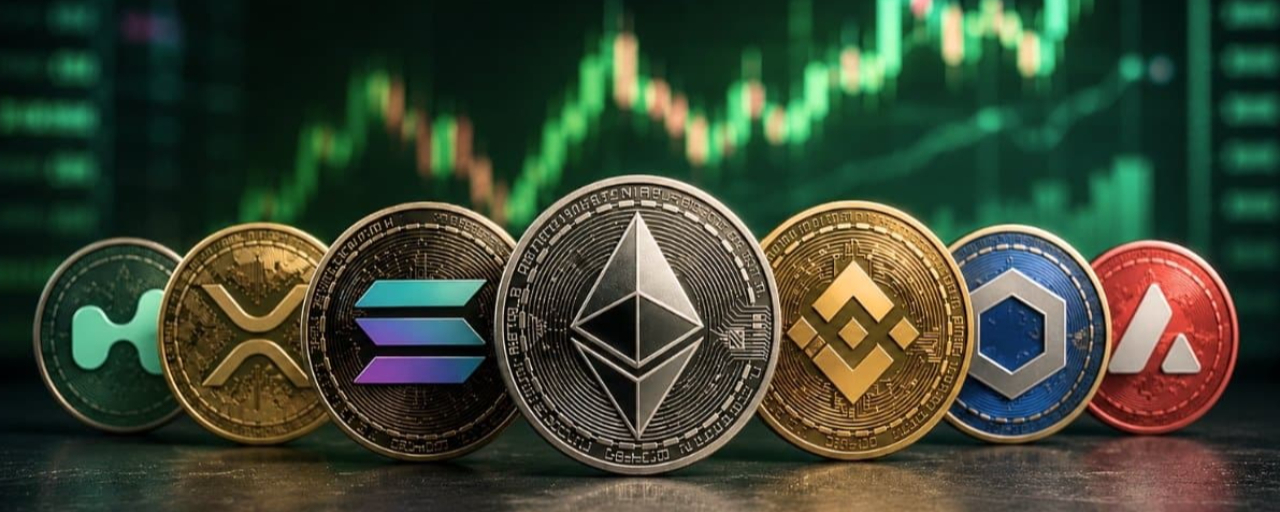
You’ve already heard of Bitcoin, but you keep seeing dozens of other names: ETH, SOL, BNB, ADA, etc.
These are altcoins. And that’s often where beginners get lost.
In this post, I’ll simply explain what an altcoin is, then I’ll give you a concrete method to choose your major altcoins without drowning in information.
What is an altcoin?
Altcoin = “alternative coin.”
Basically: any crypto that isn’t Bitcoin.
Bitcoin (BTC) = the first crypto, the most well-known.
Everything else (ETH, SOL, BNB, etc.) = altcoins.
Some altcoins are:
Platforms to build applications (e.g., Ethereum).
DeFi protocols (lending, borrowing, decentralized exchange).
Infrastructure (oracles, layer 2, storage, etc.).
More speculative projects, with little real usefulness.
To put it simply: if BTC is “digital gold,” then altcoins are all the other ideas and experiments around crypto.
Why focus on major altcoins?
Major altcoins are:
Solid projects, with real utility.
An identifiable team and track record.
A significant market cap (often in the top 50–100).
An active ecosystem (developers, partners, users).
They offer:
More performance potential than BTC in certain periods.
But also more volatility and risks.
The idea isn’t to buy 50 altcoins, but to choose a few—well understood.
5 simple criteria to choose a major altcoin
1. What is this project for?
Ask yourself this question:
“If I had to explain this project to a friend in 2 sentences, I would say what?”
Examples:
“It’s a platform for creating decentralized applications.”
“It’s a protocol that lets you lend and borrow crypto without a bank.”
“It’s a project that connects real-world data to the blockchain.”
If you can’t explain it simply, move on.
My rule: I only buy what I understand at least a little.
2. Is there real utility?
Look:
Is the project used (volume, users, TVL for DeFi, etc.)?
Does it solve a real problem?
Does it have partnerships or concrete integrations?
A good major altcoin isn’t just a “nice website” and a whitepaper.
There are people using it, developers building on top of it.
3. Who’s behind the project?
You don’t need to know everyone, but check:
Do they have an identifiable team?
Do they have a track record (previous projects, experience)?
Is it active (updates, communication, GitHub, etc.)?
Serious projects don’t hide behind complete anonymity (except in very specific cases).
4. How is the token created and distributed?
Without getting into technical details, look at this:
Total supply: how many tokens exist / will exist?
Distribution: who holds the majority of the tokens (team, investors, community)?
Future emissions: will a lot of tokens be created in the coming years (inflation)?
A token with:
A large share is held by a few wallets.
A very strong inflation is coming.
…is more risky.
Personally, I avoid projects where I can’t find this information clearly.
5. What’s the project’s position in the market?
Look:
Market cap: is it in the top 50–100?
Volume: can you buy/sell easily?
Listing: is it on reputable exchanges (Binance, etc.)?
Major altcoins have:
A significant market cap.
Steady volume.
Presence on multiple platforms.
How many major altcoins should you choose?
You don’t need a 30-line portfolio.
For most people:
3 to 8 major altcoins are enough.
It’s better to really understand 4 projects than to have 20 without truly knowing what you hold.
What I do: I keep my main portfolio fairly concentrated, and I only add a new altcoin if I take the time to study it properly.
A mini checklist before buying an altcoin.
Before clicking “Buy,” ask yourself:
I can explain in 2 sentences what this project is for.
It has real utility and users.
The team and project are identifiable and active.
The token distribution and inflation seem reasonable to me.
It’s in the top 50–100 and well listed.
I don’t put more than 10–15% of my crypto portfolio into a single altcoin.
If you check all these boxes, you’re already well above average.
And then what?
If you want, I can prepare:
A concrete example of 3–4 major altcoins analyzed with these criteria (for educational purposes).
A simple profile template to analyze an altcoin yourself in 10 minutes.
A future post about common mistakes with altcoins (and how to avoid them).
Question for you:
What’s the altcoin you know best after ETH?
And what holds you back the most when you want to choose a new one?
Write it in the comments—I’ll reply, and we can even analyze a project you have in mind together.