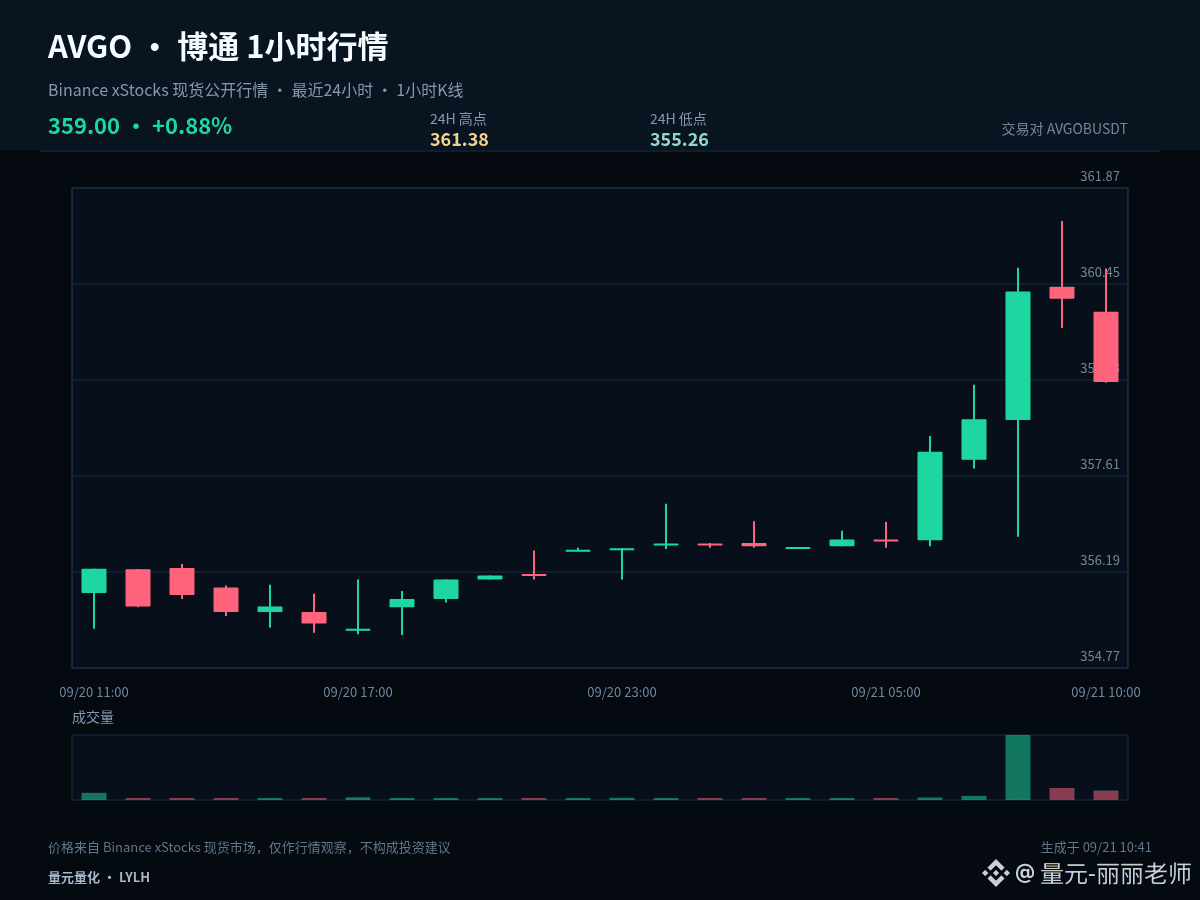
$AVGOB #AVGO Current price 359, 1 hour -0.34%, 24 hours +0.59%. Rather than choosing long or short in advance, it’s better to list the possible paths and the corresponding actions.
With the current 1-hour -0.34% and 24-hour +0.59%, the two time windows haven’t formed a sufficiently clear directional alignment. In a range-bound market, the tolerance for chasing and killing is lower; it’s more suitable to confirm direction with a breakout at the upper band and confirm support with a hold near the lower band. The midline is only used as the line dividing strength and weakness.
The first path is upward: the price needs to break above 361.38 and form a stable close above it; only then does a subsequent pullback that fails to break count as a valid confirmation. The second path is downward: once 355.26 is lost and the rebound cannot reclaim it, that indicates insufficient support/holding power—prioritize defense rather than rushing to add positions.
If the price continues to stay between 361.38 and 355.26, 358.32 is only a reference for short-term initiative. There’s no clear advantage in the middle of the range, so don’t force entries just for the sake of being involved—wait for the market to show the direction.
Existing positions can be handled in stages according to key levels to avoid making all decisions at once. Those currently in cash should wait for breakout confirmation or signs that pullbacks have stabilized. Also, for U.S. stock underlyings, pay attention to volatility caused by trading session changes. Your plan should be based on price conditions, not on emotion.
The focus of short-term positions isn’t to predict every single K-line, but to ensure there’s a basis for entries, trimming, and exits. Do less without confirmation; when key levels fail, redo the plan. Control single-trade risk first, then discuss potential upside/downside space.
#XRPExchangeReservesHitSevenYearLow
With the current 1-hour -0.34% and 24-hour +0.59%, the two time windows haven’t formed a sufficiently clear directional alignment. In a range-bound market, the tolerance for chasing and killing is lower; it’s more suitable to confirm direction with a breakout at the upper band and confirm support with a hold near the lower band. The midline is only used as the line dividing strength and weakness.
The first path is upward: the price needs to break above 361.38 and form a stable close above it; only then does a subsequent pullback that fails to break count as a valid confirmation. The second path is downward: once 355.26 is lost and the rebound cannot reclaim it, that indicates insufficient support/holding power—prioritize defense rather than rushing to add positions.
If the price continues to stay between 361.38 and 355.26, 358.32 is only a reference for short-term initiative. There’s no clear advantage in the middle of the range, so don’t force entries just for the sake of being involved—wait for the market to show the direction.
Existing positions can be handled in stages according to key levels to avoid making all decisions at once. Those currently in cash should wait for breakout confirmation or signs that pullbacks have stabilized. Also, for U.S. stock underlyings, pay attention to volatility caused by trading session changes. Your plan should be based on price conditions, not on emotion.
The focus of short-term positions isn’t to predict every single K-line, but to ensure there’s a basis for entries, trimming, and exits. Do less without confirmation; when key levels fail, redo the plan. Control single-trade risk first, then discuss potential upside/downside space.
#XRPExchangeReservesHitSevenYearLow