Instant takeaway: After about 10 years, NIST used the BIPM’s torsion balance to re-measure the gravitational constant big G, but the result still does not match the French original experiment—off by about 0.0235%.
According to NIST’s press release (2026-04-16) and the Metrologia paper (DOI 10.1088/1681-7575/ae570f): the team measured G ≈ 6.67387×10⁻¹¹ m³·kg⁻¹·s⁻², which is lower than the BIPM 2007 result by about 235 parts per million. To prevent “expectation-value” bias in the analysis, they blinded the key calibration-mass data and hid the correction values in sealed envelopes; the envelopes were opened only in 2024-07. Two sets of masses—made of copper and sapphire—yielded almost the same results, ruling out the “material effects” explanation.
Independent checks: APS Physics (2026-05-01) and ScienceDaily (2026-09-20) retold the story using the same framing—meaning the remaining discrepancy is more likely due to unrecognized systematic errors, and it does not rule out the possibility that our understanding of gravity still has gaps; everyday bathroom scale readings won’t change as a result.
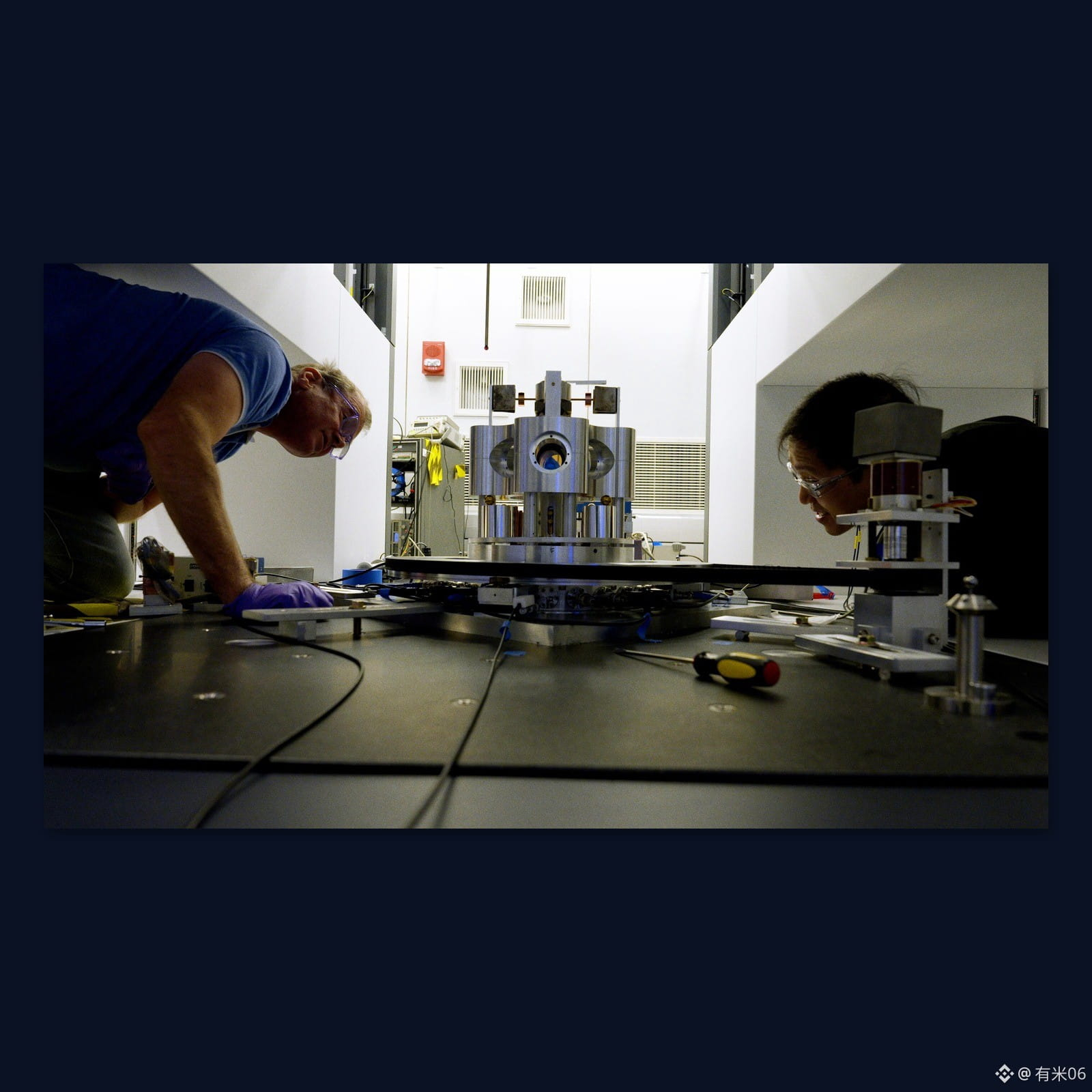
Figure: Photo of NIST’s torsion balance in the lab (R. Eskalis) + schematic of the experimental setup (S. Kelley); not AI.
Data through: Metrologia DOI 10.1088/1681-7575/ae570f; NIST 2026-04-16; APS Physics 2026-05-01; ScienceDaily 2026-09-20
#物理 #Scientific research
According to NIST’s press release (2026-04-16) and the Metrologia paper (DOI 10.1088/1681-7575/ae570f): the team measured G ≈ 6.67387×10⁻¹¹ m³·kg⁻¹·s⁻², which is lower than the BIPM 2007 result by about 235 parts per million. To prevent “expectation-value” bias in the analysis, they blinded the key calibration-mass data and hid the correction values in sealed envelopes; the envelopes were opened only in 2024-07. Two sets of masses—made of copper and sapphire—yielded almost the same results, ruling out the “material effects” explanation.
Independent checks: APS Physics (2026-05-01) and ScienceDaily (2026-09-20) retold the story using the same framing—meaning the remaining discrepancy is more likely due to unrecognized systematic errors, and it does not rule out the possibility that our understanding of gravity still has gaps; everyday bathroom scale readings won’t change as a result.
Figure: Photo of NIST’s torsion balance in the lab (R. Eskalis) + schematic of the experimental setup (S. Kelley); not AI.
Data through: Metrologia DOI 10.1088/1681-7575/ae570f; NIST 2026-04-16; APS Physics 2026-05-01; ScienceDaily 2026-09-20
#物理 #Scientific research