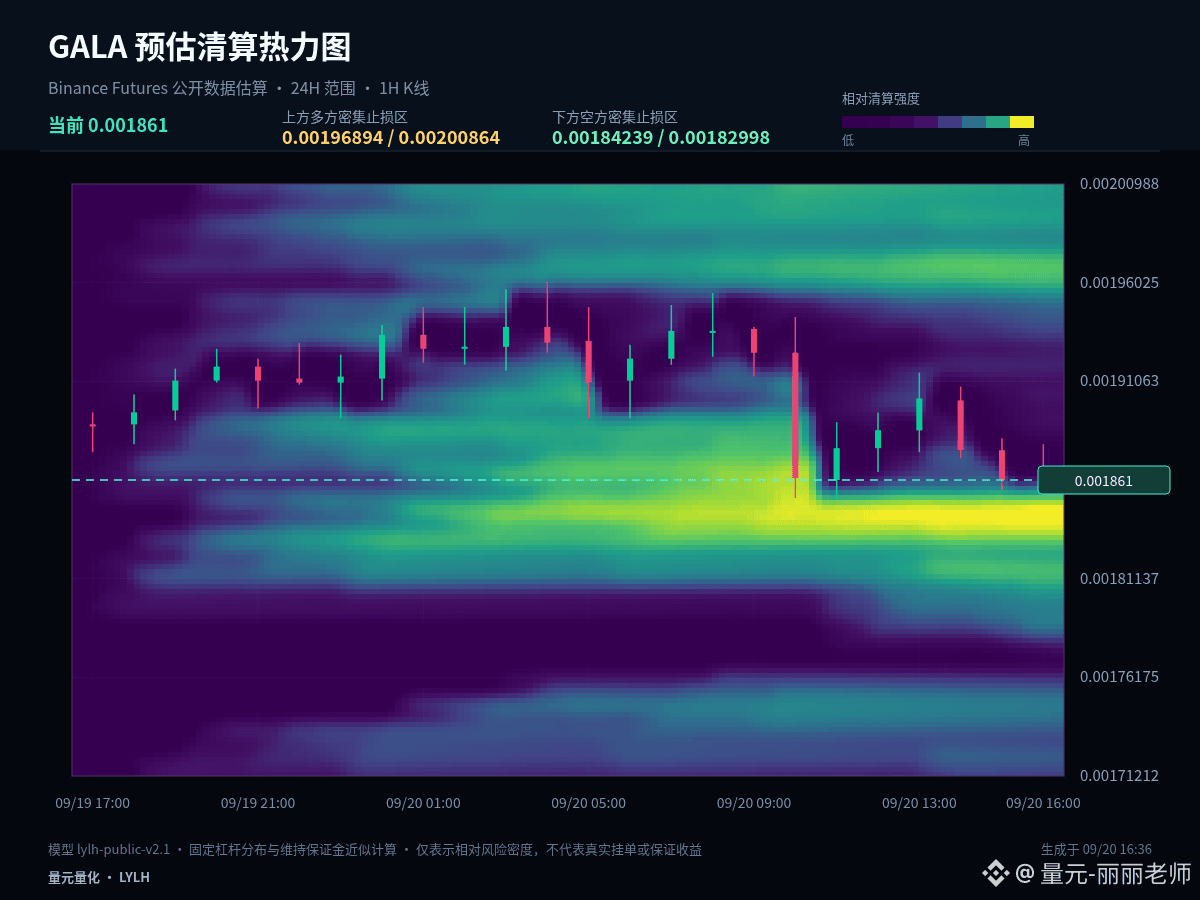
$GALA #GALA From a layout perspective, the key is not to chase already-occurred fluctuations, but to decide in advance where you are willing to wait. Current price: 0.001863, 1 hour: 0.00%, 24 hours: -1.06%.
The current price is near the lower end of the past 24-hour range. 1 hour: 0.00%, 24 hours: -1.06%. The essence of analyzing lows is not to front-run a bottom, but to observe whether price can quickly recover after breaking down. Being able to recover indicates that selling pressure has been absorbed; staying under the lower band for a prolonged period suggests weakness has not ended.
The first observation zone is 0.0019065, used to judge whether a normal pullback has ended. The second observation zone is 0.001852, used to judge whether a deeper retracement can form support and bounce. On the upside, focus on 0.001961. After a breakout, a pullback confirmation is required to avoid mistaking a brief wick-through for a trend that has already opened.
In terms of position sizing, you need to distinguish between spot and futures. If you already hold spot, manage it in stages around key levels; don’t frequently flip direction because of a single 1-hour candlestick. If you are in cash with no position, wait for confirmation and then enter in batches more calmly. Futures place greater emphasis on your entry location and invalidation conditions. When volatility expands, proactively reduce exposure to avoid turning short-term judgments into passive holding.
The purpose of scaling in is not to keep averaging down, but to control your pace while the structure remains valid. Once a key support fails, you should stop the original setup plan and wait for a new price range to form.
Your trading plan must include invalidation conditions. If your judgment is correct, you can realize profits in stages. If your judgment is wrong, you must also allow yourself to exit—do not use adding to conceal the fact that the initial logic has changed. The market will update, and your viewpoint should adjust along with price evidence.
#XRPExchangeReservesHitSevenYearLow
The current price is near the lower end of the past 24-hour range. 1 hour: 0.00%, 24 hours: -1.06%. The essence of analyzing lows is not to front-run a bottom, but to observe whether price can quickly recover after breaking down. Being able to recover indicates that selling pressure has been absorbed; staying under the lower band for a prolonged period suggests weakness has not ended.
The first observation zone is 0.0019065, used to judge whether a normal pullback has ended. The second observation zone is 0.001852, used to judge whether a deeper retracement can form support and bounce. On the upside, focus on 0.001961. After a breakout, a pullback confirmation is required to avoid mistaking a brief wick-through for a trend that has already opened.
In terms of position sizing, you need to distinguish between spot and futures. If you already hold spot, manage it in stages around key levels; don’t frequently flip direction because of a single 1-hour candlestick. If you are in cash with no position, wait for confirmation and then enter in batches more calmly. Futures place greater emphasis on your entry location and invalidation conditions. When volatility expands, proactively reduce exposure to avoid turning short-term judgments into passive holding.
The purpose of scaling in is not to keep averaging down, but to control your pace while the structure remains valid. Once a key support fails, you should stop the original setup plan and wait for a new price range to form.
Your trading plan must include invalidation conditions. If your judgment is correct, you can realize profits in stages. If your judgment is wrong, you must also allow yourself to exit—do not use adding to conceal the fact that the initial logic has changed. The market will update, and your viewpoint should adjust along with price evidence.
#XRPExchangeReservesHitSevenYearLow