Starting tomorrow (September 21), we will officially resume live streaming.
From Monday to Friday, there will be live streams every day at 7–8 AM (as soon as we wake up) and at 3 PM for the event contract. At 10 PM, we will stream perpetual contracts & event contracts (watch the market).
On Saturdays and Sundays (whether we stream or not depends on the market—if there’s no liquidity, we’ll take a break). Please be informed.

Attention, answer questions, get red envelopes! SOL
乘风Sunshine
·
--
Starting tomorrow (September 21), we will officially resume live streaming.
From Monday to Friday, there will be live streams every day at 7–8 AM (as soon as we wake up) and at 3 PM for the event contract. At 10 PM, we will stream perpetual contracts & event contracts (watch the market).
On Saturdays and Sundays (whether we stream or not depends on the market—if there’s no liquidity, we’ll take a break). Please be informed.

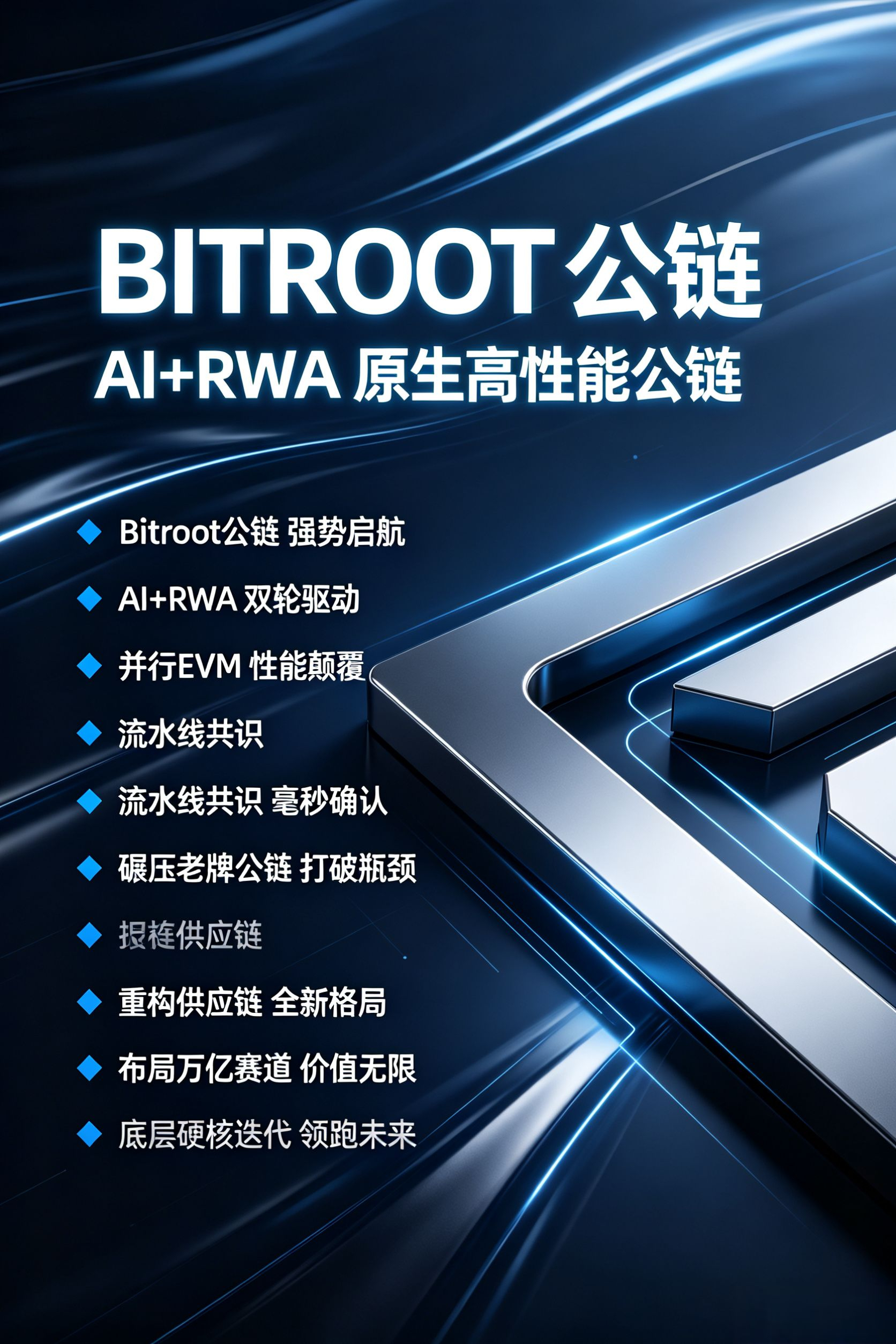
Focusing on the trillion-yuan physical AI boom, Bitroot has officially entered the real-world intelligence competition. It has completed a strategic investment layout for core physical AI enterprises, marking the main growth line for the next phase of technology. By leveraging a public chain as the underlying layer to support massive simulation computing power, Bitroot builds an on-chain system for verifying and transferring AI data, models, and devices. It connects the channels of real-world and digital economic value, laying a reliable infrastructure so global participants can share the dual dividends of the physical AI and Web3 tracks.

Follow him, answer questions to get lucky money! @Jin Yi
瑾怡
·
--
Newcomer report, hoping to receive the attention and support from even more family members; a small red envelope 🧧 is my gratitude for your关注. May all the family members who are paying attention be smooth sailing, with good luck coming one after another 🙏

Cherish passion and set out for the mountains and seas; don’t waste your time, and don’t let down the love in your heart. Keep passion in heart, chase dreams and live up to yourself.

U.S. President Trump, in the midst of revitalizing things, has launched a renaming poll on social media. He pointed out that many people believe the term “artificial intelligence” is not accurate and that the wording is also quite awkward. For this new phenomenon, a more elegant and precise name could be Superior Intelligence, or Extreme Intelligence, or Supreme Intelligence.
Trump urged everyone to take part in the voting and choose the new name that best fits “this ever-evolving ‘revolution’.” As of now, more than 170,000 people have voted. The leading “new name” is “Superior Intelligence” (abbreviated as “SI”), with 40.6% of the vote.
A few hours later, Elon Musk left a remark under the post. Instead of simply choosing one option, he said, “It will be smart enough that we can’t understand it.” $GOOG.US
《A Pure Technical Sharing Post by Riding the Wind Sunshine: How to Judge Support/Resistance Levels That Act as Pressure Support》
(1) Big Waffle: For every 1,000 points, there are three pressure support/resistance levels (reference levels) 200, 500, 900
(2) Volatility level (Monday to Friday) Small volatility: USD 3 million, not exceeding USD 5 million Medium volatility: USD 5 million or more, not exceeding USD 8 million (not excluding the possibility that a single candlestick may reach 10 million or more) Large volatility: each move no less than USD 10 million (the first candle in the market may not reach 10 million; it may be around 5–8 million)
(3) Real or confirmed support/resistance levels on the chart (80200 as an example) 80200, small volatility: oscillate 20–50 points up and down (support: oscillating upward, 80220–80250; resistance: oscillating downward, 80150–80180) 200 points, medium volatility: oscillate 50–100 points up and down (support: oscillating upward, 80250–80300; resistance: oscillating downward, 80100–80150) 200 points, large volatility: oscillate 100–200 points up and down (support: oscillating upward, 80300–80400; resistance: oscillating downward, 80000–80100)
80500, small volatility: oscillate 20–50 points up and down (support: oscillating upward, 80520–80550; resistance: oscillating downward, 80450–80480) 500 points, medium volatility: oscillate 50–100 points up and down (support: oscillating upward, 80550–80600; resistance: oscillating downward, 80400–80450) 500 points, large volatility: oscillate 100–200 points up and down (support: oscillating upward, 80600–80700; resistance: oscillating downward, 80300–80400)
80900, small volatility: oscillate 20–50 points up and down (support: oscillating upward, 80920–80950; resistance: oscillating downward, 80850–80880) 900 points, medium volatility: oscillate 50–100 points up and down (support: oscillating upward, 80950–81000; resistance: oscillating downward, 80800–80850) 900 points, large volatility: oscillate 100–200 points up and down (support: oscillating upward, 81000–81100; resistance: oscillating downward, 80700–80800)
A real trading review should answer: Why did I enter then? Were the conditions met at the time? If they were met, was my execution correct? If they weren’t, why did I still enter? Where was the risk? Why did the exit happen? If I could do it again, what would I change? Finally, classify the mistakes. For example: Mistake A: Chasing the breakout. Mistake B: Delaying the stop-loss. Mistake C: Position size too large. Mistake D: Not following the system trading rules. Mistake E: Overconfidence after a streak of consecutive wins. One month later, you will gain something extremely valuable: your own database of mistakes. And that matters far more than buying another book. Because the mistakes other people tell you are always their mistakes. Only the mistakes you’ve repeatedly made, recorded, and corrected yourself will truly become part of your behavioral system.
🎙️ Crypto market updates & community discussion; answering questions for newcomers ✅ Keep building the community 🦅 Spread the idea of freedom! Maintain ecological balance!
Trading isn’t talent—it’s a craft you must practice over and over
When many people first come into contact with trading, they have a very romantic fantasy. They think that the truly great people in the market are born with something others don’t have. Some people think they’re born with boldness. Some people think they’re smart from birth. Some people think they’re especially sensitive to numbers. Others think they have some kind of “market sense” that ordinary people can’t understand. And then, when ordinary people see experts spot the market at a glance and make a lot of money with a single trade, they develop a misconception: So trading is a game for geniuses. The reason I can’t make money is because I don’t have talent.
Starting next Monday (September 21), we will officially resume live streaming.
From Monday to Friday, daily at 7:00 AM (stream as soon as you wake up) and 3:00 PM we will open event contracts. At 10:00 PM (watch the market), we will stream perpetual contracts & event contracts.
As for Saturdays and Sundays (whether we stream depends on the market—if there is no liquidity, we’ll take a break), please be informed.
Starting next Monday, we will officially resume live streaming. From Monday to Friday, we will broadcast the spot contract & event contract at 7:00 AM and 3:00 PM each day, and broadcast the perpetual contract & event contract at 10:00 PM. Please be informed.
1. SEC clears the way for tokenized US stock trading: The U.S. SEC has introduced an “innovative exemption,” allowing qualifying tokenized securities trading platforms to be exempt from registration as traditional exchanges for a period of up to five years, and to trade tokenized stocks using licensed AMMs and liquidity pools. 2. BTC stabilizes and rebounds after the rate hike: The Federal Reserve raised rates by 25 basis points to 3.75%–4% on the 16th, but on the 17th BTC traded in a range around about $76.5K. The rebound in U.S. stocks also eased short-term market pressure. 3. The U.S. sanctions the Iranian crypto exchange BitBank: The U.S. Treasury Department has added the Iranian trading platform BitBank and related individuals to the sanctions list, citing its involvement in transferring hundreds of millions of dollars’ worth of bitcoin to Iran’s Islamic Revolutionary Guard Corps. Digital assets have once again become a focus of sanctions enforcement. 4. The UK intensifies crackdowns on illegal P2P crypto trading: The UK FCA, together with tax authorities and police, conducted actions at three locations in London suspected of operating unregistered P2P crypto businesses and issued stop orders. The FCA said the UK currently has no registered P2P crypto trading firms. 5. S&P Global acquires OpenZeppelin: S&P Global announced it will acquire blockchain security company OpenZeppelin. Its smart contract infrastructure has supported more than $370 billion in large-scale on-chain transfers, as traditional financial institutions continue to invest in on-chain infrastructure.
Kovner’s Paradox: When “Risk Control” Meets “Annualized 87%”—What Are We Missing?
I. The paradox is laid out on the table Bruce Kovner left the trading world its most famous piece of advice: the risk on any single trade should not exceed 1% to 2% of the principal. This discipline has been written into nearly every trading beginner book, and it is repeatedly quoted like scripture in countless training courses. Circulating alongside this rule is another set of numbers: during Kovner’s tenure at Caxton Associates, he produced consecutive years of performance with an average annualized return as high as 87%. He himself started with a borrowed $3,000 and ultimately accumulated a personal fortune of nearly ten billion dollars. These two sets of numbers placed together form a contradiction that is almost impossible to reconcile with common sense. If, every time you place a bet, you only risk 1% to 2% of the principal, then what kind of compounding structure could possibly support a figure like an annualized 87%? Most articles that paraphrase Kovner’s “golden quote” have never seriously addressed this contradiction—they treat risk discipline as the whole truth to teach, yet they dodge a more fundamental question: risk control explains why Kovner didn’t go bankrupt, but it completely fails to explain why he became so extraordinarily wealthy.
The real secret of Kovner isn’t “only losing 1% per trade”: what he taught the masses may just be a half-set system
Many traders will remember a very beautiful quote when they first come across Bruce Kovner: “Don’t take on more than 1%—2% risk per trade.” And then a question arises that seems very reasonable at first glance, but doesn’t hold up under deeper scrutiny: If you only allow yourself to lose 1%—2% each time, how could a trader possibly achieve exceptionally high long-term compounded returns? Going further, if Kovner himself was described in (Market Wizards) as having achieved a streak of ten consecutive years with an average annual compounded return of about 87%, then how exactly does 1%—2% risk control coexist with such an outrageous level of returns?
Log in to explore more content
Join global crypto users on Binance Square
⚡️ Get latest and useful information about crypto.