


First, clarify the message.
On September 17, the SEC issued a five-year “innovation exemption,” defining the compliance boundaries for on-chain trading of tokenized U.S. stocks. The core mechanism is to create a new type of trading venue—tokenized securities trading venues—which can facilitate matched trading via licensed automated market makers and liquidity pools, without first completing full exchange registration; operators only need to notify the SEC to begin operating.
Several key constraints are worth noting. Tokenized shares must grant holders exactly the same economic and governance rights as traditional stocks, including dividends and voting rights. Synthetic tokens that provide only price exposure are expressly excluded from the exemption. Public companies retain veto power. Before a third-party platform can list tokenized underlying assets, it must provide written notice to the issuer and allow a 30-day objection period; if the issuer objects, trading cannot proceed. The underlying smart contracts must be deployed on a public, permissionless distributed ledger, but participants entering the liquidity pool must undergo a qualification review.
In other words: the foundation is the public chain; anyone who pools funds must pass an access threshold—synthetic tokens are not included here.
The backdrop for this exemption is that crypto legislation in the Senate was blocked. (The Digital Assets Market Transparency Act) On September 15, it failed to reach the 60-vote threshold needed to advance in a procedural vote. Two days later, SEC Chair Paul Atkins issued this order and explicitly stated, “Whether or not there is legislation, the SEC will act within its existing authority.” He also specifically highlighted “No Synthetics,” making his stance clear: tokens must embody real shareholder rights, not merely provide price exposure.
Second, is there any relation to the upswing in the coin market? It could be one of the catalysts.
After the news hit, during September 18th’s trading session Bitcoin broke through $80,000, the first time since September 4 it stood above that level; within 24 hours it rose 5.88%. Crypto-related stocks reacted even more sharply: Coinbase closed up 11.7%, Strategy rose about 16.4%, Robinhood rose more than 9.1%, and miner MARA Holdings closed up nearly 13.8%.
But attributing the entire rally to “the SEC giving the green light” doesn’t hold up logically.
The direct fuel that pushed Bitcoin through that day’s breakout was a short squeeze. According to Coinglass data, within 60 minutes, short liquidations totaled $183 million; in that hour’s total leverage liquidation amount, about 95 cents out of every dollar came from traders betting on further price declines. FxPro Chief Market Analyst Alex Kuptsikevich described it as: “Traders had piled up leverage short positions expecting the downtrend to continue, and when these problems were forced to be covered, that became the fuel for the breakout.”
Under the ash of a leveraged market, changes in spot demand are a more valuable signal to track. On September 17, U.S. spot Bitcoin ETFs recorded about $159 million in net inflows. BlackRock’s IBIT was the primary absorption tool; the fund’s historical total net inflows have reached $64.016 billion.
More importantly, Bitcoin’s stance in the face of macro events this week itself conveys information. The Federal Reserve raised rates by 25 bps to 3.75%—4.00% on September 16, the first time since July 2023; yet Bitcoin did not break below the $75.2k 50% retracement level, instead holding above three major moving averages. The Bank of Japan then also raised its policy rate with a 7-to-2 vote to 1.25%, the highest level in 31 years since 1995; Bitcoin likewise refused to break down.
The market’s pricing for inflation has already been completed, and there has been no forced de-risking. This combination—neutral RSI, a positive funding rate, and price positioned above the moving-average structure—describes a state of “completed rate-hike pricing,” not panic.
Third, don’t ignore two structural distinctions
The first distinction: putting stocks on-chain doesn’t mean the money is used to buy coins.
Some people put money into an on-chain account just to hold tokenized stocks. Using blockchain technology doesn’t automatically mean the related public-chain token captures value to the same extent. The impact on BTC comes more from an overall repair in risk appetite rather than the SEC policy being transmitted directly. For specific public chains and protocols, the key is whether they truly onboard real business, and whether business growth can be translated into token value.
The second distinction: not all RWA concept coins can benefit.
“No Synthetics,” separately marked in Atkins’ order, has drawn the boundary. Large numbers of securities exchange contract products overseas that track stock prices but do not provide shareholders’ rights are not included in this exemption. The regulatory choice is a “real equity on-chain” path, not a “price mapping on-chain” one.
Fourth, what on-chain data is saying
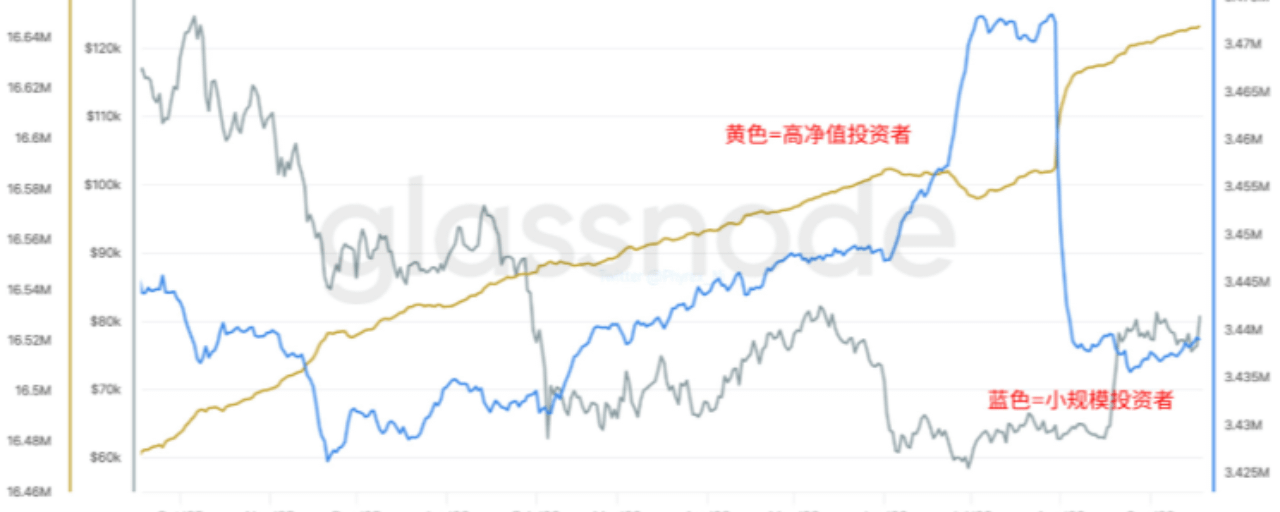
The behavior of short-term holders is worth paying attention to. After the CLARITY Act vote was thwarted, the amount of Bitcoin that short-term holders moved to exchanges increased from about 19.4k BTC to 33.1k BTC; of this, roughly 23.2k BTC is in unrealized losses, representing the largest stop-loss selling by short-term holders in the past month. Sell orders were concentrated among investors who bought recently, and long-term holders did not show signs of a synchronized exit.
Meanwhile, the pace of accumulation on the institutional side is accelerating. Morgan Stanley increased holdings through its spot Bitcoin ETF MSBT in September; as of September 17, total shares first exceeded 8,000, reaching 8,026, worth about $614 million. On September 16, another whale spent $15 million to buy 197.35 BTC at an average price of $76,007 and transferred it on-chain.
The divergence in on-chain structure is clear: short-term stop-loss sell orders are accelerating the clearing under macro uncertainty, while institutions and mid-to-long-term holders keep accumulating in the pullback range.
Fifth, what to watch next
To judge the sustainability of this rally—not just looking at single-day price or the total direction of capital flows—you should watch three things:
Which platforms are truly launching. The exemption framework provides potential U.S. business entry points for platforms like Robinhood, Coinbase, and Gemini, but it’s not an automatic go-ahead—platforms need to adopt a license-based AMM structure that meets the conditions for trading tokenized securities. Existing overseas token products that only offer price exposure cannot simply be copied over. Coinbase has stated its desire to launch tokenized stocks in the U.S. after regulatory approval, while Robinhood plans to let holders exchange stock tokens for actual shares on a 1:1 basis and add voting rights.
Are trading volume and capital scale growing? The exemption sets limits on the number of tradable code items and the traded volume, and requires periodic publication of data such as price, quantity, time, and pool addresses. These data will become the first-hand signals to observe real demand for on-chain securities.
Whether users continue to use it. The five-year exemption is not an official and permanent regulatory rule; it allows the market to develop first, gather information about real-world operations, and then use that to formulate a more flexible long-term regime. If there’s no congressional legal protection, the future government could revoke this exemption—an ongoing uncertainty the industry will have to face.
Sixth, written in closing
Traditional finance is willing to use on-chain technology—this is an opportunity at the industry level. With this move, the SEC bypasses the legislative deadlock in Congress and, through administrative exemptions, opens the first door for tokenized securities to trade on-chain. Its historical significance is that regulators are beginning to provide concrete frameworks for using on-chain trading mechanisms for real securities.
But who exactly can make money will still depend on a specific company and a specific protocol. When news and a rise occur at the same time, it’s not enough to prove who caused whom. This is an industry development worth tracking, but it’s not a reason to chase once you see the words “tokenized stocks.”
As for the further possibilities—if tokenized securities form sufficient scale and liquidity on-chain, whether they would in turn reshape the competitive landscape of traditional exchanges, or even shake the legal definition of what “exchanges” means—perhaps only when the five-year exemption period ends will there be a preliminary answer.