


Recently, the crypto circle has had a phenomenon that really enraged people on the Asia-Pacific stock boards.
In the US stock market, Strive (ticker ASST) saw its share price double in a month, surged above $30, and reached a market cap of $2.5 billion—becoming the world’s fifth-largest listed Bitcoin-holding institution. Meanwhile, in Hong Kong stocks, Boyaa Interactive (00434.HK), which also holds 4,316 Bitcoins, has its share price lying at HK$2.87, with a market cap in USD of only $280 million.
One is at the center of the stage; the other is by the roadside...
The Bitcoin in Boyaa’s hands, valued at current prices, is worth $340 million—nearly 20% more than the market cap of its entire company. Simply put: for 80 cents on the dollar, you can buy $1 worth of Bitcoin on Boyaa’s books, and you also get a gaming business that earns nearly HK$200 million in annual profit and has grown 72%.
So what about buying ASST? You need to pay $1.3 to get $1 of Bitcoin that’s sitting on its balance sheet. If you account for the possibly diluted share count, you’d need $1.7.
Same with DAT (a digital asset treasury company): Boyaa’s mNAV is only 0.82x, while ASST is 1.7x. One gets a 20% discount, the other charges a 70% premium.
Let’s break it down carefully.
First, why is ASST expensive?
ASST’s expensiveness has a reason.
Founded by Vivek Ramaswamy, the company plays a “growth flywheel”: it issues a type of perpetual preferred stock called SATA, uses the proceeds to buy Bitcoin in the market, and keeps increasing the BTC amount corresponding to each share—while common shareholders aren’t diluted throughout.
Just in September alone, it bought over 1,800 coins; the CEO directly said it aims to end the year by targeting the position of the world’s No. 2 Bitcoin treasury company, second only to MicroStrategy. In one month, its holdings rose from 14.5k to 25k BTC.
What the market buys at the core is its ability to continuously “print money” to buy Bitcoin. In a sense, its financing capability and merger-and-acquisition aggressiveness aren’t inferior to mstr’s first-round bull market. But mstr’s current platform is a bit too large—many institutions can’t swallow it. ASST, on the other hand, is precisely in the market-cap range where many big institutional players can just make it onto the trading table.
Now look at where Boyaa’s money went.
So why is Boyaa only priced at an 80% level?
If you treat it as a company that’s “simply hoarding coins,” then yes, that would be a mispricing. But when you look through Boyaa’s announcements, you’ll find a key fact: of its 4,316 Bitcoins, about 2,600—exactly 60%—are no longer in cold wallets.
Where did they go?
Boyaa launched a Web3 transformation in 2023 with the slogan “game applications + ecosystem building + value storage” as a three-in-one. These 2,600 BTC are the ammunition put into its own ecosystem:
1,000 coins are staked on the MTT Network game public chain, supposedly to “ensure network security”;
1,000 coins are staked on Boyaa’s self-developed “Boyaa Chain,” which went live in this year’s second quarter;
500 coins are placed into its own YAAKO wallet cross-chain bridge liquidity pool;
100 coins plus 4.18 million USDT are invested into the MTT Sports esports platform, receiving 25% equity and 19% coin rights;
In addition, about 90 coins are given to players as tournament prizes; the incentive quota of 100 coins has already been burned off 90%.
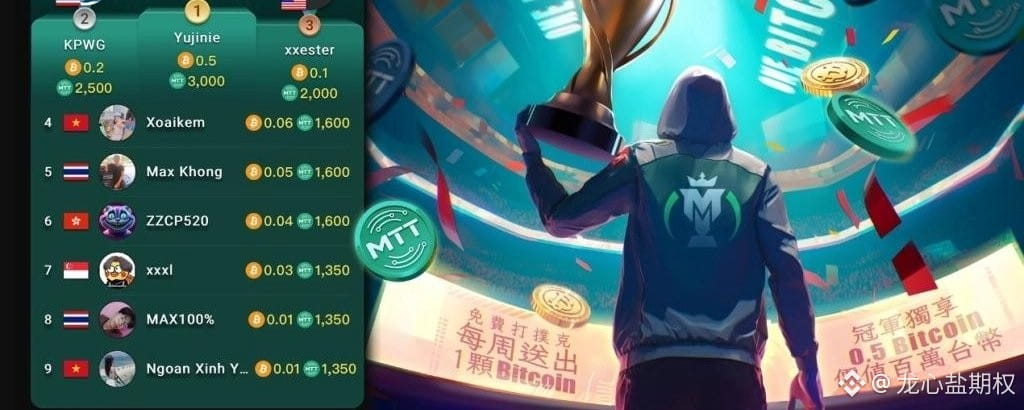
This chart is the MTT Sports weekly tournament settlement leaderboard—using the banner “Free to play poker; we give out 1 Bitcoin every week” to attract new users. Sounds great, but the data is honest: monthly active users on the platform fell from 60,000 to 30,000, and daily active addresses on-chain dropped from 10,000 to 4,300. Users attracted by burning coins can’t be retained…
The harsh truth on the ledger
How did the financial performance of this ecosystem story look?
Boyaa’s 2025 annual report provides the answer: Web3 business segment revenue was HK$21.68 million, and the segment loss was HK$391 million.
What’s even more painful are a few details: the MTT coin still hasn’t disclosed a public market pricing; the 19% coin rights are worth how much—only the company can decide. Cross-chain bridges have historically been one of the categories with the largest “amount hacked” in crypto history, and Boyaa put 500 BTC into its own bridge. The endgame of two public chains is issuing tokens, but the token economics model is still far from even being drafted.
And in September 2025, Boyaa raised net HK$410 million from a share placement, and 90% of that was also used to buy Bitcoin. Diluting shareholders to exchange for coins—whether retail investors buy the story or not, the stock price has already answered.
So this 60% stake isn’t Bitcoin sleeping in cold wallets; it has become collateral for two self-run public chains that haven’t issued tokens yet, liquidity for one of its own bridges, and equity in an esports platform with 30,000 monthly active users.
The market isn’t unaware of these $340 million of coins; it just can’t tell how much of that $340 million can still be retrieved intact.
Half the valuation—what exactly are you buying?
So is Boyaa basically pure trash? Not necessarily.
Its fundamentals are actually solid: adjusted net profit from Texas Hold’em games in the first half of 2026 was HK$98.20 million, up 72%. Its BTC holding cost is $68,280; at the current price it’s up roughly 15%. The assets are held in custody at licensed institutions such as Coinbase Prime and OSL, with cold storage plus multiple-signature controls.
Here’s a pragmatic algorithm: only treat the roughly 1,700 undeployed Bitcoins and the gaming business—valued at an 8-to-10x profit multiple—as a buffer. The 2,600 already-deployed Bitcoins are counted at a 50% discount. Even if you are extremely pessimistic about its Web3 projects, the NAV is still more than 40% higher than the market cap.
In other words, in Boyaa’s discount, half is the reality that Hong Kong stock liquidity and Mainland capital can’t reach each other; the other half is the market’s lack of trust—an “I don’t believe in this ecosystem experiment” vote.
The former is mispricing from an overreaction; the latter is pricing.
Buying it, in essence, is buying a combination of “game cash flow + a BTC upside option + an ecosystem comeback lottery.” If the lottery goes to zero, the first two still remain. And ASST’s 1.7x premium means you’re buying the perpetual machine behind American-style capital operations.
Let’s also look at the recent headline roundup for Boyaa.
String together the disclosed data from the company:
In 2025, the Web3 business segment had revenue of HK$21.68 million and a segment loss of HK$391 million (excluding fair value fluctuations of BTC).
In a September 2025 share placement near HK$7, it net raised HK$410 million, and 90% of that went into BTC—diluting shareholders to buy coins.
An asset management plan’s principal of HK$111 million is tied up in litigation; the fair value of the equity investment fund Jiaxing Boyaa has gone to zero.
In 2026H1, the core business (Texas Hold’em, etc.) really has been recovering: adjusted net profit was HK$98.20 million, up 72%. But paid players fell year-on-year by 54% to 104,000. Revenue growth is driven by ARPPU, not by an increase in users.
Signs of management upheaval: Chairman Dai Zhikang (the former founder of Paipaidai) was still signing documents in August to issue profit warnings, but on 8/20 Zhang Shuang reduced holdings once, selling 277.6 million shares (36.01% of holdings). Related parties such as Emily Technology increased holdings at the same price range.
So it seems the company has plenty of internal messes too—making people genuinely question what happened to the BTC they took out.
It’s the same with DAT: the expensive ones are expensive for reasons, and the cheap ones are cheap for reasons. Once you see where these 2,600 BTC went, then everyone can decide whether to take this “half the valuation” bet.
Related interest: I previously held Boyaa shares, then cleared them around the highs. This year I bought some again around an average cost near 2.7. I’m also an ASST holder with costs around 37. The money made on MSTR is all lost on this ASST...