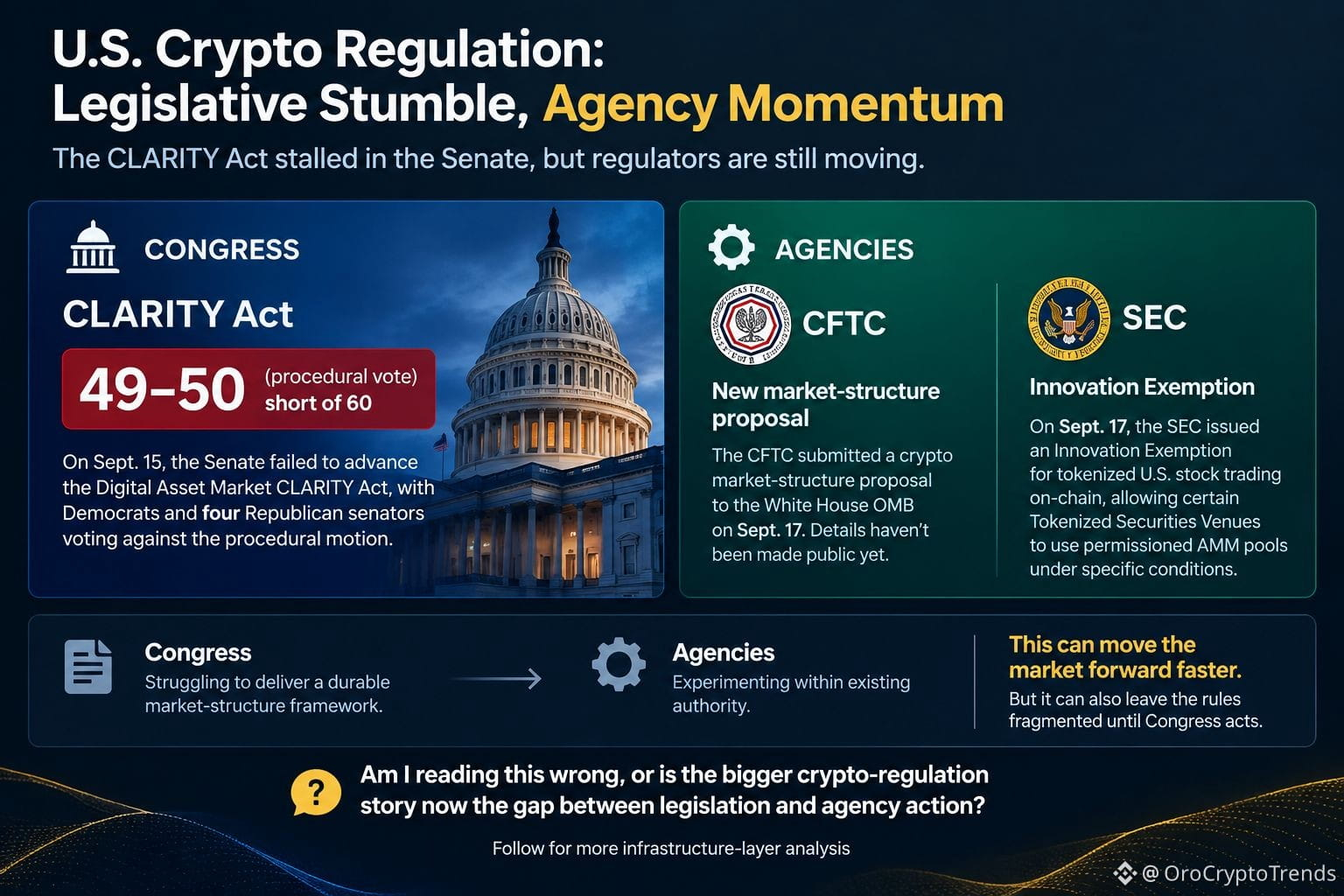

The CLARITY Act stalled in the Senate. U.S. crypto regulation didn’t.
On Sept. 15, the Senate voted 49–50 against advancing the Digital Asset Market CLARITY Act, falling short of the 60 votes required for the procedural motion.
What I find more interesting is what happened next.
The legislative route hit a wall, but the regulatory machinery kept moving. Bloomberg reported that the CFTC submitted a new crypto market-structure proposal to the White House Office of Management and Budget on Sept. 17. The details aren’t public yet, so I’m not going to pretend we already know exactly what the rule contains.
At the same time, the SEC has already created another piece of the puzzle. Its Sept. 17 Innovation Exemption allows certain Tokenized Securities Venues to facilitate limited onchain trading of tokenized NMS stocks through permissioned AMM liquidity pools, subject to conditions including investor protections, public smart contracts and limits on symbols and trading volume.
That creates a regulatory pattern worth watching.
Congress is struggling to produce a durable market-structure framework, while agencies are experimenting within their existing authority.
That can move the market forward faster. But it can also leave the rules fragmented until Congress acts.
Am I reading this wrong, or is the bigger crypto-regulation story now the gap between legislation and agency action?
On Sept. 15, the Senate voted 49–50 against advancing the Digital Asset Market CLARITY Act, falling short of the 60 votes required for the procedural motion.
What I find more interesting is what happened next.
The legislative route hit a wall, but the regulatory machinery kept moving. Bloomberg reported that the CFTC submitted a new crypto market-structure proposal to the White House Office of Management and Budget on Sept. 17. The details aren’t public yet, so I’m not going to pretend we already know exactly what the rule contains.
At the same time, the SEC has already created another piece of the puzzle. Its Sept. 17 Innovation Exemption allows certain Tokenized Securities Venues to facilitate limited onchain trading of tokenized NMS stocks through permissioned AMM liquidity pools, subject to conditions including investor protections, public smart contracts and limits on symbols and trading volume.
That creates a regulatory pattern worth watching.
Congress is struggling to produce a durable market-structure framework, while agencies are experimenting within their existing authority.
That can move the market forward faster. But it can also leave the rules fragmented until Congress acts.
Am I reading this wrong, or is the bigger crypto-regulation story now the gap between legislation and agency action?