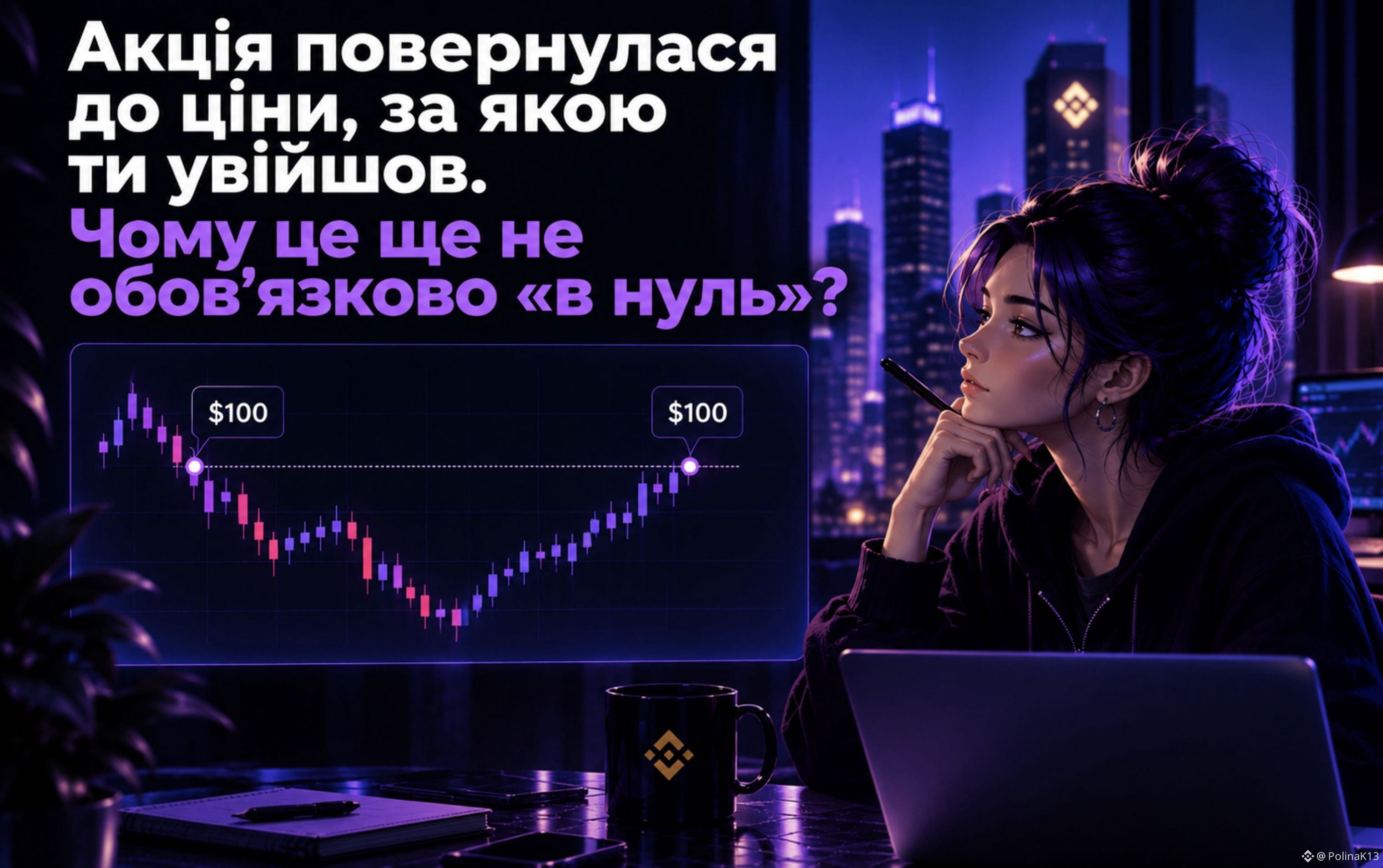
The promotion has returned to the price you entered at. Why it still doesn’t necessarily mean “back to zero”?
Let’s imagine:
You opened a position when the asset was $100.
First it fell to $95, and then it returned to $100.
It seems:
“Price returned → I’m back to zero.”
But not quite.
The outcome of a trade can be affected by costs associated with the position.
For example:
a commission for opening and closing;
funding if it’s perpetual;
the difference between the price you see on the chart and the actual execution price.
So even if the underlying asset returns to your entry price, the actual result of the position can remain negative.
And this is where an important distinction comes in:
The price returned to the entry point ≠ the trade automatically closes at zero.
The chart shows price movement.
And your real P&L also depends on what instrument you’re trading and what costs were incurred during the trade.
So looking only at:
“I entered at $100, and now it’s $100 again”
—isn’t enough.
Sometimes the price is back to zero, but your position is not yet.
#Trading #RiskManagement
Let’s imagine:
You opened a position when the asset was $100.
First it fell to $95, and then it returned to $100.
It seems:
“Price returned → I’m back to zero.”
But not quite.
The outcome of a trade can be affected by costs associated with the position.
For example:
a commission for opening and closing;
funding if it’s perpetual;
the difference between the price you see on the chart and the actual execution price.
So even if the underlying asset returns to your entry price, the actual result of the position can remain negative.
And this is where an important distinction comes in:
The price returned to the entry point ≠ the trade automatically closes at zero.
The chart shows price movement.
And your real P&L also depends on what instrument you’re trading and what costs were incurred during the trade.
So looking only at:
“I entered at $100, and now it’s $100 again”
—isn’t enough.
Sometimes the price is back to zero, but your position is not yet.
#Trading #RiskManagement