
#香港拟年底前推出批发cbdc
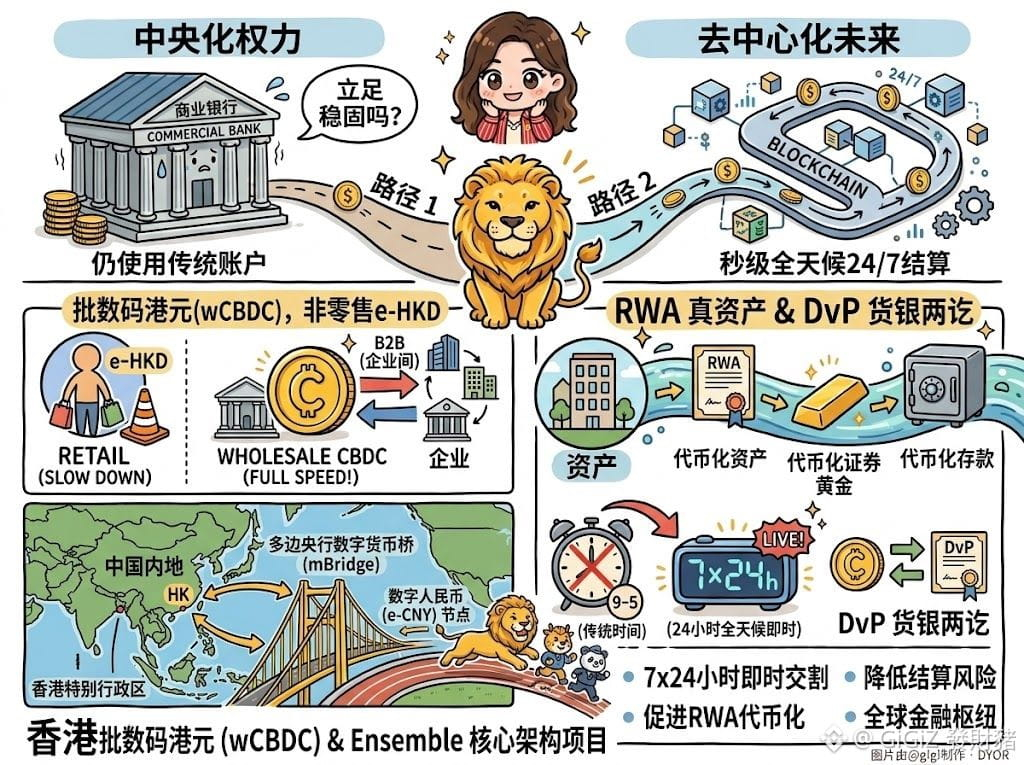
If future money no longer goes into traditional accounts, but instead settles on the blockchain in real time at second-level speed, can existing commercial banks still hold their ground?
Hong Kong’s Monetary Authority has recently finalized plans to officially roll out the wholesale layer central bank digital currency, wCBDC, by the end of this year—its key milestone being Project Ensemble TX.
Many people can’t tell the difference between retail and wholesale, but in fact the Monetary Authority’s strategy is very clear: for everyday citizens, the retail digital HKD (e-HKD) is not the priority to push right away; the focus is squarely on the B2B side.
This wCBDC is specifically designed to enable 24/7 real-time settlement for interbank tokenized deposits, tokenized government bonds, and tokenized real-world assets (RWA) with delivery-versus-payment (DvP) synchronized between funds and assets.
In my view, Hong Kong’s move is extremely shrewd.
▶️ Cutting costs and improving efficiency—hitting the pain point
Traditional large-value cross-bank and cross-border settlements rely on SWIFT and RTGS, which involve many intermediary steps, incur high costs, and require closing at night and over weekends. wCBDC directly turns central bank money into a tokenized base layer, achieving atomic settlement (DvP) where funds and assets are delivered simultaneously. This not only enables 7x24 instant clearing, but also saves enormous compliance, risk-control, and operational costs.
▶️ Anchoring on RWA and the stablecoin ecosystem
Hong Kong isn’t building CBDC in isolation. It’s threading it together with a regulated stablecoin framework and the tokenization of Web3 assets. wCBDC acts as the ultimate, top-tier risk-free settlement instrument; tokenized bank deposits function as the intermediate commercial layer. By directly connecting the underlying infrastructure to crypto capital, Hong Kong is positioned to seize global RWA pricing power.
Next, it’s expected that in the near term, the technology architecture of traditional banks will face major challenges. Large institutions that complete tokenization interface integrations first will capture the initial wave of liquidity benefits.
Looking at the long term, cross-border multilateral central bank digital currency Bridges will inevitably be deeply integrated with Ensemble. Hong Kong will very likely become a super hub linking Mainland China’s digital renminbi with the global Web3 finance ecosystem. In this covert battle over monetary infrastructure, Hong Kong has already pulled ahead of other financial centers by half a step.
DYOR
If future money no longer goes into traditional accounts, but instead settles on the blockchain in real time at second-level speed, can existing commercial banks still hold their ground?
Hong Kong’s Monetary Authority has recently finalized plans to officially roll out the wholesale layer central bank digital currency, wCBDC, by the end of this year—its key milestone being Project Ensemble TX.
Many people can’t tell the difference between retail and wholesale, but in fact the Monetary Authority’s strategy is very clear: for everyday citizens, the retail digital HKD (e-HKD) is not the priority to push right away; the focus is squarely on the B2B side.
This wCBDC is specifically designed to enable 24/7 real-time settlement for interbank tokenized deposits, tokenized government bonds, and tokenized real-world assets (RWA) with delivery-versus-payment (DvP) synchronized between funds and assets.
In my view, Hong Kong’s move is extremely shrewd.
▶️ Cutting costs and improving efficiency—hitting the pain point
Traditional large-value cross-bank and cross-border settlements rely on SWIFT and RTGS, which involve many intermediary steps, incur high costs, and require closing at night and over weekends. wCBDC directly turns central bank money into a tokenized base layer, achieving atomic settlement (DvP) where funds and assets are delivered simultaneously. This not only enables 7x24 instant clearing, but also saves enormous compliance, risk-control, and operational costs.
▶️ Anchoring on RWA and the stablecoin ecosystem
Hong Kong isn’t building CBDC in isolation. It’s threading it together with a regulated stablecoin framework and the tokenization of Web3 assets. wCBDC acts as the ultimate, top-tier risk-free settlement instrument; tokenized bank deposits function as the intermediate commercial layer. By directly connecting the underlying infrastructure to crypto capital, Hong Kong is positioned to seize global RWA pricing power.
Next, it’s expected that in the near term, the technology architecture of traditional banks will face major challenges. Large institutions that complete tokenization interface integrations first will capture the initial wave of liquidity benefits.
Looking at the long term, cross-border multilateral central bank digital currency Bridges will inevitably be deeply integrated with Ensemble. Hong Kong will very likely become a super hub linking Mainland China’s digital renminbi with the global Web3 finance ecosystem. In this covert battle over monetary infrastructure, Hong Kong has already pulled ahead of other financial centers by half a step.
DYOR