


Recently I spent some time reading through all the messages in @dapangdun’s TG group from late 2023 to now—there are a whopping 10w+ of them 😅 The main purpose is to map out the entire development path of the RGB ecosystem. After all, "by studying history, one can understand the rise and fall." Starting from here to learn about it is better than anything.
As for the RGB ecosystem, I’ve written four articles so far, respectively:
(Read in one article: RGB ecosystem (Part 2) (Chinese): When the BTC ecosystem needs the next phenomenon-level narrative, is RGB really the answer?)
(Read in one article: RGB ecosystem (Part 1) (Chinese): From the ideal of a single protocol to the reality of two routes—what exactly is being sold inside the gourd in the RGB ecosystem?)
(Read this article to understand the RGB ecosystem (Part 2): After August, why I’m more willing to cast my long-term votes for RGB v0.12?)
Thoughts from reading Teacher Fatdun (why I chose RGB v0.12)
Let’s talk about my personal view on RGB next.
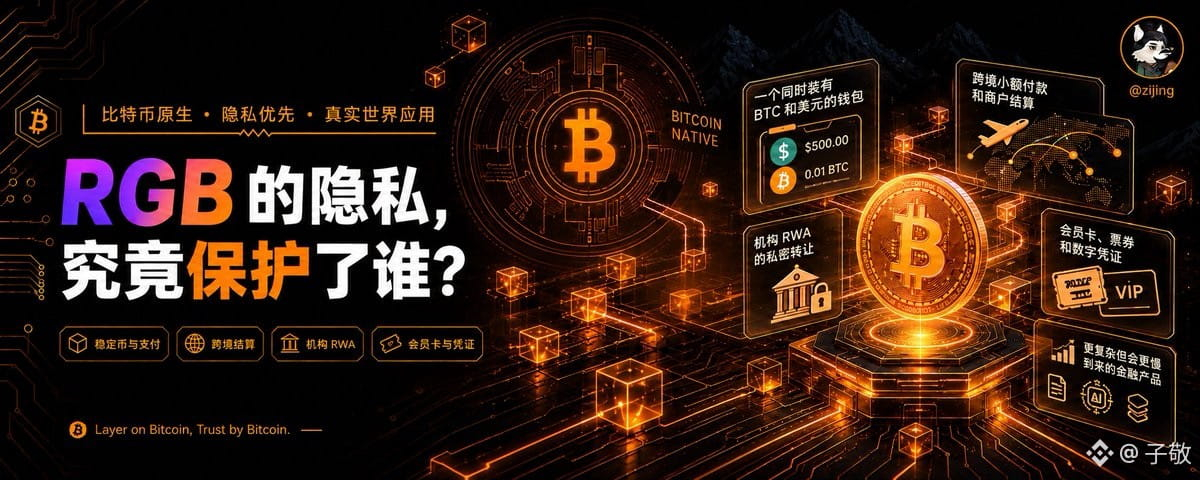
One of the most attractive narratives about RGB is privacy.
When many people first learn about RGB, the most interesting thing for them is its privacy.
Because on public chains like Ethereum before, balances, transfer records, and transaction paths are basically all visible at a glance—anyone can see the full picture of an address via a block explorer.
RGB offers a different way of thinking.
It won’t record all asset information publicly on the blockchain. Many transaction details are only passed between the payer and the payee, and the chain will only leave behind a small portion of information used to prove that the transaction is valid.
That way, ordinary people can’t easily find out—like analyzing an EVM wallet—how much an RGB address holds and all of that address’s transaction history.
That is indeed a major advantage of RGB.
But here’s an easy-to-misunderstand point: RGB has privacy features, but it doesn’t mean it completely blocks everyone.
More precisely, RGB only reduces the publicly exposed information and changes how information is disclosed, but it doesn’t make the information disappear.
Exactly which people can see what depends on who you’re trading with, what wallet you’re using, and what type of asset it is.
Also, it’s important to note that among privacy chains, the recently popular ZEC isn’t the same kind of thing.
In terms of technical approach, ZEC’s privacy is protocol-level privacy within the protocol, while RGB uses out-of-protocol privacy.
ZEC’s risks lie in regulation and liquidity: privacy coins face long-term delisting pressure from exchanges. Meanwhile, if the shielded pool usage rate is insufficient, anonymous pools are diluted and the privacy strength gets discounted.
RGB’s risk is engineering and user experience: client-side validation means losing local data equals losing proof of assets. Wallet maturity, historical data passing (consignment), and complexity of cross-party interactions are all real obstacles to real-world deployment.
The fundamental difference between the two is where the privacy is placed and where the trust is placed:
ZEC uses zero-knowledge proofs so the whole network can verify “invisible transactions.” The corresponding cost is that you must build your own chain and consensus.
RGB keeps data out of the chain, using Bitcoin only as a timestamp to prevent double-spending. The cost is shifting verification and custody responsibilities to the user.
To understand RGB privacy, we need to break observers into a few categories.
First, there are ordinary on-chain observers.
On traditional public chains, all transfers from a wallet are recorded publicly. Anyone can then organize a complete map of that wallet’s funds relationship based on the address, amounts, and time.
On the RGB side, however, it won’t put the full asset transaction records on-chain. External observers usually can only see some transactions and crypto information on BTC, but can’t directly know which RGB asset was transferred, nor can they simply know the exact amount.
This lets RGB better protect users on the public ledger layer.
But if you have an RGB transaction with a specific person, that counterparty can still see the content and information that they need to see for that transaction.
For example:
What asset was transferred
How much did it transfer?
Where did this asset come from before?
How can you prove that it’s valid?
Is this asset created by some issuing party?
Because RGB transaction data needs to be sent from the payer to the payee; otherwise the payee can’t confirm that the asset they received is real.
So, RGB isn’t “completely invisible transfers.”
It’s more like it doesn’t publicly disclose the transaction to the whole world, but it will pass the information needed to verify the transaction to the counterparty.
This is a form of point-to-point privacy.
Also, the asset issuing party…
This is especially important in stablecoin scenarios.
On the RGB protocol, many types of assets can be issued, including stablecoins, company shares, NFTs, and community tokens. But the rules for different assets can be designed by the issuing party themselves.
Some assets can’t be frozen at all.
Other assets allow the issuing party to freeze accounts, refuse transfers, claw back assets, or directly put certain addresses on a blacklist.
So RGB can hide transaction records, and that doesn’t mean the issuer has lost its management power.
When Tether announced its plan to bring $USDT to RGB, it emphasized Bitcoin-native, lighter transactions, better privacy, and the future possibility of pairing with the Lightning Network.
But that doesn’t mean RGB’s $USDT will become an asset that can’t be frozen or censored.
After all, USDT’s credibility itself comes from Tether’s ability to issue and redeem. As long as the issuer is still responsible for the asset, the issuer may retain certain management permissions. I believe they will definitely take this step to pave the way for future compliance.
Therefore, RGB’s technical privacy and stablecoin issuers’ powers are two different things.
That way, an asset can achieve both: ordinary people can’t see the full transaction history, but the issuer can still freeze or refuse certain assets according to the rules. These two are not in conflict.
Next come the wallets and service providers.
A key feature of RGB is that many assets and data are stored in the user’s own wallet, rather than being automatically copied across the entire network like on other chains.
This gives users stronger control, but it also creates a real problem: if users lose the relevant data in their wallet, the asset may also end up in trouble.
The official RGB documentation explicitly reminds users to back up their Stash—(RGB usage instructions).
In simple terms, Stash is the batch of RGB asset data and transaction history stored in the wallet. If this data is lost, the blockchain may not be able to help users recover it.
It’s a bit like the seed phrase for a BTC wallet, but it’s relatively more complex.
The seed phrase mainly proves “who you are.”
RGB’s local data is also responsible for proving “where your assets came from and what changes they went through.”
So RGB users not only need to protect their seed phrase, but also protect the wallet data at the same time.
If you’re using a cloud wallet, a custodial wallet, or you need to connect to a Lightning service provider, then the service provider may come into contact with some additional information, such as:
When the user used the wallet
What assets that wallet frequently sends and receives
How much liquidity the user needs
Roughly which people the user has traded with before
Which incoming payments in the wallet failed in the past
The user’s device and network information
Even if the service provider can’t see the complete asset history, it may still infer part of the user’s behavior through time, network addresses, and usage patterns.
This is also an easily overlooked point in RGB privacy: although you can’t see it on-chain, it doesn’t mean everything is invisible at every step.
Even if a user doesn’t publicly disclose their asset balances, the wallet service provider can still know that the user is using some stablecoin every day.
Even if the user doesn’t disclose the transfer path, the transaction platform can still link the wallet to a real person by identity verification.
The Lightning Network has similar issues.
Lightning can let RGB assets be transferred quickly, but it requires channels, nodes, and liquidity. The nodes providing these services may know when a user starts the service, what kind of assets they need, and roughly how much receiving capacity is required.
So, for RGB protocol privacy, we’d better understand it in layers:
For ordinary on-chain observers, RGB does hide a lot of publicly available information.
For counterparties, they can see what needs to be verified about this transaction.
For the issuer, they have powers like freezing, refusing, or redeeming.
For wallets, LSPs, and trading platforms, they may be able to know the user’s usage time, device information, and trading habits.
That means RGB privacy is not just a simple “privacy switch.” It’s more like a permission table:
Different people can see different information, and different assets have different management rules.
As ordinary users, what we truly need to care about is no longer just “whether RGB is private,” but also the following questions:
Who is the issuer of the assets I hold?
Can that issuer freeze my assets?
Will my wallet service provider upload my data to a server?
Does the Lightning service provider only provide services, or does it actually control the assets?
After losing my wallet, can I recover the assets myself?
After closing the channel, can I still get the assets back on my own?
Will the trading platform link my wallet to my real identity?
If there are no answers to the questions above, then “privacy” may just be a marketing slogan.
My personal understanding of RGB privacy is:
RGB can indeed reduce the amount of information exposed by on-chain public ledgers, making it harder for ordinary people to track someone else’s complete asset history. But it doesn’t automatically remove the observation capabilities of counterparties, issuers, wallet service providers, and trading platforms.
RGB gives some privacy back to users, but at the same time it shifts more responsibility onto users.
We need to decide for ourselves:
Which information can be given to the wallet, which can’t be given to the service provider, which assets can be trusted, which assets need to have the issuer rules checked first, and which features may be convenient but increase our reliance on third parties.
RGB’s privacy advantage is real, but you can’t simply understand it as “others can’t see anything.”
A more accurate way to put it is: RGB makes the public ledger know less, but it also requires users to know more clearly who is watching their information.
My take on the RGB protocol is very clear: I’m bullish on RGB becoming an important narrative in the next round of the crypto market—there’s even a strong chance it will become an underlying entry point for BTC’s next large-scale expansion.
Reasons are as follows:
In the past few BTC bull cycles, the market narratives have mainly revolved around “digital gold,” “payment networks,” and “institutional assets.”
But the BTC ecosystem has long lacked an open layer capable of carrying more assets and applications.
RGB is trying to fill this gap. It combines Bitcoin’s security, the Lightning Network’s speed, and asset issuance and smart contracts.
In the future, if stablecoins, securities, fund shares, corporate assets, and all kinds of applications can be issued and circulated on BTC, then $BTC it won’t just be a dead asset meant for long-term holding—it could also morph into a network layer that supports global financial activity.
If that were to happen, the impact could be much larger than simply adding a few generic wallets or a few major exchanges.
Because truly big market moves usually aren’t driven by a single new feature, but by a whole new asset model and application ecosystem.
In the last cycle, ETH formed a narrative combination of DeFi, NFTs, and stablecoins. After Solana’s “rebirth,” it also relied on low-cost transactions, memes, and high-frequency applications to build its own niche.
RGB’s potential opportunity is to bring similar asset expansion to the BTC ecosystem.
$BTC It has the strongest brand in crypto, the deepest capital consensus, and the widest global recognition.
If RGB can solve asset issuance, wallet usage, Lightning liquidity, the trading market, and user recovery, then it could become a key step for the BTC ecosystem to move from a “single-asset ecosystem” to a “multi-asset network.”
This is also my main reason to focus on RGB. In today’s market, I can’t find a narrative with higher certainty than this one.
That said, we should also clarify: being bullish on the RGB protocol doesn’t mean it’s already fully ready in its current stage.
Right now, RGB can be said to still be in the phase of gradually completing the infrastructure.
The v0.12 led by @BitlightLabs has already solved many protocol-layer issues, and the wallet, Lightning, LSP, and asset issuance tooling are also being continuously developed. But whether ordinary users can get a truly smooth experience—like receiving payments seamlessly, recovery, cross-wallet transfers, and swaps—still needs more real-world usage to prove.
At this stage, I’d rather see RGB as a high-speed highway that hasn’t been fully opened yet.
With BTC as the most important main road, RGB is meant to carry more assets and applications. The Lightning Network is responsible for improving circulation speed, while wallets and LSPs determine whether ordinary users can truly get onto this road.
If all these pieces can be connected, what RGB brings this time might not be just another ordinary hype cycle—but a grand structural expansion of the BTC ecosystem. That would be the next big “BTC summer,” forming the next genuinely sustainable narrative.
As for $RGB, I think it has a chance to become one of the most important representative assets in the RGB ecosystem.
However, this path isn’t guaranteed automatically. If the RGB protocol succeeds, the stablecoins issued on it succeed, Lightning-based assets succeed, and the final value of the whole protocol may end up concentrated mainly in BTC, USDT, wallets, trading platforms, and application projects.
So ultimately, what determines the value of $RGB is whether it can truly participate in building the ecosystem—whether it becomes a target that the whole ecosystem endorses, with stable liquidity, a user base, application demand, and community consensus.
RGB has the opportunity to become the starting point for the next big narrative in the BTC ecosystem, and it may also lead a BTC asset bull run more dramatic than the past. Good food doesn’t fear being late—we may still need to wait it out a bit.
The previous protocol upgrades were just the beginning. What truly makes RGB a big narrative is ordinary users’ effortless usage, issuers’放心 deployment, the ample liquidity provided by the trading market, and developers’ continuous building.
If all of those happen to come together, then what RGB brings this time likely won’t be just a new feature on BTC—it could be the turning point for the BTC ecosystem to move from a “single-currency network” to a “global asset network.”
That’s my reason for being bullish on the RGB protocol right now.
Alright, thanks for making it this far. Please feel free to discuss, share, and spread the word 🙏
In my next post, I might write about how the value of the RGB protocol could be transmitted to $RGB. Stay tuned 😎