



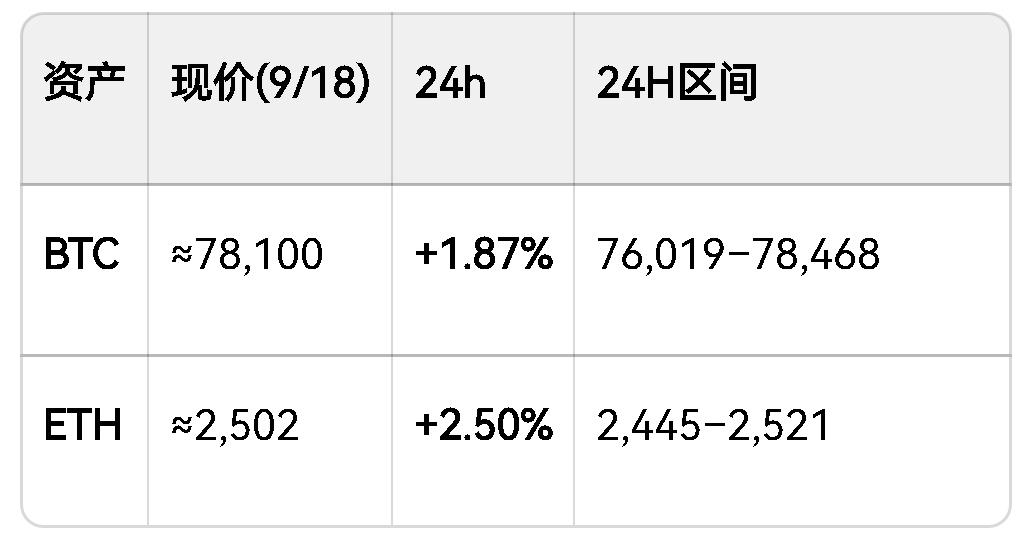
I. Current real-time market conditions and sentiment
II. This week’s macro event timeline (already occurred)
1. 9/3: Initial unemployment claims exceeded expectations + a Waller no-show → the market once briefly pared back rate-hike bets, and BTC surged above 80,000.
2. 9/15: (The Digital Assets Market Clear Act) (CLARITY Act) did not pass a procedural vote in the Senate → crypto crashed across the board; BTC fell below 75,000, and ETH hit a low of 2,350.
3. 9/16: The Fed raised rates by 25 bp for the first time since 2023 to 3.75%–4.00%, and the dot plot was hawkish (12 members expected one more hike this year, 4 expected two) → but BTC steadied around 75,000 and rebounded (bad news priced in—sell the fact).
4. On 9/17: The House Financial Services Committee passed 28:21 (the U.S. Reserve Modernization Act) (H.R. 8957), establishing a strategic Bitcoin reserve, the Treasury as custodian, locking roughly 324,500 seized BTC, prohibiting sales for 20 years; at the same time, Trump signed an executive order → BTC surged against the trend.
5. Current as of 9/18: BTC around 78,100 and ETH around 2,502, holding at the highs after the rebound.
Key qualitative view: This is a “repair rebound under the dual effect of hawkish rate-hike news being priced in + the strategic reserve bill being bullish,” so it’s a news-driven impulse, not a reversal into a loose-money uptrend.
III. A contest of forces between bulls and bears
Bullish (supporting the floor):
- Strategic reserve bill advancing: roughly 324,500 BTC locked for 20 years, effectively reducing potential selling pressure;
- A JPMorgan research note says BTC has more upside room than gold, and there are dense short positions, creating potential for a short squeeze;
- After the rate hike is implemented, there is “sell the fact” buying + short-covering.
Negative news (pressuring upside):
- Dot plot is hawkish; markets price in December still carrying the risk of another rate hike, and high interest rates suppress valuation of risk assets;
- CLARITY Act (regulatory clarity) fails; near-term policy/regulatory expectations are dashed;
- September’s historical performance is relatively weak + there may still be disturbances from option expiry later.
IV. Price forecast by time period
1) 24 hours (high-volatility window)
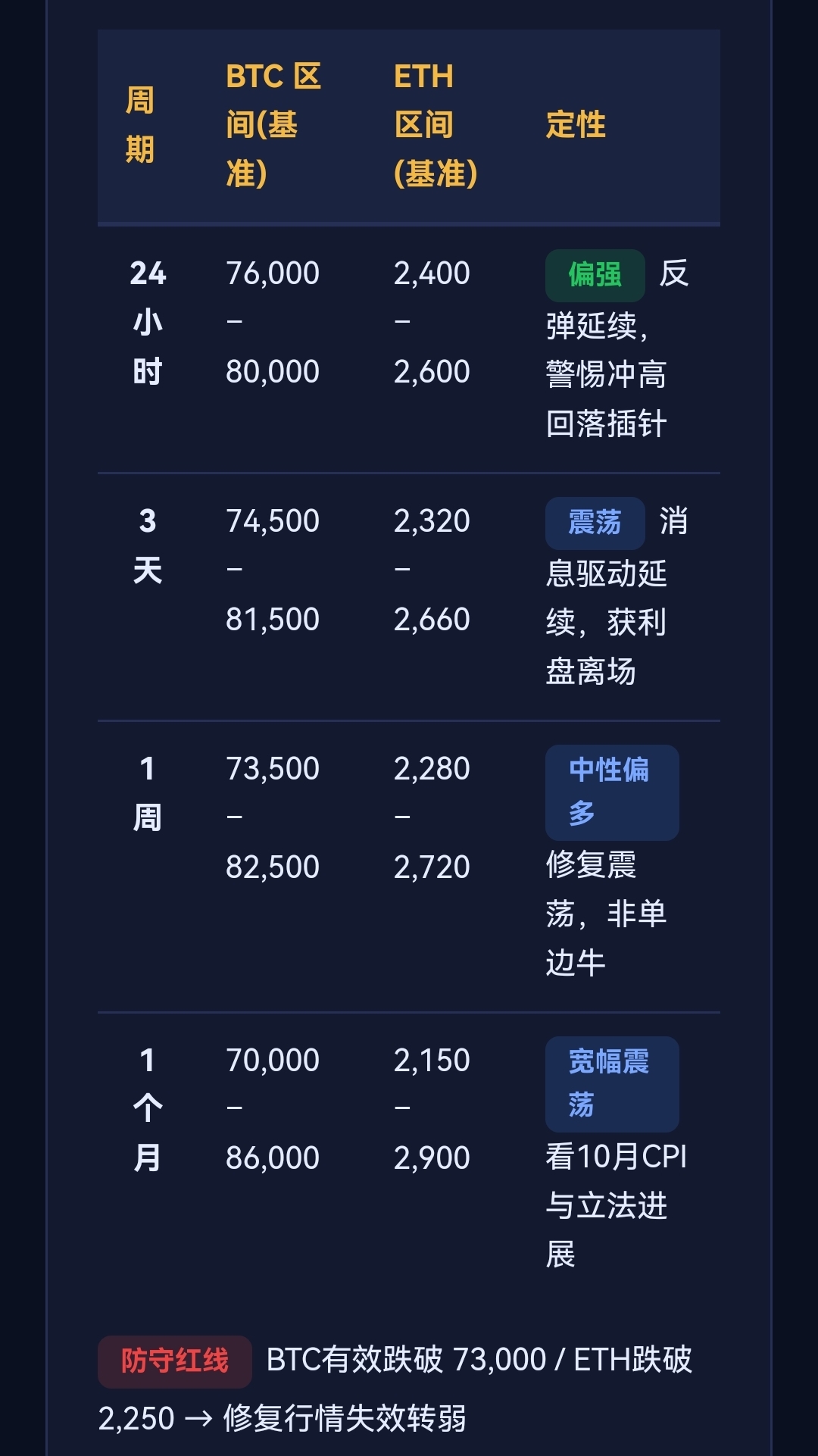
- Base scenario (65%): BTC 76,000–80,000; ETH 2,400–2,600
With the reserve-bill tailwind plus continued short-covering, the market is still relatively strong in the short term; however, be wary of profit-taking after a spike and price “needles.”
- Key levels: BTC support 76,000 (previous high breakout platform), resistance 78,500–80,000; ETH support 2,400, resistance 2,560–2,600.
2) 3 days
- Base case (60%): BTC 74,500–81,500; ETH 2,320–2,660
The news-driven rebound is likely to continue, but the dot plot’s hawkish stance suppresses it, while short-term profit-taking may exit, making it easy to spike up then pull back with wide-range volatility—hard to sustain a one-way move.
- If it effectively breaks down below 76,000, the rebound strength will weaken, with a possible move down toward around 74,000.
3) One week (late September)
- Base case (55%): BTC 73,500–82,500; ETH 2,280–2,720
Overall neutral-to-bullish, but it’s still a range-bound repair, not a one-way bull market. The bullish strategic reserve supports the downside, while the December rate-hike expectations create overhead pressure.
- Defense line: If BTC effectively falls below 73,000 or ETH falls below 2,250, then the repair rally would fail and likely weaken.
V. Trading recommendations
Short term (24h–one week):
1. Don’t chase upside impulse rebounds; don’t treat a news-driven move as a signal that a bull market has started. In the overhead resistance zone (BTC 78,500–80,000), prioritize cutting short-term positions on rallies.
2. After retesting key support and stabilizing, then try small-position re-entry; if the defense line breaks (BTC 73,000 / ETH 2,250), promptly reduce positions to manage risk.
3. The reserve bill has not yet been passed by the Senate and signed by the president, so there is legislative uncertainty—don’t go heavy on betting a single event.
Medium term (1–3 months):
1. Use staggered DCA on pullbacks for the core position rather than going all-in at once; the layout should focus on the 72,000–74,000 zone.
2. Continue tracking four indicators: ① October CPI inflation data; ② changes in December rate-hike expectations; ③ progress of the reserve bill in the U.S. Senate; ④ BTC/ETH spot ETF fund flows.
3. In a high interest-rate environment, the overall qualitative view is range-bound repair with the bottom lifting; it’s not advisable to pre-assume a one-way, insane bull run.
Risk reminder:
The dot-plot is hawkish (a rate hike is still possible in December), the failure of the CLARITY Act, repeated legislative back-and-forth, and option-expiry disturbances are all suppressing factors;
The essential driver of this upswing is “bearish news being priced in + bullish reserve news.” Make sure to control position sizing and set stop-losses.
