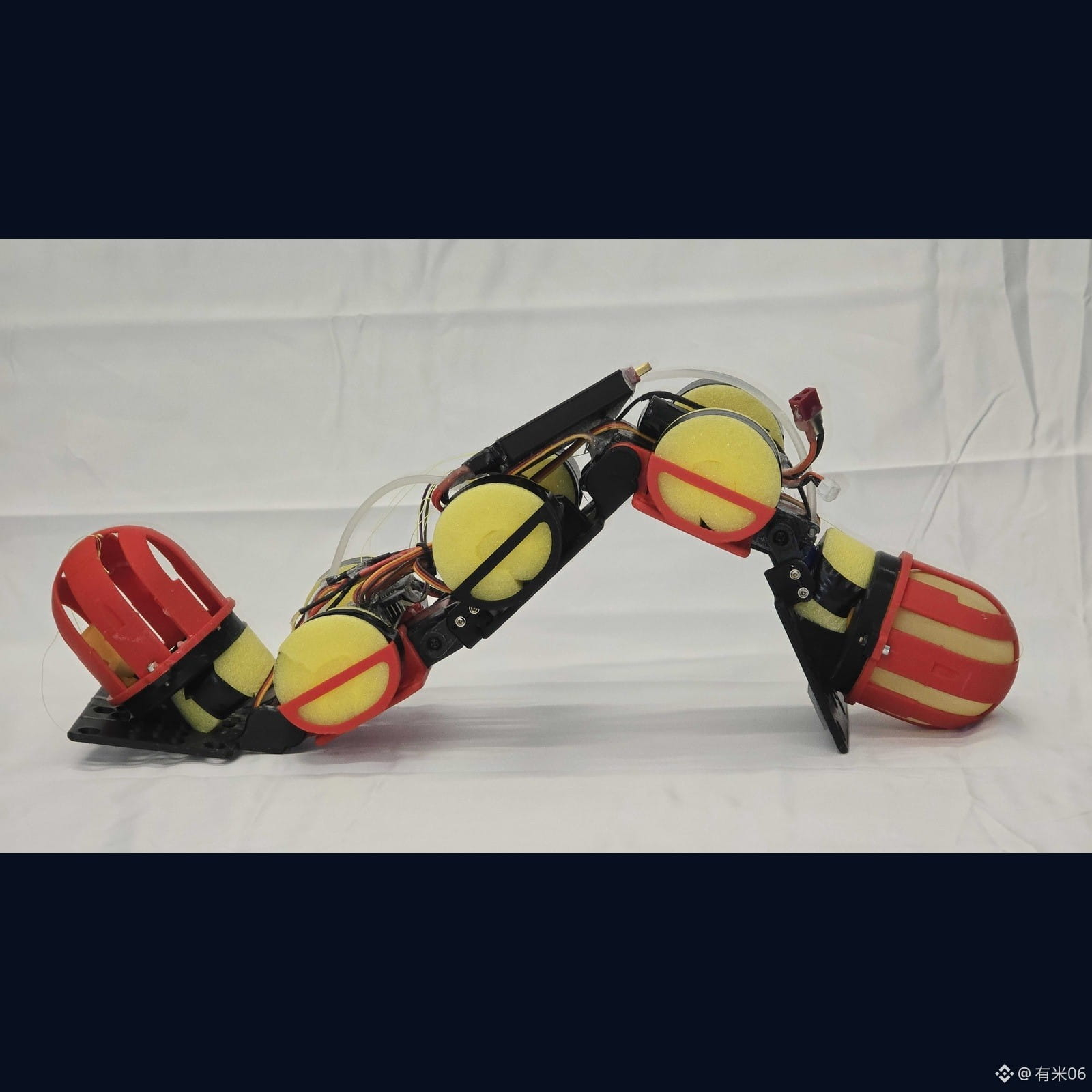
A worm robot doesn’t swap its legs or its gait—just sloshes the water in its belly back and forth, and it can climb slopes, go up stairs, and then descend into water.
Nana Obayashi and PhD student Daniil Filimonov from NYU Tandon built a five-segment, four-joint machine called WorMa (worm + mass). It’s about 50 cm long, just over 1 kilogram, with a latex water bladder at each end. A pump in the middle shifts roughly 300 grams of water (about 28% of the total mass) between the two ends. The locomotion patterns are similar; what changes is where the center of mass lands.
On a slope, moving the water toward the head makes the front contact points press down more firmly. The steepest slope measured was 19.5°—only the head-heavy configuration could climb it, with transport costs at least 33% lower. In water, the opposite happens: the tail-heavy state moves farthest and fastest, improving speed by up to 26%, with efficiency about 52% higher. For climbing stairs, the water must be shifted back and forth: first make the head heavy to grab the ground, then lift the head and neck using the tail-heavy state to push the tail closer; once the head rests on the stair edge, add weight to the head again. With this method, it can cross the highest step—about 15 cm. Exiting the water also requires a head-heavy setup.
Across the whole route—flat ground → stairs → slope → open water—the robot successfully transitions both entering and exiting water. The authors describe this as the first demonstration of a limbless crawling robot completing an amphibious terrain switch.
The paper is published in Advanced Robotics Research (DOI 10.1002/adrr.70163); NYU Tandon’s 2026-09-16 press release aligns with the same wording.
Image: Nana Obayashi / NYU Tandon (not AI)
#机器人 #科研
Nana Obayashi and PhD student Daniil Filimonov from NYU Tandon built a five-segment, four-joint machine called WorMa (worm + mass). It’s about 50 cm long, just over 1 kilogram, with a latex water bladder at each end. A pump in the middle shifts roughly 300 grams of water (about 28% of the total mass) between the two ends. The locomotion patterns are similar; what changes is where the center of mass lands.
On a slope, moving the water toward the head makes the front contact points press down more firmly. The steepest slope measured was 19.5°—only the head-heavy configuration could climb it, with transport costs at least 33% lower. In water, the opposite happens: the tail-heavy state moves farthest and fastest, improving speed by up to 26%, with efficiency about 52% higher. For climbing stairs, the water must be shifted back and forth: first make the head heavy to grab the ground, then lift the head and neck using the tail-heavy state to push the tail closer; once the head rests on the stair edge, add weight to the head again. With this method, it can cross the highest step—about 15 cm. Exiting the water also requires a head-heavy setup.
Across the whole route—flat ground → stairs → slope → open water—the robot successfully transitions both entering and exiting water. The authors describe this as the first demonstration of a limbless crawling robot completing an amphibious terrain switch.
The paper is published in Advanced Robotics Research (DOI 10.1002/adrr.70163); NYU Tandon’s 2026-09-16 press release aligns with the same wording.
Image: Nana Obayashi / NYU Tandon (not AI)
#机器人 #科研