


The problem it wants to solve is very direct:
When a task, data, message, or on-chain operation is executed by a certain system, who will prove that this thing is true and correct—and that it has not been tampered with by some centralized node?
DeepSafe defines its mission as:
Universal Verification Layer, the universal verification layer.
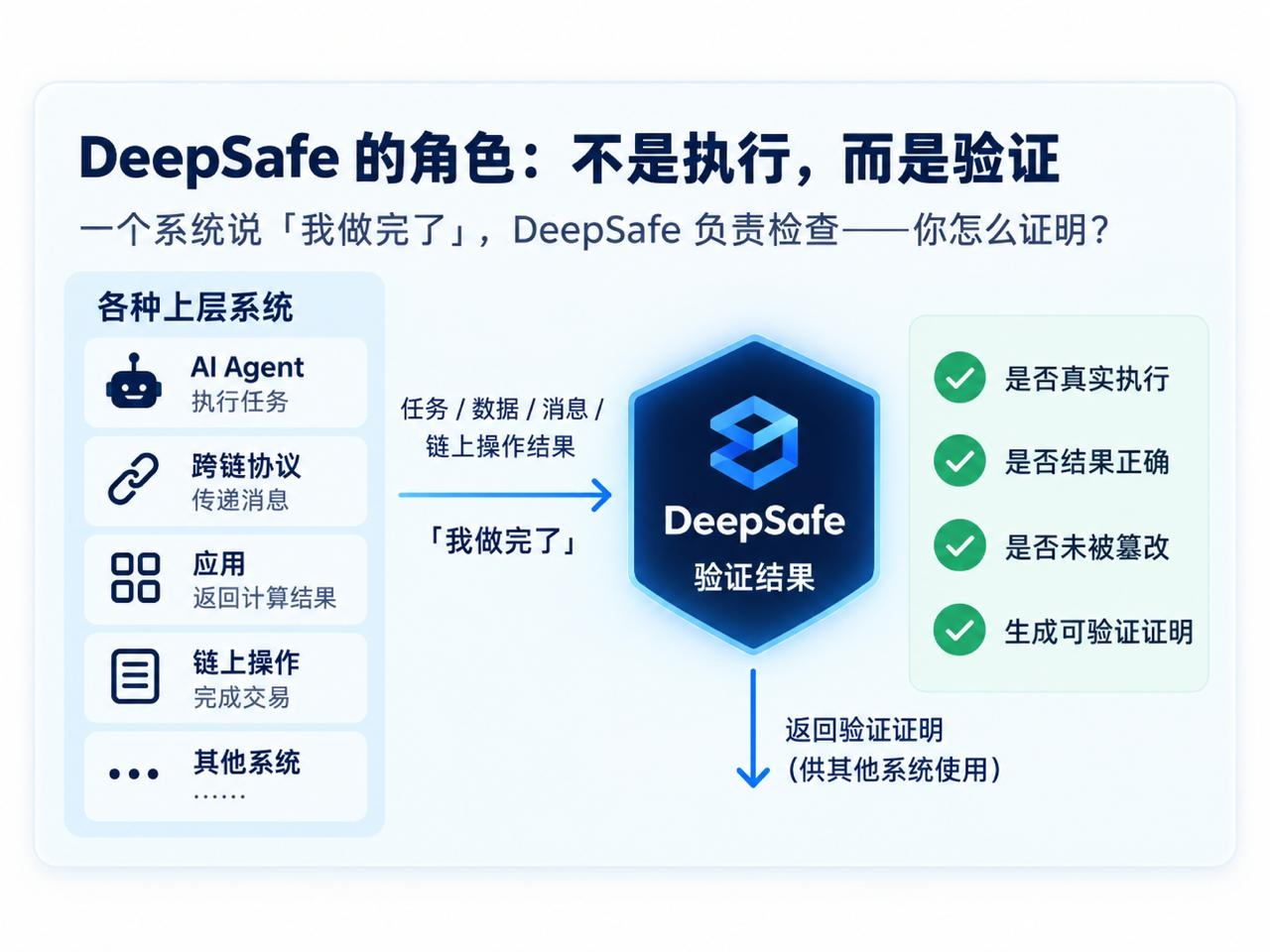
📍At its core, it wants to build an independent verification network.
No matter whether the upper layer is an AI Agent, a cross-chain protocol, an application, or any other system that requires trustworthy execution, DeepSafe wants to provide an external verification layer.
In plain language:
A system says, “I’m done,” and DeepSafe is responsible for checking—
How do you prove it?
🗝️ 1. What problem exactly does DeepSafe solve?
Today, many applications actually rely on a very simple trust model:
A server tells you what the result is, and you assume it isn’t malicious.
A node tells you the message has been executed, and you assume it’s telling the truth.
A system returns a result, and you assume it didn’t do any harm.
This isn’t a big issue in low-value scenarios.
But the moment money, assets, cross-chain, or automated execution come into play, the risk of single-point trust starts to balloon.
So what DeepSafe wants to do isn’t to complete all these tasks itself.
Instead, it adds a layer to the task:
verifiability.
For example:
An agent executes a transaction.
DeepSafe doesn’t take the place of trading for it; it verifies the execution result.
A certain system passes a cross-chain message.
DeepSafe isn’t responsible for deciding the content of the message; it verifies whether this message was produced and transmitted correctly.
A computation result needs to be adopted by other systems.
DeepSafe wants users not to have to simply trust the result provider.
That’s the core logic of what it calls the Verification Layer.
📍2. What is CRVA?
DeepSafe’s core is the CRVA verification network.
It involves different technologies like Ring VRF, MPC, TEE, ZKP, and more.
These English names look complicated, but you don’t really need to think of them as mystical.
It can be broken down into a few things:
🔻 Randomly select verifiers to reduce the risk of long-term control by fixed nodes’ systems;
🔻 Multiple parties jointly complete verification to prevent the result from being determined entirely by a single entity;
🔻 Use trusted execution environments like TEE to reduce the possibility that the execution process is externally interfered with;
🔻 And then, using cryptographic tools like ZKP, provide verifiable proofs for the result.
Putting these things together, what it ultimately aims to solve is just one problem:
How to reduce the risk of “one node deciding everything” as much as possible.
I think this is the most important point to understand DeepSafe.
There are many technical terms, but the project’s essence isn’t complicated.
It’s doing:
decentralized verification.
🗝️ 3. Why is it called a “Universal Verification Layer”?
because DeepSafe doesn’t want to bind itself to just one scenario.
If it only provides verification for a particular AI Agent, then it’s basically like an Agent plugin.
If it only serves cross-chain use cases, it’s more like a Bridge Verification Network.
But what DeepSafe wants to do is a deeper, more underlying layer:
As long as a system has a need for “the result to be verified by a third party,” in theory it can integrate.
So what it emphasizes is Universal.
This is also the infrastructure mindset that’s typical of this project:
It doesn’t directly produce the final product; it provides trusted capabilities for the upper-layer system.
If this positioning can ultimately be proven workable, its value won’t depend only on whether a single application succeeds; more importantly, it depends on whether it can become a verification network that different systems can jointly call.
Of course, this is also the difficulty.
“Universal” means the ceiling is high.
But it also means needing to be compatible with more scenarios, developer needs, and business requirements.
📍4. DeepSafe is not a sudden AI pivot
I think this is worth saying separately.
DeepSafe’s predecessor was Bool Network.
Since 2024, the team has been pushing forward on directions like the verification network, BTC cross-chain, TEE, CRVA, and more.
So what it talks about today is Verification—not suddenly packaging the original project into an AI concept after AI Agents became popular.
It was originally researching trusted execution and verification.
DeepSafe’s Beta Mainnet is already running.
Its native token is DEF, with a total supply of 1 billion coins.
You can also see continuous development records on GitHub.
Previously, the project also disclosed a $3 million Seed round, with participating institutions including Antalpha Ventures, ViaBTC Capital, Gate Ventures, Spark Digital Capital, CKB Eco Fund, and others.
At least from the timeline, its technical roadmap is continuous.
This is much stronger than simply “changing the name and riding the AI trend.”
🗝️ 5. I think what DeepSafe truly needs to prove isn’t technology, but demand
Projects like verification networks often have a problem:
The technology looks complete.
It has cryptography, TEE, MPC, and ZK—all of it.
The architecture diagram also looks great.
But in the end, there aren’t enough applications willing to call it.
That’s the biggest risk.
Because infrastructure ultimately has to answer one question:
Who’s willing to pay for this infrastructure layer?
For DeepSafe, I think the most worth watching going forward isn’t how many more technical modules get added.
Rather than a few more realistic metrics:
Is there real usage that keeps calling the verification network?
Can the number of verification requests grow?
Has there been a true, urgent need in AI, cross-chain, or on-chain automation scenarios?
Are developers willing to take on additional verification costs and latency?
And ultimately whether DEF can form a real link with network usage.
These things are more important than simply announcing a few partnerships.
📍So, if I were to give DeepSafe a positioning right now:
I would view it as an infrastructure project that supports the growth of a “verifiable computation / verifiable execution” requirement.
Its advantage is that the roadmap is fairly coherent, and it already has technical accumulation from the Bool Network era—it’s not starting from zero.
But its problems are also very typical:
Will the verification layer really become an independent and large-enough market?
We can’t answer in advance yet.
What DeepSafe needs to prove isn’t “Verification is important.”
There isn’t much controversy about this proposition.
The real difficulty is:
Is the market willing to pay specifically for Verification?
If in the future it can truly move from a “technical verification network” to “infrastructure that gets called by a large number of applications,” then this project can be considered to have completed its most critical step.
Before that, I’d be more inclined to put it on a watchlist.
The technical roadmap is already there—what remains is usage.