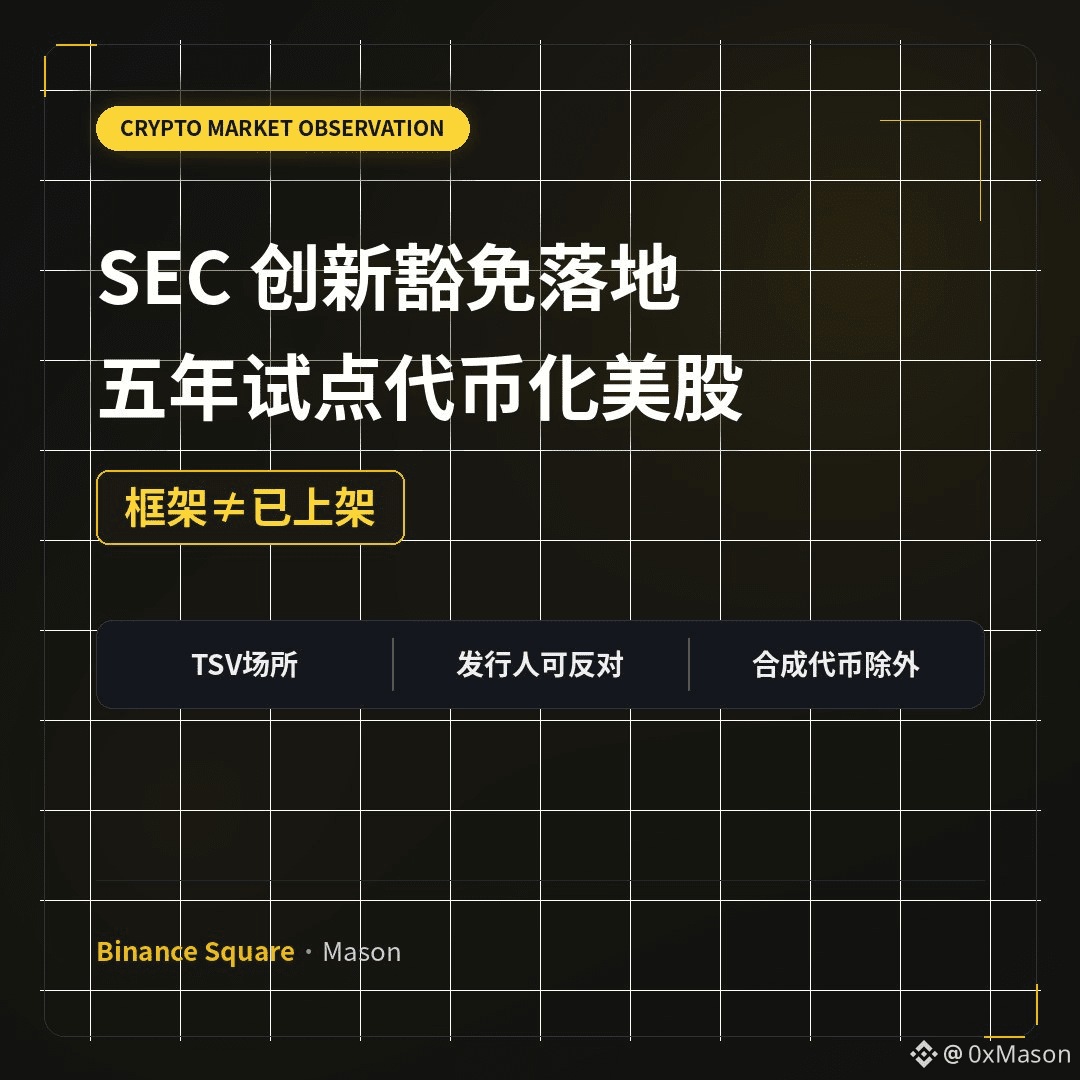
SEC Innovation Exemption: Five-Year Pilot for Tokenized U.S. Stock Trading Venues — Framework ≠ Already Listed
Don’t mistake today’s adoption of the “SEC-approved innovation exemption” as meaning tokenized U.S. stocks can now be freely put on-chain and traded.
What’s being implemented today is a five-year, conditional, temporary framework: a licensed Tokenized Securities Venues model. With AMM liquidity pools matching tokenized NMS-listed stocks, these venues may be temporarily not treated as “exchanges” under the Exchange Act of 1934. Parties that provide liquidity to the pools also receive a conditional dealer exemption. The threshold is spelled out very strictly—there are caps on the number of underlying assets and trading volume; the tokens must carry the same rights as comparable traditional stocks; any third party that wants to tokenize a particular stock must provide written notice to the issuer, which the counterparty can object to; the smart contracts must be auditable, public, and deployed on a permissionless public ledger; and if the primary market pauses trading, trading must pause here as well. For derivative token products that look “like stocks” through synthetic exposure, Reuters states they are explicitly not included in this framework.
Here’s the catch: the exemption relaxes rules for venues and market-making structures—not a retail ordering menu you can use to place trades immediately. If an issuer objects, listings can be blocked. If you’re not on the allowed permission list, you can’t get in or even reach the pools. The framework is open—but it doesn’t mean the assets are already on the shelf.
Don’t mistake today’s adoption of the “SEC-approved innovation exemption” as meaning tokenized U.S. stocks can now be freely put on-chain and traded.
What’s being implemented today is a five-year, conditional, temporary framework: a licensed Tokenized Securities Venues model. With AMM liquidity pools matching tokenized NMS-listed stocks, these venues may be temporarily not treated as “exchanges” under the Exchange Act of 1934. Parties that provide liquidity to the pools also receive a conditional dealer exemption. The threshold is spelled out very strictly—there are caps on the number of underlying assets and trading volume; the tokens must carry the same rights as comparable traditional stocks; any third party that wants to tokenize a particular stock must provide written notice to the issuer, which the counterparty can object to; the smart contracts must be auditable, public, and deployed on a permissionless public ledger; and if the primary market pauses trading, trading must pause here as well. For derivative token products that look “like stocks” through synthetic exposure, Reuters states they are explicitly not included in this framework.
Here’s the catch: the exemption relaxes rules for venues and market-making structures—not a retail ordering menu you can use to place trades immediately. If an issuer objects, listings can be blocked. If you’re not on the allowed permission list, you can’t get in or even reach the pools. The framework is open—but it doesn’t mean the assets are already on the shelf.