


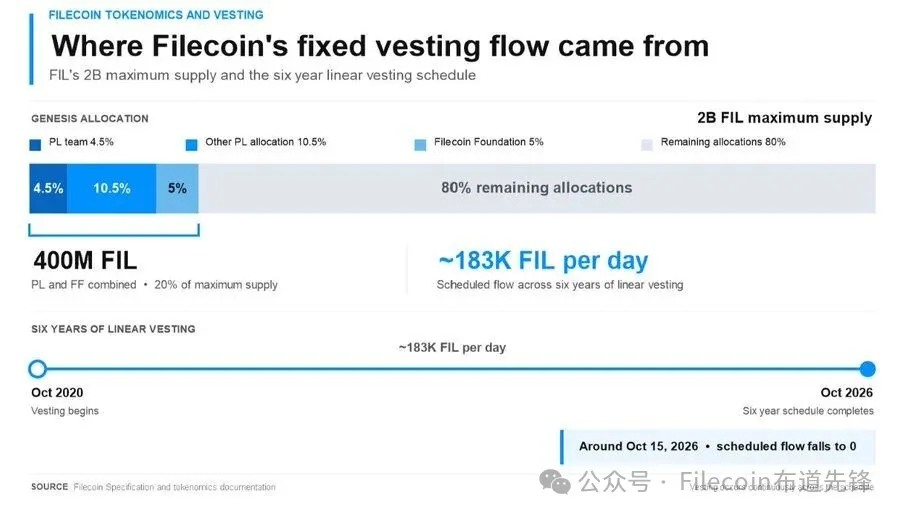
On October 15, 2026, Filecoin will reach a key milestone in its tokenomics: the full 6-year linear unlock period by Protocol Labs and the Filecoin Foundation will come to an end. The fixed daily inflow of approximately 183,000 FIL will drop to zero, and the network’s total issued supply will decrease by roughly 75% directly.
After that, the circulating supply of Filecoin will no longer be driven primarily by early-institution unlocks; instead, it will be determined by real business needs from the network.
This article doesn’t talk about mysterious concepts—it only covers three things: how much the six-year unlock actually releases, what changes occur to the supply formula, and whether it will trend toward contraction or continued growth under three different scenarios.
1. Historical unlocks: 400 million FIL over six years, continuously flowing in at 183,000 FIL per day
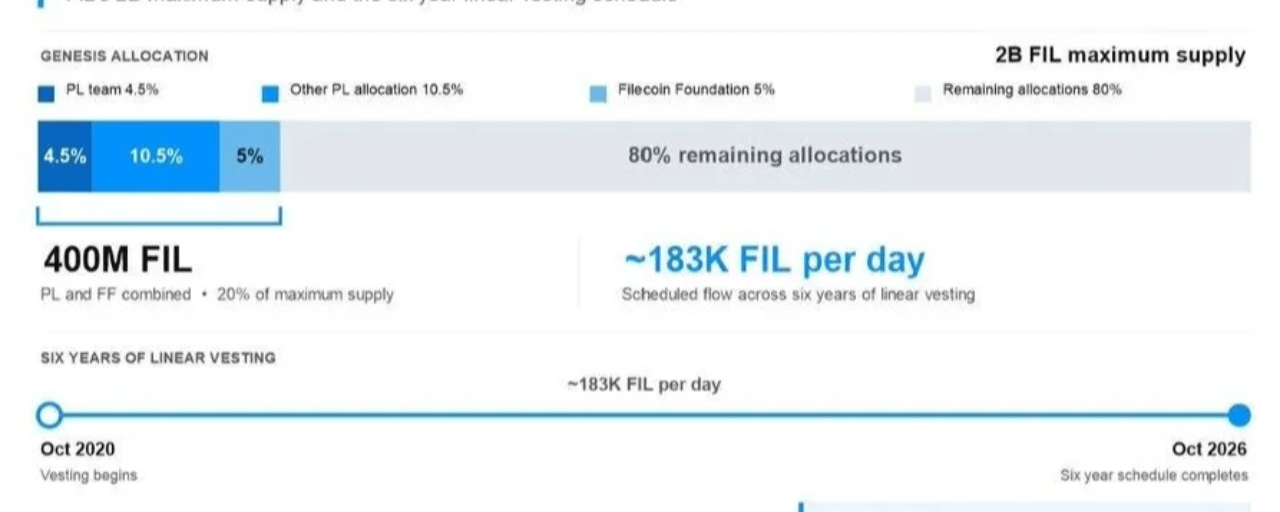
In Filecoin’s genesis allocation, Protocol Labs (PL) receives 15% of the total, and the Filecoin Foundation (FF) receives 5%. Together, that totals 400 million FIL, distributed via a linear unlock schedule over 6 years—starting in October 2020 and continuing until October 15, 2026.
Over these six years, this portion of tokens steadily releases into the circulating market at a pace of about 183,000 FIL per day.
PL+FF annual unlock volume is about 66.7 million FIL, while annual block reward production is about 21.7 million FIL. Before October 15, the PL and FF unlocks are a very important source of circulating supply.
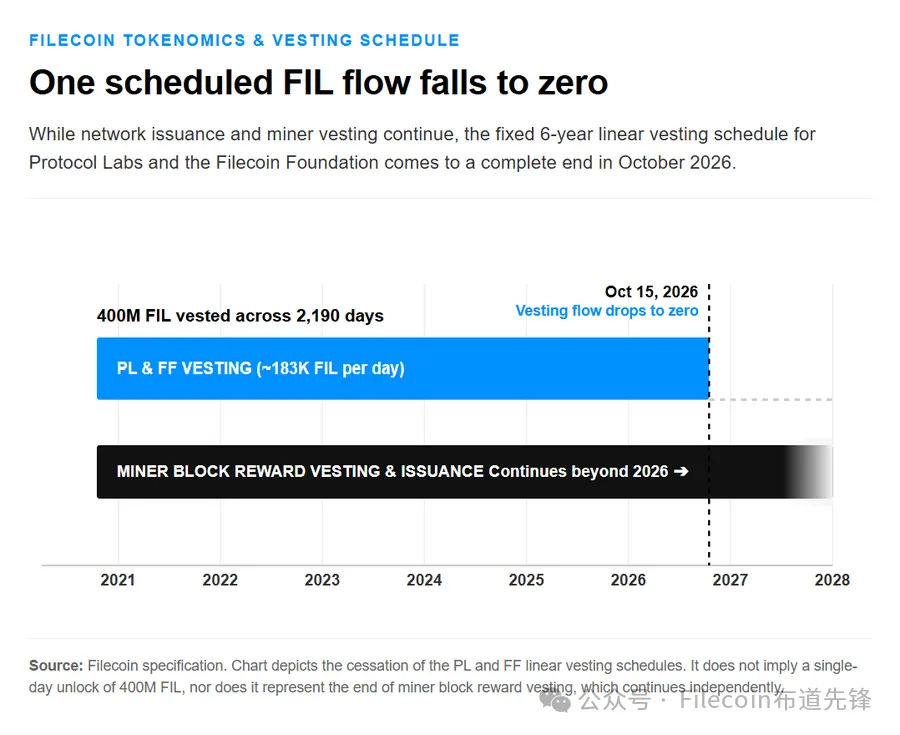
After the unlock completes on October 15, this daily fixed inflow immediately goes to zero, and the network’s total issuance drops directly by 75%.
Special note: the unlocking of miner block rewards will continue and will not stop. What ends completely is the fixed linear unlock schedule for PL and the foundation.
Second, rewritten supply formula: the weights of collateral lockups and burning increase significantly
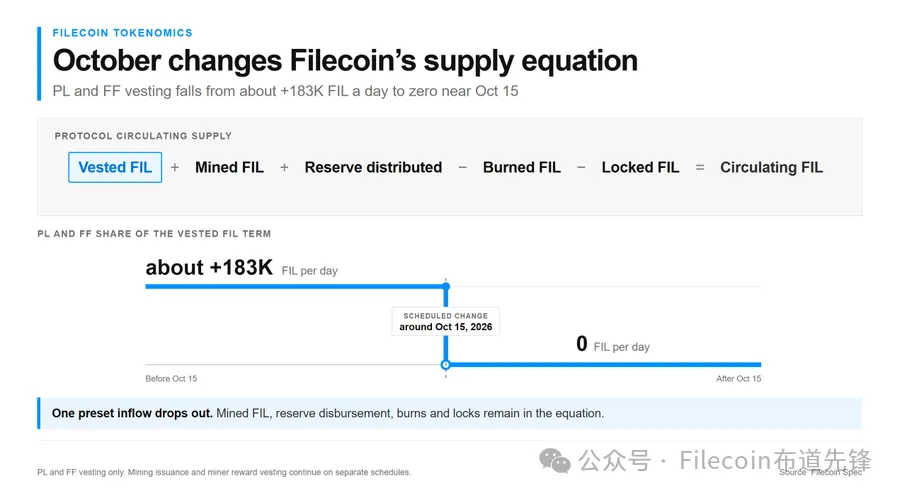
Filecoin circulating supply calculation formula:
Circulating FIL = unlocked FIL + produced FIL + reserve distribution − burned FIL − collateral locked FIL
After October 15, the unlock items for PL and FF directly become 0. The remaining variables are only: miner block rewards, reserve distributions, collateral lockups, and token burning.
In other words: collateral lockups and token burning will have a significantly amplified impact on daily circulating supply. Real on-chain storage business (new order collateral, order renewal collateral lockups) will increasingly determine how daily circulating supply changes.
Third, simulation of three future scenarios: from modest growth to net deflation
Filecoin TL;DR: Based on on-chain data, we built three sets of models for projections. The baseline reference is daily supply +474K FIL in August 2026, projected through the end of 2027.
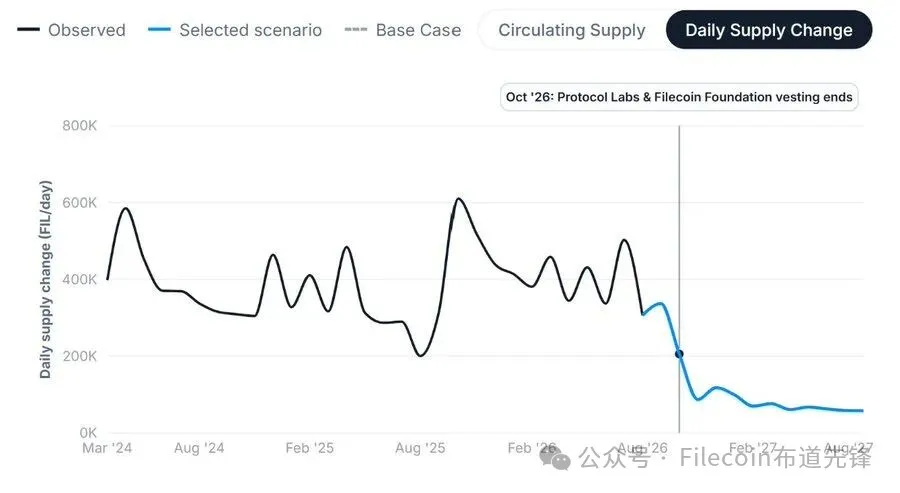
Scenario 1: Baseline Case
New storage orders grow by 10% each month, while renewals stay at the current level. By the end of 2027, daily supply growth declines to +46K FIL. Compared with the August baseline, daily supply growth drops 90%—it still remains positive growth and will not become deflationary.
Scenario 2: Demand Stalls
New orders have fallen sharply: daily new additions are only 0.1 PiB, and the renewal rate drops to 10%. By the end of 2027, daily supply growth will be +68K FIL. Compared with the baseline, that’s down 86%; it’s still positive supply growth, but heavily suppressed.
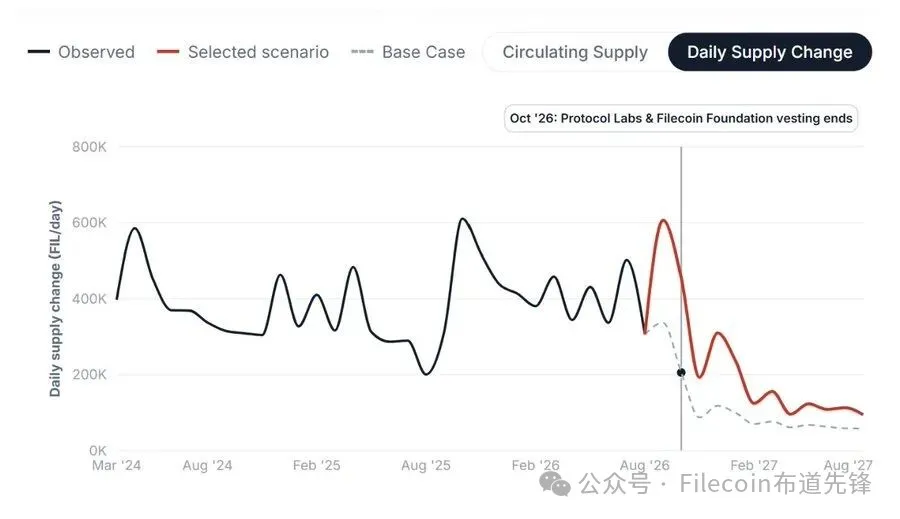
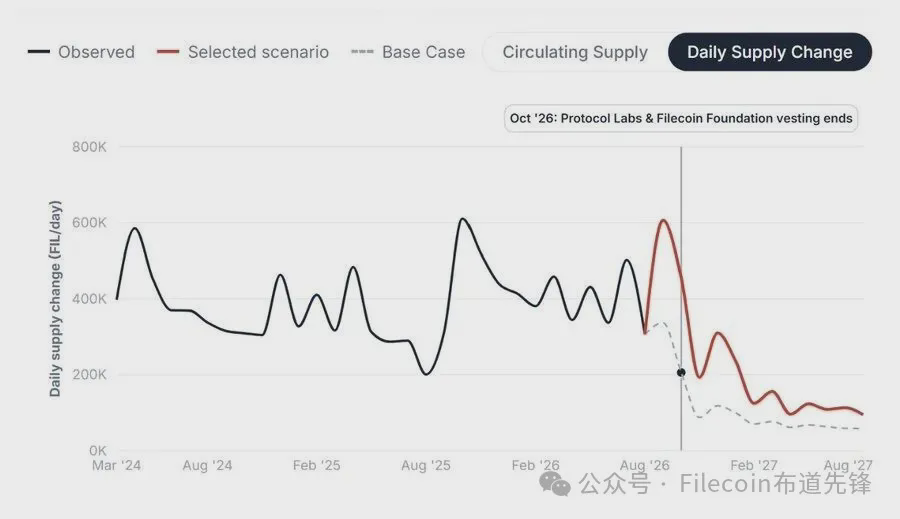
Scenario 3: Demand Surge
Storage business explodes: daily new storage reaches 35 PiB, and the renewal rate rises to 80%. By the end of 2027, the daily supply change reaches −90K FIL, entering a net deflationary state.
Net deflation trigger condition: when the total amount of new collateral lockups + token burning on the network exceeds protocol inflows such as mining output, daily circulating supply becomes negative—that is, net deflation. New order collateral lockups and order renewals will continue to lock FIL; expired sectors release the collateral back into circulation.
Fourth, the most important change: the supply logic is completely switched
Over the past six years, genesis unlocks (PL&FF) have been an important driver of circulating supply growth. Institutions release tokens linearly over time, leaving business demand only able to passively adapt to supply.
After October 2026, the rules of the game change fundamentally:
Network business demand will become the core force influencing daily circulating supply.
More storage orders and strong renewals: large amounts of FIL are locked as collateral, making deflation more likely; weak storage business: fewer collateral lockups, and circulating supply will remain in a small-growth pattern.
Filecoin has officially entered a new phase of “demand-driven supply.”
Fifth, combining the present: dual resonance between on-chain commercialization and the token model
Based on recent on-chain data, the three main threads are stacking together:
First, Onchain Cloud on-chain cloud payment metrics continue to surge. Filecoin Pay’s GPV annualized and active paying users keep rising—real commercial demand is taking shape.
Second, the October FIP-0118 Solstice upgrade. Rewards will be tied to real paid business; rewards without real business will be destroyed, further strengthening the logic of demand-driven supply.
Third, the PL&FF unlock ends on October 15. This brings a 75% supply contraction, and the fixed inflow from institutional unlocks becomes彻底 zero.
The combined effect of technical upgrades, commercialization rollout, and shrinking token supply is the underlying logic of this Filecoin cycle.
Sixth, rationally assess it: four risks you can’t ignore
First, the model is only for simulated projections; it doesn’t mean it will necessarily happen in the future. The actual outcome depends on the real scale of stored business rollout. The three scenarios are theoretical projections based on current data.
Second, even after unlocks end, miner block rewards continue to be produced. It does not immediately become deflationary; under both the baseline scenario and the demand-stagnation scenario, supply still maintains positive growth.
Third, to achieve net deflation, you need sufficiently strong storage business demand to support it. The demand surge scenario—35 PiB daily new additions and an 80% renewal rate—requires the Onchain Cloud ecosystem to continuously attract large-scale enterprise customers.
Fourth, crypto asset volatility is extremely high; changes in token economics do not necessarily mean the price will rise. Supply contraction is only one basic variable of the fundamentals; the price is also affected by multiple factors such as market sentiment, macro environment, and capital flows.
Conclusion
October 15 is a critical turning point in Filecoin’s development history. After six years of linear institutional unlocks end, the network shifts from “time determines supply” to “real business demand determines supply.”
The direction of the future network will depend more on real commercial demand from ecosystems such as Onchain Cloud, the AI memory layer, and Warm Storage, and on how they are rolled out.
What can be determined right now is: the fixed inflow from institutional unlocks is about to go to zero, and the supply formula has already been rewritten. But how it will ultimately affect the network landscape and token value depends on subsequent ecosystem rollout, enterprise adoption, and market feedback.
Source of material: official media / online news
Statement: The content published on this account is for learning and exchange purposes only. The materials in the text come from publicly available online sources. If any copyright issues are involved, please leave a message to contact us, and we will correct or remove it promptly. This article is intended to share more market information and does not constitute any investment advice.