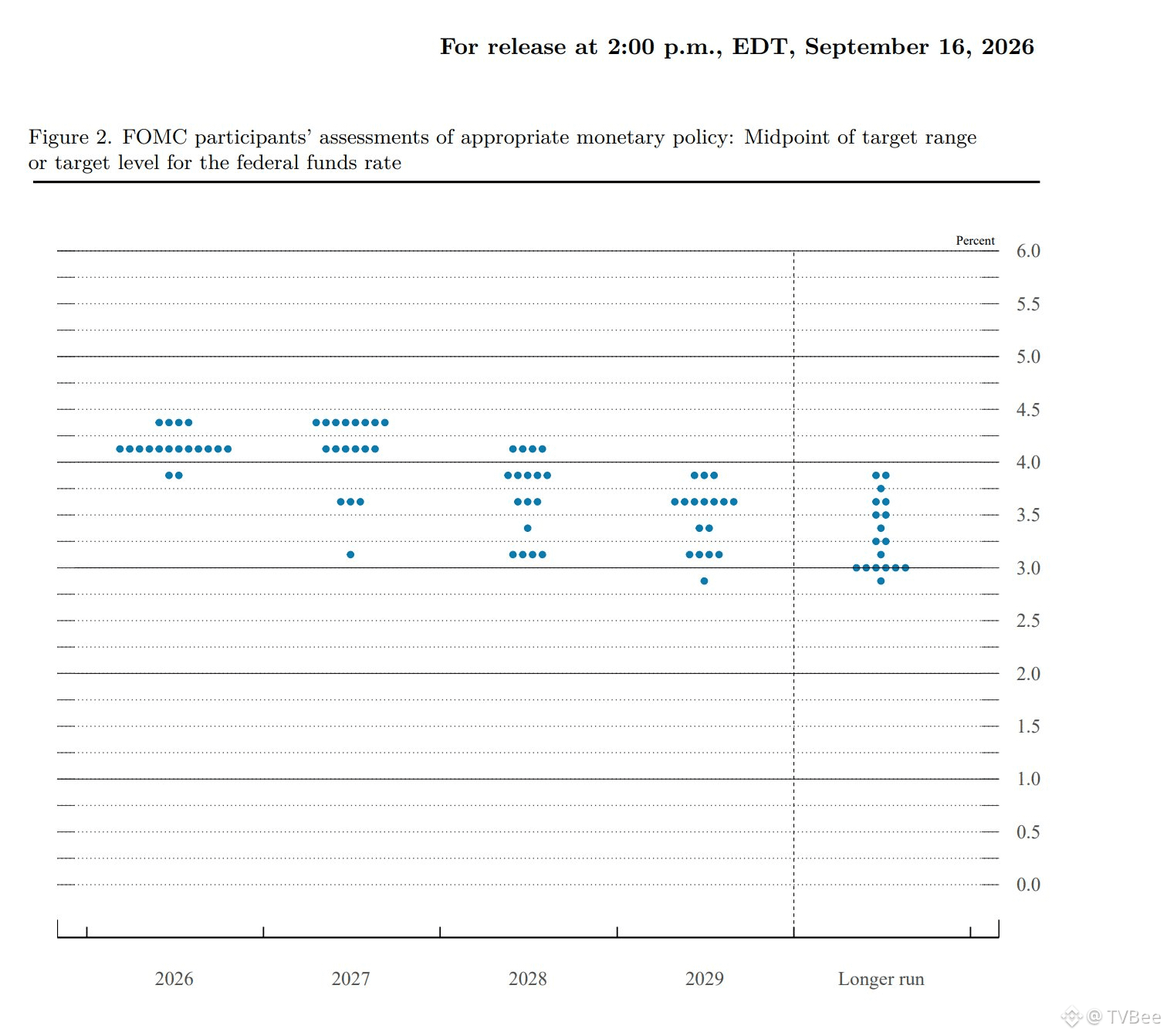

Excellent— the Federal Reserve’s independence has been proven, and it continues to disrupt market expectations with a slightly hawkish dot plot. By the end of next year, there may be 1–2 more rate hikes.
┈➤12:0 rate-hike decision
12 Federal Reserve officials—none had concerns about U.S. Treasury yields, and none paid attention to Trump’s request to cut rates...
Of course, they still worry about the impact of rate hikes on the economy and employment. So the dot plot should be considered slightly hawkish, but not too hawkish.
┈➤Slightly hawkish dot plot
The dot plot has only 18 dots. Waller should have abstained again and did not participate in the forecast.
╰✦ A major forecast for 2026: one more rate hike
Based on the dot plot forecast, most likely (12 people, 66.67%) expect another rate hike in 2026 (by 25 basis points).
4 people expect two more hikes, and 2 people expect rates to remain unchanged.
╰✦ 2027 forecast: 0–1 rate hike
As for 2027, on top of the one hike already expected in 2026:
8 people (44.4%) think there will be one more hike (25 basis points), 6 people (33.33%) think rates will stay unchanged, 3 people think there will be two rate cuts, and 1 person thinks there will be four rate cuts.
If we consider the mode, there should be one more rate hike in 2027.
If we consider the median, rates should remain unchanged in 2027.
╰✦ Possible rate cuts in 2028
After 2028, the dot plot shows expectations for rate cuts—which also seems reasonable. By 2028, Trump is set to leave office, and the U.S. and Iran may enter a reconciliation process after Trump’s departure, with expectations brought forward; on the other hand, Venezuela’s oil infrastructure is gradually improving and should continue to grow, so global oil supply may increase. As a result, oil prices and inflation in 2028 are expected to decline.
Up to the end of next year, according to the September dot plot, the Federal Reserve may still hike rates 1–2 more times (strictly speaking, one scenario cannot be ruled out: more than two hikes, followed by subsequent rate cuts later). Ultimately, it will still depend on the trend of oil prices and inflation.
As of the end of next year, under normal circumstances there are still 10 FOMC meetings left, implying 1–2 more hikes. Brother Feng thinks this is slightly hawkish—possibly even weaker than “slightly hawkish.” (In the media’s wording system, it includes: dovish, slightly dovish, neutral, slightly hawkish, hawkish.)
┈➤12:0 rate-hike decision
12 Federal Reserve officials—none had concerns about U.S. Treasury yields, and none paid attention to Trump’s request to cut rates...
Of course, they still worry about the impact of rate hikes on the economy and employment. So the dot plot should be considered slightly hawkish, but not too hawkish.
┈➤Slightly hawkish dot plot
The dot plot has only 18 dots. Waller should have abstained again and did not participate in the forecast.
╰✦ A major forecast for 2026: one more rate hike
Based on the dot plot forecast, most likely (12 people, 66.67%) expect another rate hike in 2026 (by 25 basis points).
4 people expect two more hikes, and 2 people expect rates to remain unchanged.
╰✦ 2027 forecast: 0–1 rate hike
As for 2027, on top of the one hike already expected in 2026:
8 people (44.4%) think there will be one more hike (25 basis points), 6 people (33.33%) think rates will stay unchanged, 3 people think there will be two rate cuts, and 1 person thinks there will be four rate cuts.
If we consider the mode, there should be one more rate hike in 2027.
If we consider the median, rates should remain unchanged in 2027.
╰✦ Possible rate cuts in 2028
After 2028, the dot plot shows expectations for rate cuts—which also seems reasonable. By 2028, Trump is set to leave office, and the U.S. and Iran may enter a reconciliation process after Trump’s departure, with expectations brought forward; on the other hand, Venezuela’s oil infrastructure is gradually improving and should continue to grow, so global oil supply may increase. As a result, oil prices and inflation in 2028 are expected to decline.
Up to the end of next year, according to the September dot plot, the Federal Reserve may still hike rates 1–2 more times (strictly speaking, one scenario cannot be ruled out: more than two hikes, followed by subsequent rate cuts later). Ultimately, it will still depend on the trend of oil prices and inflation.
As of the end of next year, under normal circumstances there are still 10 FOMC meetings left, implying 1–2 more hikes. Brother Feng thinks this is slightly hawkish—possibly even weaker than “slightly hawkish.” (In the media’s wording system, it includes: dovish, slightly dovish, neutral, slightly hawkish, hawkish.)