
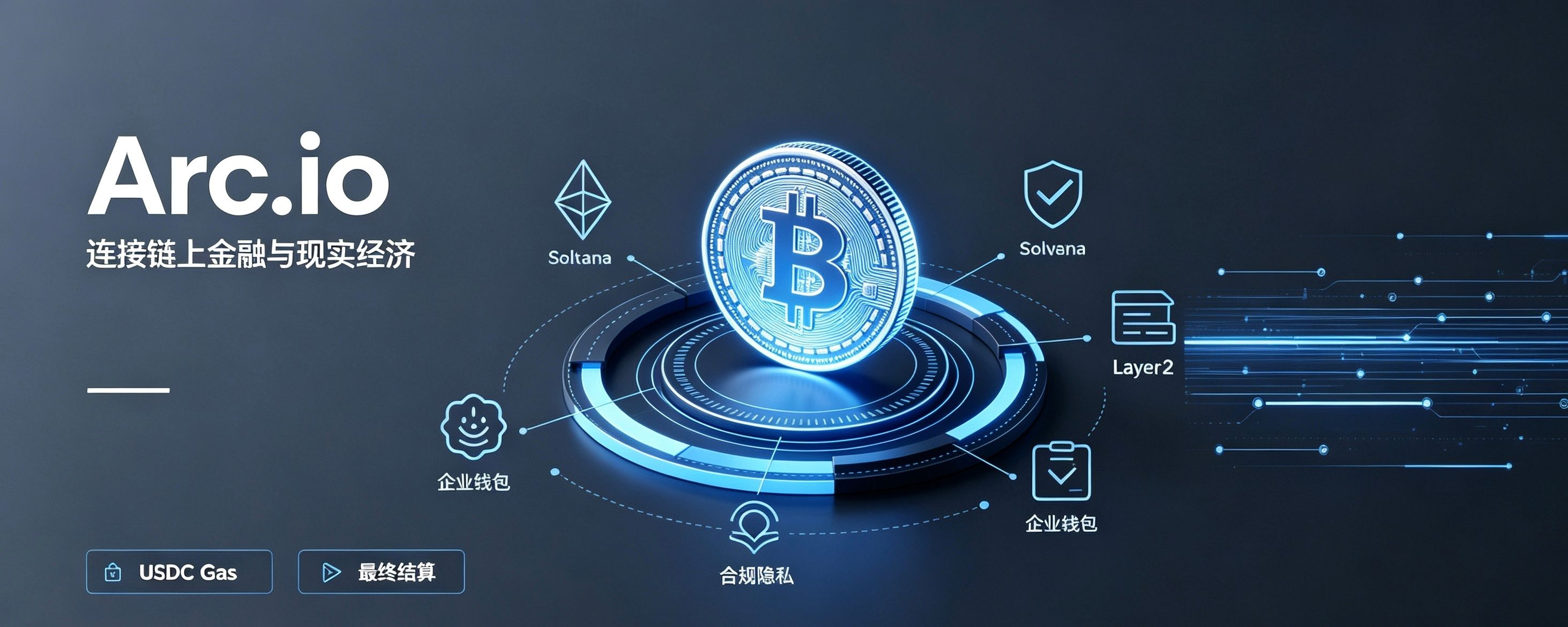

As stablecoin USDC has already become the most important store of value on-chain, the shortcomings of existing public chains are becoming increasingly clear: gas costs fluctuate dramatically with token market conditions, transactions carry the risk of being rolled back, institutional compliance and privacy are difficult to balance, and cross-chain asset transfers are cumbersome.
Circle has launched a new public blockchain layer, Arc (official site: arc.io). Its positioning is the economic operating system of the internet. It is not a general-purpose public chain for NFTs or chain games; instead, from the ground up, it is custom-built for real-world financial business volume. Behind it are major traditional financial players, including Goldman Sachs, BlackRock, Visa, and Mastercard. This is a Web3-and-traditional-finance convergence experimental project that is definitely worth paying attention to.
Open the arc.io official website, and you can see the complete project vision, technical features, deployment scenarios, institutional partnerships, and developer documentation. Currently, the Arc testnet is already running stably. Each week it processes nearly 20 million transactions. The number of deployed contracts is substantial, and the developer ecosystem is being built quickly.
Arc’s four core technology designs directly address pain points in financial scenarios
1. Use USDC as gas fees—costs are predictable
The vast majority of public chains require native tokens to pay Gas. Sudden token price surges or crashes directly make transaction costs uncontrollable, preventing companies from doing financial budgeting.
Arc directly uses USDC to pay transaction fees. Regardless of the transfer amount, transaction costs remain stable. On the testnet, the average per-transaction cost is only $0.045—clearing the cost barrier for enterprise-grade applications.
2. Sub-second deterministic finality
Transaction confirmation on a typical public chain is not equal to final completion. There is a risk of block reorganizations and transaction rollbacks. If a large financial transaction rolls back, it can cause enormous losses.
Arc relies on the Malachite consensus engine to achieve sub-second irreversible settlement. Once a transaction is completed, it will not roll back. This meets the settlement standards of traditional financial infrastructure and is suitable for business scenarios such as cross-border payments, clearing, and lending.
3. Optional privacy mechanisms that balance transparency and compliance
The protocol comes with optional privacy capabilities. Enterprises can hide sensitive transaction information while still retaining audit rights. Regulatory bodies can still perform compliance reviews. No extra privacy-module secondary development is needed for developers—solving the core dilemma for institutions.
4. Native full-stack integration with Circle’s entire technology ecosystem
Arc natively integrates USDC, EURC stablecoins, the CCTP cross-chain protocol, and the Gateway deposits/withdrawals channel. Assets can freely flow to major public chains such as Ethereum and Solana without being locked into a single ecosystem, greatly reducing the development difficulty of financial DApps. Multiple deployment scenarios—aiming at real-world finance
Arc is not limited to retail speculation—it targets large-scale real-world economic use cases:
✅ AI agent economy: Enables AI Agents to autonomously complete signing and fund settlement, adapting to a new economic model driven by artificial intelligence;
✅ On-chain FX: Powered by StableFX, enabling 7×24 nonstop currency exchange with instant settlement;
✅ Cross-border payments: Low-cost, instant transfers that support enterprise bulk payroll disbursements and cross-border compensation;
✅ Enterprise treasury management: A programmable on-chain treasury system that automates fund allocation and provides real-time monitoring of cash positions;
✅ Tokenization of real-world assets: Real-world assets such as bonds, real estate, and funds can be issued and traded on-chain to meet institutional compliance needs.
A luxury-grade institutional ecosystem that is open yet highly focused on compliance
Arc’s early partner lineup is exceptionally impressive: Goldman Sachs, Mastercard, Visa, BlackRock, State Street Bank, and Standard Chartered Bank are all deeply involved in building the network. The founding verification nodes are mainly composed of top global financial institutions, meeting the trust standards required for financial infrastructure.
However, it is not a permissioned chain. Ordinary developers and startup teams can still deploy contracts without permission. The official website provides complete developer documentation and sample code. The community can also get project updates via Discord, balancing institutional security with open innovation in Web3.
Opportunities and challenges
Circle CEO views Arc as the most important product after USDC. USDC solves the underlying problem of issuing on-chain digital dollars, while Arc solves the underlying issue of efficiently operating digital dollars in a compliant manner. But the project still faces real challenges: the ecosystem is still at an early stage, and large-scale institutional deployment will take time. The institutional node model also sparks community discussions about how decentralized the system is. Changes in global regulatory policies will likewise directly affect the project’s development.
Arc.io presents a new way of thinking: blockchains are no longer only meant to serve crypto speculation, but instead aim to handle the trillion-level real-world flow of funds. Whether it can truly bridge traditional finance and the on-chain world is worth continued observation.
Topic tags
#Arc #ArcIO #USDC #Circle #RWA
Risk Warning: The above is for project introduction only and does not constitute investment advice. The crypto market is extremely risky—participate with caution.