#FedRateWatch
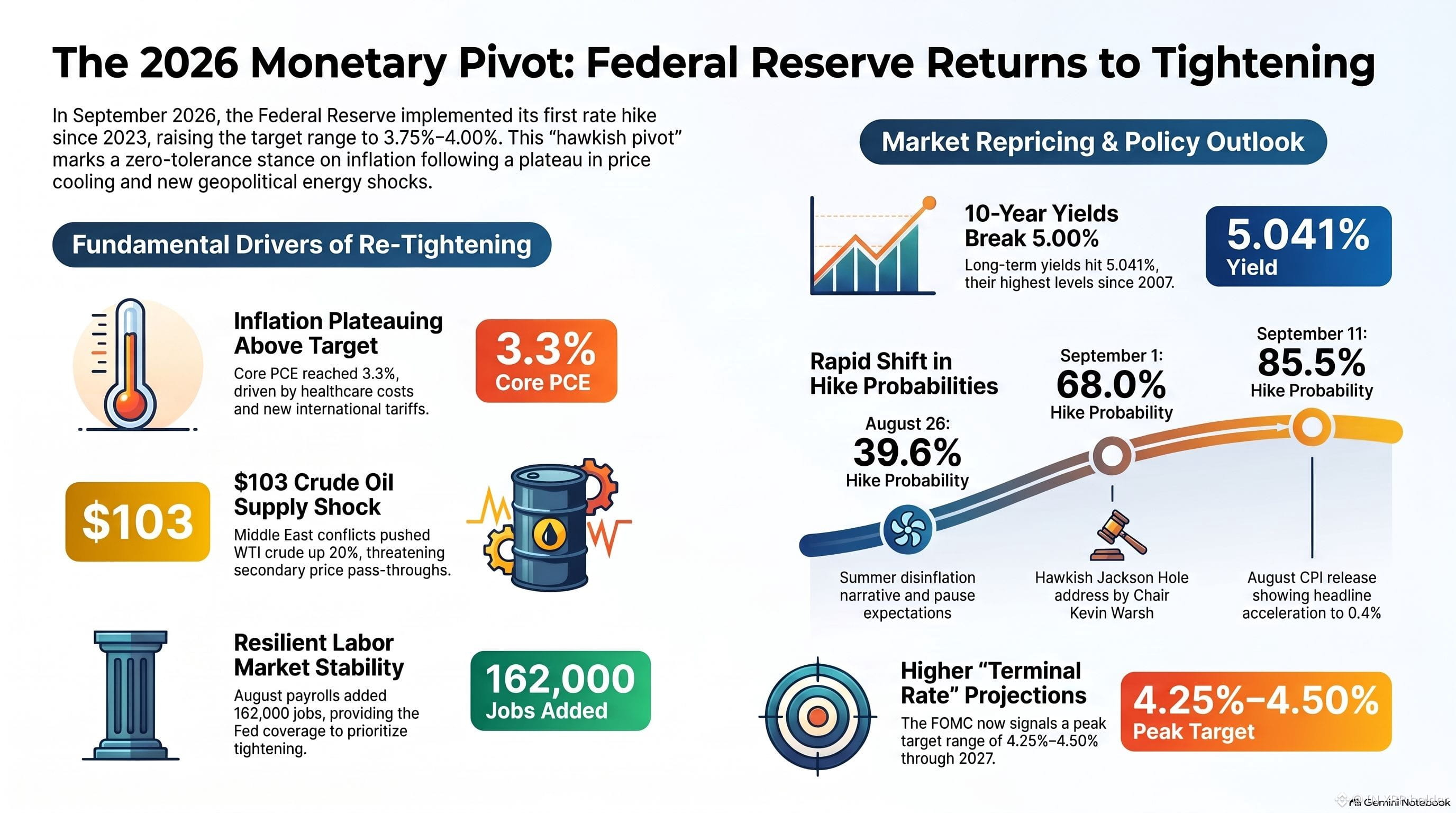
The Federal Open Market Committee (FOMC) entered its September 15–16, 2026 policy meeting under intense macroeconomic pressure, culminating in an expected 25 basis point increase in the benchmark federal funds rate to a target range of 3.75% to 4.00%. This policy adjustment represents the Federal Reserve's first rate increase since July 2023. The decision effectively reverses a period of monetary easing delivered in late 2025, which had established a target range corridor of 3.50% to 3.75% that remained unchanged through seven consecutive months in early and mid-2026.
The historical path of the target rate underscores the magnitude of this transition. After reaching a peak target range of 5.25% to 5.50% in July 2023, monetary policy underwent an easing phase throughout late 2025 that brought the policy target down to 3.50%–3.75%. The subsequent decision to hold rates firm from December 2025 through August 2026 was designed to give previous adjustments time to propagate through the economy. However, persistent price pressures forced a return to active tightening in September 2026.
This pivot highlights a fundamental shift in central bank governance under Federal Reserve Chair Kevin Warsh. Taking a firm stance on price stability, Chair Warsh's communication strategy—originally articulated at the Jackson Hole Economic Symposium—operates on the premise that inflation is fundamentally a choice, signaling a zero-tolerance approach to persistent price pressures. Under Warsh's leadership, the FOMC has de-emphasized explicit long-term forward guidance, choosing instead to focus on near-term balance sheet flexibility and incoming economic indicators. Consequently, the central bank moved to address accelerating inflation expectations before second-round effects could embed themselves across domestic labor and product markets.
The Federal Open Market Committee (FOMC) entered its September 15–16, 2026 policy meeting under intense macroeconomic pressure, culminating in an expected 25 basis point increase in the benchmark federal funds rate to a target range of 3.75% to 4.00%. This policy adjustment represents the Federal Reserve's first rate increase since July 2023. The decision effectively reverses a period of monetary easing delivered in late 2025, which had established a target range corridor of 3.50% to 3.75% that remained unchanged through seven consecutive months in early and mid-2026.
The historical path of the target rate underscores the magnitude of this transition. After reaching a peak target range of 5.25% to 5.50% in July 2023, monetary policy underwent an easing phase throughout late 2025 that brought the policy target down to 3.50%–3.75%. The subsequent decision to hold rates firm from December 2025 through August 2026 was designed to give previous adjustments time to propagate through the economy. However, persistent price pressures forced a return to active tightening in September 2026.
This pivot highlights a fundamental shift in central bank governance under Federal Reserve Chair Kevin Warsh. Taking a firm stance on price stability, Chair Warsh's communication strategy—originally articulated at the Jackson Hole Economic Symposium—operates on the premise that inflation is fundamentally a choice, signaling a zero-tolerance approach to persistent price pressures. Under Warsh's leadership, the FOMC has de-emphasized explicit long-term forward guidance, choosing instead to focus on near-term balance sheet flexibility and incoming economic indicators. Consequently, the central bank moved to address accelerating inflation expectations before second-round effects could embed themselves across domestic labor and product markets.