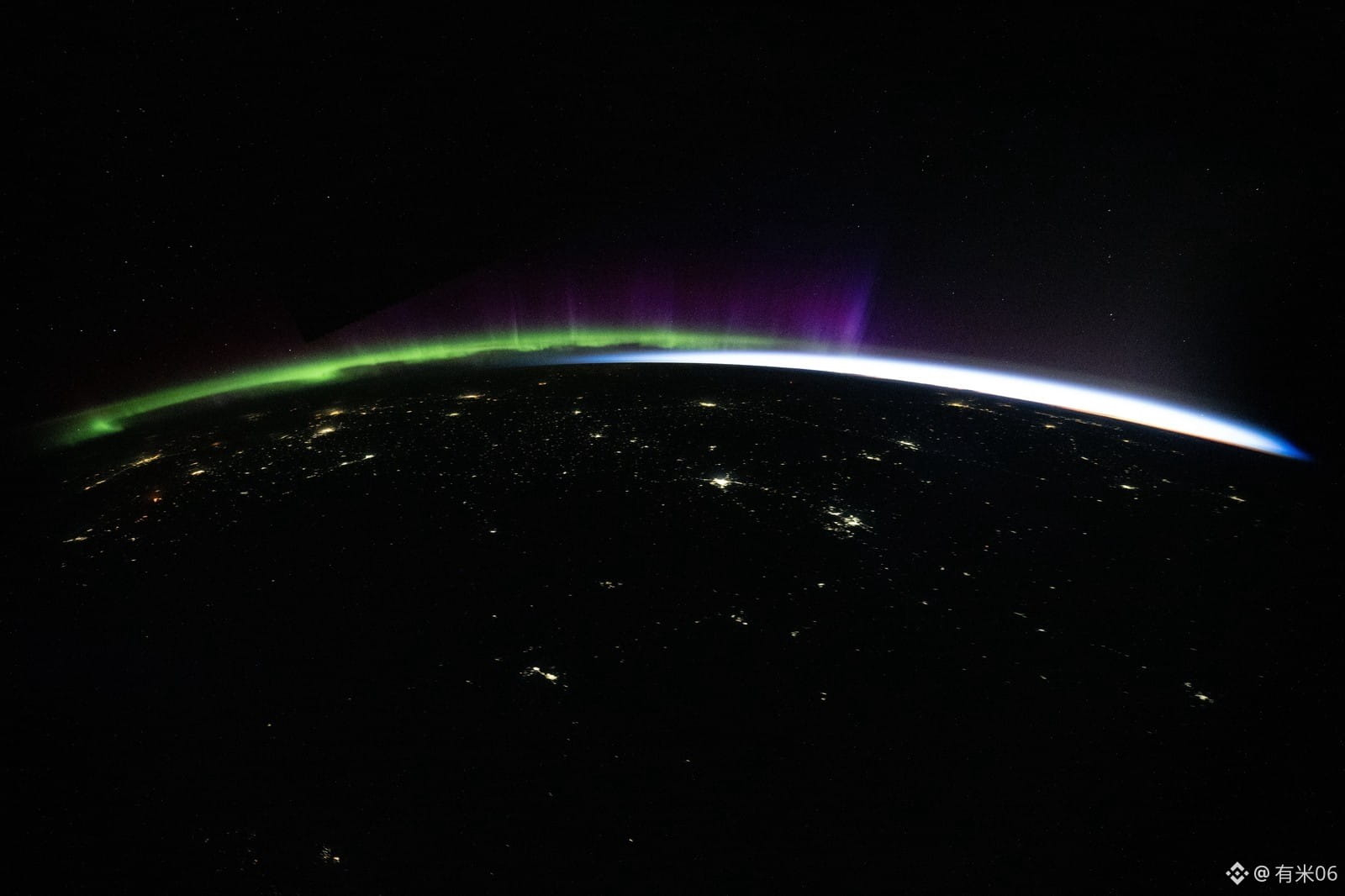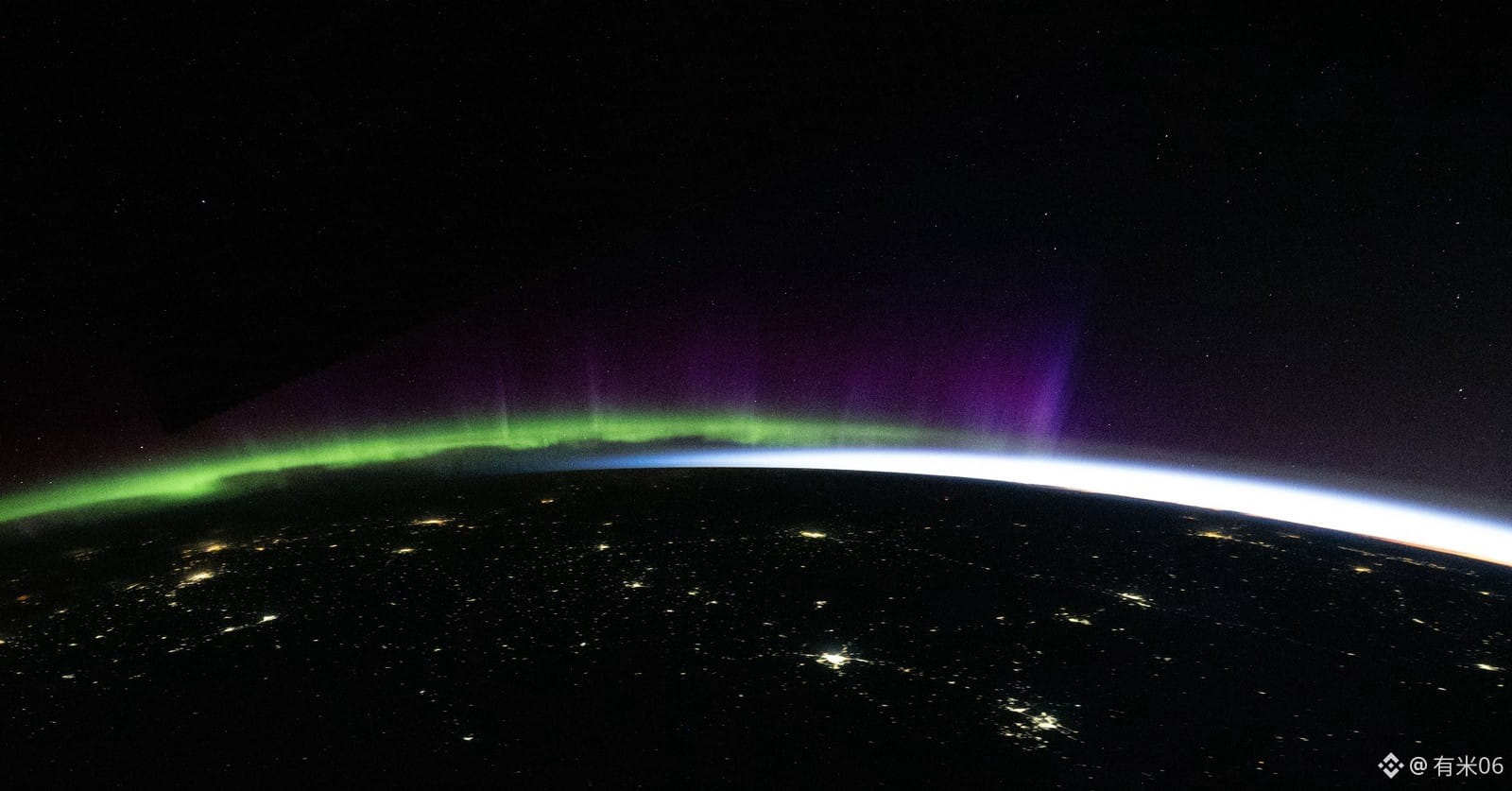
Looking down from the space station, this aurora over Kyrgyzstan: a green band hugs the edge of the atmosphere, while a rare patch of purple flashes up.
According to NASA Earth Observatory (2026-09-16, image for today): Expedition 75 astronauts captured ISS075-E-88592 on 2026-09-07. At the time, the ISS was at an altitude of about 411 kilometers (255 miles), and the sub-satellite point was over the northern part of Kyrgyzstan. The photo was taken with a Nikon Z9 at a focal length of 15 millimeters. The green band curves along the horizon, while purple/magenta light columns rise and spread apart; below, you can still see the city lights across Central Asia. The next day, NASA astronaut Jessica Meir posted that she had “never seen such a bright purple wavelength,” and she also quoted Hendrix’s line, “I wanna kiss the sky.”
Explanation: The NOAA Space Weather Prediction Center says that at the time, high-speed solar wind from a coronal hole combined with residual effects from multiple coronal mass ejections. Magnetospheric disturbances then triggered a mild (G1) geomagnetic storm. The purple light is often linked to nitrogen excitation, or to the alignment and superposition of green/red light along the line of sight; when viewed from the orbital side, altitude layering becomes clearer. Around the equinoxes in spring and autumn, geomagnetic field and solar-wind geometry are more “in sync” (the Russell–McPherron effect), so astronauts are more likely to encounter displays like this.
Independent verification: Fstoppers (2026-09-16) confirmed the same frame number, the approximate capture time of 21:46 GMT, the sub-satellite point of about 41.9°N / 72.2°E, and the G1 / coronal-hole high-speed stream criteria—consistent with NASA EO.
Image: NASA / ISS Crew Earth Observations (ISS075-E-88592); Expedition 75
Data current through: the image date 2026-09-07; NASA EO release 2026-09-16
#NASA #aurora
According to NASA Earth Observatory (2026-09-16, image for today): Expedition 75 astronauts captured ISS075-E-88592 on 2026-09-07. At the time, the ISS was at an altitude of about 411 kilometers (255 miles), and the sub-satellite point was over the northern part of Kyrgyzstan. The photo was taken with a Nikon Z9 at a focal length of 15 millimeters. The green band curves along the horizon, while purple/magenta light columns rise and spread apart; below, you can still see the city lights across Central Asia. The next day, NASA astronaut Jessica Meir posted that she had “never seen such a bright purple wavelength,” and she also quoted Hendrix’s line, “I wanna kiss the sky.”
Explanation: The NOAA Space Weather Prediction Center says that at the time, high-speed solar wind from a coronal hole combined with residual effects from multiple coronal mass ejections. Magnetospheric disturbances then triggered a mild (G1) geomagnetic storm. The purple light is often linked to nitrogen excitation, or to the alignment and superposition of green/red light along the line of sight; when viewed from the orbital side, altitude layering becomes clearer. Around the equinoxes in spring and autumn, geomagnetic field and solar-wind geometry are more “in sync” (the Russell–McPherron effect), so astronauts are more likely to encounter displays like this.
Independent verification: Fstoppers (2026-09-16) confirmed the same frame number, the approximate capture time of 21:46 GMT, the sub-satellite point of about 41.9°N / 72.2°E, and the G1 / coronal-hole high-speed stream criteria—consistent with NASA EO.
Image: NASA / ISS Crew Earth Observations (ISS075-E-88592); Expedition 75
Data current through: the image date 2026-09-07; NASA EO release 2026-09-16
#NASA #aurora