



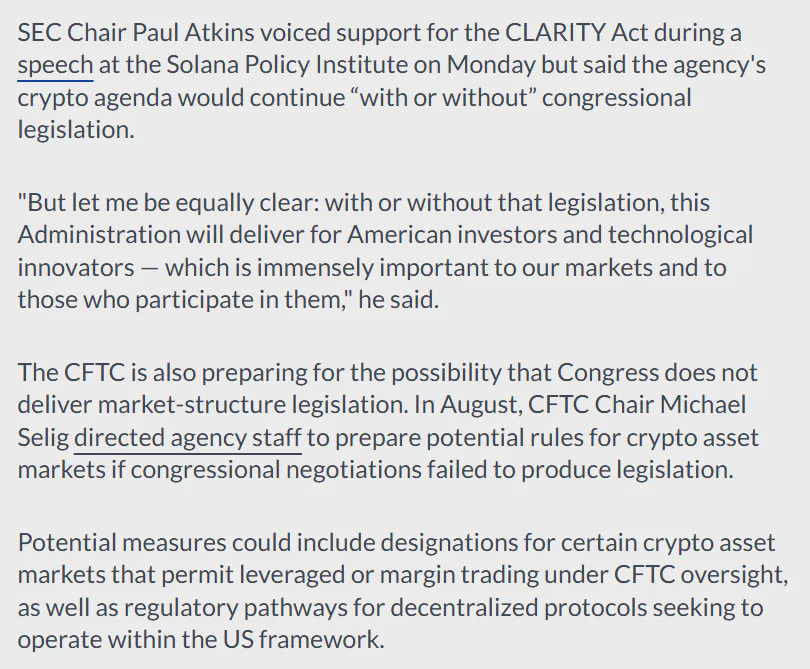
September 15 (U.S. Eastern Time): the U.S. Senate held a Cloture roll-call vote on the (CLARITY Act). (This refers to the Senate’s use of a roll-call vote to decide whether to end debate on a given matter and move on to the next procedural step.) The actual result was 49 votes in favor and 50 against—failing to reach the 60-vote threshold required to continue advancing the bill. This also means that there is essentially no hope of the legislation being introduced in 2026.

Actually, in the earlier articles (for example, the one on August 20), we also mentioned the CLARITY Act: the prospects for it to pass this year are rather bleak. Even though the Senate will hold a procedural vote on September 15, officials are still expected to find it very difficult to resolve the disagreements within a comparatively short timeframe. In addition, with the U.S. election season underway this year, advancing legislation of this kind this year will likely become even more difficult. Unless something unexpected happens, the formal enactment and implementation may also need to wait until next year (2027).
The current version of the (CLARITY Act) is a successor to the 2024 House bill FIT21. The entire bill is about 600 pages, and there is essentially just one core issue it aims to resolve: for a given asset (such as a token), is it governed by the SEC or by the CFTC? And perhaps influenced by the CLARITY Act’s failed vote in the Senate, the price of Bitcoin at one point fell to around $75,000. Of course, these are all effects in the short term. The failure to end debate in the Senate does not mean the bill itself has failed. Once Republicans and Democrats ultimately negotiate and finish allocating interests among all parties, passage of the CLARITY Act is simply a matter of time (i.e., regulation of the crypto industry through legislation is an issue that’s only a matter of when, not if).
Although the CLARITY Act vote was blocked, based on some past information and a synthesis of reports, even if U.S. federal legislation is not being pushed forward at this stage, the SEC (U.S. Securities and Exchange Commission) and the CFTC (U.S. Commodity Futures Trading Commission) may still use their existing authorities to continue drafting certain rules targeting the crypto market or crypto industry. This could also become the main area of focus for the market on the regulatory front going forward.
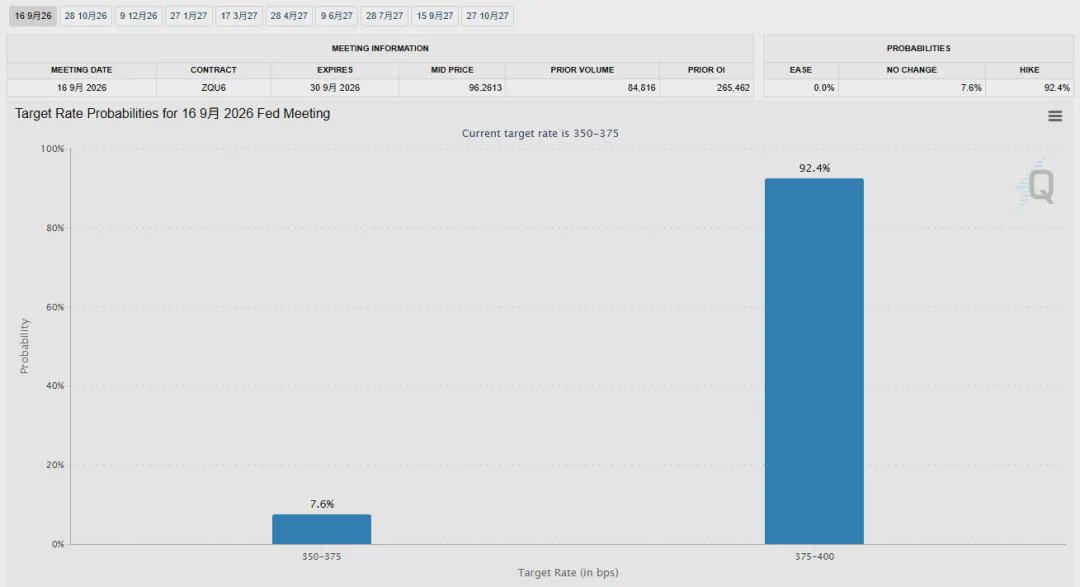
Of course, the voting on the CLARITY Act is only one of the factors affecting near-term market volatility. The September 16 FOMC meeting (corresponding to the early hours of September 17 Beijing time, when the interest rate decision will be released) is another matter the market is currently paying close attention to. According to the CME FedWatch data, the market is currently pricing in a 25-basis-point rate hike by the Fed in September with a probability exceeding 92%, as shown in the chart below.
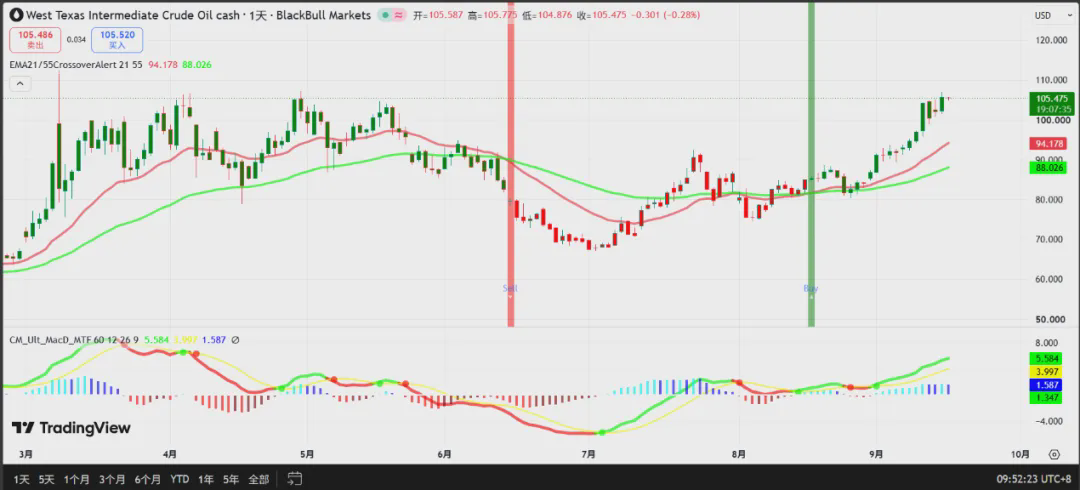
As of the time of writing, the price of WTI crude oil has also surged to around $105, as shown in the chart below. This is a second unfavorable factor for the Fed’s decision-making. Because at the time of the FOMC meeting, the sharp spike in oil prices will inevitably intensify the market’s concern about further inflation. Persistent inflation could also force the Fed to adopt a more hawkish stance.
Although, at present, the CLARITY Act has been stalled, and the inflation pressure expectation brought by the surge in crude oil prices has caused some shock and pressure on the short-term market, Bitcoin has still held within the $75,000–$76,000 range. Going forward, at the macro level, besides keeping an eye on the Fed’s FOMC meeting, we also mentioned in our previous article that we need to pay extra attention to the yen. According to media reports, the Bank of Japan may also hike rates this Friday to 1.25%, which would be the highest level of Japanese interest rates since 1995.
The Fed may be planning a rate hike this week, and the Bank of Japan may also hike rates this week (the ECB already hiked last week)... But Bitcoin is still holding onto a fairly key level. Bitcoin seems to be continuing to act as a liquidity-hedging tool for some funds. As for this month’s market trend, we will continue to keep the viewpoint mentioned in the previous article: in this month (September), the market will most likely remain dominated by range-bound/choppy movement. Although the CLARITY Act has produced new results, the market is still mostly waiting. As for whether the current price performance of Bitcoin has already priced in and completed the various bearish factors in the near term, we’ll find out soon enough.
In other words, if after the bearish factor related to the rate hike is played out, Bitcoin can quickly reclaim a key level (for example, above $78,000), then we can continue to expect higher follow-on movement. But if the bearish factor related to the rate hike plays out, and it is then compounded by a more hawkish attitude from the Fed, Treasury yields continue rising or remain at elevated levels, the U.S. dollar index strengthens, and ETF flows show clear net outflows, then the market may continue to face further volatility.
As for price levels, as we mentioned in the previous article as well: if prices move further downward, then we may continue to see $71,000 (Short-Term Holder Realized Price, the cost price of short-term holders) to $74,000 (the 0.236 Fibonacci level). The leverage in altcoins at that time may also be compressed to a certain extent. If instead price chooses to move upward again, then first check whether it can return above $78,000 (EMA55). Then comes the $83,000 to $86,000 range we mentioned earlier.
Of course, what we want to convey here is not really about predicting or guessing short-term price changes. Rather, it’s to say that Bitcoin’s price may already have digested some of the earlier unfavorable news or expectations—meaning it has already priced in part of the CLARITY Act being stalled and the expectation of Fed rate hikes. On the one hand, the market is not falling into a so-called panic (the Fear and Greed Index still remains in the “greed” range). When an asset stops dropping noticeably on news that everyone can predict, it also implies that panic sentiment naturally won’t get any worse. On the other hand, maybe the market’s upcoming volatility is no longer about whether the Fed will hike rates this month, or how many basis points it will hike. Instead, it’s about what the Fed’s latest stance is regarding the policy direction going forward. That is likely what the market is still waiting for right now.
According to on-chain data, within just 20 minutes after the CLARITY Act’s failed Senate vote, long positions worth $275 million were liquidated. Investing often looks like this: if your investment thesis relies solely on a specific catalyst (such as a news event or policy expectations), it is essentially gambling. If you bet correctly, you may gain short-term returns and the excitement of it. But once the corresponding catalyst and your expectations (or your personal hopes) go the opposite way, it can lead to part of your losses and even a position crisis.
For trading, if we don’t hold any personal hopes, we won’t create the so-called disappointment and wavering. What we need to do is to build our convictions more on things that we can fully understand and control, rather than merely hoping that some voting outcome is the one you personally want, or that some meeting result is the one you personally want... Things like that are short-term matters. Put another way, if our investment philosophy is built on things that we truly have already mastered and understand, then any short-term catalyst (such as a temporary blockage of a bill) won’t affect our long-term plans and decisions.
For the vast majority of retail investors, opportunities are not only about grabbing the so-called market first-mover advantage; more importantly, it’s about whether you can always maintain sufficient self-discipline. For example, right now, some people are anxious about whether the Fed will truly hike rates by 25 basis points this month. Others are continuing to make longer-term plans based on the adoption curve of a certain kind of asset. So which type are you?
That’s what we’ll talk about for this issue (20260916). All of the above is my personal perspective and analysis, and is only for record-keeping and discussion. It does not constitute any investment advice.