You’ve learned so much about “how to make money,” but have you ever learned “how to lose”?
Let me ask you something first:
Since you started trading, what have you learned?
How to read candlestick charts, how to draw support and resistance, how to find entry points, how to judge trends…
It’s all about “how to make money.”
But have you ever learned “how to lose money”?
How to lose is also a skill that needs to be learned.
You might say: Who can’t lose money? Do I really need to learn it?
Yes, because you don’t actually know how to lose.
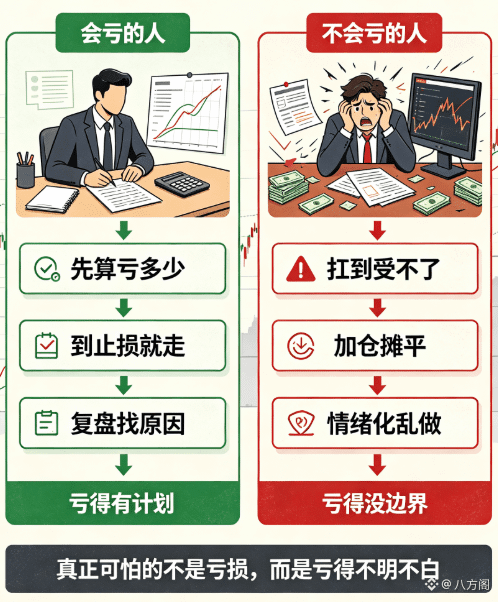
When you lose, you hold on until you can’t stand it anymore, then you sell at the lowest point.
When you lose, you average down to “balance it out”—adding more and more until you get liquidated.
When you lose, you get emotionally carried away, and one losing trade wipes out the profit from the previous ten trades.
That isn’t “knowing how to lose.” That’s just losing chaotically.
So what does a real expert at losing do?
First, before entering every single trade, calculate how much you can lose at most. If I can accept losing up to that amount, then anything beyond it means I don’t enter—if I do, I’m violating discipline.
Second, once your loss reaches the stop-loss level, leave unconditionally. No hesitation, no wishful thinking, no averaging down, no praying. Once it hits, you go—cleanly and decisively.
Third, after you’ve lost, do a review. Why did this trade lose? Was your direction wrong? Your position wrong? Or was it simply bad luck? Find the cause and avoid it next time.
Someone who knows how to lose loses less, loses clearly, and after losing, they can keep trading.
Someone who doesn’t know how to lose loses more, loses blindly, and once they’ve lost, they’re out.
Trading isn’t about who makes the most money. It’s about who loses the least. If you learn how to lose, making money is only a matter of time.
If you realize you’ve never learned “how to lose,” come in tonight.
I’ll use the current mainstream altcoin market conditions and explain on the spot: before entering a trade, how to calculate your maximum loss, how to set a stop-loss, and how to review it after you’ve lost.
Let me ask you something first:
Since you started trading, what have you learned?
How to read candlestick charts, how to draw support and resistance, how to find entry points, how to judge trends…
It’s all about “how to make money.”
But have you ever learned “how to lose money”?
How to lose is also a skill that needs to be learned.
You might say: Who can’t lose money? Do I really need to learn it?
Yes, because you don’t actually know how to lose.
When you lose, you hold on until you can’t stand it anymore, then you sell at the lowest point.
When you lose, you average down to “balance it out”—adding more and more until you get liquidated.
When you lose, you get emotionally carried away, and one losing trade wipes out the profit from the previous ten trades.
That isn’t “knowing how to lose.” That’s just losing chaotically.
So what does a real expert at losing do?
First, before entering every single trade, calculate how much you can lose at most. If I can accept losing up to that amount, then anything beyond it means I don’t enter—if I do, I’m violating discipline.
Second, once your loss reaches the stop-loss level, leave unconditionally. No hesitation, no wishful thinking, no averaging down, no praying. Once it hits, you go—cleanly and decisively.
Third, after you’ve lost, do a review. Why did this trade lose? Was your direction wrong? Your position wrong? Or was it simply bad luck? Find the cause and avoid it next time.
Someone who knows how to lose loses less, loses clearly, and after losing, they can keep trading.
Someone who doesn’t know how to lose loses more, loses blindly, and once they’ve lost, they’re out.
Trading isn’t about who makes the most money. It’s about who loses the least. If you learn how to lose, making money is only a matter of time.
If you realize you’ve never learned “how to lose,” come in tonight.
I’ll use the current mainstream altcoin market conditions and explain on the spot: before entering a trade, how to calculate your maximum loss, how to set a stop-loss, and how to review it after you’ve lost.