

The Venezuelan economic board added this week an element that few people associate with the foreign exchange market: international cooperation. Acting President Delcy Rodríguez received in Miraflores the UNDP regional director for Latin America and the Caribbean, Michelle Muschett, who delivered the first Post-Disaster Needs Assessment (PDNA) report— the technical diagnosis aimed at organizing the country’s recovery after the earthquakes of June 24.
At PitbullChain, we don’t view this type of announcement as a mere ceremonial act. When a multilateral organization puts numbers, sectors, and priorities on the table, what usually comes next is financing, technical assistance, and—eventually—foreign currency. And in an economy where the exchange rate moves every day, any external flow deserves attention.
## A PDNA that orders the ball before asking for money
Muschett was explicit about the approach: the report aims to serve as input for a "resilient" recovery framework that links the Executive’s priorities with financing needs and governance mechanisms. In plain terms: before asking for resources, a damage and cost inventory is compiled, along with the critical sectors.
Rodríguez, for his part, highlighted coordination with the UN, the World Bank, CAF, the IDB, and the European Union to have "one single plan" with a real diagnosis of needs. The political signal is clear: Caracas wants to present lenders with a single roadmap, not a patchwork quilt.
For the everyday Venezuelan, the details matter less than the outcome: if that framework translates into disbursements, the country would receive hard currency. And historically, hard currency ends up affecting the parallel dollar, the gap, and inflation.
## Does the dollar go down if financing comes in?
Here it’s best to be cautious. A report is not a disbursement, and a disbursement is not an immediate rush of dollars into the street. A large part of multilateral financing arrives in the form of technical cooperation, goods, contracts, and the execution of works—not as cash circulating in the market.
However, there are two effects that the P2P operator should watch. First, expectations: when the market believes more foreign currency supply will be available, pressure on the exchange rate typically eases temporarily. Second, execution: if reconstruction is paid in bolívares, the Government needs foreign currency to import materials, inputs, and machinery, which can strain dollar demand at specific times.
In other words, the impact is neither linear nor automatic. It depends on the speed of disbursements, whether they go through the BCV or through trusts, and how much of that money actually ends up in the real economy.
## USDT: the economy’s silent operating system
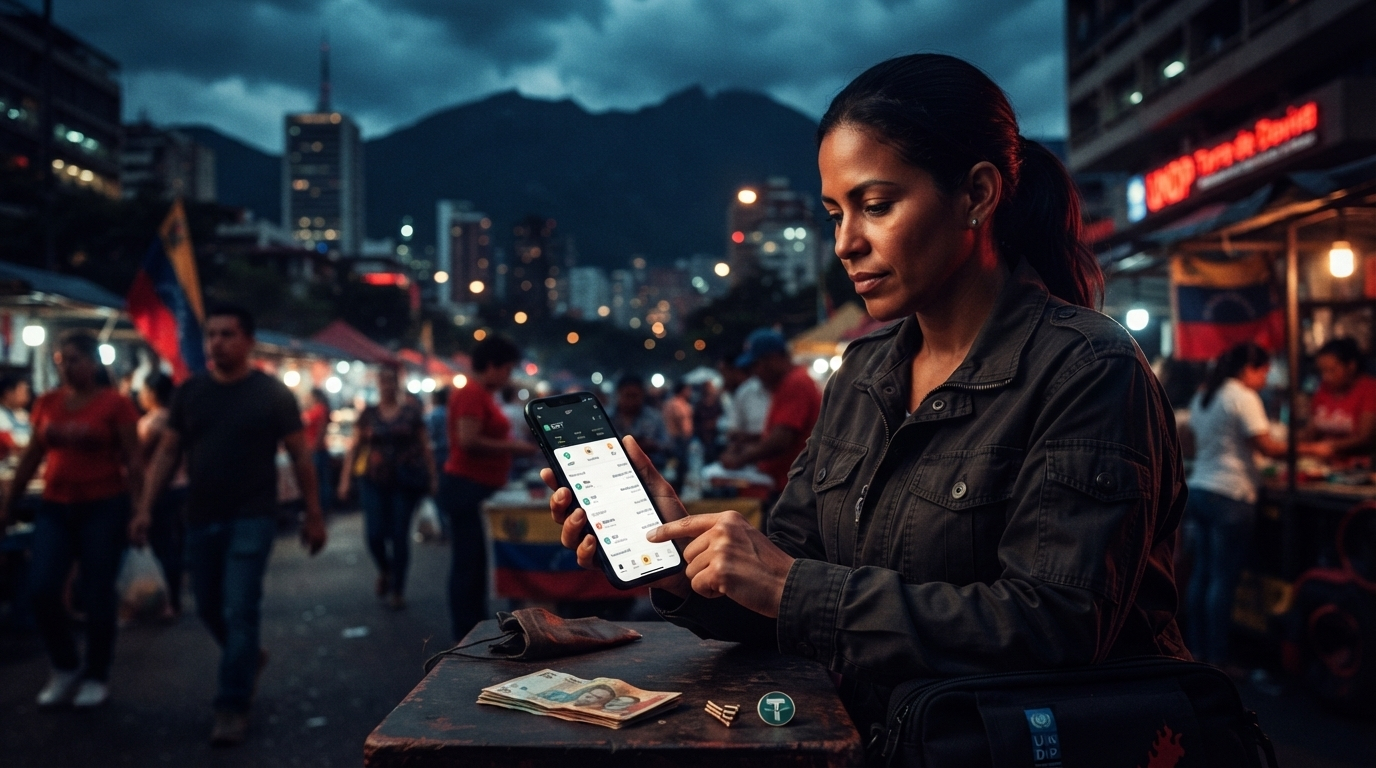
While people debate how aid will arrive, the country already has its own mechanism for liquidity in dollars: USDT. For merchants, transport operators, technicians, and families receiving remittances, the stablecoin stopped being a curiosity and became infrastructure.
If reconstruction boosts sectors like construction, hardware, logistics, and technical services, it’s reasonable to expect an increase in P2P activity. Why? Because many of those payments will take place in environments where access to bank foreign currency is still limited, and because USDT makes it possible to receive and pay without depending on business hours, agencies, or authorizations.
The weak point remains the same as always: the gap between the P2P price and official rates. If external financing is shifted to a preferential exchange rate while the market operates using another reference, the distortion widens and arbitrage becomes more aggressive.
### Digital banking: the missing piece
The report also mentions technological tools to simulate scenarios and prioritize interventions. Great on the analytical side, but the real test is on the payment rails. Venezuela needs digital banking and fintechs to be able to connect wallets, accounts, and payments quickly, with clear rules and without absurd friction.
Today, users handle things through P2P, Binance, local platforms, and Telegram groups. It works, but it’s costly, opaque, and fragmented. If reconstruction brings any push toward financial modernization, that should be the priority: interoperability, reasonable compliance, and low costs.
## What to watch in the coming weeks
- If the PDNA turns into concrete financing commitments or stays at the diagnosis stage.
- The behavior of the official and parallel dollar when amounts are announced.
- USDT liquidity on the main P2P exchanges and the spread versus the BCV.
- Any sign of new FX rules or easing for banking.
In conclusion: the meeting between Rodríguez and UNDP doesn’t move the USDT price by itself. But it marks the formal start of a process that, if it moves forward, could alter the supply of foreign currency, market expectations, and the way Venezuelans move their money. In an economy where information arrives late, anticipating it is the only real advantage.
📊 Live rates and analysis at https://pitbullchain.com
$USDT #PNUDVenezuela #USDTVES #mercadoP2PVenezuela #dolarBCV #recoveringeconomyVenezuela