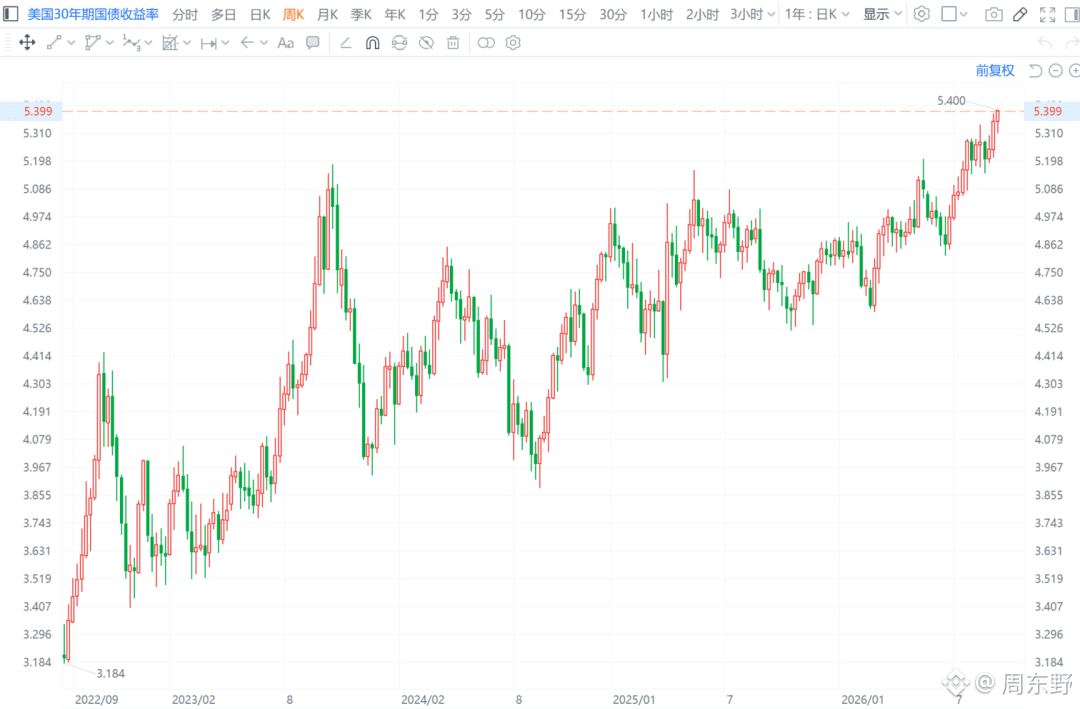
The yield on US 30-year Treasury bonds surged all the way to 5.40%, immediately setting a new record high since June 2007.
On the surface, this move in US Treasury yields looks like the market is repricing long-term fiscal deficits and inflation expectations. In reality, it’s the benchmark anchor for the global risk-free rate being forcibly pulled upward. Once long-term borrowing costs are pinned firmly at this level, the liquidity-drain effect may arrive sooner—and hit harder—than many expect.
Many funds are still betting on the upside of a rate-cut cycle. But runaway yields on the long end signal that big money doesn’t believe rate cuts can solve the core problem. With tens of trillions of dollars in newly issued Treasuries each year that the market must absorb, it’s inevitable that buyers will demand a higher term premium. This kind of risk-free return is brutally oppressive to on-chain and risk assets. When you can earn a hard, annualized net return above 5% from compliant risk-free assets, investors’ requirements for high-risk, high-friction yield agreements rise to an extremely harsh level.
That means any arbitrage models that rely on liquidity premiums—or try to prop up results with inflated APY—will instantly fail in the face of this cost of capital. For assets that can truly hold up, or even chart their own independent rally, they must either have extremely solid underlying real-return ledgers, or be extreme safe-haven instruments completely detached from the fiat currency pricing system. The destructive power of this kind of macro liquidity environment is only just beginning to show.
$BTC
#美国30年期国债收益率升破5.40%
On the surface, this move in US Treasury yields looks like the market is repricing long-term fiscal deficits and inflation expectations. In reality, it’s the benchmark anchor for the global risk-free rate being forcibly pulled upward. Once long-term borrowing costs are pinned firmly at this level, the liquidity-drain effect may arrive sooner—and hit harder—than many expect.
Many funds are still betting on the upside of a rate-cut cycle. But runaway yields on the long end signal that big money doesn’t believe rate cuts can solve the core problem. With tens of trillions of dollars in newly issued Treasuries each year that the market must absorb, it’s inevitable that buyers will demand a higher term premium. This kind of risk-free return is brutally oppressive to on-chain and risk assets. When you can earn a hard, annualized net return above 5% from compliant risk-free assets, investors’ requirements for high-risk, high-friction yield agreements rise to an extremely harsh level.
That means any arbitrage models that rely on liquidity premiums—or try to prop up results with inflated APY—will instantly fail in the face of this cost of capital. For assets that can truly hold up, or even chart their own independent rally, they must either have extremely solid underlying real-return ledgers, or be extreme safe-haven instruments completely detached from the fiat currency pricing system. The destructive power of this kind of macro liquidity environment is only just beginning to show.
$BTC
#美国30年期国债收益率升破5.40%