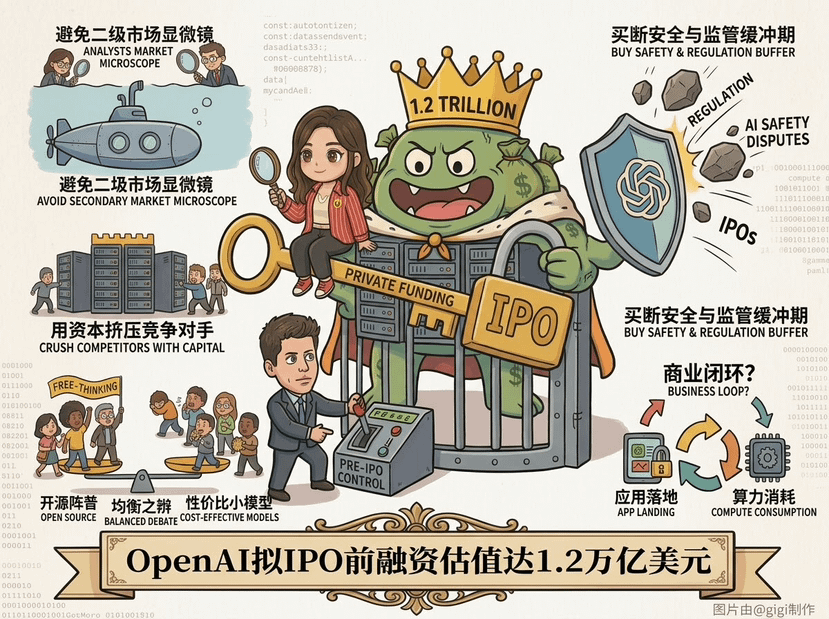

Valuation jumps to $1.2 trillion—OpenAI is directly trying to lock in the position of an industry behemoth before going public.
Look at the current landscape: annualized revenue has broken through $40 billion. The math is extremely precise. While the compute moat and ecosystem advantages are still in place, it aims to push valuation as high as possible without letting the stock-market microscope in the secondary market get involved.
Why is it rushing to raise a large round of primary financing before the IPO?
▶️ To dodge the secondary market’s microscope
Going public means quarterly earnings pressure and profit-margin scrutiny. Large models are extremely cash-intensive. Raising money in the private market can avoid public-market price fluctuations, and instead use a high premium to secure long-term capital.
▶️ To squeeze competitors with capital
Compute, data centers, and electricity all involve astronomical numbers. A $1.2 trillion valuation is intended to reserve the capital needed for years of “burn,” using financial barriers to keep would-be followers out of the gate.
▶️ To buy time: a buffer for security and regulation
By pushing the IPO to after 2027, it can avoid the direct impact on share prices from today’s AI safety controversies and regulatory storms.
OpenAI is taking the path of an absolute-monopoly supergiant—but the open-source camp and cost-effective small models are eroding its downstream market.
The key variable going forward is whether the “high investment to generate revenue” model can form a true commercial closed loop. If the pace of application deployment can’t keep up with compute consumption, $1.2 trillion may end up being the final peak “spotlight bubble” in the private market.
DYOR #OpenAI
Look at the current landscape: annualized revenue has broken through $40 billion. The math is extremely precise. While the compute moat and ecosystem advantages are still in place, it aims to push valuation as high as possible without letting the stock-market microscope in the secondary market get involved.
Why is it rushing to raise a large round of primary financing before the IPO?
▶️ To dodge the secondary market’s microscope
Going public means quarterly earnings pressure and profit-margin scrutiny. Large models are extremely cash-intensive. Raising money in the private market can avoid public-market price fluctuations, and instead use a high premium to secure long-term capital.
▶️ To squeeze competitors with capital
Compute, data centers, and electricity all involve astronomical numbers. A $1.2 trillion valuation is intended to reserve the capital needed for years of “burn,” using financial barriers to keep would-be followers out of the gate.
▶️ To buy time: a buffer for security and regulation
By pushing the IPO to after 2027, it can avoid the direct impact on share prices from today’s AI safety controversies and regulatory storms.
OpenAI is taking the path of an absolute-monopoly supergiant—but the open-source camp and cost-effective small models are eroding its downstream market.
The key variable going forward is whether the “high investment to generate revenue” model can form a true commercial closed loop. If the pace of application deployment can’t keep up with compute consumption, $1.2 trillion may end up being the final peak “spotlight bubble” in the private market.
DYOR #OpenAI