
#费城半导体指数跌5.9%
Is AI hardware finally full? Is it time for software and computing cost to face the tribulation?
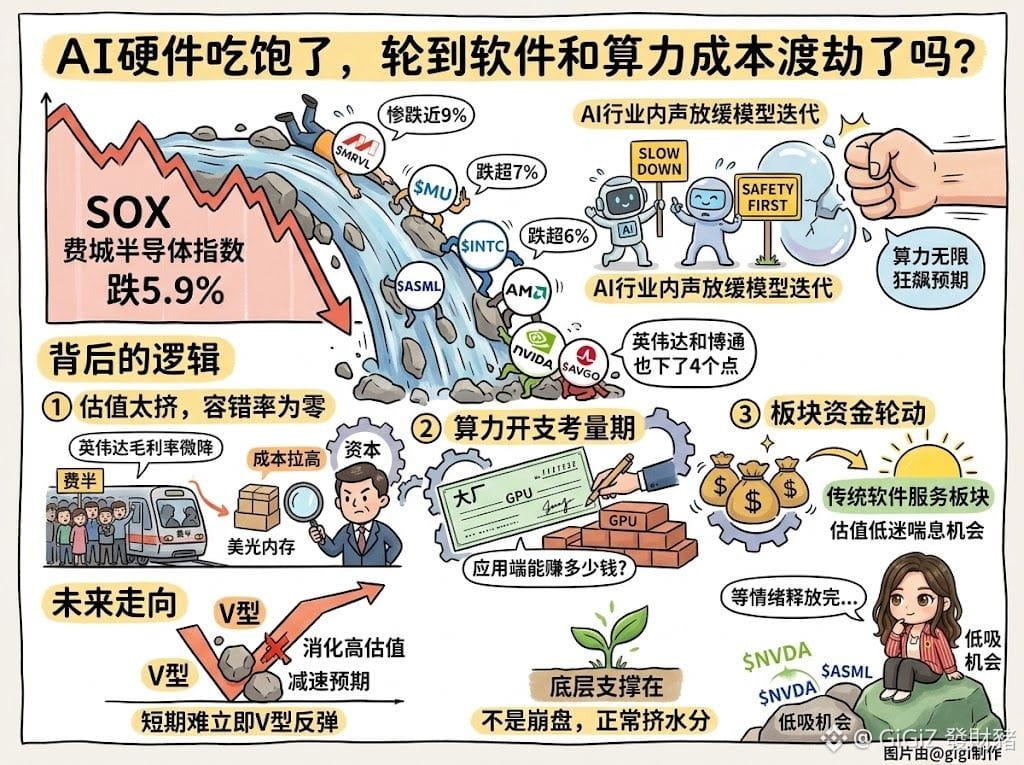
Last night, the Philadelphia Semiconductor Index plunged 5.9%. Marvell Technology fell nearly 9%, Micron and Intel dropped more than 7%, ASML and AMD fell more than 6%, and even the leaders—NVIDIA and Broadcom—couldn’t hold up, both sliding about 4 points.
The core fuse for this drop is quite interesting: it wasn’t driven by external bad news, but by voices from within the AI industry. Over the past few days, several AI heavyweights have openly called for slowing down the iteration speed of large models, to leave time for safety governance. This directly punctured the market’s expectation that hardware and compute power would endlessly surge.
Valuations are too crowded, and there’s zero room for error
The Philadelphia semi index has gained more than 50% year-to-date, with institutions extremely crowded in. NVIDIA’s gross margin saw a slight decline. Memory costs for players like Micron rose. Capital has shifted from frenzy back to rationality regarding chipmakers.
Capex for compute enters an output-focused phase
Big tech has pretty much bought its GPUs. The next step is to do the math—see how much profit the application side can actually generate. If model iteration slows, the pace of hardware procurement is bound to move from reckless expansion to a wait-and-see stance.
Sector rotation
Funds are moving out of the overly crowded hardware end and into traditional software service sectors that have been undervalued for a long time—and may even get a chance to catch their breath if large-model iteration slows.
We expect that in the short term, semiconductors will be hard-pressed to rebound in a V-shape immediately. It will take time and market volatility to digest the elevated valuations and the expectations of deceleration. But this absolutely isn’t an AI meltdown—it’s more like the normal squeezing out of excess after a hardware frenzy.
As long as the logic for real-world AI applications still holds, the long-term underlying support for semiconductors won’t be broken. Once this wave of sentiment has run its course and the bubble gets trimmed, the hard-core players that can truly deliver and control costs are actually decent opportunities to buy the dip.
Philadelphia Semiconductor Index (SOX)
Marvell Technology $MRVL
Micron Technology $MU
Intel $INTC
ASML $ASML
Advanced Micro Devices $AMD
NVIDIA $NVDA
Broadcom $AVGO
DYOR
Is AI hardware finally full? Is it time for software and computing cost to face the tribulation?
Last night, the Philadelphia Semiconductor Index plunged 5.9%. Marvell Technology fell nearly 9%, Micron and Intel dropped more than 7%, ASML and AMD fell more than 6%, and even the leaders—NVIDIA and Broadcom—couldn’t hold up, both sliding about 4 points.
The core fuse for this drop is quite interesting: it wasn’t driven by external bad news, but by voices from within the AI industry. Over the past few days, several AI heavyweights have openly called for slowing down the iteration speed of large models, to leave time for safety governance. This directly punctured the market’s expectation that hardware and compute power would endlessly surge.
Valuations are too crowded, and there’s zero room for error
The Philadelphia semi index has gained more than 50% year-to-date, with institutions extremely crowded in. NVIDIA’s gross margin saw a slight decline. Memory costs for players like Micron rose. Capital has shifted from frenzy back to rationality regarding chipmakers.
Capex for compute enters an output-focused phase
Big tech has pretty much bought its GPUs. The next step is to do the math—see how much profit the application side can actually generate. If model iteration slows, the pace of hardware procurement is bound to move from reckless expansion to a wait-and-see stance.
Sector rotation
Funds are moving out of the overly crowded hardware end and into traditional software service sectors that have been undervalued for a long time—and may even get a chance to catch their breath if large-model iteration slows.
We expect that in the short term, semiconductors will be hard-pressed to rebound in a V-shape immediately. It will take time and market volatility to digest the elevated valuations and the expectations of deceleration. But this absolutely isn’t an AI meltdown—it’s more like the normal squeezing out of excess after a hardware frenzy.
As long as the logic for real-world AI applications still holds, the long-term underlying support for semiconductors won’t be broken. Once this wave of sentiment has run its course and the bubble gets trimmed, the hard-core players that can truly deliver and control costs are actually decent opportunities to buy the dip.
Philadelphia Semiconductor Index (SOX)
Marvell Technology $MRVL
Micron Technology $MU
Intel $INTC
ASML $ASML
Advanced Micro Devices $AMD
NVIDIA $NVDA
Broadcom $AVGO
DYOR