


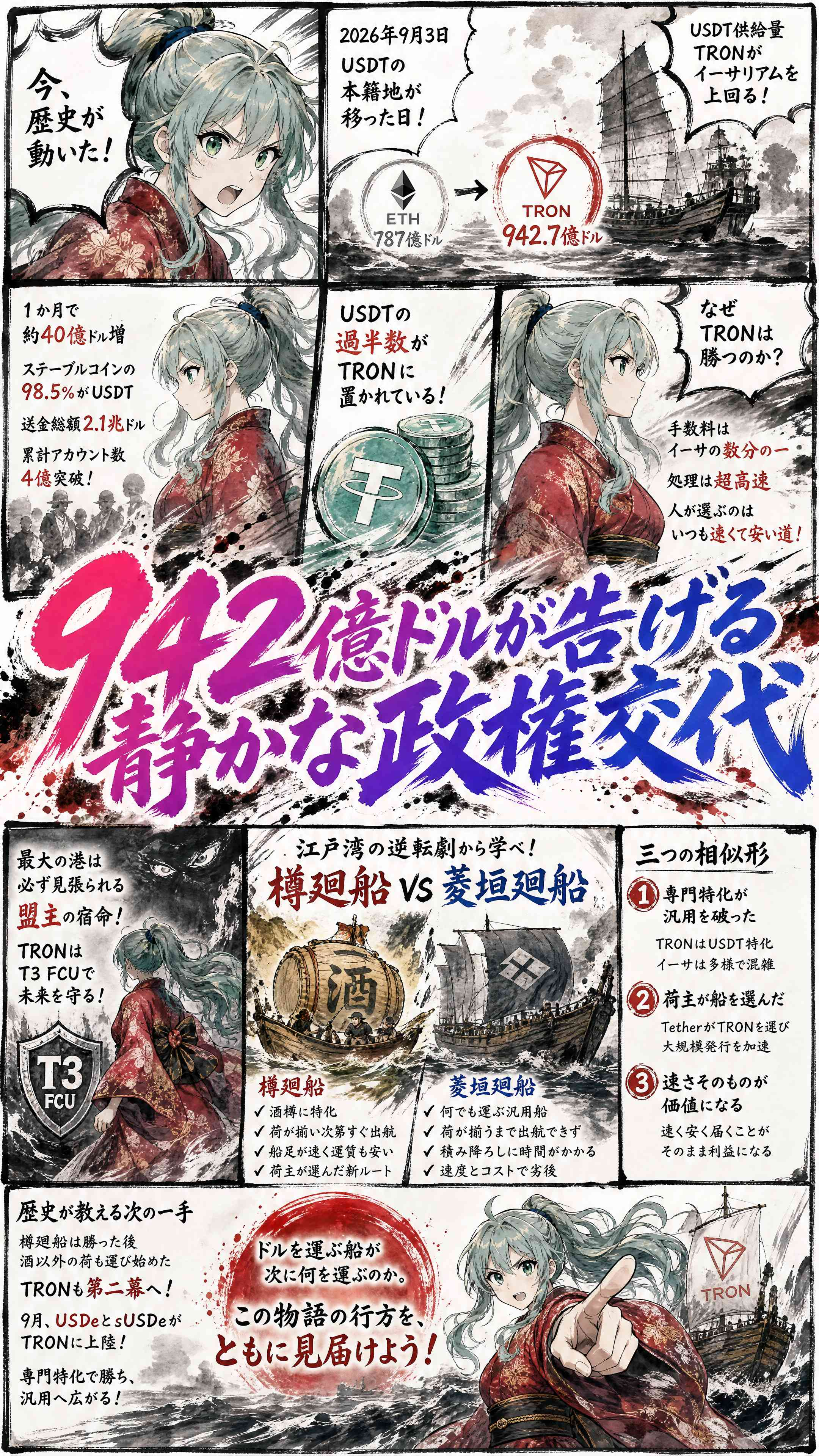
On September 3, 2026, Crypto Briefing published a short article. The headline read: “USDT supply reaches $94 billion, and TRON surpasses Ethereum.”
It’s not a flashy incident. But in the sense that the “whereabouts” of the digital dollar’s concentration has changed, this is the quietest and heaviest event in this year’s crypto-asset industry.
Let’s start with the facts. According to on-chain data, the circulating supply of USDT on TRON increased by about $4 billion over the past month, reaching $94.27 billion. It has clearly overtaken Ethereum, which used to be the main battlefield for stablecoins.
There were hints. According to Messari’s “State of TRON Q2 2026,” as of the end of the second quarter TRON stood at $87.9 billion, while Ethereum was $78.7 billion. The gap was already about $9.2 billion. This is the story of how it widened further over the summer.
TRON’s stablecoin economy is made up almost entirely of USDT. Of the stablecoins on the network, 98.5% are USDT. In just the second quarter alone, the total remittance volume of USDT was $2.1 trillion. Daily remittances often exceed $20 billion, and by late August the cumulative number of accounts surpassed 400 million.
And there is another decisive number. At multiple points in time, the share of USDT that exists on TRON exceeded 50% of all USDT in the world. More than half of the dollars issued by Tether are placed on TRON. This is what “a transfer of domicile” means.
🟥Why does TRON keep winning?—the logic of the “highway”
The reason isn’t complicated. Fees are a fraction of those on Ethereum, and its processing capacity is far higher. That’s all.
But don’t treat the meaning of “just that” lightly. Who moves stablecoins the most often? It isn’t institutional investors. It’s individual traders, migrant workers who send money overseas, and small-to-medium businesses in emerging countries where dollar-denominated digital payments are a matter of urgent need. For them, the cost of a single remittance is directly tied to revenue and living expenses. If there’s a cheap and fast route, they take it. Of course.
Another factor you can’t ignore is the actions of the issuer, the Tether company. Tether issues USDT on multiple networks, but its tendency has increasingly been to prioritize TRON as a major venue for large-scale new issuance. Around 2022, situations began to appear in which TRON intermittently surpassed Ethereum in new issuance volume, and this reversal is part of that same arc. The point is: shippers chose the fastest ships.
🟥Light and shadow — “the biggest port” is always under watch
Of course, the leading power has its own troubles. As each country’s governments tighten restrictions on the issuance and settlement of stablecoins, it’s inevitable that a network holding the largest USDT pool will attract regulators’ attention all at once.
However, this should be read not as a “weakness,” but as the “destiny of the leading power.” The place through which the most money flows is the place that is monitored most strictly. That’s a fundamental rule of financial history. The question is whether you can build a system capable of withstanding those eyes. The financial crime prevention unit “T3 FCU,” launched by TRON in cooperation with Tether and TRM Labs, is one answer to that.
🟥The “reversal” that happened in Edo Bay — the conflict between the Hishigaki-senkai and the Taru-senkai
Now, this is the real question. Can’t we learn from this event by looking at historical events?
My answer is the “reversal of the Hishigaki-senkai by the Taru-senkai” that occurred in Edo-period maritime shipping.
The Hishigaki-senkai began in Genna 5 (1619) as the original regular freight ship route connecting Osaka and Edo. The name comes from the diamond-shaped fence decoration along the ship’s side. It carried all kinds of supplies supporting everyday life in Edo—cotton, oil, paper, sake, soy sauce, and more. The shippers were Osaka’s twenty-four wholesaler groups and Edo’s ten wholesaler groups. It was a proud mainstream institution and the star of Edo’s logistics.
But the Hishigaki-senkai had a weakness. Because it mixed and carried cargo from many wholesalers, it couldn’t set sail until the loads were all gathered. Loading and unloading also took time. For shippers handling products where freshness and speed are everything, this was fatal.
The product, you see, is sake. In Kyoho 15 (1730), the sake wholesalers of the Kamigata region separated from the Hishigaki-senkai and arranged dedicated ships for sake casks. That is the Taru-senkai. It carried only one kind of cargo—a sake cask. Once the loads were ready, it left immediately. It was fast, and the freight was cheap. Eventually, Taru-senkai began loading cargoes other than sake as “side cargo,” taking away the Hishigaki-senkai’s shipments.
In Meiwa 7 (1770), an agreement was reached between the two that divided up the kinds of cargo they would handle. Even so, the flow didn’t stop. Shippers chose faster, cheaper ships. In the early 19th century, the Hishigaki-senkai declined, and though ten sets of wholesalers tried to revive it by borrowing the shogunate’s power, they couldn’t make up for it; when kabu-nakama dissolved under the Tenpō reforms, the Taru-senkai’s advantage became decisive.
🟥Three parallel shapes—why this story is about TRON
① “Specialization beat general-purpose”
The Taru-senkai specialized in just one type of cargo—sake casks—maximizing speed and cost. TRON is similar: 98.5% of its stablecoins are USDT, essentially specializing in a single kind of load. The Hishigaki-senkai—Ethereum—which can carry anything, had to absorb congestion and fees in exchange for versatility: carrying a wide variety of DeFi and assets.
② “Shippers chose the ships”
The Taru-senkai was created not by shipowners, but by sake wholesalers—the shippers. The factor that determined the USDT reversal was also that the issuer, Tether, kept choosing TRON as a place for large-scale issuance. The rule of dominance in infrastructure isn’t decided only by technical superiority. It’s decided by who holds the most valuable cargo—and which road they choose.
③ “Speed itself becomes value”
In Edo, every year a “new-sake escort boat” event was held, in which sake-cask–carrying Taru-senkai raced to compete for arrival from Nishinomiya to Edo, and the highest bidder got the first ship’s sake. Even in remittances, arriving a little faster and a little cheaper means the sender’s profit. Speed isn’t an added value—it is the product itself.
🟥The next move that history teaches
However, history hasn’t forgotten to issue a warning to the winners, either. The Taru-senkai’s advantage kept being tossed about by changes in the shogunate’s regulations and the institution of kabu-nakama. The ship that carries the most cargo attracts the most attention.
And one more thing: the Taru-senkai won by specializing in sake, but after winning, it began loading cargo other than sake. TRON, too, has started putting new cargo on top of the “routes” it built with USDT. In September, Ethena’s USDe and sUSDe landed on TRON. Win through specialization, then expand into general-purpose. This is the standard path of the reversers—and TRON is now entering its second act.
$94.2 billion isn’t the finish line.
A ship that once carried sake casks to Edo somehow came to shoulder “Edo’s logistics itself”—and then “a ship that carries dollars.” What will it carry next? Isn’t this a story worth witnessing in full?