
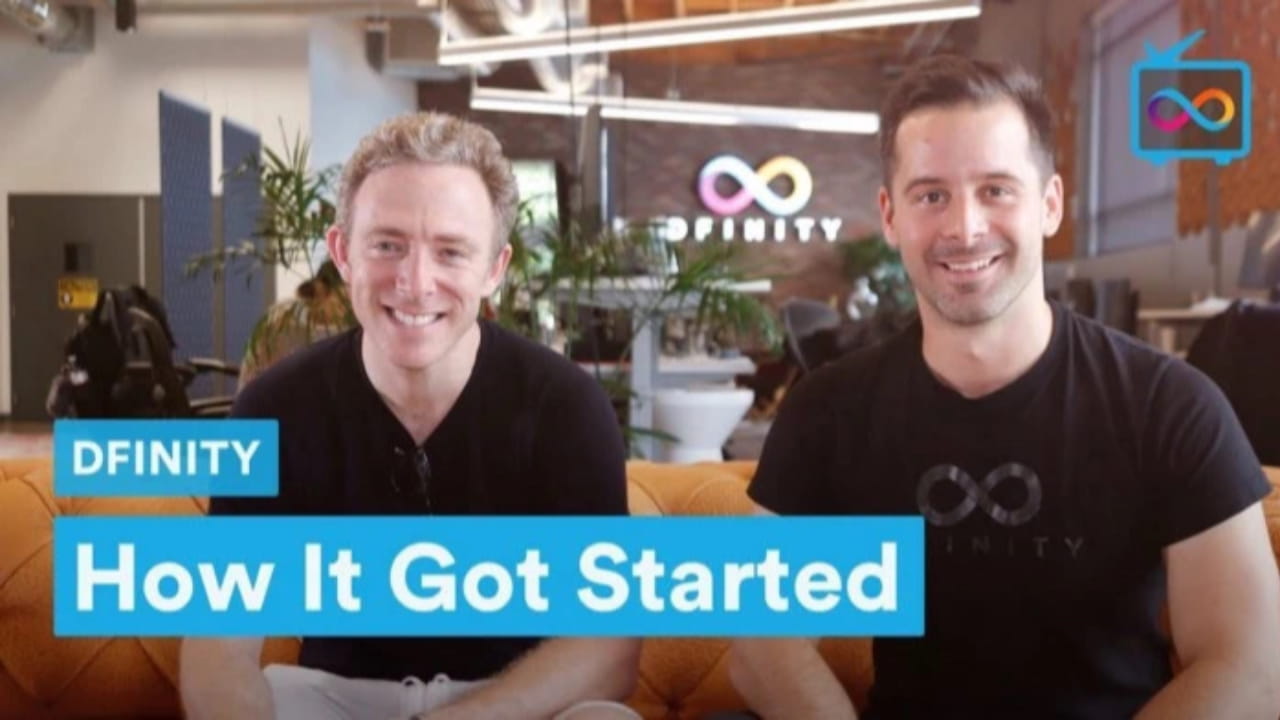

This is Part 1 of my conversation with Dominic Williams. Dom and I sat down to talk about how DFINITY started, how he came up with the name, and most importantly: where we’re going.
Join us for a conversation about the milestones we’ve reached and the ones that lie ahead of us!
Hello and welcome to another episode of Inside DFINITY. As of now, I am still based in Palo Alto, our home base.
Right now it’s a very exciting time, we’ve had a few more people join every week so far and it’s been super exciting with all the fun and hassles that come with it.
But today, I want to talk about how it all began, and in particular, I want to speak to Dominic Williams, our founder, chief scientist, and the man who started it all.
Dom and I first got in touch about two years ago. It was Q2 of 2016, and shortly after we first met in Palo Alto. At that time, it was not in our current location, but in the hacker house we previously rented and worked from.
So, two years later I got to spend a little time with him to look back and look forward, and hear his vision for DFINITY, and I’m even more excited about it. Without further ado, let’s get started.
The origins of DFINITY
Cédric: Well, welcome Dominic to Inside DFINITY. Dom, we’re glad to have you here. Of course, everyone already knows you, you’re the founder and chief scientist of DFINITY. But there’s one thing that maybe people don’t know, and it kicks off our interview today: When did you come up with the idea for DFINITY? When was that? What was it like?
Dominic: There is a lot of prehistory, in late 2013 I started working on a ledger that could be tweaked to create a cryptocurrency for the gaming industry. My interest came from creating massive online multiplayer games for millions of user bases, so I was familiar with the needs of that industry.
I think it would not be a good thing if people could trade crypto for virtual goods in one game to take it to another game, and so on, and the game could make money from commissions on buying and selling virtual goods.
So I started digging deeper and I won’t mention names but I looked at some of the cryptocurrencies, all the tokens and all the digital currencies around that claimed to be faster.
The idea of a new cryptocurrency
Dominic: After some time, I realized that they were not enough and there were major problems with the architecture used as well as the encryption and distributed computing protocols.
By February-March 2014, I had decided to create a brand new cryptocurrency. My initial approach was to delve into traditional Byzantine Fault Tolerant consensus protocols.
In particular, this consensus protocol is called the fully asynchronous free sync protocol. Trying to find ways to repurpose these protocols for decentralized network settings, because decentralized networks have their own special needs.
So I spent four months working on traditional Byzantine fault-tolerant consensus protocols 10 to 12 hours a day. It takes a long time, and it's a complex area of computer science.
Pebble
Dominic: Then, I started developing my own protocol using existing science. The cryptocurrency was called Pebble, and I worked with Artia, where I am now the COO. We had some very interesting ideas, for example, we wanted to have on-chain automated payments.
So the idea is that internet giants like Facebook could make requests to remove ads in exchange for automated cryptocurrency, essentially micropayments.
We were running around and trying to raise funds for the project.
At the time, some of the popular notions about the only possible consensus protocol was proof of work, and if you came up with a consensus protocol that no one else could understand, no one would understand it, right?
Most people don’t even really understand proof of work, they just think Satoshi solved the Byzantine Generals’ Problem, which of course is bullshit. I mean there have been consensus protocols around for decades.
And if you come up with alternative protocols, especially ones that are faster, you'll almost be considered a fraud.
So on one hand you have the traditional Bitcoin community who are extremely skeptical and even angry that someone could come up with a different consensus protocol because only Satoshi could do that.
On the other hand, the venture capital community was completely unfamiliar with this and either assumed that network effects would mean Bitcoin would dominate, or they were reluctant to enter the space because they felt they didn’t understand it well enough.
So, before the end of 2014, we disbanded our work on Pebble, and some time later, we made a daring attempt to raise funding, which proved impossible.
Consensus in a decentralized network
Dominic: Then I continued to work on the technical side. In early 2015, while working on skins and stuff, I thought of another way to achieve consensus in a decentralized network. Basically, I saw that I could create this random number sequence using a protocol called threshold relay.
And what's amazing is that these random numbers can be created extremely efficiently in a way that is completely unmanipulatable, no attacker can actually manipulate the random number sequence, it's almost unstoppable, it's highly fault tolerant and unpredictable.
I realized that if I could generate these random numbers efficiently and quickly in a decentralized network of any size, I could use these random numbers to drive other protocols.
So once I had threshold relays, I started looking at other ways to do it… The network has agreed on a set of random numbers, and I’m now looking at protocols that can drive things like transactions and state.
So 2015 was a very productive year, I was coming up with all kinds of crypto theories and so on.
Scalable blockchain
Early on, I thought it should be possible to create a scalable decentralized network (essentially a scalable blockchain). How about creating a decentralized cloud that hosts the world’s software and data?
It has some very special properties that make it attractive for hosting standard software systems, but you can also create entirely new Internet services on top of the open platform.
The DFINITY project was born.
Cédric: Very cool. So this basically goes back to your research in 2014-2015.
String Lab Collaboration
Dominic: I continued working on the protocol, still somewhat of a private project in 2016, and then joined String Labs. String Labs is an incubator whose purpose is to incubate crypto projects and get a stake in the founders’ tokens.
Initially, we were working on something called Mirror Assets, which was an evolution of an idea that Nick Szabo originally came up with, and that's what a company called Mirror Labs was pursuing.
Cédric: Was Mirror Labs the company you were working for at the time, or did this happen here?
Dominic: I think it was three months working in San Francisco in 2015 trying to help them with software architecture and software development processes.
So in the spring of 2016, we realized that Mirror Assets was premature and that we might not be able to overcome a lot of the regulatory challenges.
We said to the team at String Labs: Hey, it looks like DFINITY is well established and we have a lot of science behind it. It’s also well known in the industry because I’ve been at events about DFINITY and the various technologies I was working on at the time. I said let’s do DFINITY.
So in the summer of 2016, String Labs started putting some money into it, we built the team, we created the foundation in the fall of 2016, and you and I?
Cédric: Yes, I think it was October 2016. Time flies.
The DFINITY Team
Dominic: We have a foundation, and there are some very smart new people in the team at this stage, such as Tim Hankey, Mahnush, etc.
By the way, I should also thank Tom Ding. He was amazing, and at that stage he was helping many good people from many projects to build the organization together.
In early 2017 we started running what many people call the first ICO, but the idea was very different. It was a fully automated and fully decentralized crowdfunding campaign, but those were some naive days.
We decided, look, we don't need that much money at this stage. So we set the soft cap at 1 million Swiss francs, and once we raise 1 million Swiss francs, we will stop taking payments.
After a few hours, I think it raised 3.9 million Swiss francs. One of the ironic things about this is actually that I think it’s the only fully decentralized, automated crowdfunding campaign that has ever been done, with no central server, and it’s all done with client software and Ethereum smart contracts.
So we did it, and we were really happy with the money we raised and really excited about it, but, pretty quickly, a new type of ICO emerged.
intuition
Dominic: A few weeks later, I think the intuition came in and raised $10 million, selling 5% of the tokens. We got there and said, look, we’re going to do this responsibly, just click on a million dollars.
Pretty soon people were saying we want to raise as much money as we can to make the market feel like we’re worth it, and I’m going to let this crowdfunding run for six weeks with no limits.
And then, of course, we're going to do a year of uncapped crowdfunding. So the whole ethos changes.
In 2017, the tokens grew in value, so we were well funded and we just continued to scale the business, but we didn’t have much money compared to some of the other projects in the space.
But we pulled back from that, we didn’t want to run an ICO like we saw them because we weren’t comfortable with some of the things that were going on.
So we raised funding later that year in what is known as the 2018 strategic round.
We still received amazing funding, and we scaled the organization in a very dramatic way.
Cédric: Before we dive into the funding and how it has been used so far to scale the team and move the project forward, can you remember when you first came up with the name DFINITY? Maybe you could say a few words about what it means for people who have never heard of it?
General Computing
Dominic: I can’t remember the exact moment, but at some point I realized that it was possible to create a decentralized cloud.
I was always very interested in the Ethereum project and kept in close contact with it when it started in 2014. I realized that it was definitely a smart contract platform, but I really found the computer side more interesting.
So I think we can focus it more on general computing, focusing on getting big performance improvements and finding ways to scale the network. My research shows that it's possible.
Infinitely scalable network
Dominic: The D obviously stands for decentralized, and the rest is infinity — an infinitely expanding network. So the ambition of DFINITY is to host the world’s next generation of software and data. That’s why it’s called DFINITY.
In fact, if you go back to the Wayback Machine and see the Internet Archive from the fall of 2015, it was a very basic DFINITY website, and I created an embarrassing DFINITY logo, and when you look at the current version, you think it's really bad.
The degree and the mission are almost the same as now, so it has been around for a long time.
This is not like an ICO project that can be launched immediately. DFINITY involves a lot of technical work. I think this is why we are able to scale the team with truly world-class talents and leaders in fields such as cryptography and distributed computing, including outstanding Haskell engineers, etc.
I just mentioned this in the intro, it's a very exciting time. We're basically adding people every week right now. It's really exciting as we think about expanding our office and operations not only in Palo Alto, but also opening offices in different parts of the world.
Cédric: Maybe, could you just give us a quick overview of what has happened in the last 12 to 18 months since we completed the first fundraise that you mentioned? What are some of the milestones for DFINITY before we start looking forward?
DFINITY Research Center
Dominic: Organizationally, we've upgraded from the Hacker House where we were located to the Palo Alto Research Center, we built a new research center in Zurich, and we have people all over the world, we have people in three places: Germany, the UK, and Japan, as well as the United States.
So people come here and pass through this office, and it's a place where people gather and meet, and the same is true for the Zurich headquarters, and there's also going to be a San Francisco research center.
So I think the two biggest bases are really kind of like the Swiss Silicon Valley, but we have people all over the world.
So that's been really great, and it's allowed us to have a great geographic footprint when we're looking for talent, and the best talent in the world isn't in one place, it's everywhere. You have to be willing to give them reasonable options as to where they can move.
Cédric: That's great. I mean, at the moment when we talk about technology, a lot of people forget how hard it is to scale an organization.
DFINITY as a decentralized NASA
Dominic: The goal of DFINITY has always been to build what we call a decentralized NASA.
Cédric: NASA is the space agency.
Dominic: NASA is the space agency. DFINITY is obviously a non-profit foundation, and NASA is a non-profit organization.
We believe that if you really want to create a platform that hosts the next generation of global software and data, it needs to be not only great, but also complex.
And it's going to be a huge community of engineers and researchers supporting it, finding security holes, fixing problems that come up, building development, and making it better and better.
Otherwise, people will never have the confidence to build on it.
DFINITY’s Best Talent
Dominic: So, in that respect, we have always been different from other players in the decentralized industry because we believe that protocols alone are not enough.
We believe that it is imperative to build a large talent pool that will support the network itself and continue to grow. That is why we want to have a decentralized NASA.
A lot of people might imagine that this is easy if you have lots of money like we do, but it’s actually really hard to scale an organization.
You have to find people with the right cultural background and a certain level of skill, and you have to hire operations people like yourself.
As a company grows, there are all sorts of complexities, like transferring money, taxes, offices, payroll, and so on.
I think that’s been our biggest achievement so far because we knew we were going to set out to build a decentralized NASA, and we’re not there yet, but we’re able to methodically scale it.
This process is accelerating, so the quality of the team is absolutely astounding. You will see a new wave of hiring in the next few weeks.
I think you're going to be astounded by the quality of some of the people who are joining us, world-renowned people in various branches of computer science, and top-notch managers with incredible track records.
I think it’s not about the technology, the team and organization we’ve built is probably one of our biggest achievements.
IC content you care about
Technology Progress | Project Information | Global Activities
Collect and follow IC Binance Channel
Get the latest news