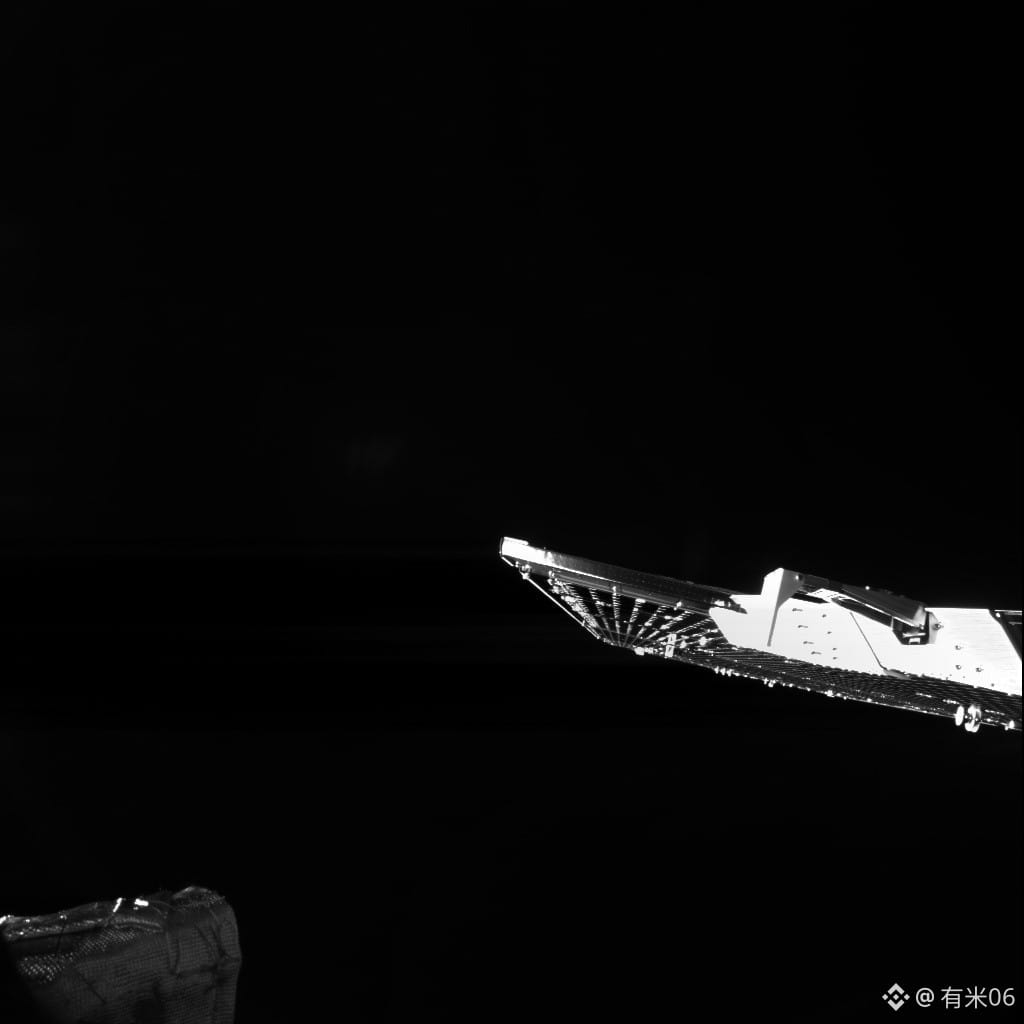
At the mouth of the Mercury gate, the propulsion module first took a photo of the “last selfie,” and then they went their separate ways.
On September 3, 2026, in the joint ESA–JAXA mission to Mercury—BepiColombo—its Mercury Transfer Module (MTM), which had been responsible for powering and electric propulsion throughout the journey, separated from the spacecraft assembly. ESA mission control performed the separation at about 14:00 CEST, and at 15:49 CEST received a confirmation signal—after eight years and roughly 9.9 billion kilometers of travel, as well as nine planetary gravity assists, the propulsion module’s job was officially done.
Earlier that morning before separation, the MTM used three monitoring cameras (M-CAMs) to capture the final set of selfies. This one is taken by M-CAM 1: on the right is the deployed large solar sail, and on the left is a section of the spacecraft body from the assembly. The cameras were originally meant to monitor the spacecraft’s condition, and along the way they also captured flybys of Earth, Venus, and Mercury.
After splitting off, the MTM has no power source or communications, and will continue orbiting the Sun. ESA expects it to later fly past Mercury at a distance of about 130,000 kilometers, and then fully enter an interplanetary trajectory. The remaining elements—the ESA Mercury Planetary Orbiter (MPO) and JAXA’s Mio—will continue onward, with plans to enter orbit on November 21 and then separate from each other in December.
Image: ESA / BepiColombo MTM M-CAM 1 official image
#水星 #航天
On September 3, 2026, in the joint ESA–JAXA mission to Mercury—BepiColombo—its Mercury Transfer Module (MTM), which had been responsible for powering and electric propulsion throughout the journey, separated from the spacecraft assembly. ESA mission control performed the separation at about 14:00 CEST, and at 15:49 CEST received a confirmation signal—after eight years and roughly 9.9 billion kilometers of travel, as well as nine planetary gravity assists, the propulsion module’s job was officially done.
Earlier that morning before separation, the MTM used three monitoring cameras (M-CAMs) to capture the final set of selfies. This one is taken by M-CAM 1: on the right is the deployed large solar sail, and on the left is a section of the spacecraft body from the assembly. The cameras were originally meant to monitor the spacecraft’s condition, and along the way they also captured flybys of Earth, Venus, and Mercury.
After splitting off, the MTM has no power source or communications, and will continue orbiting the Sun. ESA expects it to later fly past Mercury at a distance of about 130,000 kilometers, and then fully enter an interplanetary trajectory. The remaining elements—the ESA Mercury Planetary Orbiter (MPO) and JAXA’s Mio—will continue onward, with plans to enter orbit on November 21 and then separate from each other in December.
Image: ESA / BepiColombo MTM M-CAM 1 official image
#水星 #航天