

Let’s talk today about where your money goes.
Have you ever added up how much all the junk you’ve bought and later regretted buying over the years has cost you?
During big sales, you stay up until the middle of the night bundling purchases, and your home ends up looking like a corner shop. Then, when you move and sort through all the stuff you don’t need, you fill more than a dozen giant trash bags—and it all becomes garbage. It’s easy to turn money into stuff, but turning stuff back into money is next to impossible.
You can’t always stop yourself from buying things—and it’s not just because you lack willpower.
These are all tricks used by platforms and sellers. The countdown is ticking, stock is dwindling, and the livestream host is shouting that there are only 30 orders left. It’s all designed to cloud your judgment. Your brain has a mechanism called loss aversion: the moment you see the words “on sale,” it automatically releases dopamine, making you feel like you’re losing out if you don’t buy.
But think about it calmly: no matter how steep the discount, if you don't need something, buying it is a 100% loss. The seller may knock 10% off, but you end up spending all of it.
This is what I've always thought was the biggest trap. A lot of people are taught from childhood that being good at saving money means being good at managing a household, and that stockpiling things is a virtue. But that's simply not true. People who are really good at managing their money don't first think, “This is cheap.” They ask, “Will I actually use it?” Buying less is a hundred times better than being good at shopping.
Why does it hurt so much when you can't sell something?
I have a friend who earns 8,000 a month. She used to spend most of it watching livestream shopping. Once, when she urgently needed money, she listed some unused things on a resale site. She put up a dress with its tags still on for 50. A week went by, and no one even asked about it.
That night, sitting in the middle of a room full of stuff, it suddenly clicked for her. The more excited you are when you snap up a bargain, the more disappointed you feel when you try to sell it.
Why does this happen? Because the moment you place the order, you're not really buying the item itself—you're buying the thrill of scoring a bargain. That feeling fades in three days, but the stuff stays there, reminding you every day that you wasted your money.
Actually, it's the same mindset people have when trading meme coins.
In everyday life, start by keeping your impulses in check. Ask yourself first:
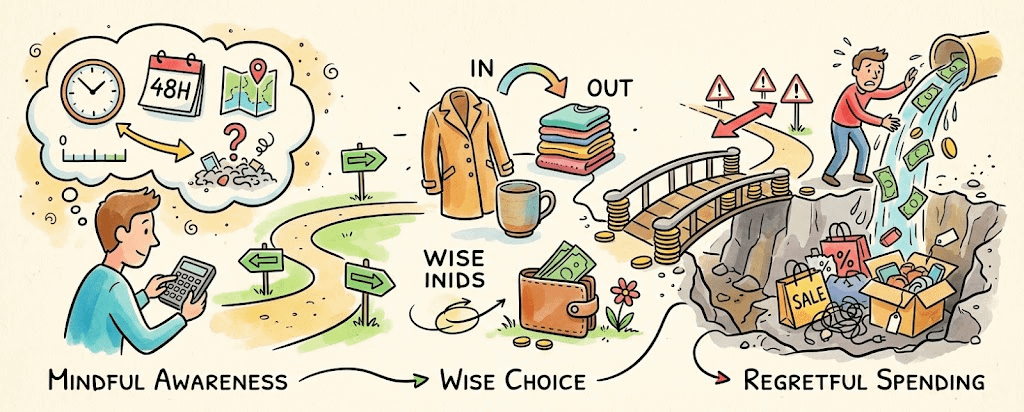
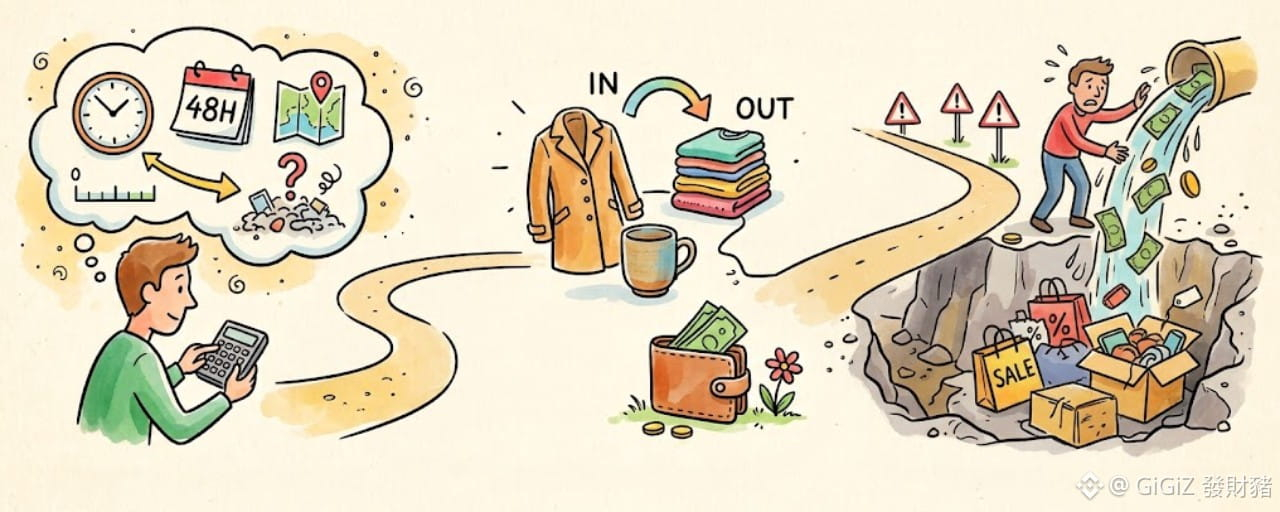
First, whenever you want something, wait 48 hours.
Don't rush to pay. Save the link, put your phone away, and wait two days. During that time, ask yourself three questions: Do I already have something similar at home? Will I really use this at least ten times? Where will I put it? Usually, by the next day, the urge has passed. If a deal can slip away, it probably wasn't something you needed in the first place.
Second, work out the cost based on your home's price per square meter.
Say homes in your area cost 20,000 per square meter. You spend 99 on a storage rack and shove it in a corner, where it takes up 0.3 square meters. That means you've effectively spent 6,000 on floor space to pile up junk. Once you look at it that way, you'll understand: cheap stuff is the most expensive, because it steals space from your home and peace of mind. This isn't being stingy—it's just using a different yardstick to figure out whether something is worth it.
Third, for every new thing that comes in, let one old thing go.
Don't expect to clear everything out all at once. Just set a rule: buy something new, get rid of something old. Buy a new pair of shoes? Pass on the pair you haven't worn in a year. Keeping old things you never use just takes up space and reminds you every day that you spent more money.
Saving money doesn't mean you can't buy anything, and it definitely doesn't mean living a deprived life.
Quite the opposite. You could buy ten cheap items and never wear any of them for long. But if you spend the same amount on one good item and wear it for five years without getting tired of it, that's what treating yourself well looks like. Put the brakes on spending money on things you don't need, so you can save it for what really matters.
We might have once thought that treating ourselves well meant buying whatever we wanted. Later, we learned that it means having money in the bank, space at home, and peace of mind.
A good life is about having space, not piling things up.
So next time your finger is about to hit “Pay,” pause for three seconds and ask yourself: Do I really need this, or do I just want to feel like I'm getting a bargain?
That one second can help you hold on to your money.