
#usstrikestargetsnearhormuzandjask
🚨⚓ US STRIKES NEAR HORMUZ & JASK: OIL SUPPLY RISK FLASHES RED ⚓🚨
When missiles meet the world's energy crossroads, the shockwave does not stop at the shoreline.
In the Gulf, every strike now carries a price tag for global markets.
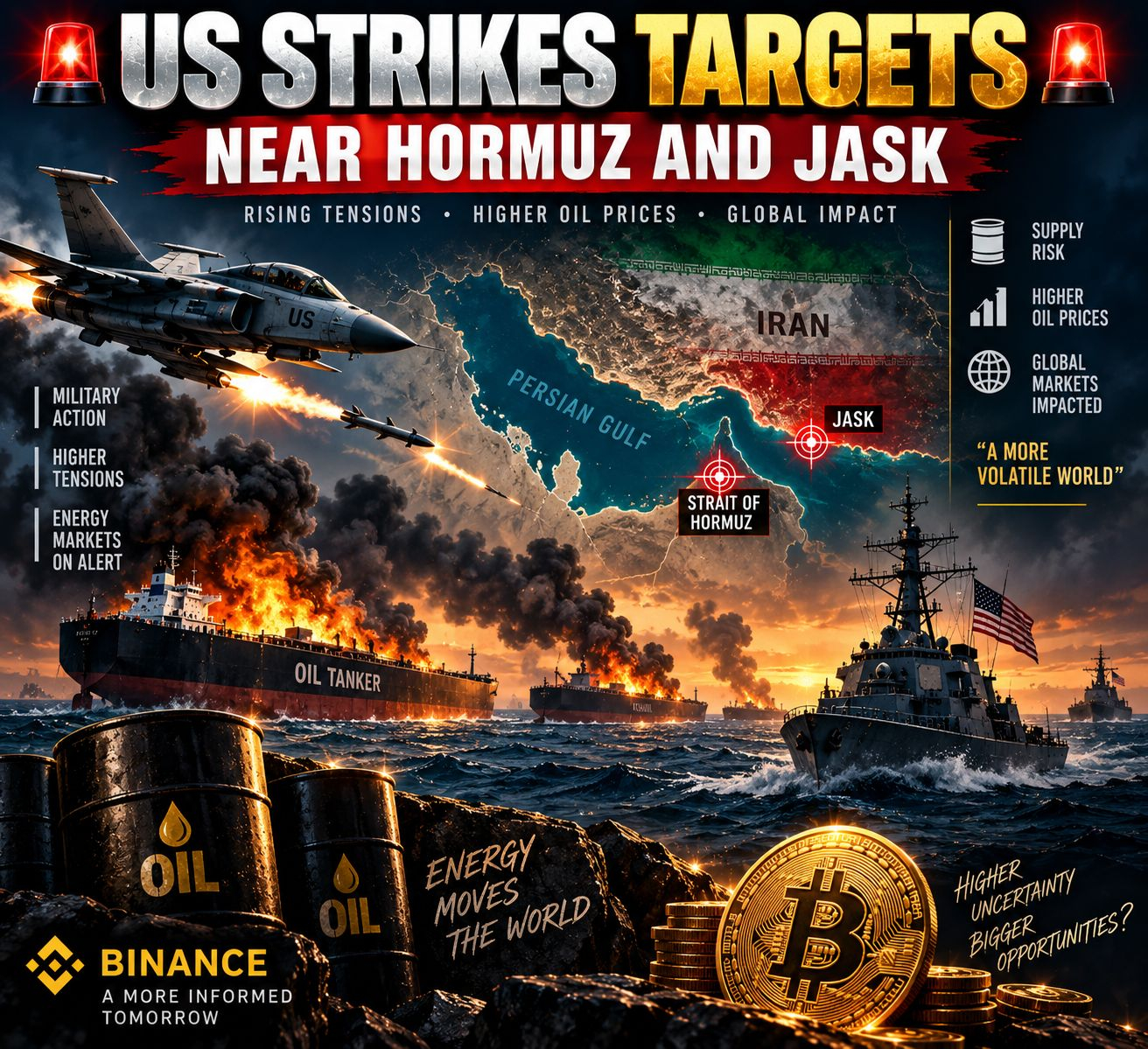
The United States says it destroyed five Iranian oil tankers after Iran's Revolutionary Guard targeted a U.S. warship with ballistic missiles. Reports also placed strikes near Iran's southern port of Jask and Kharg Island.
The bigger story is not simply the military exchange. It is the growing risk to oil supply and shipping through the Strait of Hormuz, one of the world's most critical energy routes.
Iran subsequently claimed attacks on ships near Hormuz, including oil tankers, while the U.S. maintains pressure on Iranian maritime activity.
Markets are already reacting. Brent crude pushed above $100, reaching its highest level since July, as traders priced in a larger geopolitical supply risk.
For crypto, this matters because sustained energy inflation can pressure risk assets, complicate interest-rate expectations, and increase volatility across global markets.
The central signal is clear: geopolitical risk is becoming a liquidity story.
If Hormuz tensions intensify, do you expect Bitcoin to behave more like a risk asset or a geopolitical hedge?
Disclaimer: This is market commentary, not financial advice.
#Oil #Hormuz #GrowWithSAC $SOPH $QKC $GLMR
#USStrikesTargetsNearHormuzAndJask
🚨⚓ US STRIKES NEAR HORMUZ & JASK: OIL SUPPLY RISK FLASHES RED ⚓🚨
When missiles meet the world's energy crossroads, the shockwave does not stop at the shoreline.
In the Gulf, every strike now carries a price tag for global markets.
The United States says it destroyed five Iranian oil tankers after Iran's Revolutionary Guard targeted a U.S. warship with ballistic missiles. Reports also placed strikes near Iran's southern port of Jask and Kharg Island.
The bigger story is not simply the military exchange. It is the growing risk to oil supply and shipping through the Strait of Hormuz, one of the world's most critical energy routes.
Iran subsequently claimed attacks on ships near Hormuz, including oil tankers, while the U.S. maintains pressure on Iranian maritime activity.
Markets are already reacting. Brent crude pushed above $100, reaching its highest level since July, as traders priced in a larger geopolitical supply risk.
For crypto, this matters because sustained energy inflation can pressure risk assets, complicate interest-rate expectations, and increase volatility across global markets.
The central signal is clear: geopolitical risk is becoming a liquidity story.
If Hormuz tensions intensify, do you expect Bitcoin to behave more like a risk asset or a geopolitical hedge?
Disclaimer: This is market commentary, not financial advice.
#Oil #Hormuz #GrowWithSAC $SOPH $QKC $GLMR
#USStrikesTargetsNearHormuzAndJask