

Let’s start with a number: 23 minutes.
When Liquid went wrong, the attacker went from starting the action to completely taking the funds away in just 23 minutes—throughout the entire process, no one on-chain had time to raise any doubts.
It’s the same with Bitcoin sidechains and the same "anchored asset": Liquid’s entire exit process took only 23 minutes, whereas in the design of the GOAT BitVM3 bridge, every withdrawal must publicly accept a challenge on Bitcoin, and it takes at least a week to be finalized. Once someone raises a dispute, the frozen time for that exit will be even longer.
23 minutes and at least a week—putting these two numbers together, you can actually explain the most convoluted problem about Bitcoin Layer 2 over the years.
A sidechain is an independent chain. On the Bitcoin side, you only hold those anchored coins, so it can’t see what happens on that chain. Therefore, whether it ultimately allows the release depends entirely on what the operator says. No matter how diligent or transparent the operator is, “validity” is still determined by the sidechain’s own software.
And GOAT’s BitVM3 bridge makes every exit on Bitcoin something that can be questioned: the operator must produce evidence showing the withdrawal followed the rules. Meanwhile, the set of rules used to judge it is itself written into Bitcoin—outside of the software that those rules constrain.
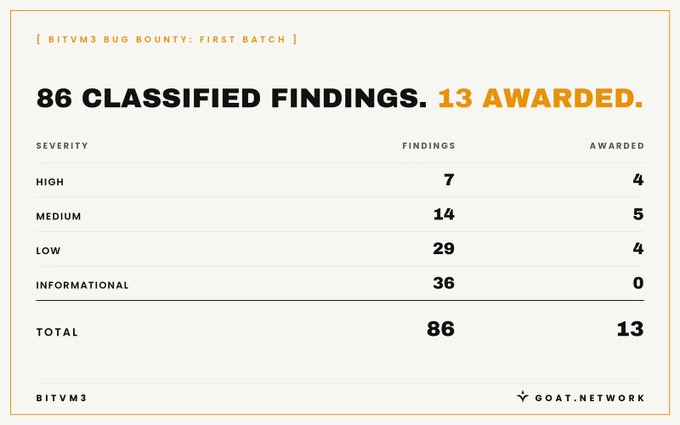
Speaking of where the rules are written—there’s no getting around the BitVM3 vulnerability bounty that kicked off on August 18. At the time, the official requirement was: treat it like an enemy and attack it. The first batch of submissions has now completed the full engineering review. The result: 86 categorized findings, spanning the entire BitVM3 technical stack horizontally—node and P2P behavior, validator and challenge logic, bridge and contract logic, transaction validation, proof and circuit-level analysis, and even API behavior. Across six directions, they basically swept everything from the underlying network layer all the way up to the interface layer.
Of the 86, 13 received the bounty, from a $5,000 prize pool: 4 High, 5 Medium, 4 Low.
What I’d emphasize even more are the five findings that were posted to the bitvm-node repo as publicly visible GitHub issues, because they all concentrate on the bridge’s automated defense path—the logic of “if operators misbehave, automatically trigger a challenge.” Honestly, this is exactly the place where an adversarial review should go digging—and indeed, it did:
430, High: A validator’s assertion checks may be skipped under specific conditions, causing an invalid operator assertion to go unchallenged.
431, High: The kickoff detector monitors only one image per operator, so a second unauthorized kickoff can slip through without any automatic challenge.
429, Medium: The automatic challenge to an unauthorized kickoff is one-time; if it hits a certain timing edge case, it will fail open.
429, Medium: With a single on-chain claim using a non-standard script and at extremely low cost, you can jam the bridge-out watcher of a committee node.
448, Low: The bridge-out instance ID is predictable. Anyone can plant a record in advance to keep the bridge-out cursor stuck.
In the comments, someone specifically restated #431 to confirm their understanding. I find that pretty moving—here’s a hole that can prevent the “second illegal kickoff” from being automatically challenged, yet an external researcher puts it down in black and white. By itself, that shows this open review mechanism is actually doing work.
There’s a saying in the community that I really agree with: in the first batch of 86 findings, 13 people got the reward—the open security review is exactly how the trust-minimized system gets stronger. While congratulating the winners, I also want to say this: having these 13 issues unearthed and fixed shows that this whole thing is being seriously refined far more than any audit report. Audits are about hiring people to sign; bounties are about hiring people to pry open doors—the latter leaves a tougher trail.
What GOAT is doing now is turning the thing “rules are written on Bitcoin, and exits can be challenged” from whitepaper language into an engineering checklist with IDs, tiers, and remediation records. This is the intermediate state where narrative becomes reality—and it’s also the phase most likely to trigger repricing.
BitVM3’s label is a bridge with minimized trust: at least a one-week challenge window, a dispute-freezable exit, and operators must prove their innocence. These design choices carry a premium in capital markets because they directly map to the one thing Bitcoin’s most orthodox users care about: when I hand you my coins, you shouldn’t be the only reason I can trust you.
I tend to believe that as the mainnet and bridge are further deployed, and ecosystem assets enter, GOAT’s influence and valuation elasticity in the Bitcoin Layer 2 track still have substantial upside—something worth putting on a watchlist early and continuously adding to the position as attention grows.
@GOATNetwork What they’re really doing is something a bit plain but very heavy: making the assets on Bitcoin remain protected even when they leave. Liquid proved in 23 minutes how much it costs to hide the “invisible,” and what GOAT wants to prove is this: writing the rules into Bitcoin means that exiting is no longer an act that operators generously give you, but a right you already have. Once this is made to work, the beneficiaries won’t be just one chain, but the trust foundation of all BTCFi. Anyone who wants to build Bitcoin Layer 2 must first answer one question: When you exit, are you willing to have it challenged on Bitcoin for a week?
My view on GOAT’s future valuation is simple: in a cycle where everyone keeps shouting that “Bitcoin assets need to be activated,” projects that actually put trust minimization into code, bounties, and remediation records won’t lack attention—and they shouldn’t only get pricing at the industry average.