

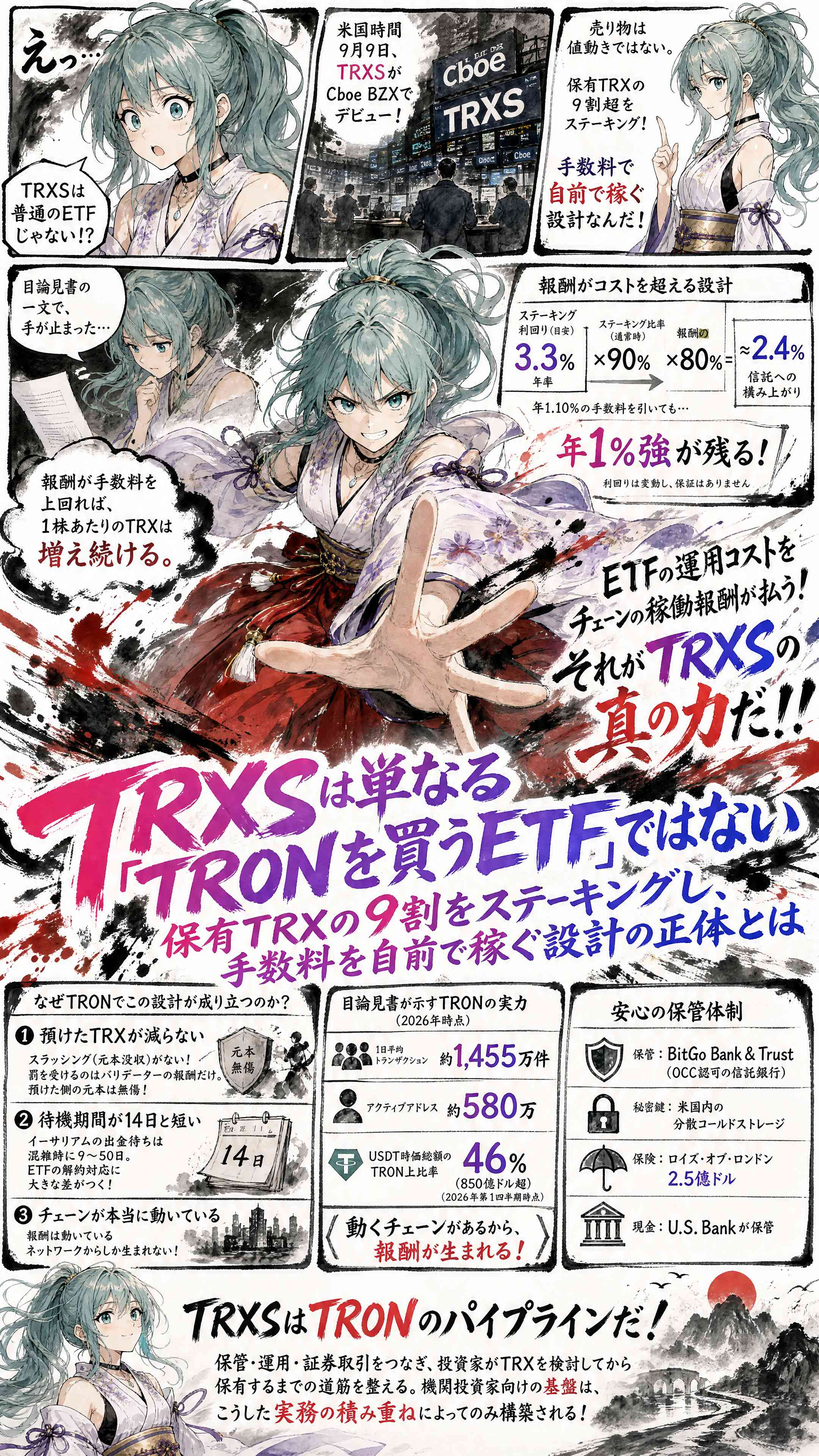
On the U.S. time of September 9 at 9:30 AM, four letters—"TRXS"—appeared on the order book of Cboe BZX (an exchange based in Chicago with a high trading share of major listed stocks and ETFs in the U.S.). ETF analyst Henry Jim of Bloomberg Intelligence pointed out the expected listing date on September 7. On the following day, September 8, Justin Sun himself posted a congratulatory message calling it "the Chicago exchange," and on the same day, a Form S-1 for the listing registration was filed with the SEC.
Let me be honest.
At first, I read this news as “only one more altcoin ETF is added.”
Solana’s staking ETFs were listed multiple times in November 2025 and gathered $1 billion in assets under management within the month. Grayscale enabled staking on its Ethereum ETF in March 2026, and BlackRock did the same that month, launching a staking-type Ethereum trust. The road was already paved, and TRXS is just one more car driving down it. With that in mind, I opened the prospectus dated August 19 (Amendment No. 4 to Form S-1), and my attention stopped on a single sentence.
It says that if staking rewards fall below the sponsor fee and expenses, then the number of TRX shares represented by one share will decline over time. In other words, as long as rewards exceed fees, the TRX per share will keep increasing.
The first objective stated in the prospectus is to track the TRX price, and the second objective is to build up TRX through staking. In normal times, at least 90% of the TRX you hold is staked, and the costs related to rewards are capped at 20%; the remaining 80% belongs to the trust and, in principle, all of it is restaked. The rewards enter the trust’s wallet every business day and are reflected in that day’s NAV. The sponsor fee is 1.10% per year. In a world where U.S. Bitcoin ETFs compete at 0.19% to 0.25%, it looks expensive. But what should be compared here is just one thing: whether the rewards can cover the fees.
I’ll show my rough estimates. TRX’s direct staking yield is 3.24% per year, according to StakingRewards on September 9, though some aggregated sites put it as high as 4.5%. If we assume 3.3% and apply 90% and 80%, then the trust would accumulate TRX worth about 2.4% per year. Even after subtracting 1.10%, more than 1% per year still remains. The yield will fluctuate, and there is no guarantee anywhere. Even so, that very structure—“the chain’s operating rewards pay for the ETF’s operating costs”—becomes a weapon that Bitcoin ETFs that do not stake do not have.
Why this design works on TRON
There are three reasons.
First, the deposited TRX does not decrease. Many chains have a punishment called “slashing,” where if the validator you delegate to behaves dishonestly, you can have your principal confiscated along with it—but TRON does not. The punishment applies only to the validator’s rewards; the principal of the party that deposited remains intact.
Second, the waiting period is short—14 days. Ethereum withdrawals can take 9 to 50 days during periods of congestion. Since ETFs must process daily redemptions, this difference directly becomes the difference in “how much you can stake, in percent.”
Second, the chain is truly operating. In the figures cited in the prospectus, as of June 2026 the average number of transactions per day is about 14.55 million, active addresses are about 5.8 million, and as of Q1 2026, 46% of the USDT market cap (more than $85 billion) is on TRON. Rewards are generated only from the active network.
Custody is with BitGo Bank & Trust. A trust bank licensed by the Office of the Comptroller of the Currency (OCC), where the private keys are held in cold storage distributed across the United States, and insured for $250 million by Lloyd’s of London. Cash is held by U.S. Bank.
Let’s zoom out one step. TRXS for TRON is not an “entry point” placed in the U.S. market. It’s a pipeline that directly links four things in one: the asset TRX, regulated custody, staking, and a company listed in the U.S. In July, TRX futures were listed on Bitnomial under CFTC regulation, and on Nasdaq you can find Tron Inc., which puts TRX at the core of its financial strategy. On August 23, TRON’s total number of accounts surpassed 400 million. TRON’s pipeline is slowly getting thicker.
I view TRXS as an important step forward for TRON.
Because it connects custody, operations, and securities trading—laying out the path from when investors consider TRX to when they actually hold it. This kind of foundation for institutional investors can only be built through layers of these practical implementations.