
#三星sk海力士领涨韩股走高
The semiconductor rebound has been strong—how long can the explosive demand for AI chips really last?
In the past two days, the Korean stock market has been lifted by Samsung and SK Hynix, but the industry is undergoing a profound upheaval driven by technological iteration and structural reorganization $SAMSUNG $SKHY
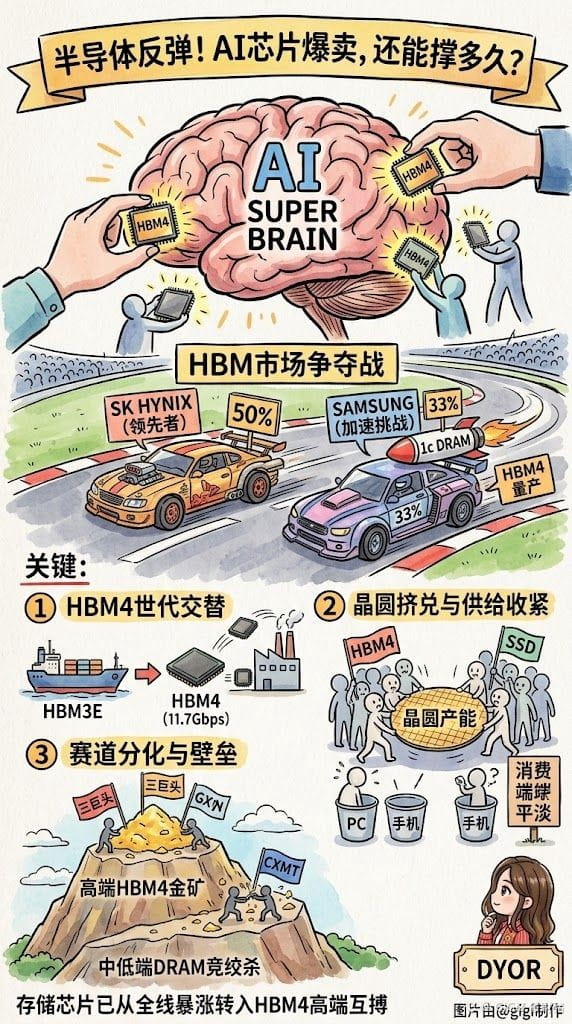
The global HBM market landscape is showing significant loosening. SK Hynix remains the leader with about 50% of revenue share, but as Samsung accelerates mass production on HBM4 based on its 1c DRAM process, its quarterly market share has jumped sharply to 33%, noticeably narrowing the gap between the two.
This rally has three key points
▶️The focus of competition is shifting to the HBM4 generation
The market has moved from simply racing to buy HBM3E to locking in HBM4 with speeds above 11.7Gbps. Whoever can be the first to achieve stable HBM4 production and delivery in the second half of the year will secure stronger pricing power.
▶️Wafer squeeze effects are tightening supply
With major players' inventories kept at low levels, capacity being aggressively pulled by HBM4 and enterprise SSDs, and DRAM capacity for phones and PCs being squeezed, consumer demand may be lukewarm, but memory manufacturers can still maintain high gross margins thanks to supply-side tightening.
▶️The track is becoming more differentiated and barriers are rising
Emerging players such as ChangXin Memory $CXMT have raised their share in the traditional DRAM market to around 10%. The memory sector is accelerating its split: high-end HBM4 is a high-barrier gold mine for the three giants, while mid- and low-end commodity memory will face direct competition.
Trend outlook
▶️In the short term, margins should be supported during the HBM4 mass-production transition, but the rivalry between the two leaders will likely cause greater stock-price volatility.
▶️In the medium to long term, the key factor is the AI investment return of cloud giants. Once monetization of downstream applications slows, elevated prices will face cyclical correction.
Memory chips have shifted from broad-based surging gains to high-end HBM4 head-to-head competition. The core thing to watch is the actual mass-production delivery of HBM4 from the giants in the second half of the year.
DYOR
The semiconductor rebound has been strong—how long can the explosive demand for AI chips really last?
In the past two days, the Korean stock market has been lifted by Samsung and SK Hynix, but the industry is undergoing a profound upheaval driven by technological iteration and structural reorganization $SAMSUNG $SKHY
The global HBM market landscape is showing significant loosening. SK Hynix remains the leader with about 50% of revenue share, but as Samsung accelerates mass production on HBM4 based on its 1c DRAM process, its quarterly market share has jumped sharply to 33%, noticeably narrowing the gap between the two.
This rally has three key points
▶️The focus of competition is shifting to the HBM4 generation
The market has moved from simply racing to buy HBM3E to locking in HBM4 with speeds above 11.7Gbps. Whoever can be the first to achieve stable HBM4 production and delivery in the second half of the year will secure stronger pricing power.
▶️Wafer squeeze effects are tightening supply
With major players' inventories kept at low levels, capacity being aggressively pulled by HBM4 and enterprise SSDs, and DRAM capacity for phones and PCs being squeezed, consumer demand may be lukewarm, but memory manufacturers can still maintain high gross margins thanks to supply-side tightening.
▶️The track is becoming more differentiated and barriers are rising
Emerging players such as ChangXin Memory $CXMT have raised their share in the traditional DRAM market to around 10%. The memory sector is accelerating its split: high-end HBM4 is a high-barrier gold mine for the three giants, while mid- and low-end commodity memory will face direct competition.
Trend outlook
▶️In the short term, margins should be supported during the HBM4 mass-production transition, but the rivalry between the two leaders will likely cause greater stock-price volatility.
▶️In the medium to long term, the key factor is the AI investment return of cloud giants. Once monetization of downstream applications slows, elevated prices will face cyclical correction.
Memory chips have shifted from broad-based surging gains to high-end HBM4 head-to-head competition. The core thing to watch is the actual mass-production delivery of HBM4 from the giants in the second half of the year.
DYOR