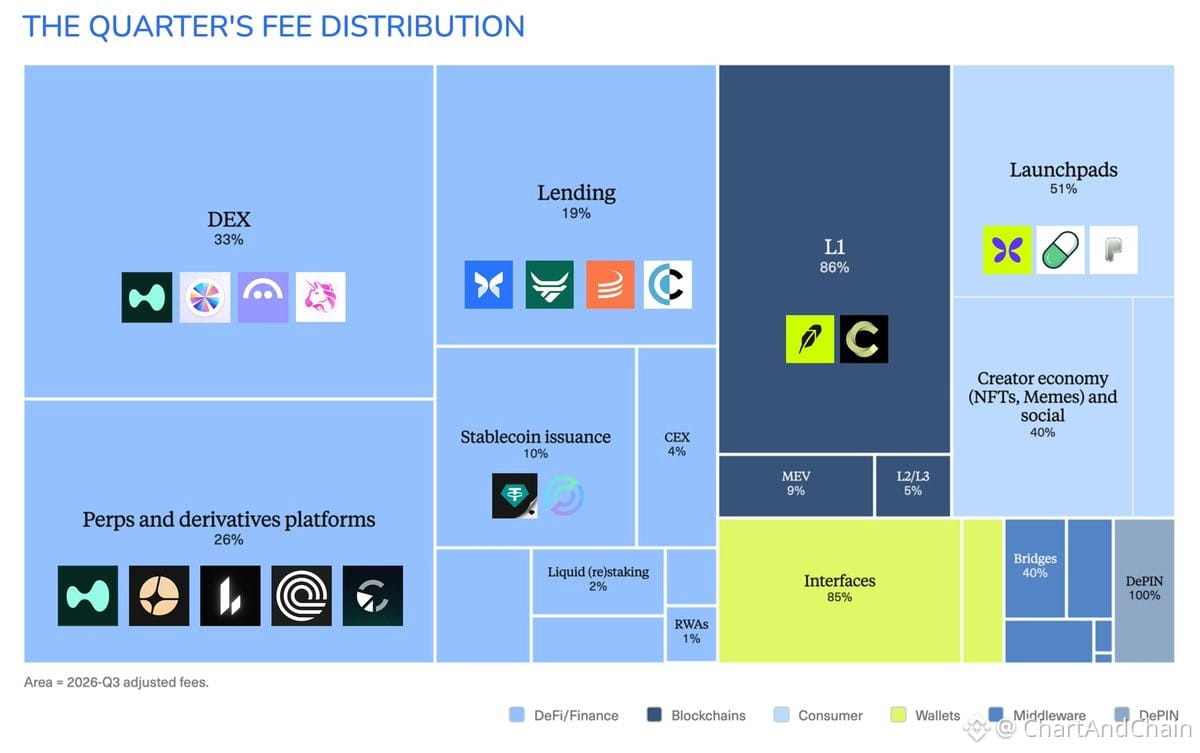
Looked at where users are actually paying onchain fees this quarter. Current Q3 run rate is $2.9B, extrapolated from July:
DeFi/Finance: $1.7B (60%)
Blockchains: $440M (15%)
Consumer: $421M (15%)
Wallets: $173M (6%)
Middleware: $66M (2%)
DePIN: $37.8M (1%)
Fee capture has moved from blockspace to applications that control user activity. Blockchains generate only 15% of the current Q3 fee run rate. DeFi, consumer apps and wallets generate around 81%.
DEXs, perps and lending alone account for $1.35B, or 47% of all onchain fees. Users are paying primarily to trade, borrow, launch assets and access better execution. They are no longer paying mainly because blockspace is expensive.
Current leaders in each sector:
DeFi: Pump.fun, Hyperliquid, Uniswap
Blockchains: Canton Network, Tron, Solana
Consumer: Fragment, Pons, Collector
Wallets: Axiom Exchange, Phantom
Middleware: Chainlink leads with 27%, followed by CatFee at 20% and NEAR at 15%
DePIN: Aethir leads with 24%, followed by GEODNET at 8%
Applications now control most user monetization. I care more about who controls distribution, liquidity and execution than which chain processes the final transaction.
The strongest protocols will increasingly own several parts of the transaction:
User distribution
Execution or liquidity
A direct fee model
A mechanism that retains or distributes revenue
Owning only infrastructure is becoming less attractive as transaction costs continue to fall. Owning only the interface is also vulnerable because users can move quickly. The strongest position is owning both the user relationship and the financial activity behind it.
Still avoid treating fees as token value accrual. Uniswap can generate large trading fees while much of that value goes to LPs. Lending fees may flow to suppliers. Some interfaces retain a much larger share.
The next step is not finding the protocols with the highest fees. It is finding which of these protocols can retain those fees, return value to holders and maintain activity when speculation slows.
DeFi/Finance: $1.7B (60%)
Blockchains: $440M (15%)
Consumer: $421M (15%)
Wallets: $173M (6%)
Middleware: $66M (2%)
DePIN: $37.8M (1%)
Fee capture has moved from blockspace to applications that control user activity. Blockchains generate only 15% of the current Q3 fee run rate. DeFi, consumer apps and wallets generate around 81%.
DEXs, perps and lending alone account for $1.35B, or 47% of all onchain fees. Users are paying primarily to trade, borrow, launch assets and access better execution. They are no longer paying mainly because blockspace is expensive.
Current leaders in each sector:
DeFi: Pump.fun, Hyperliquid, Uniswap
Blockchains: Canton Network, Tron, Solana
Consumer: Fragment, Pons, Collector
Wallets: Axiom Exchange, Phantom
Middleware: Chainlink leads with 27%, followed by CatFee at 20% and NEAR at 15%
DePIN: Aethir leads with 24%, followed by GEODNET at 8%
Applications now control most user monetization. I care more about who controls distribution, liquidity and execution than which chain processes the final transaction.
The strongest protocols will increasingly own several parts of the transaction:
User distribution
Execution or liquidity
A direct fee model
A mechanism that retains or distributes revenue
Owning only infrastructure is becoming less attractive as transaction costs continue to fall. Owning only the interface is also vulnerable because users can move quickly. The strongest position is owning both the user relationship and the financial activity behind it.
Still avoid treating fees as token value accrual. Uniswap can generate large trading fees while much of that value goes to LPs. Lending fees may flow to suppliers. Some interfaces retain a much larger share.
The next step is not finding the protocols with the highest fees. It is finding which of these protocols can retain those fees, return value to holders and maintain activity when speculation slows.