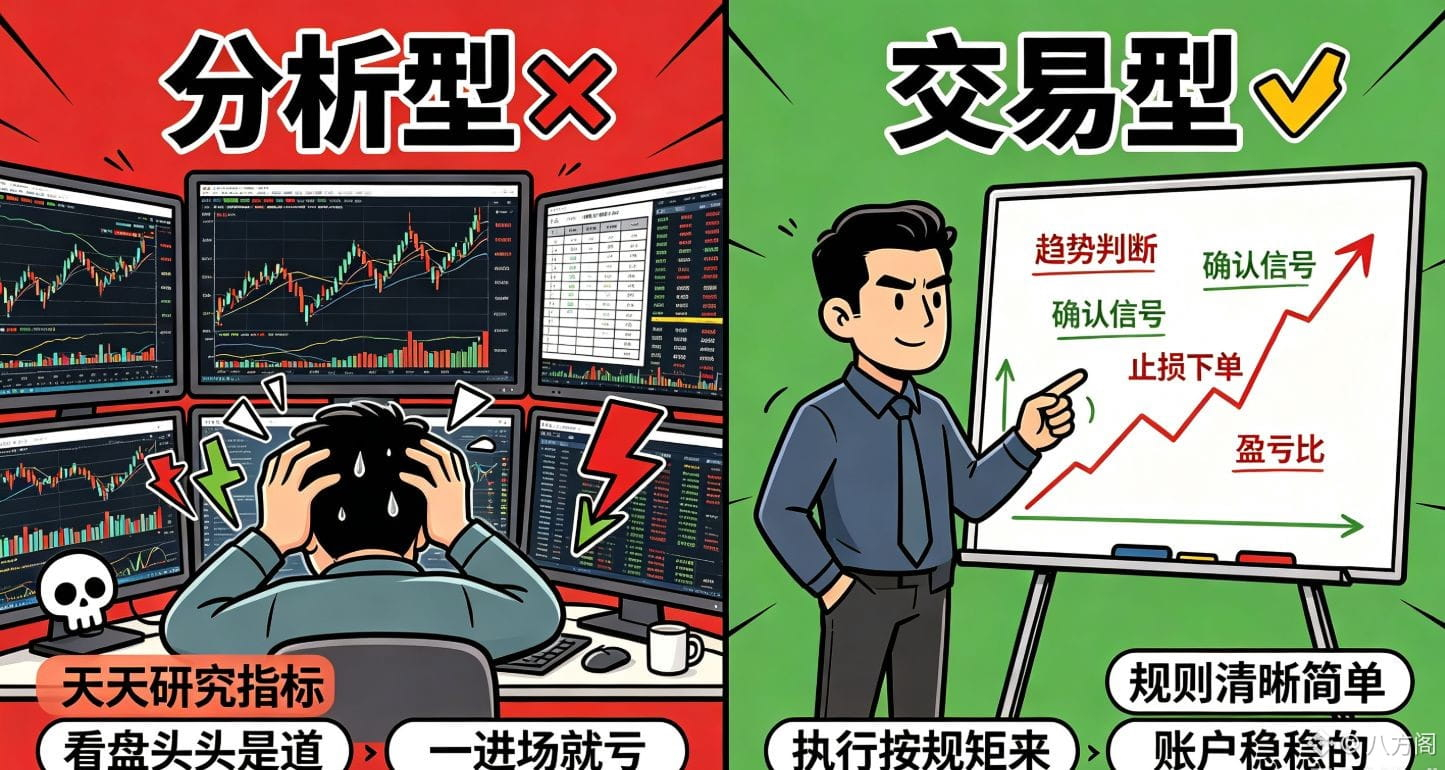
Still losing money after learning a bunch of techniques? Because you haven’t distinguished between “analysis” and “trading”
Do you also feel this way?
You’ve learned a ton of technical analysis — MACD, KDJ, Bollinger Bands, moving averages, Elliott Wave theory...
When you look at the market, you sound very convincing, but the moment you trade live, you’re lost.
When analyzing, you feel “this trade is solid,” but as soon as you enter, you get trapped.
Once trapped, you start doubting yourself: Is what I learned useless?
It’s not useless — you’re just mixing up two different things.
Analysis is analysis. Trading is trading. They are two separate things.
Analysis: finding patterns on the chart.
Trading: executing actions according to rules.
Many people spend all their time on analysis, but never build their own trading rules.
No matter how good your analysis is, without rules and execution, it all goes to waste.
What’s the difference between analysis and trading?
Analysis is open-ended. You can look at MACD, moving averages, volume, patterns... the more things you look at, the less certain you become.
Trading is closed-ended. You only need to check whether your rules have been triggered. If they have, you enter; if not, you do nothing.
The most common mistake beginners make is treating analysis as the entirety of trading.
They think that as long as the analysis is in place, they can make money.
The reality is: analysis only accounts for 20%; the remaining 80% is rules and discipline.
So how should beginners learn?
The sequence should be like this:
Step 1: Set the rules
First, don’t rush into complex technical analysis. Start with the simplest possible set of rules.
For example: draw two lines (support and resistance), act when price reaches the line, and watch from the sidelines when it doesn’t.
Once you have rules, your entries and exits have a basis.
Step 2: Practice execution
After the rules are set, the next step is practice. Follow the rules on every trade. Review when you make a mistake, and summarize when you do well.
You are practicing execution, not analysis skills.
Step 3: Then optimize the rules
After practicing for a while, you’ll find that some parts of the rules can be improved.
Only then, when you look back at technical analysis, will you know what’s useful for you and what is just noise.
Once you’ve gone through this process, you can truly say you’ve learned how to trade.
If you’re currently the kind of person who is “great at analysis but always loses money when trading,” come in tonight.
I won’t talk about complicated techniques — I’ll talk about how to set rules and how to practice execution.
We’ll use the current mainstream altcoin market as an example, explain it step by step while trading, and take you through the complete process.
Tonight at Bafang Pavilion: mainstream altcoin trade calls + one-on-one teaching
Do you also feel this way?
You’ve learned a ton of technical analysis — MACD, KDJ, Bollinger Bands, moving averages, Elliott Wave theory...
When you look at the market, you sound very convincing, but the moment you trade live, you’re lost.
When analyzing, you feel “this trade is solid,” but as soon as you enter, you get trapped.
Once trapped, you start doubting yourself: Is what I learned useless?
It’s not useless — you’re just mixing up two different things.
Analysis is analysis. Trading is trading. They are two separate things.
Analysis: finding patterns on the chart.
Trading: executing actions according to rules.
Many people spend all their time on analysis, but never build their own trading rules.
No matter how good your analysis is, without rules and execution, it all goes to waste.
What’s the difference between analysis and trading?
Analysis is open-ended. You can look at MACD, moving averages, volume, patterns... the more things you look at, the less certain you become.
Trading is closed-ended. You only need to check whether your rules have been triggered. If they have, you enter; if not, you do nothing.
The most common mistake beginners make is treating analysis as the entirety of trading.
They think that as long as the analysis is in place, they can make money.
The reality is: analysis only accounts for 20%; the remaining 80% is rules and discipline.
So how should beginners learn?
The sequence should be like this:
Step 1: Set the rules
First, don’t rush into complex technical analysis. Start with the simplest possible set of rules.
For example: draw two lines (support and resistance), act when price reaches the line, and watch from the sidelines when it doesn’t.
Once you have rules, your entries and exits have a basis.
Step 2: Practice execution
After the rules are set, the next step is practice. Follow the rules on every trade. Review when you make a mistake, and summarize when you do well.
You are practicing execution, not analysis skills.
Step 3: Then optimize the rules
After practicing for a while, you’ll find that some parts of the rules can be improved.
Only then, when you look back at technical analysis, will you know what’s useful for you and what is just noise.
Once you’ve gone through this process, you can truly say you’ve learned how to trade.
If you’re currently the kind of person who is “great at analysis but always loses money when trading,” come in tonight.
I won’t talk about complicated techniques — I’ll talk about how to set rules and how to practice execution.
We’ll use the current mainstream altcoin market as an example, explain it step by step while trading, and take you through the complete process.
Tonight at Bafang Pavilion: mainstream altcoin trade calls + one-on-one teaching